Ukraine jails North Koreans in missile espionage case

One of the two North Koreans being led to courtBy JOSEPH FITSANAKIS | intelNews.org |
A court in Ukraine has jailed two North Korean citizens on charges of trying to obtain secret technical information about missile engines. A Ukrainian government official said on Monday that the North Koreans had each been sentenced to eight years in prison, and that “they will serve their sentence in Ukraine”. Speaking to Russian-language Ukrainian daily Segodnya, the official said that Ukrainian authorities had expected that Pyongyang would request extradition of its two citizens, but that the North Korean government’s reaction had been “passive”. According to the paper, the two convicted men, who have not been named, were employed by the North Korean trade mission in Belarusian capital Minsk. It was from there that, several months ago, they arrived by train to Kiev, where they tried —unsuccessfully— to recruit a number of locals as informants. One of the latter tipped off Ukrainian authorities, who placed the two North Koreans under surveillance. Eventually, the two suspects were arrested in a rented garage in the Ukrainian city of Dnipropetrovsk, while photographing technical documents with a pair of handheld miniature digital cameras. The Segodnya report stated that the documents consisted of doctoral dissertations, marked ‘confidential’, which described highly technical methods of designing effective solid- and liquid-fuel supply systems for missile engines. Some of the documents concerned the technical specifications of computer software to assist in the design of missile fuel supply systems, said the paper. The confidential documents had reportedly been taken from the Yuzhnoye Design Bureau, a cornerstone of the Soviet —and now the Ukrainian— space industry, which in the early 1960s developed the R-16 (known in the West as SS-7), the first inter-continental ballistic missile (ICBM) successfully deployed by the Soviet Union. Read more of this post

Research sheds light on famed psychoanalyst’s espionage activities

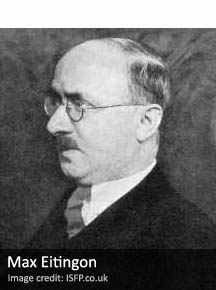
Max EitingonBy JOSEPH FITSANAKIS | intelNews.org |
An early student of Sigmund Freud, who introduced psychoanalysis in what is today Israel, was likely an agent of Soviet intelligence, according to historical evidence stemming from his life and the lives of his close relatives and friends. Max Eitingon, who was a member of Freud’s inner circle of students, funded and directed the Psychoanalytic Institute and polyclinic in Berlin, Germany, in the 1920s and early 1930s. In 1933, the rise of German national socialism prompted Eitingon, who was Jewish, to emigrate to Palestine, where he continued his psychoanalytic work. The view that Eitingon may have actively collaborated with Soviet intelligence in both Germany and Palestine was famously discussed in a lengthy letter exchange in The New York Review of Books in the summer of 1988. Although the debate continues among intelligence historians, two researchers, Isabella Ginor and Gideon Remez, both of the Hebrew University’s Truman Institute, believe that there is “a preponderance of circumstantial evidence” that Eitingon did collaborate with Soviet intelligence in Germany and Palestine. In a paper published in March of this year, the two researchers argue that Eitingon’s services to the Soviets included dispatching messages and providing safe houses for Moscow’s operatives. But in a fascinating research update, published yesterday in online journal Tablet, Ginor and Remez contend that historical evidence pertaining to the activities of Eitingon’s Russian-born wife, Mirra, and other relatives and friends, adds credence to the view that the famed psychoanalyst was working for Soviet intelligence. The two scholars point out that Mirra Eitingon, née Burovsky, had a son from a previous marriage, named Yuli Borisovich Khariton. Yuli, who remained close to his mother even after she left Russia, grew up to become the principal designer of the Soviet atomic bomb. Additionally, Ginor and Remez call attention to the role of two of Eitingon’s professional acquaintances: Adolf Yoffe, the Soviet Union’s first ambassador to Germany, and his successor, Viktor Kopp, both of whom shared Eitingon’s psychoanalytic interests. Specifically, Kopp was second-in-command at the Soviet Psychoanalytic Association, while Yoffe had been mentored by Alfred Adler, one of the psychoanalytic movement’s co-founders in Austria. In this sense, Ginor and Remez argue that psychoanalysis and intelligence work were “intertwined” in Eitingon’s life and career. Read more of this post
Mossad ‘helped arrest’ alleged Hezbollah operative in Cyprus

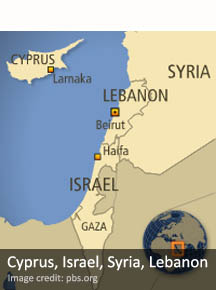
Cyprus, Israel, Syria, Lebanon By JOSEPH FITSANAKIS | intelNews.org |
Israeli intelligence was directly involved in the recent arrest of an alleged member of Lebanese militant group Hezbollah, who is said to have been planning a series of attacks against Israeli targets on the Mediterranean island of Cyprus. Cypriot media quoted police spokesman Andreas Angelides, who confirmed that the 24-year-old man was arrested on July 7 during a raid on his hotel in the tourist resort of Limassol. He also said that the man, whose name has not been released, was arrested “on possible charges pertaining to terrorism laws” soon after entering Cyprus using a Swedish passport. According to local media, Cypriot authorities were tipped off as to the man’s alleged Hezbollah connections and plans by an unnamed “foreign intelligence agency”. However, several news reports suggested over the weekend that officers of Israeli intelligence agency Mossad have already been dispatched to Cyprus to aid local counterterrorist officials involved in the investigation. Several sources allege that the Swedish-passport holder has been collaborating with his interrogators, telling them that he traveled to Cyprus with the intent of launching an armed attack at the embassy of Israel in Cypriot capital Nicosia. He allegedly changed his mind after observing the heavy security measures in place at the embassy, and opted instead for a plan to blow up a commercial airplane belonging to El Al Airlines, Israel’s national air carrier. He also allegedly considered attacking a number of buses belonging to Israeli tour companies operating in Israel. Cypriot police said that a thorough search of the man’s hotel room netted information on Israeli bus tour companies on the island, detailed flight schedules of Israeli airline operators, as well as digital photographs of popular destinations among Israeli tourists holidaying in Cyprus. Read more of this post

News you may have missed #761

Robert de La RochefoucauldBy TIMOTHY W. COLEMAN | intelNews.org |
►►US aircraft company owner charged with supplying Venezuelan military. Kirk Drellich, owner and president of SkyHigh Accessories in Florida, has pleaded not guilty to charges that he illegally supplied Venezuelan military contacts with pressure switches and cooling turbines, as well as other airplane parts. Court documents indicate that the aircraft parts were to be used for Venezuelan F-16 jets, attack helicopters and other military crafts. Prosecutors in Florida have filed charges (.pdf), stemming from violations of the Arms Export Control Act, on three other individuals who are supposedly involved in the conspiracy to export arms to Venezuela. Other defendants in the case include Alberto Pichardo and Freddy Arguelles, both former members of Venezuela’s Air Force, as well as Victor Brown, a local businessman.
►►Trial delayed again in Delisle espionage case. As previously reported on this blog, the espionage case against Sub-Lt. Jeffrey Paul Delisle, the Canadian navy intelligence officer accused of spying for Russia, has again been delayed. The attorney for Delisle requested an adjournment based on the governments disclosure of new documents and evidence in the case. The adjournment is expected to last until July 17.
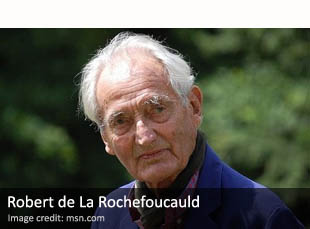
►►Legendary WWII spy de La Rochefoucauld dies. Robert de La Rochefoucauld, a French national who became a legendary British spy, helping direct and organize the Free French forces in England and underground movements in France during World War II, has died of natural causes at the age of 88. De La Rochefoucauld’s exploits as a spy have all the makings of a movie. As a little boy, he met Adolf Hitler, and as a spy he twice escaped execution by the Nazi’s. He was a knight in the French Legion of Honor, received the Medal of Resistance from France, was widely herald for his exceptional service by the British and he is believed to have been the last remaining French member of Winston Churchill’s Special Operations Executive.

News you may have missed #760

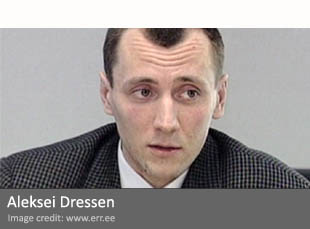
Aleksei DressenBy TIMOTHY W. COLEMAN | intelNews.org |
►►Turkey breaks up major military espionage ring. Turkish newspaper Hurriyet Daily News reported on July 9 that 51 active-duty soldiers from over twelve cities have been implicated in a major espionage ring involving Turkey’s military. Following a series of raids on July 7, at least 40 people were detained and four others were taken into custody. The raids were in response to an investigation launched in 2009, regarding warcraft radar locations in Turkey, illegal surveillance, as well as wiretapping of military officers.
►►Taiwan navy misplaces classified naval charts. During the decommissioning last June of Taiwan’s Hai Ou missile boats, classified naval charts were discovered to have gone missing during a final inventory check. The Taipei Times reports that the individual officer tasked with the responsibility of safeguarding the charts in question claimed to have burned one by accident, but was unable to account for the second chart. The classified charts contained information on Taiwanese naval activity including deployments in the Taiwan Strait.
►►Estonia security official and wife jailed for treason. Aleksei Dressen, a former security official at Estonia’s Interior Ministry, and his wife, Viktoria, were both convicted of treason, receiving 16 years and 6 years respectively. During a closed trial the proceedings did not provide direct evidence as to whom Dressen and his wife were working for. However, reports indicate that Dressen’s handlers were most likely representatives of Russia’s FSB.  The prosecution alleged that Dressen brought classified state secrets from the Estonian Interior Ministry to the airport in an envelope and then passed them along to his wife, who acted as a courier to Russian handlers. Heili Sepp, the Estonian prosecutor, indicated that the sentencing of the Dressens was part of a plea bargain effort, noting: “To our knowledge, this is the harshest punishment meted out in plea bargain proceedings in Estonia”.

News you may have missed #759 (analysis edition)

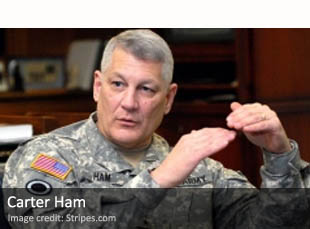
Carter HamBy IAN ALLEN | intelNews.org |
►►What goes on in the mind of a spy? An interesting article on the psychology of espionage operatives and those who handle them. It includes several insightful observations, including this one: “Just as they face outward physical dangers, agents face many inner psychological adversities. These pressures in the psyche are as taxing as physical hardships. Furthermore, while physical hazards and hardships disappear once the active espionage is over, the psychological toll can linger”. IntelNews has covered psychological and psychiatric issues around espionage before.
►►Researchers propose using decoys to detect leaks. A group or researchers working for the US Pentagon’s research wing have come up with a new plan for busting leakers: spot them by how they search, and then entice the secret-spillers with decoy documents that will give them away. Computer scientists call it it “fog computing”, and it is seen as part of a broader assault on so-called “insider threats”, launched by the Pentagon in 2010, after the WikiLeaks imbroglio. In a related development, the US federal government announced recently that it spent over $11 billion to protect its secrets last year, double the cost of classification a decade ago. The total does not include the costs incurred by the US Intelligence Community, which remains classified.
►►US General says US military spies ‘across Africa’. America’s top commander in Africa, General Carter Ham, has revealed that the US military has conducted spy operations all over the continent as part of the fight against international adversaries from al Qaeda-allied terror groups that target the homeland to suspected war criminals like Joseph Kony. “Do we collect information across Africa? Yes, we do”, the commander of US Africa Command said in a leadership conference at the Africa Center for Strategic Studies. Ham noted that US troops do at times go on “short-term deployments of capabilities” in various African nations, but always with the permission of the host country.

Belarus announces arrest of alleged Lithuanian spy ring members

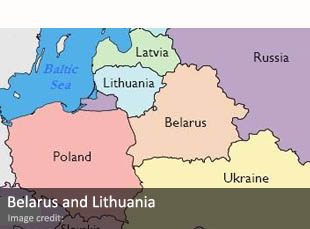
Belarus and LithuaniaBy IAN ALLEN | intelNews.org |
The government of Belarus has announced the arrest of an espionage ring allegedly operating out of the Lithuanian embassy in Belarusian capital Minsk. It appears that the alleged ring consisted of at least one Lithuanian embassy official, identified only as “Mr. F” in Belarusian state documents, as well as an undisclosed number of Belarusian nationals. A brief statement published on the website of the Belarusian State Security Committee, the KGB, said that the Lithuanian official, who is said to be a military attaché at the embassy, was arrested along with several Belarusian members of the alleged spy ring. The arrests reportedly took place soon after members of the spy ring were caught in the act of exchanging information; the KGB press office added that “electronic equipment” and “spy gadgets” of an undisclosed nature were confiscated from the arrestees. Little is known at this point about the precise focus of the accused spies; the KGB claims that they were “engaged in efforts to gain information in the military sphere”. Media reports from Minsk suggest that the activities of the alleged ring were particularly focused on bilateral security arrangements between Belarus and Russia. Belarus, a former Soviet republic, is today one of Russia’s staunchest allies in Europe; since 1994, the country has been ruled by Russophile President Alexander Lukashenko, who often accuses other former Soviet republics —including Lithuania— of stooping to the West. Read more of this post

News you may have missed #758

Heinz FrommBy IAN ALLEN | intelNews.org |
►►NSA head claims Americans’ emails ‘won’t be read’. The House of Representatives in April approved a bill that would allow the government and companies to share information about hacking. Critics have raised privacy concerns about the sharing of such information, fearing it would allow the National Security Agency, which also protects government computer networks, to collect data on American communications, which is generally prohibited by law. But in a speech at the American Enterprise Institute, NSA Director Keith Alexander said that the new law would not mean that the NSA would read their personal email.
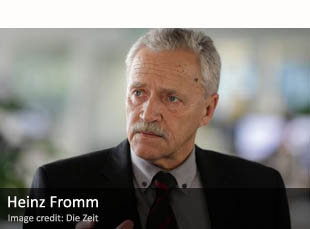
►►German spy chief quits in neo-Nazi files scandal. The head of Germany’s domestic intelligence agency, the Verfassungsschutz, Heinz Fromm, resigned last week, after admitting that his agency had shredded files on a neo-Nazi cell whose killing spree targeting immigrants rocked the country late last year. The “National Socialist Underground” (NSU), which went undetected for more than a decade despite its murder of 10 people, mostly ethnic Turkish immigrants. German media have said an official working in the intelligence agency is suspected of having destroyed files on an operation to recruit far-right informants just one day after the involvement of the NSU in the murders became public. Fromm had led the Verfassungsschutz since 2000.
►►US spy agency accused of illegally collecting data. The US National Reconnaissance Office (NRO) is pressuring its polygraphers to obtain intimate details of the private lives of thousands of job applicants and employees, pushing the ethical and legal boundaries of a program that is designed to catch spies and terrorists, an investigation has found. The NRO appears so intent on extracting confessions of personal or illicit behavior of its employees, that its officials have admonished polygraphers who refused to go after them and rewarded those who did, sometimes with cash bonuses. And in other cases, when it seems the NRO should notify law enforcement agencies of its candidates’ or employees’ past criminal behavior, it has failed to do so.

Charges dismissed against Israeli general accused of outing Egyptian spy

Ashraf MarwanBy JOSEPH FITSANAKIS | intelNews.org |
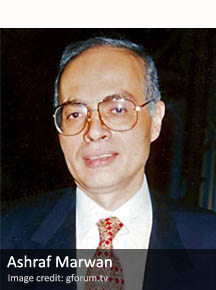
Israel’s Attorney General has dismissed all charges against a former Director of the country’s Military Intelligence, who had been accused of leaking the identity of an Egyptian spy found dead in London in 2007. General Eli Zeira, 84, had been investigated as a possible source of the leak that identified Egyptian businessman Ashraf Marwan as an Israeli spy who worked in London and Cairo in the 1970s. Marwan, the son-in-law of Egyptian President Gamal Abdel Nasser, is said to have approached Israeli intelligence agency Mossad in 1969 during a visit to the Israeli embassy in London. On October 5, 1973, he warned his Israeli handlers that Egyptian and Syrian forces would attack the Jewish state on the next day, thus giving Tel Aviv a last-minute warning of what later came to be known as the Yom Kippur War. However, Marwan was found dead underneath the balcony of his London home in June 2007, five years after his alleged espionage activities were revealed in a book by London-based Israeli historian Ahron Bregman. Marwan’s widow claims that her husband was murdered by intelligence operatives. In 2004, the Israeli government initiated an official investigation into the affair, after allegations that General Eli Zeira, the Director of Israel’s Military Intelligence during the Yom Kippur war, was the source that leaked Marwan’s espionage activities to Bregman. The main force behind the allegations against Zeira was Zvi Zamir, Director of the Mossad from 1968 to 1974. In 2011, Zamir, now 87, wrote a book openly accusing General Zeira, not only of leaking Marwarn’s espionage activities, but also of failing to heed the Egyptian’s warnings in time for Israel to adequately prepare for the Yom Kippur war. Read more of this post

Pakistani militant group ‘more dangerous than al-Qaeda’: ex-CIA official

Bruce RiedelBy JOSEPH FITSANAKIS | intelNews.org |
A former senior official of the United States Central Intelligence Agency has argued that al-Qaeda is no longer the most powerful group in the global Islamist insurgency. Writing in The Daily Beast earlier this month, Bruce Riedel, who served in the CIA for nearly 30 years prior to his retirement in 2006, warned that Lashkar e-Taiba is now “the most dangerous terror group in the world”. In his editorial, the former CIA analyst, who is now a professor at the Johns Hopkins School of Advanced International Studies, said that LeT operates freely inside Pakistan and continues to have strong operational connections with the Pakistani armed forces and the country’s intelligence establishment. Since its founding in 1990, LeT’s traditional political aspiration has been to end Indian rule over the predominantly Muslim state of Jammu and Kashmir, and then integrate the latter with Pakistan. But the group’s aims appeared to expand significantly in November of 2008, when it sent ten heavily armed operatives to Mumbai on speedboats. Once they landed in India’s most populous city, the LeT operatives proceeded to strike nearly a dozen tourist-related targets in well-calculated suicide missions. By the end of the four-day terrorist spree, 166 people —including six Americans and many other Western tourists— had been killed. Riedel views the 2008 Mumbai strike as “the most significant and innovative terrorist attack since 9/11”, and says that it marked LeT’s maturation “from a Punjabi-based Pakistani terror group targeting India exclusively” to an outfit with a global outlook, “targeting the enemies of al Qaeda: the Crusader West, Zionist Israel, and Hindu India”. Today, nearly four years after the Mumbai attacks, LeT maintains a global presence, with active cells throughout the Middle East and Asia, and funding operations in North America, Australia and Europe, claims Riedel. Additionally, LeT does not appear to feel threatened by Washington. Read more of this post

Intelligence wars heat up in Lebanon amid regional instability

Lebanese-Israeli-Syrian borderBy JOSEPH FITSANAKIS | intelNews.org |
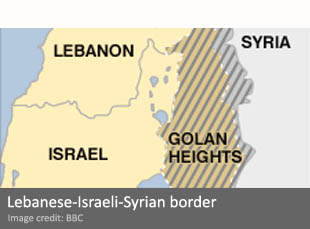
As the security situation in Syria and Egypt deteriorates, Lebanon is rapidly emerging as a major intelligence hub in the wider geopolitical power-struggle currently unfolding in the Middle East. On Monday, Lebanon’s leading Arabic-language newspaper, An-Nahar, reported the discovery last month of a foreign espionage network allegedly operating in Lebanese capital Beirut. The paper said that the clandestine network was spying on behalf of “a major Western country”, and was unearthed by forces loyal to Hezbollah, the Shiite group that controls large parts of southern Lebanon. The network allegedly consisted of at least three men, all Lebanese citizens, who lived in close proximity to each other in Beirut’s southern suburbs —a traditional Hezbollah stronghold. The three men were not Hezbollah members, said An-Nahar, but one was stoutly religious and all had good relations with local Hezbollah cells operating in their respective neighborhoods. The alleged head of the spy ring was an unnamed Lebanese citizen who had lived in the Ukraine for several years, where he operated a human smuggling network transporting Arab men into Europe. However, he was eventually arrested by French authorities in Paris and spent two years in prison. According to An-Nahar, the man was able to secure a deal with his captors, under which he would be allowed to return to Lebanon in exchange for informing them about the activities of a senior Hezbollah official wanted by Interpol. His ultimate mission was allegedly to lure the Hezbollah official, with whom he was friends, to Europe, where he could be arrested. Hezbollah has refused to comment on the newspaper’s claims. But the militant Shiite group did confirm on Tuesday the reported explosions of three alleged Israeli spy devices found in Southern Lebanon. Read more of this post

Israel, not US, behind killings of Iranian scientists, claims new book

Yossi MelmanBy IAN ALLEN | intelNews.org |
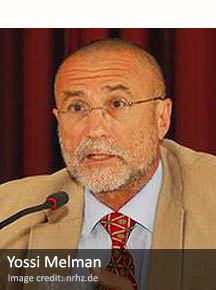
The United States has endorsed but does not actively participate in an ongoing Israeli-led program of assassination operations against Iranian nuclear scientists, according to a new book by two veteran Israeli intelligence commentators. Published today, July 9, by Levant Books, Spies Against Armageddon: Inside Israel’s Secret Wars, is written by CBS News correspondent Dan Raviv and Yossi Melman, intelligence and military affairs analyst for Israel’s leading newspaper, Ha’aretz.  The two authors claim that the killings, which are allegedly aimed at preventing Iran from building a nuclear weapon, form one aspect of a multi-layered program of sabotage that consists of regular spy-missions deep inside Iranian territory. Raviv and Melman allege that Israeli operatives routinely enter and exit Iran using “a multitude of routes” and an extensive network of safe houses that is said to predate the 1979 Islamic Revolution. The book, an advanced copy of which has been received by intelNews, appears to dispute widespread media speculation that Israeli covert operations inside Iran are carried out by members of ethnic minorities hostile to Tehran and trained by the Mossad, Israel’s primary covert action intelligence agency. According to Raviv, the task of ‘beheading’ the Iranian nuclear program is considered politically delicate by the Israeli government; the latter would never consider “farm[ing] out a mission that is that sensitive”. The CBS correspondent argues that Mossad would indeed use ethnic, religious or political “dissidents” inside Iran, primarily “for assistance and logistics”. But the hit itself, said Raviv, would be carried out by Mossad officers: Read more of this post

Analysis: The Danger in Ignoring Non-Muslim Religious Terrorism

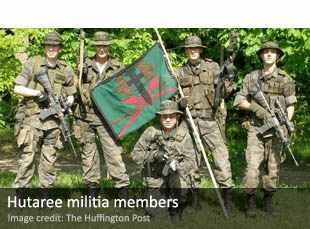
Hutaree militia membersBy JOSEPH FITSANAKIS | intelNews.org |
Even though over a decade separates us from the tragic events of September 11, 2001, Americans continue to be heavily preoccupied with terrorism. But what is the face of terrorism in our time? Too often, the term ‘terrorist’ conjures up the stereotypical image of an Arabic-speaking Muslim male from the Middle East —viewed by many Westerners as an abstract geopolitical notion that erroneously includes Afghanistan. There is no doubt that Islamic-inspired terrorism is both very real and very dangerous. However, consciously or subconsciously associating terrorism solely with Islam is not only flawed, but also potentially dangerous for our collective security. In reality, all religious dogmas contain extremist elements. This includes religious doctrines that are widely considered peace-loving, such as Anabaptism, or even Buddhism. A case in point that is often overlooked by Westernern observers is Aum Shinrikyo, the Japanese millenarianist cult inspired by Buddhist tenets. In 1995, Aum members used sarin gas in a large-scale terrorist attack on the Tokyo subway system, which killed 13 and injured close to a thousand commuters. In later years it was revealed that, prior to engaging in chemical terrorism, Aum had become history’s first known terrorist group to actively try to acquire nuclear material for tactical purposes. It was only after failing to obtain nuclear material that Aum’s leadership turned to sarin. This past Thursday, July 5, an interview of mine was aired on this very subject, namely the current state of homegrown, religiously-inspired terrorism in the United States. Read more of this post

Medical tests suggest Yasser Arafat may have been poisoned

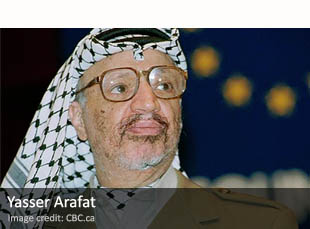
Yasser ArafatBy JOSEPH FITSANAKIS | intelNews.org |
A nine-month forensic toxicological investigation into the death of Yasser Arafat has raised the possibility that the Palestinian leader may have been poisoned with a radioactive substance. The Institut de Radiophysique (IRA) in Lausanne, Switzerland, has announced the discovery of significant traces of polonium-210 on the personal artifacts that Arafat used during his final days. Speaking at a press conference in Switzerland on Monday, IRA Director Dr. Francois Bochud said that the Institute could “confirm that we measured an unexplained, elevated amount of unsupported polonium-210 in the belongings of Mr. Arafat that contained stains of biological fluids”. According to the IRA, some of the Fatah founder’s personal belongings, including his underwear and his toothbrush, contained levels of polonium that were as many as ten times higher than those in random samples used as control subjects in the study. The findings of the investigation, which was sponsored by the Qatari news channel Al-Jazeera, may eventually shed light into the cause of Arafat’s death, which remains a medical mystery. Doctors in the West Bank and France have confirmed that the Palestinian leader was in sound health until he suddenly fell ill in mid-October 2004, and that his body showed no symptoms of any known disease. Polonium-210 made news headlines in a major way in November 2006, when it was identified as the poison used to kill Alexander Litvinenko. Read more of this post

News you may have missed #757

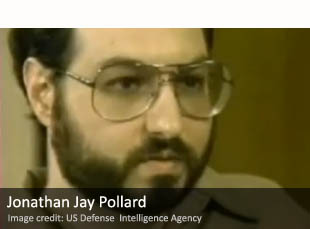
Jonathan Jay PollardBy TIMOTHY W. COLEMAN | intelNews.org |
►►US government Pollard video declassified. In response to a Freedom of Information Act request initiated by the Institute for Research: Middle Eastern Policy, the Defense Intelligence Agency has released a 14-minute instructional video, which cites the Jonathan Pollard spy case. Pollard was a US Naval intelligence officer who for over 18 months provided thousands of classified documents to the Israelis government. He is serving a life sentence. The DIA’s Office of Security and Counterintelligence produced the instructional video in 1987 to urge employees to be on the lookout for suspicious behavior of fellow employees and to encourage them to report known security violations immediately. The video interviews an actor portraying the government employee who first reported Pollard’s espionage activities.
►►Senior CIA officer accused of being Mafia hitman. Enrique “Ricky” Prado’s resume reads like the ultimate CIA officer: a candidate for the CIA’s most senior post in South Korea, a top spy in America’s espionage programs against China, and deputy to Cofer Black, a chief strategist in America’s war on terror. But he is also alleged to have started out a career as a hitman for a notorious Miami mobster, and kept working for the mob even after joining the CIA. Finally, he went on to serve as the head of the CIA’s secret assassination squad against Al-Qaida. That’s according to journalist Evan Wright’s blockbuster story How to Get Away With Murder in America, distributed by Byliner. In it, Wright compiles lengthy, years-long investigations by state and federal police and tracks the history of Prado’s alleged Miami patron and notorious cocaine trafficker, Alberto San Pedro, and suspicions that Prado moved from a secret death squad from the CIA to notorious mercenary firm Blackwater.
►►Colombian pleads guilty to spy charges in Nicaragua. As previously reported on this blog, Luis Felipe Rios, a 34-year-old Colombian national, was arrested for espionage in Nicaragua on June 15. The Inside Costa Rica news agency says Rios admitted he was indeed committing espionage on behalf o foreign nation, and he is providing Nicaraguan authorities with all the details. Rios will likely be sentenced on July 9 and he faces up to 16 years in prison for violating Nicaragua’s state secrets and state intrusion laws.