Turkish intel officer arrested for abducting Syrian defector

Hüseyin Mustafa HarmuşBy JOSEPH FITSANAKIS | intelNews.org |
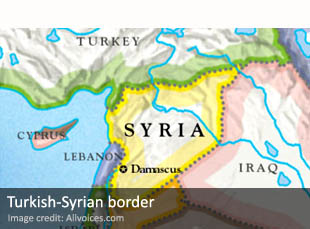
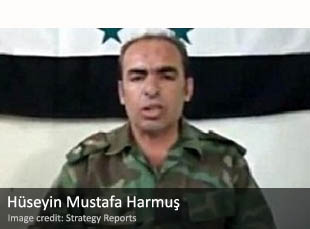
There seems to be no end in sight to the troubles of Turkey’s spy service. According to reports from Ankara, an employee of the country’s National Intelligence Agency (MİT) has been arrested for orchestrating the abduction of a leading Syrian military defector, who had sought refuge in Turkey. According to authorities in Ankara, the MİT employee, who has been identified only by his initials, Ö.S., had been under surveillance for nearly half a year, along with four of his collaborators. Last week, Turkish police arrested Ö.S. in connection with the abduction of Colonel Hüseyin Mustafa Harmuş, one of the most senior Syrian military officials to have defected to the opposition, and the founder of the Free Syrian Army. Harmuş, who defected from the Syrian military in June of 2011, had crossed the border into Turkey and was living in a camp set up and supervised by the Turkish government in Hatay, a province in south-central Turkey. Following his defection, Harmuş became one of the most vocal and media-savvy members of the Syrian opposition, frequently directing strong public criticism of the Syrian regime led by President Bashar al-Assad. The Syrian government responded by declaring Harmuş a traitor and offering a $100,000 reward for his capture. Then, all of a sudden, Harmuş disappeared without a trace on August 29. After a detailed investigation, Turkish authorities found that Ö.S. had assembled a team of four people who collaborated to kidnap Harmuş, deliver him to the Syrian government, and pocket the hefty reward. By utilizing his access to Turkish government communications, Ö.S. forged a letter authorizing him permission to escort Harmuş to another camp in Turkey’s Anatolia region. Upon gaining custody of the Syrian defector, Ö.S. delivered him to two of his collaborators, who in turn handed him over to the Syrian authorities. Read more of this post

News you may have missed #679

Salem al-HassiBy IAN ALLEN | intelNews.org |
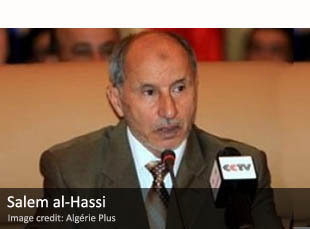
►►New spy chief in Libya. Libya’s ruling National Transitional Council yesterday appointed a lifelong opponent of slain Libyan leader Muammar Gaddafi as the country’s new intelligence chief. Salem al-Hassi, who was involved in a bid to assassinate Gaddafi in 1984, was appointed as the intelligence chief at a meeting of the council.
►►Anonymous hackers release German classified information. Hackers from the group Anonymous said last week they had accessed classified German files and posted them online, revealing details of the country’s military operations in Afghanistan. The military documents were collected for an inquiry, now finished, into a September 2009 airstrike by US jets under German orders that killed more than 140 Taliban fighters and Afghan civilians. Anonymous said it obtained the data from a server at the Bundestag  (German parliament).
►►Did Chinese espionage lead to F-35 delays? Did Chinese cyber spying cause the United States’ F-35 Joint Strike Fighter’s cost spikes and production delays? This is the question being asked by US Pentagon budget officials, according to industry magazine Aviation Week. Chinese spies apparently hacked into secure conference calls and listened to meetings discussing the classified technologies aboard the jets. In particular, China may have stolen info about the F-35’s secure communications and antenna systems, leading to costly software rewrites and other redesigns to compromised parts of the plane.

Research: Spies increasingly using Facebook, Twitter to gather data

Spying on social networkingBy JOSEPH FITSANAKIS | intelNews.org |
During the past four years, this blog has reported several incidents pointing to the increasing frequency with which spy agencies of various countries are utilizing social networking media as sources of tactical intelligence. But are we at a point where we can speak of a trend? In other words, is the rapid rise of social networking creating the conditions for the emergence of a new domain in tactical intelligence collection? This past week saw the publication of a new research paper (.pdf), which I co-authored with Micah-Sage Bolden, entitled “Social Networking as a Paradigm Shift in Tactical Intelligence Collection”. In it, we argue that recent case studies point to social networking as the new cutting edge in open-source tactical intelligence collection. We explain that Facebook, Twitter, YouTube, and a host of other social networking platforms are increasingly viewed by intelligence agencies as invaluable channels of information acquisition. We base our findings on three recent case studies, which we believe highlight the intelligence function of social networking. The first case study comes out of the Arab Spring, which, according to one report, “prompted the US government to begin developing guidelines for culling intelligence from social media networks”. We also examine NATO’s operations during the 2011 Libyan civil war (Operation UNIFIED PROTECTOR), when Western military forces systematically resorted to social networking media to gather actionable intelligence, by utilizing open sources like Twitter to pinpoint targets for attack. Finally, we examine the sabotage by Israeli security services of the 2011 “Welcome to Palestine Air Flotilla” initiative, a campaign organized by several European groups aiming to draw worldwide attention to the travel restrictions imposed by Israeli authorities on the Occupied Territories. Read more of this post

News you may have missed #678

Hakan FidanBy IAN ALLEN | intelNews.org |

►►Russia ‘exposed 199 spies’ last year. Outgoing Russian President Dmitry Medvedev said Tuesday that Russian counterintelligence had exposed 199 spies working for foreign powers last year. He was speaking at a meeting of the Federal Security Service. He also urged the FSB to “take extra measures to protect Russian interests” and reinforce the country’s borders in the Arctic.
►►Germany expels four Syrian diplomats. As tensions mount between Western nations and Syria, the German authorities said Thursday that they had ordered the expulsion of four Syrian diplomats after arresting two men accused separately of spying on opponents of President Bashar al-Assad. The four diplomats —three men and a woman who were not identified by name— have been given three days to leave Germany.
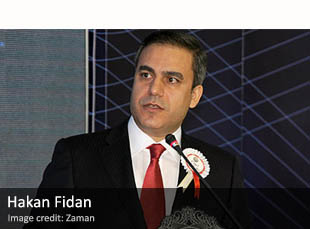
►►Turkey summons spy chief over talks with Kurds. Prosecutors have summoned Hakan Fidan, head of Turkey’s National Intelligence Agency (MİT), as well as his predecessor, Emre Taner, for questioning, over reports of secret peace talks in Norway between Turkish intelligence agents and Kurdish militant leaders. Predictably, MİT has appealed the move.

Has China’s most famous police official defected to the United States?

Wang LijunBy IAN ALLEN | intelNews.org |

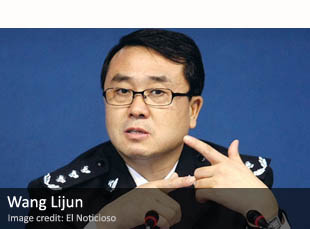
There are rumors that China’s most famous law enforcement official may have tried to defect to the United States, after Chinese police surrounded a US consulate in Southwest China. Three years ago, Wang Lijun, the chief of police in Chongqing, a city of nearly 30 million inhabitants, launched an extensive campaign aimed at dismantling southwestern China’s criminal networks. Among his targets were the notorious Triad gangs, as well as China’s extensive drugs, human, and consumer goods smuggling networks. Since that time, he has conducted nearly 1,100 arrests, helped convict several organized syndicate bosses to death, and overseen an anti-corruption program that led to the removal or arrest of several Chongqing police officials. Media sources in China report that Wang, who has become a popular icon of anti-corruption campaigners in China, has been targeted in numerous knife and sniper attacks, one of which left him in a coma for over a week. But the 52-year-old police official has survived thanks to the support of the Chinese government and Chongqing’s Communist Party secretary, Bo Xilai, who in 2011 appointed Wang to the position of vice-mayor. All this changed last week, however, when Bo’s office abruptly issued a brief statement saying that Want had been demoted to a local government post outside the law enforcement chain of command. On the following day, it emerged that a group of investigators from the Communist Party of China’s Central Disciplinary Commission had been dispatched to Chongqing to check on Wang’s activities. And on Wednesday, another cryptic message from the Chinese government stated that Wang had accepted “vacation-style treatment […] because of long-term overwork”, which had left him “highly stressed and in poor health”. Read more of this post

News you may have missed #677: Analysis edition

Che Guevara after his arrest in BoliviaBy IAN ALLEN | intelNews.org |

►►New book ties Johnson administration to Che Guevara’s death. Michael Ratner and Michael Steven Smith are the co-authors of a new book about the US role in the killing of Cuban revolutionary Ernesto “Che” Guevara. In their book, Who Killed Che?, Ratner and Smith draw on previously unpublished government documents to argue the CIA played a critical role in the killing. “The line of the [US] government was that the Bolivians did it, we couldn’t do anything about it. That’s not true”, Smith said. “This whole operation was organized out of the White House by Walt Whitman Rostow. And the CIA, by this time, had become a paramilitary organization”.
►►CIA digs in as US withdraws from Iraq and Afghanistan. The CIA is expected to maintain a large clandestine presence in Iraq and Afghanistan long after the departure of conventional US troops as part of a plan by the Obama administration to rely on a combination of spies and Special Operations forces to protect US interests in the two longtime war zones, US officials said. They added that the CIA’s stations in Kabul and Baghdad will probably remain the agency’s largest overseas outposts for years.
►►Indian Army ‘preparing for limited conflict with China’. Noting that India is increasingly getting concerned about China’s posture on its border, James Clapper, US Director of National Intelligence, said this week that the Indian Army is strengthening itself for a “limited conflict” with China. “The Indian Army believes a major Sino-Indian conflict is not imminent, but the Indian military is strengthening its forces in preparation to fight a limited conflict along the disputed border, and is working to balance Chinese power projection in the Indian Ocean,” he said.

Germany summons Syrian ambassador following spy arrests

Ferhad AhmaBy JOSEPH FITSANAKIS | intelNews.org |
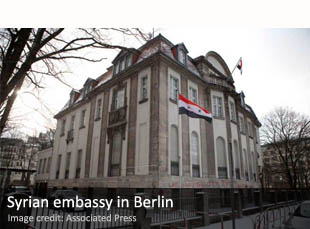
The government of Germany has summoned the Syrian ambassador to Berlin after German counterintelligence officers arrested two Syrian nationals on espionage charges. The two men, believed to be employees of Syrian intelligence, have been identified as 34-year-old Akram O., a Syrian national, and Mahmoud El A., a German citizen of Lebanese descent. Both were arrested early on Tuesday morning, during a sting operation involving over 70 German counterintelligence operatives, who searched the suspects’ apartments. According to a statement by the German Federal Prosecutor’s Office, the two men are “strongly suspected” of having engaged “for years” in systematic surveillance against Syrian political figures in Germany, with particular focus on expatriate groups critical of the government of Syrian President Bashar al-Assad. The statement added that German authorities are investigating the apartments of six alleged accomplices, suspected of assisting the two alleged spies. According to media reports, the counterintelligence operation was authorized after Ferhad Ahma, a Syrian-born elected official of the Green Party, was severely beaten at his apartment on December 26, by two men posing as German police officers. The Green Party launched a complaint with German police, suspecting that the two thugs were in fact Syrian government agents trying to intimidate Ahma, who is known in Germany for his strong criticism of the al-Assad regime. In announcing the diplomatic protest, German Minister of Foreign Affairs Guido Westerwelle told journalists that “any apparent activity against the Syrian opposition in Germany is in no way tolerable and a violation of [German] law”. Read more of this post

News you may have missed #676

Razvan UngureanuBy IAN ALLEN | intelNews.org |
►►CIA silent on new drone casualties report. The CIA really needs somebody to go to bat for it on a scathing new investigative report from the UK-based Bureau of Investigative Journalism, because the findings are pretty horrific: US drones target not just the militants they initially strike, but those who come to do rescue work after those strikes, and mourners at the funerals for victims of those strikes. They’ve killed somewhere between 282 and 535 civilians in a total of 260 strikes, the report found.
►►Romania spy chief nominated to replace Prime Minister. Romania’s president has nominated Mihai Razvan Ungureanu, chief of the country’s Foreign Intelligence Service (SIE), as prime minister hours after Emil Bloc resigned amid austerity protests. Ungureanu has a master’s degree from Oxford University and was foreign minister between 2004 and 2007 during Basescu’s first term of office.
►►Lawsuits target Pakistan’s powerful ISI intelligence agency. Pakistan’s top spy agency faces a flurry of court actions that subject its darkest operations to unusual scrutiny. The cases against the agency, the Inter-Services Intelligence Directorate, have uncertain chances of success, analysts say, and few believe that they can immediately hobble it. But they do represent a rare challenge to a feared institution that is a cornerstone of military supremacy in Pakistan.

Pakistan will retaliate if Israel attacks Iran, says diplomat

Hossein SalamiBy JOSEPH FITSANAKIS | intelNews.org |
A European diplomat has quoted Pakistani officials as saying that Islamabad will retaliate in kind if the Israeli military attacks Iran. Speaking to the Associated Press, the anonymous diplomat, who is stationed in Pakistan, said Pakistani military leaders have decided that “if Iran is attacked [they] will have no alternative but to launch a reprisal attack”. The warning, which the Associated Press appears to be treating as reliable, implies the involvement of Pakistan —the world’s only predominantly Muslim nuclear power— in a possible war between Iran and Israel. The latter is also widely considered to possess a formidable nuclear weapons arsenal. Other reports quote several international experts who seem to agree that it will be impossible to contain the ramifications of a possible military confrontation between Iran and Israel to a strictly regional level. Nick Witney, former Director of the European Defense Agency, who is currently Senior Fellow at the European Council on Foreign Relations, argues that an Iranian-Israeli war will have immediate effects on the global economy. According to Witney, “the political and economic consequences of an Israeli attack would be catastrophic for Europe”, as the immediate spike in oil prices will cause out-of-control defaults in countries like Italy and Greece. This will eventually push the entire European Union, including economic powerhouse Germany, into a deep and prolonged recession, and may even cause the euro to collapse altogether. Moreover, says Witney, Iran will “probably retaliate against European interests in the region, and conceivably more directly with terrorism aimed at Western countries and societies”. Read more of this post

News you may have missed #675

Maria del Pilar HurtadoBy IAN ALLEN | intelNews.org |
►►Panama refuses to extradite Colombian ex-spy chief. Panama’s foreign ministry cited the Inter-American Convention on Human Rights, an international accord on asylum and Panamanian law, as reason for denying Colombia’s request to extradite Maria del Pilar Hurtado, who faces charges in Bogota over an illegal wiretapping scandal. Currently enjoying asylum in Panama are former presidents of Guatemala, Jorge Serrano Elias; and Ecuador, Abdala Bucaram; as well as erstwhile Haitian military strongman Raoul Cedras.
►►Russian spy chief to visit Syria. Russian Foreign Minister Sergei Lavrov said on Saturday he and Foreign Intelligence Service (SVR) head Mikhail Fradkov will visit Syria and meet with President Bashar al-Assad on February 7. The visit will be made on instructions from Russian President Dmitry Medvedev. Lavrov did not reveal any details of the upcoming the visit.
►►US spy chief: ‘we don’t know if Iran is building a bomb’. At a hearing of the Senate Select Committee on Intelligence last Tuesday, James Clapper, the US Director of National Intelligence, released the following statement: “We assess Iran is keeping open the option to develop nuclear weapons, in part by developing various nuclear capabilities that better position it to produce such weapons, should it choose to do so.  We do not know, however, if Iran will eventually decide to build nuclear weapons”.

Senior army defector says Syrian military near collapse

Mustafa al-SheikhBy JOSEPH FITSANAKIS | intelNews.org |
The most senior defector from the ranks of the Syrian military has said in his first full-length media interview that the Syrian armed forces are too weak and demoralized to continue fighting after the end of this month. General Mustafa al-Sheikh served in the Syrian military for 37 years, before he made the decision last November to join several other senior Syrian defectors, who have crossed into Turkey, where they have been given refuge. General al-Sheikh told British newspaper The Sunday Telegraph that, if not handled properly, the imminent collapse of the regime of Bashar al-Assad will “explode across the whole region, like a nuclear reaction”. Commenting on the current condition of the Syrian military, he said that today it relies on only about 40 percent of its hardware and 32 percent of its human personnel. The remaining two thirds of its troops consist of mostly Sunni officers, who have either been arrested, have defected to the so-called Free Syrian Army, or not permitted to participate in combat, due to mistrust by the government. This situation has forced the Assad regime to rely primarily on members of its own Alawite minority for its military operations. Because of their small numbers and untrained members, the Alawites tend to operate more as a militia than an army, according General al-Sheikh. The dramatic reduction in the size of the Syrian army is preventing the Syrian government from asserting control over several towns in the country, and there are allegedly even suburbs of Damascus now being effectively controlled by anti-government forces. The Telegraph correctly notes, however, that, his detailed knowledge of the Syrian military aside, General al-Sheikh is far from a neutral observer. Read more of this post

News you may have missed #674

John KiriakouBy IAN ALLEN | intelNews.org |
►►Ex-CIA officers blast Kiriakou. Two former CIA intelligence officials, who spoke to The Washington Times, have rejected the image of John Kiriakou as a high-minded whistleblower who sought to expose official wrongdoing or a botched intelligence operation. Bruce Klingner, who worked as an analyst at the Defense Intelligence Agency and the CIA, called Mr. Kiriakou’s alleged actions “a betrayal of the trust the US government placed in him”. Bart Bechtel, a former CIA clandestine officer, said he considered Kiriakou’s actions “egregious”.
►►US air strikes in Yemen go largely unreported. Last Tuesday’s attacks in southern Yemen were among the biggest carried out by the United States in Yemen since airstrikes began there in November 2002. These strikes underline how the Americans are escalating covert operations against two Islamist groups in the region –al-Qaida in the Arabian Peninsula and Somalia’s al-Shabaab.
►►West explores prospects for Assad’s exile. The United States, European governments and Arab states have begun discussing the possibility of exile for Bashar al-Assad despite skepticism the defiant Syrian president is ready to consider such an offer, Western officials said on Wednesday. While talks have not progressed far and there is no real sense that Assad’s fall is imminent, one official said as many as three countries were willing to take him as a way to bring an end to Syria’s bloody 10-month-old crisis.

News you may have missed #673

Jeffrey Paul DelisleBy IAN ALLEN | intelNews.org |
►►Israel outsources intelligence-gathering to rightwing groups. The government and military of Israel have unofficially outsourced some of their intelligence work to private organizations that monitor anti-Israel incitement in the Palestinian media and are associated with right-wing politics, according to several high-ranking government and military sources.
►►NATO report finds Pakistan spies help Taliban. The BBC says it has seen a NATO report stating that the Taliban in Afghanistan are being directly assisted by Pakistani security services. The leaked report, derived from material from 27,000 interrogations with more than 4,000 captured Taliban, al-Qaeda and other foreign fighters and civilians, also claims Pakistan knows the locations of senior Taliban leaders. The US said exactly the same thing last September.
►►Another Russian diplomat ‘leaves’ Canada. Another Russian diplomat has left Canada. Dmitry Gerasimov, a consular officer with the Russian government’s office in Toronto, left in January. He is the second diplomat that the Russian embassy in Canada acknowledges has quit this country in January. The other was Colonel Sergey Zhukov, the defense attaché for the Russian government in Ottawa. All totaled, six Russian diplomats that have been dropped from Ottawa’s list of recognized foreign representatives in the last 11 days. It’s not clear which, if any, of recent these exits can be tied to the Jeffrey Paul Delisle spy controversy.

News you may have missed #672

Osama bin LadenBy IAN ALLEN | intelNews.org |
►►CIA claims bin Laden death photos would trigger violence. The Central Intelligence Agency says releasing images of a dead Osama bin Laden “could trigger violence, attacks, or acts of revenge against the United States”. Disclosing such images, including one showing the bullet wound to bin Laden’s head, the government said, “plausibly and logically pose a particularly grave threat of inflaming anti-American sentiment and resulting in retaliatory harm”. The agency made that argument Wednesday in a Freedom of Information Act lawsuit brought by Judicial Watch, which claims the CIA should release the photos taken by US forces. The American public, Judicial Watch said, has a “right to these historical artifacts”.
►►Kuwait accused of tapping phones of prominent citizens. According to the report published in Kuwaiti media, the country’s State Security Department purchased an integrated intelligence system from a former Soviet country last year, and placed it in a restricted zone inside the headquarters’ building. But last July, everything in the isolated room, including staff members hired specifically to operate the devices, vanished without an explanation, said sources. An investigation is currently ongoing to unearth the mystery behind the devices’ disappearance, and also examine information which hint that the devices could have been used by a certain unnamed individual to spy on prominent Kuwaitis.
►►Did US FDA spy on whistleblowers? The US Food and Drug Administration electronically spied on whistleblowers who alerted the Obama administration and Congress of alleged misconduct in the agency, according to a complaint filed in a US federal court. Named as defendants in the lawsuit are the FDA and several of its employees, the Surgeon General, the Health and Human Services Secretary, among others.

Maltese government secretly helped British spy operations in Libya

Libya and MaltaBy JOSEPH FITSANAKIS | intelNews.org |
In the 1980s, Malta was one of the world’s closest allies with the Libyan regime of Colonel Muammar al-Gaddafi. For this reason, during the recent Libyan civil war, it was generally presumed that the island nation’s strong cultural and strategic links with Tripoli would prevent it from joining other European nations in actively supporting the Libyan opposition. But internal British government documents, which have been acquired by the BBC, show that Malta was secretly supportive of Western efforts to undermine the regime of Colonel Gaddafi, and went so far as to help smuggle British intelligence operatives into Libya. According to a recent exposé aired by the BBC’s flagship factual program Newsnight, the Maltese government took advantage of its active role as a hub for distributing United Nations humanitarian and logistical assistance to Libyan civilians during the war. In one specific case, Malta offered to work with British external intelligence agency MI6, to fly a group of British intelligence officers to an unspecified location in Libya. The British operatives’ ultimate goal was to meet up with leading members of the opposition Libyan National Transitional Council (NTC), at a predetermined location near Libya’s second-largest city of Benghazi. According to the BBC, the Maltese government secretly authorized the transportation of the MI6 officers into Libya, using a Chinook helicopter, which took off in the middle of the night from Maltese territory. Unfortunately for the British, the mission was intercepted by NTC forces at the Benina International Airport, near Benghazi. Read more of this post