Turkish spies reportedly kidnapped nephew of dissident cleric Fethullah Gülen in Kenya
June 2, 2021 Leave a comment
 TURKISH SPIES ALLEGEDLY KIDNAPPED a nephew of dissident cleric Fethullah Gülen in Kenya and forcibly transported him to Turkey, according to reports in Turkish media. Citing “government sources”, Turkey’s state-owned news agency, Anadolu, said this week that Selahaddin Gülen had been “forcibly repatriated” to Turkey from abroad by officers of the National Intelligence Organization, known as MİT. But it did not specify when or where the alleged operation took place.
Subsequent reports suggested that Selahaddin Gülen’s wife, Serriye Gülen, posted a video on social media, in which she said the couple lived in Nairobi, Kenya, and that her husband, who worked as a school teacher, had disappeared on May 3. It was also reported that Gülen’s alleged kidnapping was soon afterwards confirmed by media outlets connected to the Gülen movement.
The Gülen movement consists of supporters of Muslim cleric Fethullah Gülen, who runs a global network of schools, charities and businesses from his home in the United States. The government of Turkey has designated Gülen’s group a terrorist organization and claims it was behind the failed 2016 coup against Turkey’s President, Recep Tayyip Erdoğan. Ever since the failed coup, Erdoğan’s government has fired or imprisoned over 200,000 government employees, which it accuses of being “Gülenists”. The cleric, who lives in the US state of Pennsylvania, denies Erdoğan’s accusations.
It is not clear whether Gülen’s nephew was kidnapped in a cover operation, or whether he was delivered to the MİT by the Kenyan authorities. Since the failed 2016 coup, the Turkish government has pressured numerous countries in the Americas, Europe, Asia and Africa to arrest and extradite alleged Gülenists. Kenya has so far refused to take action against individuals and institutions that Ankara claims are connected to the Gülen movement.
It is worth noting that in 1999 the MİT carried out a controversial covert operation in Kenya, which resulted in the kidnapping of Kurdish separatist militant Abdullah Öcalan. Öcalan, 74, is the leader of the Kurdistan Workers’ Party (PKK), which Turkey and several other countries have designated a terrorist organization. He remains imprisoned to this day.
► Author: Joseph Fitsanakis | Date: 02 June 2021 | Permalink
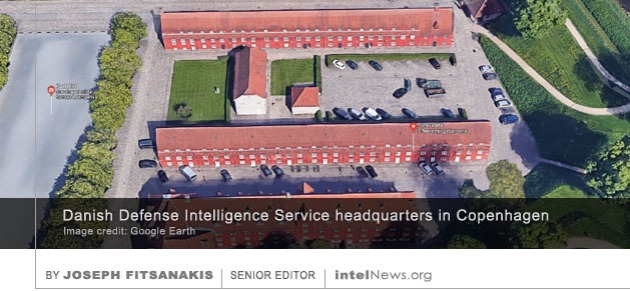 THE FIRST CLAIMS OF an alleged secret collaboration between the signals intelligence agencies of the United States and Denmark surfaced in November of 2020. By January of this year, it was clear that the Danish government would, sooner or later, need to deal with the fallout of its controversial spy deal with Washington, under which Denmark enabled the US to spy on some of its closest European allies. Still, the
 POLICE STATIONS IN CHINA are reportedly experimenting with a new technology that uses artificial intelligence to detect the emotions of subjects, and even monitors their skin pores, according to a source who spoke to the BBC. The source is a software engineer, whose identity has not been disclosed by the BBC. He said he helped install the controversial technology in a number of police stations in the Chinese region of Xinjiang.
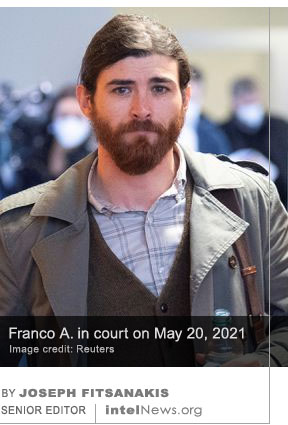 A GERMAN ARMY LIEUTENANT, who led a double life as a fake Syrian refugee, has gone on trial in Frankfurt, accused of planning to kill German politicians so as to provoke anti-Arab sentiment among Germans. The man has been identified by the German media as “Franco A.”, 32, due to strict German privacy laws. He lived in France, where he served in the Franco-German Brigade, an elite military force that combines units from the French and German armies, and is meant to symbolize Franco-German rapprochement in the postwar era.



 surprised observers with its range of weapons, such as long-range missiles with a reach that is in excess of 150 miles. This constitutes a strategic surprise for Israel. So far (May 13, 2021), Hamas has fired about 1,500 missiles at Israel, most of which have been intercepted by Israel’s air defense system called the Iron Dome.







 intelNews.org
US government takes control of Internet domains used by SolarWinds hackers
June 3, 2021 by Joseph Fitsanakis Leave a comment
THE UNITED STATES GOVERNMENT has taken control of two Internet domains used last month in a large-scale phishing campaign by the same Russian-linked hacker group that was behind SolarWinds. The Department of Justice said on Tuesday it seized the two domains, theyardservice[.]com and worldhomeoutlet[.]com, on May 28, following a decision by a US court that authorized the action.
The large-scale attack was detected on May 25, and was delivered in over 3,000 emails sent from a compromised account belonging to the United States Agency for International Development (USAID). The compromised account was paired with the services of a legitimate email marketing company called Constant Contact. It was subsequently used to deliver phishing emails to the employees of over 150 organizations worldwide, most of them American.
The phishing emails featured an official USAID logo, beneath which was an embedded link to a purported “USAID Special Alert” titled “Donald Trump has published new documents on election fraud”. The link sent users to one of the two illicit subdomains, which infected victim machines with malware. The latter created a back door into infected computers, which allowed the hackers to maintain a constant presence in the compromised systems.
According to Microsoft Corporation, the hackers behind the phishing attack originated from the same group that orchestrated the infamous SolarWinds hack in 2020. The term refers to a large-scale breach of computer systems belonging to the United States federal government and to organizations such as the European Union and the North Atlantic Treaty Organization. The threat actor behind the attack is referred to by cybersecurity experts as APT29 or Nobelium, among other names.
Speaking on behalf of the US Department of Justice’s National Security Division, Assistant Attorney General John C. Demers said on Tuesday that the seizure of the two Internet domains demonstrated the Department’s “commitment to proactively disrupt hacking activity prior to the conclusion of a criminal investigation”.
► Author: Joseph Fitsanakis | Date: 03 June 2021 | Permalink
Filed under Expert news and commentary on intelligence, espionage, spies and spying Tagged with APT29, computer hacking, cyber security, News, Nobelium, phishing, United States, US Department of Justice, US Department of Justice National Security Division, USAID