Bulgarian ex-spy director jailed for embezzling millions from public coffers

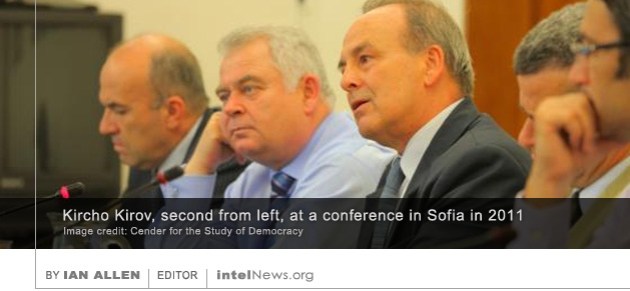
Kircho KirovA former director of Bulgaria’s intelligence service, who headed the agency for nearly a decade, has been jailed for embezzling millions of dollars from public funds. General Kircho Kirov, 67, was director of the Bulgarian National Intelligence Service (NIS) from February 2003 until January 2012. After stepping down from his post he was appointed national security advisor to Bulgaria’s Prime Minister, Boiko Borissov. But he soon fell out with Borrisov and was fired after just two months on the job. Now Borissov’s administration has jailed Kircho for 15 years, accusing him of misappropriating funds intended for NIS operations.
Government prosecutors said that during his tenure as NIS director, General Kircho conspired with a subordinate NIS employee, Dimitar Lidarev, to siphon NIS funds to a private account. They told a court in Bulgarian capital Sofia that General Kircho and Lidarev falsified documents to allow them to divert nearly $3.2 million to private accounts for their personal use. Most of the funds were stolen between 2007 and 2011, according to court documents. On Tuesday, the court handed General Kircho a 15 year jail sentence and ordered the confiscation of 50 percent of his personal assets. Lidarev, who was General Kircho’s co-defendant at his trial, was sentenced to three years in prison with another five years’ probation, for aiding and abetting General Kircho’s embezzlement by forging documents. The court decision quashed General Kircho’s appeal against an earlier sentence, delivered in 2015, that jailed him for 10 years for embezzling nearly $4 million of state funds between 2007 and 2011.

Throughout his latest trial, General Kircho insisted he was innocent and accused government prosecutors of carrying out a politically motivated campaign against him, directed by his former ally, Prime Minister Borissov. The former spy director added that he was targeted as part of a deliberate effort to convince the European Union that Bulgaria is targeting financial corruption. Next week, Prime Minister Borissov’s government will be facing a no-confidence vote in parliament, over claims that corruption remains rife in the Balkan country of 7 million people.

Author: Ian Allen | Date: 23 January 2018 | Permalink

Lebanese media accuses Mossad of assassination attempt in Sidon

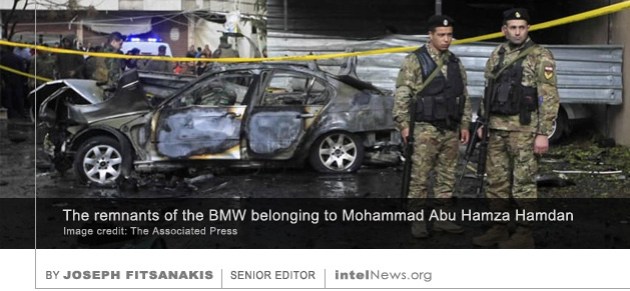
Mohammad HamdanMedia reports from Lebanon claim that Israel was behind a bomb explosion that injured an official of the Palestinian group Hamas in the southern Lebanese city of Sidon eight days ago. The official, Mohammad Abu Hamza Hamdan, who is originally from the Gaza Strip, suffered light wounds when his parked car blew up on January 14. Television footage posted online by Lebanon24 from the site of the alleged attack shows smoke coming out of a white BMW car, parked on the courtyard of Hamdan’s home. Reporters at the site said the car belonged to Hamdan and that it had been booby-trapped by unknown assailants. Hamdan was reportedly transported to a nearby hospital, where he received treatment for light wounds.
Reports quoted Lebanese officials who pointed to the fact that the booby-trapped car was parked inside the enclosed courtyard of Hamdan’s home as evidence that the attack was specifically targeted at Hamdan. Others said that the attackers may have originally planned to kill Hamdan’s brother, Osama Hamdan, also from the Gaza Strip, who has served as Hamas’ Lebanon representative for 30 years. Now a new article published by Lebanon’s Al Akhbar newspaper has accused Israel’s Mossad intelligence agency of having orchestrated the assassination attempt. The paper also said that Lebanese security officials had managed to identify the Mossad operatives that carried out the attack. It said they were headed by Ahmed Battiya, a Dutch-born Lebanese man who was recruited by the Mossad in Holland and has participated in prior assassination operations perpetrated by the Israeli spy agency. Al Akhbar said that Battiya had traveled extensively inside Lebanon on behalf of the Mossad, in order to identify Hamas officials and track their movements. The article was published hours after Hassan Nasrallah, leader of the Shiite paramilitary group Hezbollah, also accused Israel of attempting to kill Hamdan.

In Israel, however, government officials appeared to reject claims that the Mossad was behind the attack on Hamdan. The country’s Minister of Defense, Avigdor Liberman, told reporters that the Lebanese media blames Israel for everything that happens in Lebanon, and warned Hamas not to open a “new front against Israel from Lebanon”. Yisrael Katz, Israel’s Minister for Intelligence, said that, if Israel had been involved in the attack against Hamdan, “this wouldn’t have ended with him lightly wounded”.

Author: Joseph Fitsanakis | Date: 22 January 2018 | Permalink

Lebanese spy agency used Android app to spy on thousands, say researchers

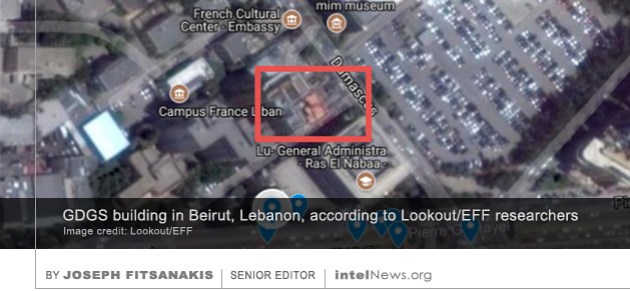
GDGS EFF LookoutThe spy agency of Lebanon used a virus designed for the Android mobile operating system to compromise the cell phones of thousands of people in at least 20 countries, according to a new mobile security report. The 50-page report was published on Thursday by a team of researchers from Lookout, a mobile security company, and the Electronic Frontier Foundation in Washington, DC. In an accompanying press release, the researchers said that the virus, which they named Dark Caracal, has been in existence for at least six years. They added that it was traced to a building in Beirut belonging to the General Directorate of General Security (GDGS), Lebanon’s primary external intelligence agency.
According to the Lookout/EFF research team, the trojanized phone application was camouflaged as a secure messaging service, resembling popular applications like Signal or WhatsApp. However, once an Android user downloaded it, it gave remote users access to the compromised phone’s cameras and microphone, thus turning it into a bugging device. The virus also stole email and text messages, pins and passwords, lists of contacts, call logs, photographs, as well as video and audio recordings stored on the compromised device. The report states that compromised devices were found in over 20 countries, including Lebanon, France, Canada, the United States and Germany. The majority of those targeted by the virus were civilian and military officials of foreign governments, defense contractors, and employees of manufacturing companies, financial institutions and utility providers.

On Thursday, Reuters contacted Major General Abbas Ibrahim, who serves as director general of GDGS. He insisted that the GDGS is known for collecting intelligence using human sources, not cyber technologies. “General Security does not have these type[s] of capabilities. We wish we had these capabilities”, General Ibrahim told the news agency.

Author: Joseph Fitsanakis | Date: 19 January 2018 | Permalink

Ex-CIA case officer was arrested after being lured back to US at least once

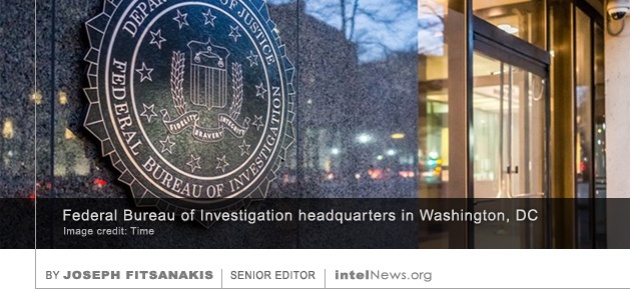
FBIA former case officer in the Central Intelligence Agency, who was arrested this week for violating the United States Espionage Act, was lured back to America from Hong Kong at least once by counterintelligence investigators, according to reports. Jerry Chun Shing Lee, 53, served in the CIA from 1994 to 2007. He was arrested by Federal Bureau of Investigation officers on Monday, as soon as he arrived in the US from Hong Kong. He is accused of carrying with him top-secret information about CIA agents and operations, which he was not authorized to possess. It now appears that the FBI had been investigating Lee since 2010, and that he was lured to the US in 2012 so that he could be investigated. It is also possible that he was lured back to the US from his home in Hong Kong on Monday, so that he could be arrested by the FBI.
The New York Times said on Wednesday that a consortium of FBI agents and CIA officers identified Lee as a suspect in a counterintelligence case involving the loss of over a dozen CIA assets in China between 2010 and 2012. By that time, Lee had left his job as a case officer —essentially a spy handler— in the CIA and was living in Hong Kong. According to NBC, the FBI decided to lure Lee back to American soil by creating a job for him in the nation’s capital. That was the reason why Lee traveled with his family back to the US in August of 2012. The family stopped in Hawaii, where, according to court documents, the FBI surreptitiously searched Lee’s possessions in a Honolulu hotel. FBI officers also searched Lee’s belongings in a hotel in Virginia a few days later. Lee was found to have with him two notebooks containing “operational notes from asset meetings”, “operational phone numbers” and even “the addresses of CIA covert facilities” —safe houses where CIA case officers meet their assets in privacy.

According to The Times, the FBI confronted Lee five times in subsequent months, but did not inform him that his belongings had been surreptitiously searched or that he had been found to possess classified information without authorization. But the FBI did not press charges against Lee, nor did it prevent him from returning to Hong Kong with his family in the summer of 2013. Instead, it focused on establishing a connection between Lee and the catastrophic loss of CIA assets in China. It was only this week, when Lee returned to the US, that authorities decided to arrest him. The reason why Lee decided to return to the US remains unknown. The possibility that he may have been lured back to the US by the FBI, just as he was in 2012, should not be excluded.

It appears that investigators have not at this point connected Lee with the more serious charge of conveying the classified information to foreign agents. Instead, the former CIA officer is charged simply with possessing top-secret information, but not with communicating it. The charge is believed to be “the same single charge that could have been brought years ago”, namely when Lee was found to be carrying classified information with him in Hawaii.

Author: Joseph Fitsanakis | Date: 18 January 2018 | Permalink

Ex-CIA case officer arrested in New York for violating Espionage Act

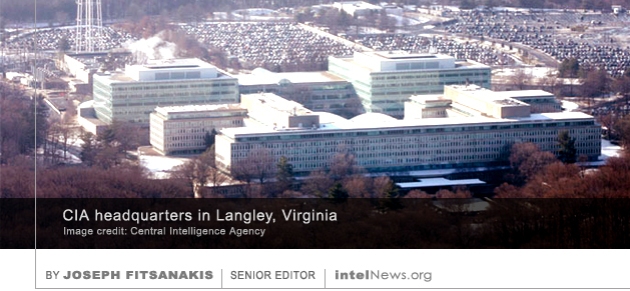
CIAA former operations officer in the United States Central Intelligence Agency has been arrested on charges of illegally possessing top secret information, including lists of real names of foreign assets and addresses of CIA safe houses. The news emerged on Tuesday, as the US Department of Justice announced that the Federal Bureau of Investigation had filed a criminal complaint over the weekend. The complaint identifies the former case officer as Jerry Chun Shing Lee, also known as Zhen Cheng Li. Lee, a 53-year-old naturalized American, served in the CIA from 1994 to 2007 “in various overseas positions and locations”, according to court documents. Lee has reportedly been living in Hong Kong since his retirement from the CIA. He was arrested by FBI officers on Monday, as he arrived on a flight that landed at the John F. Kennedy International Airport in New York.
The FBI criminal complaint alleges that Lee kept on his person a number of notebooks that contained classified details of his CIA work. These included the real names of covert CIA personnel and the real names of foreign assets —providers of intelligence information that are recruited by CIA case officers. The notebooks also contained “operational notes from asset meetings” (presumably meetings between Lee and the assets he handled during his CIA career), “operational phone numbers” and even “the addresses of CIA covert facilities” —safe houses where CIA case officers meet their assets in privacy. From the court documents it appears that the FBI has been investigating Lee since at least 2012. In August of that year, the FBI surreptitiously searched Lee’s possessions in a hotel in Hawaii, where he was staying while on holiday with his family. A few days later, FBI officers also searched Lee’s possessions in a hotel in Fairfax, Virginia, and photographed them.

According to The New York Times, Lee’s arrest is connected with reports last May that the Chinese intelligence services had arrested or killed over a dozen CIA assets in China between 2010 and 2012. There is intense speculation that the Chinese acted on information they received from a mole inside a US intelligence agency, possibly the CIA. But the court documents in Lee’s case do not mention any connection to foreign intelligence and do not accuse Lee of sharing classified information with unauthorized users. As of yesterday evening, the CIA was referring all media inquiries to the Department of Justice.

Author: Joseph Fitsanakis | Date: 17 January 2018 | Research Credit: C.B. | Permalink

Syrian rebels visit Washington to request resumption of CIA assistance

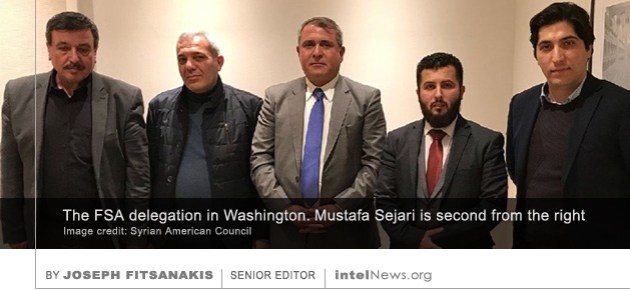
Free Syrian Army delegationA delegation of Syrian rebels is currently in Washington to ask that that United States President Donald Trump authorizes the Central Intelligence Agency to resume giving them military assistance. In 2013, the then-US President Barack Obama instructed the CIA to provide covert support to fighters in Syria. The CIA promptly began to assist fighters affiliated with the Free Syrian Army (FSA), whose goal was to topple the regime of Syrian President Bashar al-Assad. Under the project, which was codenamed TIMBER SYCAMORE, CIA personnel trained FSA fighters and gave them light weaponry. But in July of last year, President Trump abruptly terminated the CIA program, which he called “dangerous and wasteful”.

Now the FSA has sent a delegation to Washington to argue that, if the CIA does not help them, Iranian-backed militias will dominate much of Syria. On Monday, the Reuters news agency quoted Mustafa Sejari, a senior representative of the FSA, who said that the Syrian delegation had met with US Congress members and White House officials. This week they were hoping to speak with representatives from the Departments of State and Defense, said Sejari. Members of the delegation, Sejari told Reuters, “asked for the resumption of aid and explained the dangers of leaving moderate FSA forces without support”. He added that, if the US “is serious about challenging growing Iranian influence in Syria” by Hezbollah and other Shiite militias, it should resume its support of the FSA. Sejari also described Mr. Trump’s decision to end TIMBER SYCAMORE as “damaging”. The FSA, he said “endorse[s] President Trump’s statements about the need to confront Iranian hegemony in the region. It is time to turn words into action”. We went on to claim that “until now on the ground it’s the Iranian militias that are expanding without serious resistance”.

Shortly after President Trump announced his decision to terminate CIA support for the FSA, some experts warned that the move could backfire by causing the suddenly unemployed fighters to join jihadist organizations, if only to secure sources of income. In late August, it was reported that US troops deployed in Syria had exchanged fire with former FSA rebels that were now led by Turkish-trained commanders. In a related development, the government of Turkey dismissed on Monday plans by the US military to train members of the Kurdish Syrian Democratic Forces (SDF) as “terror army” tactics. The US-led coalition in Syria said that it planned to train a 30,000-strong SDF force as a professional army that could maintain control of the territories captured last year from the Islamic State.

Author: Joseph Fitsanakis | Date: 16 January 2018 | Permalink

Russian-trained Serb separatists are forming paramilitary group in Bosnia

Serbian Honor militiaA group of hardline Bosnian Serbs, some of whom have been trained in military tactics by Russian instructors, are secretly creating a paramilitary group to undermine the territorial integrity of Bosnia, according to reports. Information about the alleged paramilitary group was published on the Friday edition of Žurnal, a nonpartisan investigative newsmagazine. The allegations exposed by Žurnal were later repeated by Dragan Mektić, Bosnia and Herzegovina’s Minister for Security, who is himself a Bosnian Serb. Žurnal’s revelations came just days after hardline Serb separatists, dressed in dark-colored combat gear, staged a military-style rally in Banja Luka. The city of 200,000 is the administrative center of the Republika Srpska, the semi-autonomous Serb entity in Bosnia and Herzegovina. The entity was established under the terms of the 1995 Dayton peace agreement, which ended the Bosnian War that began in 1992.

The rally was held despite an earlier decision by the Constitutional Court of Bosnia and Herzegovina, which ruled that military-style marches by separatist organizations were unconstitutional. According to Žurnal, the rally was organized by Srbska čast (Serbian Honor), a militia made up of hardline Serb separatists. The group strongly supports Milorad Dodik, a Serb nationalist who has served as president of Republika Srpska since 2010. The investigative news site said that several members of Srbska čast’s were trained by Russian paramilitary instructors in the Russian-Serbian Humanitarian Center, a Russian-funded disaster relief center based in southern Serbia, which Western officials claim is really an intelligence base. Žurnal also said that one of Srbska čast’s leading figures, Bojan Stojković, a former commando, was trained in military schools in Russia and has been decorated by the Russian military.

Friday’s report by the investigative news outlet quoted extensively from a leaked report by Bosnia and Herzegovnia’s intelligence agency. The report allegedly states that Srbska čast leaders, including Stojković, met secretly with Dodik and discussed the formation of a new, heavily armed paramilitary unit, which will operate as an extrajudicial force in support of Dodik’s administration in Republika Srpska. One quote from the document said that the paramilitary force would engage in “possible intervention if the opposition [i.e. those opposed to Dodik] seeks to obstruct the functioning of the authorities” in the Republika Srpska. Bosnia and Herzegovina has been seeking to join the North Atlantic Treaty Organization since 2006. The country has gone through a series of stages in negotiations with NATO and ratified a membership action plan in 2010. Bosnia’s application is heavily supported by Turkey, NATO’s only predominantly Muslim member state, but is fiercely opposed by Russia and by the Balkan country’s Serb minority.

Author: Joseph Fitsanakis | Date: 15 January 2018 | Permalink

Egyptian branch of ISIS declares war on Hamas as tensions rise in Sinai

Egypt Gaza borderThe Islamic State in Egypt’s Sinai Province has declared war on the Palestinian militant group Hamas, in a move that experts say will furhter-complicate an already volatile security situation in eastern Egypt. Many observers see the group, Wilayat Sinai, as the strongest international arm of the Islamic State of Iraq and Syria (ISIS). Known officially as ISIS – Sinai Province, Wilayat Sinai was behind the 2015 downing of Metrojet Flight 9268, which killed all 224 passengers and crew onboard, most of them Russians. The same group killed 311 people at a Sufi mosque in November of last year, in what has become known as the worst terrorist attack in Egypt’s modern history.

Israeli sources claim that, in the past, Wilayat Sinai has had limited cooperation with Hamas, the militant group that controls the Gaza Strip, a coastal section of the Palestinian territories that borders with Egypt’s Sinai Province. The two organizations are believed to have engaged in limited cross-border arms-smuggling, while some injured Wilayat Sinai fighters have been treated in Gaza Strip hospitals. But the two groups have major ideological differences that contribute to their increasingly tense relationship. The Islamic State objects to participation in democratic elections, which it sees as efforts to place human will above divine law. It has thus condemned Hamas’ decision to participate in the 2006 elections in the Palestinian territories. Additionally, even though it promotes Sunni Islam, Hamas is far less strict in its religious approach than the Islamic State, and does not impose Sharia (Islamic law based on the Quran) in the territory it controls. Furthermore, Hamas suppresses Saudi-inspired Wahhabism and its security forces often arrest ISIS and al-Qaeda sympathizers in the Gaza Strip. In the past month, ISIS accused Hamas of having failed to prevent America’s formal recognition of Jerusalem as the capital of Israel. Additionally, ISIS is opposed to the support that Hamas receives from Iran, a Shiite nation that ISIS regards as heretical.

There are reports that Hamas has been quietly collaborating with Egypt and even Israel in recent months, in order to combat the rise of ISIS in the region. For several months now, the Palestinian group has exercised stricter control over its seven-mile-long border with Egypt. It has rebuilt border barriers that had previously been destroyed and has installed security fences and a digital surveillance system. It has also launched a public-relations effort to shame the families of young men from Gaza who have joined ISIS forces in Sinai. In response to these moves, Wilayat Sinai has publicly urged its supporters to kill members of Hamas and attack the group’s security installations and public buildings. The ISIS-affiliated group has also urged its members to eliminate members of the small Shiite Muslim community in the Gaza strip. According to experts, the decision by Wilayat Sinai to declare war on Hamas means that the group has now virtually surrounded itself with adversaries. The move may also increase informal collaboration between Hamas and the Israeli government, say observers.

Author: Joseph Fitsanakis | Date: 12 January 2018 | Permalink

Pakistan halts intelligence cooperation with US, but US embassy denies knowledge

Khurram Dastgir KhanPakistan said on Tuesday that it had suspended military and intelligence cooperation with the United States in the wake of Washington’s decision to stop security assistance to Pakistan. On Tuesday, Pakistan’s Minister of Defense, Khurram Dastgir Khan, said that his country had terminated all cooperation with the US in the areas of defense and intelligence. He said that the move was a response to the announcement by US President Donald Trump last week that Washington would stop providing security assistance to Pakistan. American officials stated that the change in policy took place because Pakistan had allegedly deceived America in the global war on terrorism. On Thursday last week, the President Trump accused the Pakistani government of having given the US “nothing but lies and deceit”. Trump’s accusation was followed by an official statement by the Pentagon, which said that Pakistan should cease to provide “sanctuaries in its territory for Taliban and Haqqani network leaders and operatives”.

On Tuesday, while speaking at a conference in Islamabad, Defense Minister Khan said that Pakistan had suspended “a wide field of intelligence cooperation and defense cooperation”. He was speaking during a conference hosted by the Institute of Strategic Studies, which is a government-sponsored think-tank based in the Pakistani capital. Khan accused the US of treating Pakistan as a “scapegoat” for its military and political failures in neighboring Afghanistan. He also warned Washington that Pakistan would not allow America’s war in Afghanistan to be fought on Pakistan’s territory. He ended his talk, entitled “Contours of Security Environment of Pakistan”, with what he described as “a reminder”, saying that Washington needs Pakistan’s support in its efforts against the Taliban and the Islamic State in Afghanistan: “Logistics trumps strategy”, he said.

But the Voice of America news service reported on Tuesday that the US embassy in Islamabad had no information about Khan’s announcement concerning Pakistan’s termination of military and intelligence cooperation with Washington. A spokesman at the embassy told the news service that the embassy had “not received any formal communication regarding a suspension” of military and intelligence cooperation by Islamabad. Last week, the US Secretary of Defense James Mattis insisted that his department kept open lines of communications with the Pakistani military leadership despite the suspension of security assistance by Washington. Islamabad said that communication lines with North Atlantic Treaty Organization forces remained open, but military cooperation with Washington had been terminated.

Author: Ian Allen | Date: 10 January 2018 | Permalink

Man who attended Charlottesville far-right rally tried to derail passenger train

Amtrak trainA man who attended the “Unite the Right” rally in Charlottesville, Virginia, with members of a neo-Nazi organization, has been charged with terrorism offences after he tried to derail a passenger train. Taylor M. Wilson, of St. Charles, Missouri, was arrested by federal law enforcement officials on October 22, after he attempted to sabotage a passenger train with 175 people aboard in rural Nebraska. According to the Federal Bureau of Investigation, Wilson entered the train’s engine room and pulled the emergency brakes, thus bringing the train to a sudden halt. He was eventually subdued by a train conductor and other railway employees, who successfully prevented him from reaching for a loaded revolver that he had with him. Following his arrest, police found in his backpack a box of ammunition, a knife, a hammer, and a full-face respirator mask with a filter.

Now the FBI says that Wilson boarded the train intent on carrying out a terrorist assault, and that he pulled the train’s breaks “with intent to harm those aboard”. In court documents that were unsealed last week, FBI agents state that a search of Wilson’s property in Missouri uncovered a large weapons cache consisting of fifteen firearms, some of which were automatic. Nearly 1,000 rounds of ammunition were also confiscated from Wilson’s house, where federal officers also found literature published by American white supremacist organizations like the National Socialist Movement. According to the indictment, some of the weapons and white nationalist literature had been hidden inside a concealed compartment located behind a refrigerator unit.

It appears that Wilson obtained most of his firearms legally and that he had been issued a concealed carry permit. However, the FBI claims that Wilson’s firearms “have been used for, or obtained in anticipation of engaging in, or planning to engage in, criminal offenses against the United States”. In addition to this claim, the FBI indictment states that Wilson traveled to Charlottesville, Virginia, in August of last year to attend the “Unite the Right” rally, which was organized by various white supremacist, white nationalist, neo-Nazi and militia groups. The FBI says that it has statements from Wilson’s associates and at least one family member, who claim that the accused traveled to Charlottesville as part of a contingent of a neo-Nazi group.

Author: Ian Allen | Date: 08 January 2018 | Permalink

South Korean ex-president took millions in bribes from spy agency, say prosecutors

 Park Geun-hyeSouth Korea’s disgraced former president, Park Geun-hye, has been charged with accepting bribes amounting to millions of dollars from the country’s spy agency, according to reports. Park made history in 2013, by becoming the first woman president in South Korean history. However, almost as soon as she assumed office, her administration became embroiled in successive corruption scandals. By 2016, Park’s presidency had been brought to a standstill due to mass protests urging her removal from power, while increasing numbers of officials and administrators were refusing to work with her. She was eventually impeached in 2017, after the Constitutional Court of Korea found that she had violated the country’s laws by promoting the interests of personal friends and private corporations in return for cash and favors. She is currently in custody awaiting trial for 18 different charges, including abuse of power, coercion, blackmail and bribery.

On Thursday, government prosecutors charged Park with accepting between $50,000 and $190,000 in monthly bribes from the National Intelligence Service (NIS). The monthly sums were allegedly delivered to Park almost as soon as she assumed the nation’s presidency, in 2013, and continued until the summer of 2016. Prosecutors allege that the monthly bribes total in excess of $3 million. Prosecutors allege that the cash was delivered to Park’s aides in deserted parking lots and side streets located near the Blue House, South Korea’s presidential palace. The cash allegedly came from what the prosecutors described as “special operational funds” and was meant for highly secret undercover operations. It was therefore not subject to parliamentary oversight or annual audits, according to court documents. The secret funds were allegedly used by Mrs. Park and her aides for bribes in exchange for political favors, according to the indictment.

In November, prosecutors charged three former directors of the NIS with secretly diverting funds from the agency’s clandestine budget to Park. The three men, Nam Jae-joon, Lee Byung-kee and Lee Byung-ho, headed the NIS between 2013 and 2016, when Mrs. Park was head of state. The new charges will add two more counts, one of embezzlement of funds and one of bribery, to Park’s long list of accusations. The disgraced former president is expected to remain in custody until March 3.

Author: Ian Allen | Date: 05 January 2018 | Permalink

Tony Blair denies he warned Donald Trump British spies were after him

Tony BlairA spokesman for Tony Blair has dismissed as “categorically absurd” allegations that the former British Prime Minister warned the White House that President Donald Trump was targeted by British spy agencies. The claims are made in the book Fire and Fury: Inside the Trump White House, which is due to be published next week. Its author, Michael Wolf, says he based the information in the book on more than 200 interviews that he held with President Trump and members of his inner circle during the past year.

Wolf alleges that Blair, who was Britain’s prime minister from 1997 to 2007, visited the White House in secret in February of 2017. He allegedly did so as a private citizen, as he has held no public position since 2015, when he stepped down from his post as a Middle East envoy for the United Nations. While at the White House, Blair reportedly met with Jared Kushner, Trump’s son-in-law and senior aide. During that meeting, says Wolf, Blair told Kushner that Trump could have been under surveillance by British intelligence during his presidential election campaign. The former British prime minister allegedly said that any surveillance on Trump would have been carried out by the Government Communications Headquarters (GCHQ), Britain’s signals intelligence agency. Wolf further alleges that the administration of US President Barack Obama never asked London to spy on Trump. Instead, the White House “hinted” that intelligence collection about Trump would be “helpful”, says Wolf. The reason why Blair volunteered this information to Kushner, claims Wolf, was that he was hoping to gain the US president’s trust and be appointed as Washington’s envoy to the Middle East.

Blair’s revelation, which Wolf describes in his book as a “juicy nugget or information”, allegedly “churned and festered” in Trump’s mind. It was the basis for claims made on March 14, 2017, by a Fox News commentator that the GCHQ had spied on Trump on behalf of the White House. The claim was repeated on March 17 at the White House by Sean Spicer, Trump’s then-press secretary, who said that Obama had used the GCHQ to spy on Trump so as to evade American privacy laws. Spicer’s claim prompted an angry response from the British government in London and from the British spy agency itself. In a rare public comment, GCHQ called the allegations “utterly ridiculous”.

Late on Wednesday, a spokeswoman for the office of Tony Blair said in an email that Wolf’s claims in Fire and Fury were “a complete fabrication […], have no basis in reality and are simply untrue”. Last year, another spokesman for Blair dismissed claims that the former British prime minister had lobbied to be appointed Trump’s Middle East envoy. This claim was so “completely overblown” and “so far beyond speculation there isn’t a word for it”, said the spokesman. President Trump has not commented on Wolf’s claim about Blair’s alleged visit and subsequent meeting with Kushner.

Author: Joseph Fitsanakis | Date: 04 January 2018 | Permalink

Year in review: The biggest spy-related stories of 2017, part III

Year in ReviewSince 2008, when we launched intelNews, it has been our end-of-year tradition to take a look back and highlight what we see as the most important intelligence-related stories of the past 12 months. In anticipation of what 2018 may bring in this highly volatile field, we give you our selection of the top spy stories of 2017. They are listed below in reverse order of significance. This is the last part in a three-part series. Part one is available here. Part two is available here.

Mohammed bin Salman04. Unprecedented security changes are taking place in Saudi Arabia. Analysts agree that the Kingdom of Saudi Arabia is undergoing its most important political changes in generations. On November 4, 2017, nearly 50 senior Saudi officials, including at least 11 princes, some of them among the world’s wealthiest people, were suddenly fired or arrested. A royal decree issued on that same evening said that the arrests were carried out by a new “anti-corruption committee” led by Crown Prince Mohammed bin Salman, the king’s 32-year-old son, who is first in line to the throne. The king and his son appear to be in the process of removing their last remaining critics from the ranks of the Kingdom’s security services, which they now control almost completely. Earlier in the year, the BBC alleged that Saudi security services were secretly abducting Saudi dissidents from abroad and jailing them in Saudi Arabia. Also in November, Saudi Arabia was seen to be behind a failed attempt by Lebanon’s Prime Minister Saad al-Hariri —a dual Lebanese-Saudi citizen— to resign while on a trip to Saudi Arabia. There were allegations that Hariri was under arrest by the Saudis, who objected to the presence of Hezbollah members in his cabinet. But Hariri later returned to Lebanon and rescinded his resignation.

03. Extraordinary transformation of the intelligence landscape in South Korea. Developments in North Korea have been at the forefront of security reporting in recent months. But reports from the Korean Peninsula have largely ignored the dramatic changes Moon Jae-intaking place in the intelligence infrastructure of South Korea, which are arguably as important as developments north of the 38th parallel. In June, the new center-left government of President Moon Jae-in banned the powerful National Intelligence Service (NIS) from engaging in domestic intelligence gathering. The move came after a lengthy investigation concluded that the NIS interfered in the 2012 presidential elections and tried to alter the outcome in favor of the conservative candidate, Park Geun-hye, using 30 dedicated teams of officers for that purpose. In November, three former NIS directors were charged with secretly diverting funds from the agency’s clandestine budget to aid Park, who has since been impeached and is now facing a lengthy prison sentence.

02. Turkey’s fallout with the West is affecting spy relations. Turkey has been a NATO member since 1952. However, rising tensions in the country’s domestic political scene are negatively affecting Ankara’s relations with its Western allies, particularly with Germany and the United States. Last month, Turkey issued an arrest warrant for Graham Fuller, an 80-year-old former analyst in the CIA, who Ankara says helped orchestrate the failed July 2016 military coup against the government of President Recep Tayyip Erdoğan. Washington flatly denies these allegations. In May, the Turkish Minister of Foreign Affairs Mevlüt Çavuşoğlu accused “the secret services of [Western] countries” of “using journalists and also bloggers [as spies] in Turkey”. Earlier in the year, a German report claimed that the Turkish state had asked its diplomats stationed all over Europe to spy on Turkish expatriate communities there, in order t to identify those opposed to the government of President Erdoğan. In some cases, Turkish spies have asked their Western European counterparts to help them monitor the activities Turkish expatriates, but such requests have been turned down. Nevertheless, there is increasing unease in Western Europe as Turkey intensifies its unilateral intelligence activities aimed at monitoring political dissent among Turkish communities abroad.

01. With America divided, Russian spies make dramatic post-Cold War comeback. The collapse of the Soviet Union was a traumatic experience for the once all-powerful Russian spy agencies. But, if CIA and FBI assessments are correct, the bitterly divisive state of American politics gave Russian spooks a chance for a dramatic comeback. Using a mixture of human and online intelligence operations, Russian spies helped drive a wedge between the White House and the US Intelligence Community. American intelligence agencies are tasked with providing information to Putin and Trumpassist policy-makers, including the president. So when the CIA and the FBI conclude that the Russian government launched an extensive and sophisticated campaign to undermine the 2016 US presidential election, one expects the president to take that advisement under serious consideration. However, the US leader has openly dismissed the conclusions of his own Intelligence Community and has publicly stated that he believes President Vladimir Putin’s assurances that his country did not meddle in the US election.

What we have here, therefore, is a US president who sees the Kremlin as more trustworthy than his own Intelligence Community. This is a remarkable, unprecedented state of affairs in Washington, so much so that some CIA officials have reportedly questioned whether it is safe for them to share information about Russia to President Trump. Throughout that time, the FBI has been conducting an extensive counterintelligence investigation into alleged ties between the president’s campaign team and the Kremlin. As intelNews has noted before, the FBI probe adds yet another layer of complexity in an already intricate affair, from which the country’s institutions will find it difficult to recover for years to come, regardless of the outcome of the investigation. The state of Russian politics may be uncertain, and the country’s economy in bad shape. But Russian spooks can look back to 2017 as the year in which they made an unexpected comeback, scoring a dramatic victory against their decades-old rival.

This is the last part in a three-part series. Part one is available here. Part two is available here.

Authors: Joseph Fitsanakis  and Ian Allen | Date: 03 January 2018 | Permalink

Year in review: The biggest spy-related stories of 2017, part II

End of Year ReviewSince 2008, when we launched intelNews, it has been our end-of-year tradition to take a look back and highlight what we see as the most important intelligence-related stories of the past 12 months. In anticipation of what 2018 may bring in this highly volatile field, we give you our selection of the top spy stories of 2017. They are listed below in reverse order of significance. This is part two in a three-part series. Part one is available here. Part three will be posted tomorrow.

07. 2017 was marked by high-profile assassinations and suspicious deaths. There was no shortage of assassinations, assassination attempts, and suspicious deaths in 2017. In January, Brazilian authorities launched an investigation into a suspicious plane crash that killed Supreme Court judge Teori Zavascki, who died while leading the largest corruption probe in the nation’s history, involving government officials and two giant companies. In February, Vladimir Kara-Murza, a leading member of Open Russia, a think tank founded by Russian oligarchs opposed to Russian president Vladimir Putin, nearly died Kim Jong-namas a result of “acute poisoning from an undefined substance”, according to his doctors. Also in February, Kim Jong-nam, half-brother of North Korean Supreme Leader Kim Jong-un, was killed in an audacious attack in Malaysia by two female assassins, who used a poisonous substance to murder him. Some alleged that Kim, who was a critic of his brother’s policies in the DPRK, had made contact with US intelligence prior to his assassination. In March, the Israeli military alleged that Amine Badreddine, 55, an explosives expert and senior military commander in the military wing of Hezbollah, was murdered by his own people while fighting in Syria. Allegedly the Iranians wanted him killed because he disputed the authority of Major General Qasem Soleimani, commander of Iran’s Revolutionary Guard Corps, who is often credited with having saved the Syrian government from demise during the Syrian Civil War. In October, Malta’s best known investigative journalist, Daphne Caruana Galizia, whose reporting about offshore tax evasion revealed in the Panama papers prompted a major political crisis in Malta, was killed when the rented Peugeot 108 car she was driving exploded near her home in central Malta. Eyewitnesses said that the explosion was so powerful that it tore apart the vehicle and was heard from several miles away. Finally, in November, Zhang Yang, one of the highest-profile generals in the Chinese People’s Liberation Army, committed suicide according to Chinese state media. Zhang Yang had seen a meteoric rise to power, but unceremoniously fell from grace as a result of President Xi Jinping’s nationwide campaign against corruption.

06. CIA ends its support for opposition rebels in Syria. In February, the White House instructed the CIA to halt military support to armed groups that are associated with the Free Syrian Army (FSA), a group opposed to Syrian President Bashar al-Assad. The move ended a policy that begun under US President Donald Trump’s predecessor, Barack Obama. Some analysts warned that the decision by the White House to terminate US Milo Dukanovicsupport for the rebels could backfire by causing the suddenly unemployed fighters to join jihadist organizations. In August, there were reports that US troops exchanged fire with former FSA rebels in Manbij, a Syrian city located a few miles from the Turkish border.

05. Britain accused Russia of trying to kill Montenegro prime minister. In late 2016, authorities in the former Yugoslav Republic of Montenegro alleged that “nationalists from Russia and Serbia” were behind a failed plot to kill the country’s prime minister,  Milo Dukanović, and spark a pro-Russian coup in the country. Remarkably, in March of 2017, British Foreign Secretary Boris Johnson said in an interview that Russian spies may have indeed orchestrated the failed attempt to kill Dukanović, as part of a broader plan to prevent the former Yugoslav republic from entering NATO. It is not every day that a senior cabinet official of a NATO member-state accuses the Kremlin of carrying out an assassination attempt against a European head of state.

This is part two in a three-part series. Part one is available here. Part three is available here.

Authors: Joseph Fitsanakis  and Ian Allen | Date: 02 January 2018 | Permalink

Year in review: The biggest spy-related stories of 2017, part I

End of Year ReviewSince 2008, when we launched intelNews, it has been our end-of-year tradition to take a look back and highlight what we see as the most important intelligence-related stories of the past 12 months. In anticipation of what 2018 may bring in this highly volatile field, we give you our selection of the top spy stories of 2017. They are listed below in reverse order of significance. This is part one in a three-part series; parts two and three will be posted on Tuesday and Wednesday of this week.

khalifa haftar10. Saudis, Israelis, are illegally funding a CIA-backed warlord in Libya. The strongest faction in the ongoing Libyan Civil War is the eastern-based Tobruk-led Government, which is affiliated with the Libyan National Army (LNA). The commander of the LNA is Field Marshal Khalifa Haftar, an old adversary of Colonel Gaddafi, who lived in the United States under CIA protection for several decades before returning to Libya in 2011 to launch his military campaign. American legal experts, including a former special counsel to the United States Department of Defense and a Harvard University law professor, accuse Haftar of ordering his troops to commit war crimes. But there is much evidence to suggest that Israeli, Saudi and Emirati intelligence agencies are illegally breaking a United Nations-imposed arms embargo on Libya and arming Haftar with advanced weaponry.

09. Why are American, Canadian diplomats in Havana going deaf? In 2015, relations between Cuba and the United States experienced an unprecedented rekindling, which culminated with the reopening of the US embassy in Havana after more than half a century. But in the past year, US authorities became enraged with the Cuban government after American diplomats reportedly suffered hearing loss and brain trauma as a result of a mysterious so-called “covert sonic weapon” that was directed against the American embassy. The US State Department blamed Cuba for the incident, but some believe that US embassy Cubathe alleged device may have been deployed by an intelligence service of a third country —possibly Russia— without the knowledge of the Cuban authorities. In October, the White House expelled 15 Cuban diplomats from the US in response to the incident. But the question of what harmed the health of at least 20 employees at the US embassy in Havana remains largely unanswered.

08. Role of spies in German-Swiss economic war revealed. In the wake of the Panama and Paradise leaks, offshore tax havens have faced intensifying worldwide calls for the introduction of transparency and accountability safeguards. Predictably, they are resisting. In April of 2017, German authorities announced the arrest of an employee of the Swiss Federal Intelligence Service (NDB) in Frankfurt. It appears that the Swiss man, identified only as Daniel M., was monitoring the activities of German tax-fraud investigators who have been trying for years to prevent German citizens from having secret bank accounts abroad. It is believed that he was arrested while monitoring German efforts to approach potential whistleblowers working in the Swiss banking sector. A few months after Daniel M.’s arrest, Germany announced an unprecedented investigation into three more officers of the NDB, on suspicion that they spied on German tax investigators who were probing the activities of Swiss banks.

This is part one in a three-part series. Part two is available here. Part three is available here.

Authors: Joseph Fitsanakis  and Ian Allen | Date: 01 January 2018 | Permalink