Norwegian retiree jailed in Russia says he was ‘misused’ by Norway spy agency
April 25, 2018 Leave a comment
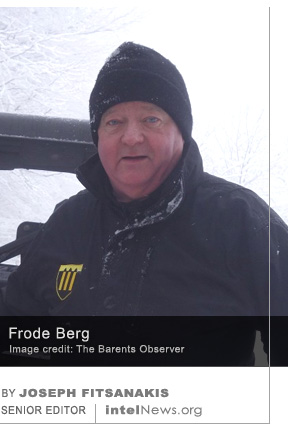 A Norwegian retiree, who was arrested in northern Russia late last year on charges of spying, acted as a courier for the Norwegian Intelligence Service (NIS), according to his lawyer. Last December, intelNews reported on the arrest of Frode Berg, 62, from Kirkenes, a small town in Norway’s far north, located near the Russian border. Berg retired in 2014 after nearly 25 years of service in the Office of the Norwegian Border Commissioner, a government agency that operates under Norway’s Ministry of Justice and Public Security. Following his retirement, Berg traveled regularly to Russia and helped organize a number of joint Norwegian-Russian community events, including athletic competitions and art festivals. But he is currently in a Russian jail and faces a long prison sentence if convicted on espionage charges.
On Tuesday, however, The Washington Post said it spoke to Berg’s lawyer, Brynjulf Risnes. On a telephone line from Oslo, Risnes told the paper that his client had come to believe that he had been “misused” by the NIS, and that he said so during a court session in Moscow earlier this year. “We are quite convinced”, said Risnes, “that this is a real Norwegian spy story”. The lawyer told The Post’s Anton Troianovski that his client had met a man named “Jorgen”, who worked for the NIS. He asked Berg to carry some envelopes during his frequent trips to Russia. Berg eventually came to realize that the envelopes contained operational instructions for Norwegian intelligence assets inside Russia, and sometimes money —up to €3,000 at times. He did as he was told “between two and five times”, said Risnes, in full knowledge that he was operating as a courier for the NIS.
However, when Berg began to have second thoughts about his activities, fearing arrest, “Jorgen” pressured him to continue, according to Risnes. At one point, the NIS representative asked Berg: “Don’t you want to be a good Norwegian?”. In doing so, the NIS effectively pressured Berg to continue acting as a courier by dismissing his hesitations as groundless and failed to inform him about the real risks involved in acting as an intelligence courier inside Russia. Risnes told The Post that no charges have yet been filed against Berg by Moscow, and that the 62-year-old retiree’s supporters back in Kirkenes hope that he could be exchanged for Russian spies held in Norway. But such persons are not known to exist at the moment and, according to Torbjorn Brox Webber, a Kirkenes resident and supporter of Berg, a spy swap is unlikely to “happen for a lot of time — for many years”.
► Author: Joseph Fitsanakis | Date: 25 April 2018 | Permalink
 Militants in the Gaza Strip have accused Israel of assassinating a Palestinian engineer based in Malaysia, who was shot dead on Saturday by unknown assailants riding motorcycles. The victim has been identified as Dr. Fadi M. al-Batsh, 35, from the town of Jabalia in the Gaza Strip, a Palestinian enclave controlled by the militant group Hamas. Al-Batsh is believed to have completed undergraduate and Master’s degrees in electrical engineering at the Islamic University of Gaza. In 2011 he enrolled as a PhD student at the University of Malaya in Kuala Lumpur, from where he subsequently received his doctorate in electrical engineering. He was then employed as a lecturer by the University of Kuala Lumpur’s British Malaysian Institute. The Institute is located in the Jalan Gombak neighborhood of the Malaysian capital, where al-Batsh lived with his wife and three children. Some reports from Israel said that al-Batsh worked on drone technology and that he had authored scientific articles on the development of drone technology, as well as on the technical specifications of transmitters used to remotely control drones.
 For the first time in its history, the United Kingdom has launched its first-ever military-style cyber campaign against an adversary, according to the director of the country’s primary cyber security agency. The target of the campaign was the Islamic State, the militant Sunni Muslim group that is also known as the Islamic State of Iraq and Syria (ISIS). The existence of the all-out cyber war was announced last week by Jeremy Fleming, the newly appointed director of the Government Communications Headquarters (GCHQ), Britain’s signals intelligence organization. Fleming, a former Security Service (MI5) officer, was
  The government of Canada has announced plans to evacuate family members of its diplomats serving in Cuba, because of medical issues caused by an alleged espionage-related technological device. These concerns have persisted among United States and Canadian diplomatic staff since the fall of 2016, when several members of staff at the US embassy in Havana
  A Russian investigative journalist, who wrote a series of articles about Russian soldiers-for-hire in Syria, has died after falling from the balcony of his apartment in western Siberia. Some of his colleagues say they suspect foul play. Maxim Borodin wrote for Novy Den (New Day) an investigative online magazine. In the past few weeks, Novy Den published a series of probing articles by Borodin about the activities of Russian mercenaries working for the Syrian President Bashar al-Assad. Borodin was one of just a handful of Russian journalists who reported on claims that more than 200 Russian mercenaries were killed in Syria on February 7.
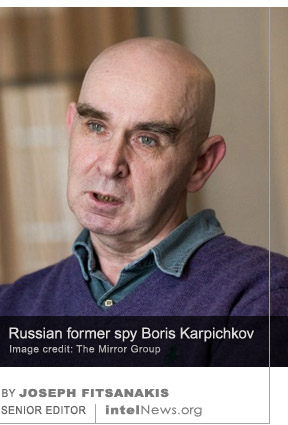 A former officer in the Soviet KGB, who now lives in the United Kingdom, is to be questioned by British police after alleging that there is a link between the recent poisoning of Sergei Skripal and the mysterious death of a British intelligence officer in 2010. There has been extensive media coverage in the past month of the poisoning of Sergei Skripal, a Russian former military intelligence officer who spied for Britain in the early 2000s and has been living in England since 2010. Nearly every European country, as well as Canada, Australia and the United States,
 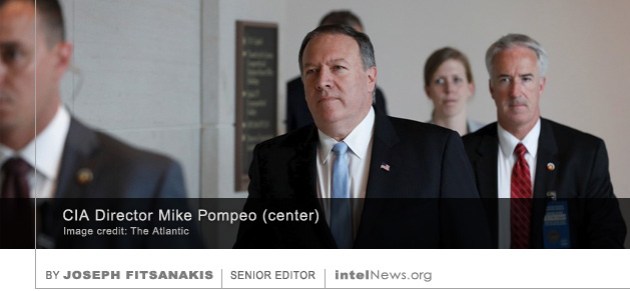 The outgoing director of the Central Intelligence Agency, Mike Pompeo, appeared on Thursday to confirm reports from last February that United States troops killed more than 200 Russian soldiers in Syria.
 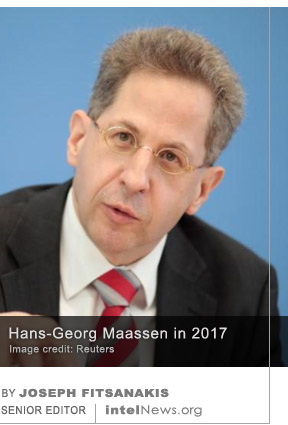 The head of Germany’s domestic intelligence agency has warned of security risks resulting from Chinese direct investment in high-technology German and other European companies. Since 2012, Hans-Georg Maassen has served as director of the Federal Office for the Protection of the Constitution, Germany’s domestic security and counterintelligence agency.
  The Syrian government tracked down and killed American journalist Marie Colvin in order to stop her from reporting about the Syrian Civil War, according to a Syrian intelligence officer who has defected to Europe. Colvin was an experienced war correspondent who worked for The Sunday Times. The British newspaper sent her to Syria soon after the outbreak of the war. From there, she gave live interviews to media outlets such as CNN and the BBC. But on the morning of February 22, 2012, Colvin was killed along with French war photographer Remi Ochlik. Their death came when Syrian government forces repeatedly shelled a media center in the city of Homs, which housed the two reporters.
 The British government may relocate Sergei Skripal, the Russian double spy who appears to have survived an assassination attempt in England, to the United States, in an effort to protect him from further attacks. The BBC
  The government of Taiwan has acknowledged publicly for the first time that a Chinese major general, who was executed by Beijing in 1999 for espionage, was indeed one of its spies. The military officer was Liu Liankun, a logistician for the Chinese People’s Liberation Army, who headed its Department of General Logistics. However, China arrested Liu for espionage in 1999, and accused him of having spied for Taiwan for five years, in exchange for money. At the time, Taiwan denied that Liu spied on its behalf and refused to acknowledge that it had any role in the major general’s alleged espionage activities.
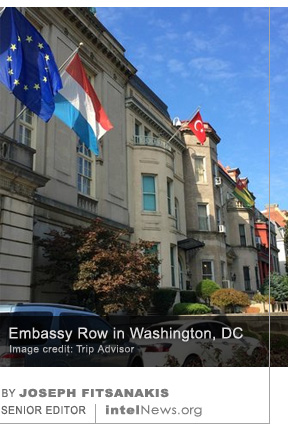 The United States government has for the first time admitted publicly that it has detected devices known to be used by foreign intelligence services to spy on cellular communications in the nation’s capital. Known commonly as Stingrays, after a leading hardware brand, these devices are primarily used by government agencies, including law enforcement. But they can be purchased by anyone with anywhere from $1,000 to $200,000 to spare. They work by simulating the activity of legitimate cell towers and tricking cell phones into communicating with them. That allows the users of these cellphone-site simulators to monitor the physical whereabouts of targeted cell phones. Some of the more expensive Stingray models can intercept the actual content of telephone conversations and can even plant Trojans on the compromised phones of unsuspecting users.
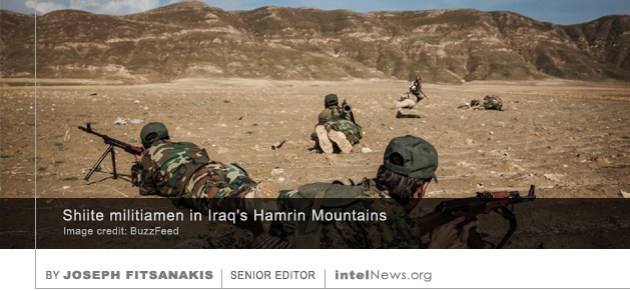 The collapse of the Islamic State of Iraq and Syria is giving rise to a host of successor groups, which are quickly regrouping, recruiting members and launching increasingly sophisticated attacks against government forces, according to experts. A military victory in the war against ISIS was officially declared by the Iraqi government in December of last year. In recent weeks, United States President Donald Trump has repeated his government’s claim that American forces are “knocking the hell out of ISIS”. The Sunni militant group, which rose to prominence in 2014 after conquering much of Syria and northwestern Iraq, is clearly on the retreat, having lost every major urban center that it used to control. However, the collapse of the organization has led to the emergence of numerous insurgent groups that are quickly forming in Iraq and Syria.
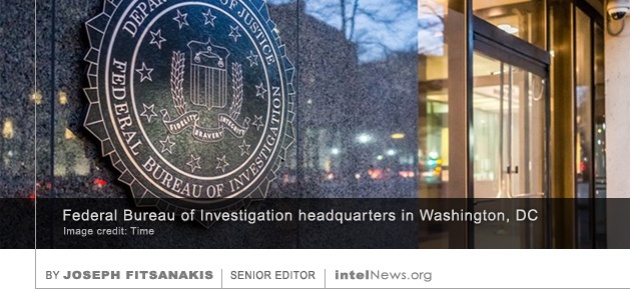 A surge in the activity of Russian intelligence personnel on United States soil has caused American spy agencies to rehire retired Russia specialists,








CIA seeking new ways to protect officers’ secret identities online, says official
April 26, 2018 by Joseph Fitsanakis 3 Comments
In her speech, Meyerriecks discussed what she described as “identity intelligence”, namely the detailed piecing of a person’s identity from data acquired from his or her online activity and digital footprint left on wireless devices of all kinds. This data, combined with footage from closed-circuit television (CCTV) systems and other forms of audiovisual surveillance, poses tremendous barriers to clandestine operations, said Meyerriecks. Today, around 30 countries employ CCTV systems with features so advanced that they render physical tracking of human operatives unnecessary, she added. She went on to warn that the combination of these advanced systems with all-encompassing digital networks in so-called smart cities, as well as with the Internet of things, pose serious threats to the CIA’s ability to operate in secret. Abandoning the online grid is not a solution, said Meyerriecks, because doing so draws attention to the absentee. “If you have […] a six figure or low seven figure income, and you own no real estate, you don’t have any health [or] life insurance policies to speak of, you turn your cell phone off every day from 8:00 to 5:00, who do you work for?”, she said.
These technological challenges will not put an end human intelligence, but they are forcing “a sea of change” in the so-called “patterns of life” of clandestine operatives, said Meyerriecks. These operatives “are going to have to live their cover in a whole different way”, she said without elaborating. Ironically, technology may provide solutions to these challenges, for instance through phone apps that fake the geospatial coordinates of the device —“a growing area of research”, she remarked. Another example of a technological solution to the problem is the use of artificial intelligence algorithms to map CCTV camera networks in urban centers. These maps can help clandestine personnel avoid areas where camera networks are present, noted Meyerriecks.
► Author: Joseph Fitsanakis | Date: 25 April 2018 | Permalink
Filed under Expert news and commentary on intelligence, espionage, spies and spying Tagged with CIA, CIA Directorate of Science and Technology, Dawn Meyerriecks, human intelligence, Internet, News