Norway invites Israeli nuclear whistleblower who is barred from leaving Israel
October 4, 2017 2 Comments
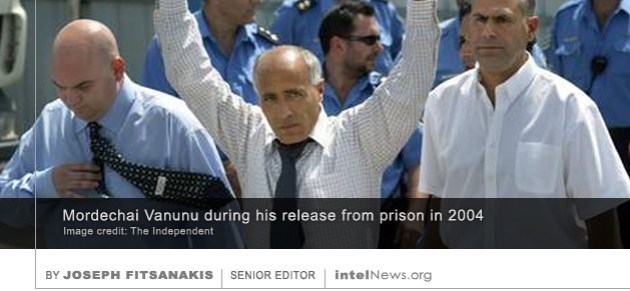 The controversial Israeli nuclear whistleblower Mordechai Vanunu, who was jailed for 18 years for revealing the existence of Israel’s nuclear program, has been invited to go to Norway to be reunited with his new wife. Vanunu was employed at Israel’s top-secret Negev Nuclear Research Center, located in the desert city of Dimona, which was used to develop the country’s nuclear arsenal. But he became a fervent supporter of nuclear disarmament and in 1986 fled to the United Kingdom, where he revealed the existence of the Israeli nuclear weapons program to the London-based newspaper The Times. His action was in direct violation of the non-disclosure agreement he had signed with the government of Israel; moreover, it directly challenged Israel’s official policy of ‘nuclear ambiguity’, which means that the country refuses to confirm or deny that it maintains a nuclear weapons program.
Israel’s spy agency, the Mossad, managed to lure Vanunu to Italy with the help of a female intelligence officer who befriended him. Vanunu was abducted by a Mossad team in Rome and secretly transferred to Israel, where he was tried and convicted to 18 years in prison. He was released in 2004, after having spent most of his sentence in solitary confinement. His release is conditional on a number of restrictions, which means that Vanunu is barred from speaking to foreigners and barred from leaving the country. However, in May 2015, Vanunu married a Norwegian theologian, Kristin Joachimsen. Last Friday, Joachimsen spoke on Norway’s TV2 channel about her marriage with the Israeli nuclear whistleblower. During her interview, she revealed that she had successfully filed a request for family reunification with her husband with the Norwegian government. According to Norwegian law, a family member living abroad is entitled to apply for reunification with a family member who is legally living in Norway. Reporters from TV2 contacted the Norwegian Directorate of Immigration, which confirmed that Joachimsen’s family reunification request had been granted by the government. Consequently, Norway had officially contacted Israel stating its willingness to host Vanunu so that he could be reunited with his wife.
However, there is no guarantee that Vanunu will be permitted to leave Israel. In her interview, the nuclear whistleblower’s wife said that his application was scheduled for review in Israel sometime in November. But she added that she had no idea whether Vanunu would be allowed to leave the Middle Eastern country. On Sunday, a spokesman from Israel’s Ministry of Foreign Affairs insisted that the restrictions on Vanunu’s freedom of movement following his release from prison were imposed “due to the danger that he posed” to the security of Israel. In a subsequent written statement, the Ministry of Foreign Affairs said that Israel would “continue to review updates of the situation in order to determine appropriate restrictions in accordance with security dangers” posed by Vanunu.
► Author: Joseph Fitsanakis | Date: 04 October 2017 | Permalink
 The seizure earlier this year of a North Korean ship secretly carrying thousands of weapons for use by the Egyptian military has revealed the scale of one of Pyongyang’s most profitable money-making ventures: global arms sales. Experts say that the North Korean state continues to supply thousands of tons of Cold-War-era conventional weapons to countries such as Eritrea, Cuba, Burma and Iran, as well as to some American allies, including as Egypt. There is also evidence that at least two non-state militant organizations, including the Lebanon-based group Hezbollah, are among Pyongyang’s customers. The latter take advantage of North Korea’s vast arsenal of weapons produced in the 1960s and 1970s, which are being sold on the international arms market at very low prices.
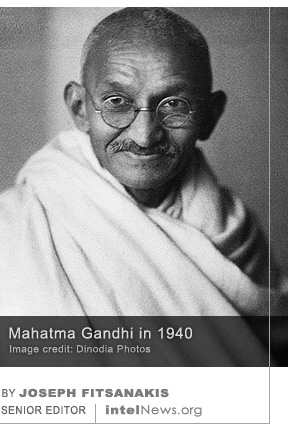 A researcher is seeking access to a potentially revealing classified telegram sent by a United States diplomat who witnessed the assassination of Indian leader Mahatma Gandhi in 1948. Gandhi, the leader of the Indian movement for independence, and a towering civil rights figure of the 20th century, was assassinated on January 30, 1948, as he was about to hold a prayer meeting in downtown New Delhi. His assassin, Nathuram Vinayak Godse, was a member of a Hindu nationalist paramilitary group, who blamed Gandhi for the bloody partition of India. He and a co-conspirator, Narayan Apte, were arrested for Gandhi’s murder and put to death in 1949.
 A senior German intelligence official has warned that foreign powers, including Russia, could try to shape the outcome of talks by German parties to form a governing coalition, following last week’s national elections. The elections resulted in a major shakeup of Germany’s political landscape, as Chancellor Angela Merkel’s Christian Democratic Union lost nearly 10 percentage points compared to its 2013 election result. It is now forced to seek the participation of other conservative or centrist political parties in a broad governing alliance. Meanwhile, the far-right Alternative for Germany (AfD) won 12.6 percent, propelling it to third place and giving it 91 seats in the Bundestag. The AfD result marks the first time since 1945 that a German far-right party has managed to secure parliamentary representation.
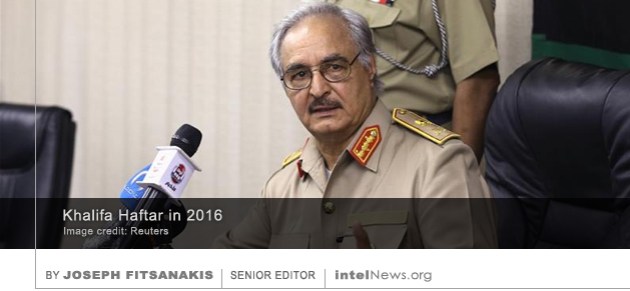 Libya’s most powerful warlord, who was an asset of the United States Central Intelligence Agency before entering the Libyan Civil War, ordered his troops to commit war crimes, according to two American legal experts. Libya has remained in a state of war since 2011, when a popular uprising backed by the West and its allies led to the demise of the country’s dictator, Colonel Muammar Gaddafi. Currently the strongest faction in the ongoing Libyan Civil War is the eastern-based Tobruk-led Government, which is affiliated with the Libyan National Army (LNA). The commander of the LNA is Field Marshal Khalifa Haftar, an old adversary of Colonel Gaddafi, who lived in the United States under Washington’s protection for several decades before returning to Libya in 2011 to launch his military campaign.
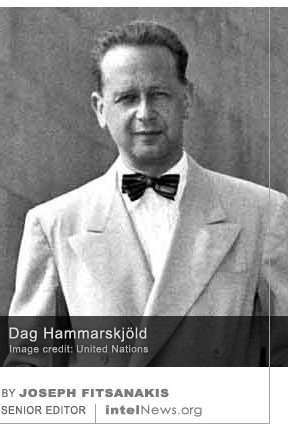 A deliberate attack by another aircraft may have caused the plane crash that killed the United Nations Secretary General in 1961, according to a report commissioned by the intergovernmental organization. On September 17, 1961, a Douglas DC-6 transport aircraft carrying United Nations Secretary General Dag Hammarskjöld crashed in the British-administered territory of Northern Rhodesia (now Zambia). The crash killed everyone onboard. At the time of his death, Hammarskjöld was flying to the Congo’s mineral-rich Katanga region to meet European-supported chieftains who in 1960 had seceded from the nationalist government of Congolese Prime Minister Patrice Lumumba. Ironically, Lumumba had been
 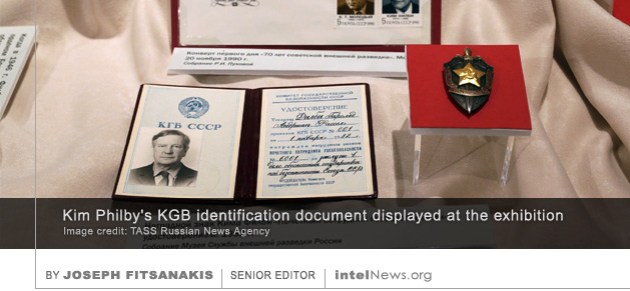 The life of Kim Philby, one of the Cold War’s most recognizable espionage figures, is the subject of a new exhibition that opened last week in Moscow. Items displayed at the exhibition include secret documents stolen by Philby and passed to his Soviet handlers during his three decades in the service of Soviet intelligence. While working as a senior member of British intelligence, Harold Adrian Russell Philby, known as ‘Kim’ to his friends, spied on behalf of the Soviet NKVD and KGB. His espionage lasted from about 1933 until 1963, when he secretly defected to the USSR from his home in Beirut, Lebanon. Philby’s defection sent ripples of shock across Western intelligence and is often seen as one of the most dramatic incidents of the Cold War.
 The world’s largest building materials manufacturer, LafargeHolcim, which is headquartered in France and Switzerland, allegedly bribed the Islamic State to keep its factory working in Syria, according to court witnesses. The company specializes in the manufacture of building materials such as cement, concrete and various byproducts. It was formed in 2015 by a merger of France-based Lafarge and Swiss-based Holcim, and currently employs an estimated 120,000 employees in nearly 100 countries around the world.
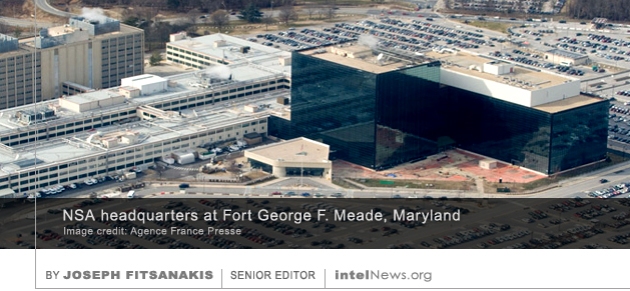 Representatives from the United States National Security Agency (NSA) withdrew a proposal to introduce new global industry standards for data encryption, after encountering prolonged skepticism by experts representing other Western countries. Some observers have interpreted this development as indicative of the damaged relationship between the NSA and its Western counterparts following revelations by American defector Edward Snowden.
 A group of cyber spies with close links to the Iranian government is becoming increasingly competent and adept, and could soon bring down entire computer networks, according to a leading cyber security firm. The California-based cyber security company FireEye said that it has been monitoring the operations of the mysterious group of cyber spies since 2013. The company, whose clients include Sony Pictures, JP Morgan Chase and Target, said that the Iranian group appears to be especially interested in gathering secrets from aviation, aerospace and petrochemical companies.
 Australia rejected a secret request by the United States Central Intelligence Agency to open an embassy in North Korea, which the Americans hoped to use as a base from where to collect intelligence on the communist state.
  Germany’s most famous living spy is on trial this week for hiding assets totaling $50 million in offshore bank accounts. He claims the money was given to him by unspecified “Western intelligence agencies” for his services. Werner Mauss became widely known in 1997, when he was arrested in Colombia for using a forged passport. He had traveled to the Latin American country to secure the release of a German woman who had been kidnapped by leftist guerrillas. The Colombian authorities eventually released him, following heavy diplomatic pressure from the German government. But the German media began investigating his background, and it soon became apparent that he was working for the German Federal Intelligence Service.
 South Africa’s National Treasury threatened to terminate all funding for covert operations last year, after the country’s spy agency refused to account for tens of millions of dollars in expenses, saying the money had been put to “secret use”. An investigation by two leading South African news outlets, the Afrikaans-language weekly newspaper Rapport and the English-language online news portal News24, has revealed the existence of a major bureaucratic spat between the National Treasury and the State Security Agency (SSA), the country’s primary civilian intelligence organization.
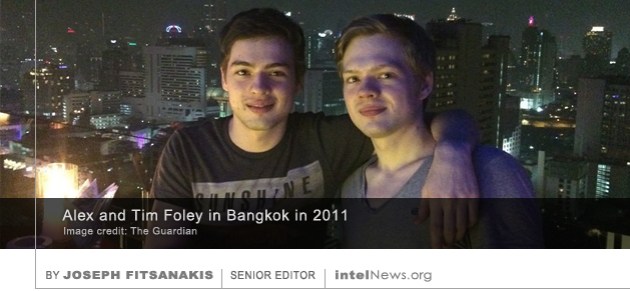 The sons of a Russian couple, who fraudulently acquired Canadian citizenship before being arrested for espionage in the United States, are seeking to reinstate their Canadian citizenship, which was annulled when their parents were found to be Russian spies. Tim and Alex Vavilov are the sons of Donald Heathfield and Tracey Foley, a married couple arrested in 2010 under Operation GHOST STORIES —a counterintelligence program run by the US Federal Bureau of Investigation (FBI). Following their arrest, their sons, who allegedly grew up thinking their parents were Canadian, were told that their parents were in fact Russian citizens and that their real names were Andrei Bezrukov and Elena Vavilova. Their English-sounding names and Canadian passports had been forged in the late 1980s by the KGB, the Soviet Union’s primary external intelligence agency.






 intelNews.org
Trump’s CIA director outlines plans to make agency more aggressive, cut red tape
October 5, 2017 by Joseph Fitsanakis 4 Comments
On Wednesday, Pompeo was the keynote speaker at a one-day conference on intelligence, hosted at George Washington University in Washington, DC. Entitled Ethos and Profession of Intelligence, the conference was co-sponsored by George Washington University and the CIA. In his speech, Pompeo outlined his plans to make CIA operations more aggressive and cut back what he repeatedly described as “red tape” at the agency. He based his observations on his opinion that the CIA is slow, not agile enough, and excessively centralized in its decision making. He added that, to better protect American national security, the Agency should engage in more offensive methods of intelligence collection. He went on to state that the most effective way to make the CIA more agile as an organization was to decentralize its decision-making processes. To do so, he said, decisions had to be pushed “to the lowest level possible”, thus allowing CIA station chiefs around the world to “call the shots” on operations. That was especially applicable to “tactical issues”, where the person with the most direct knowledge of the situation “is rarely me or anyone in my senior leadership team”, said Pompeo.
The CIA director went on to say that his plan is to “cut red tape” through various ways. One such way is reducing the numbers of CIA personnel that are required to review and approve intelligence operations, he said. Another way is increasing the number of CIA operations officers stationed abroad, thus placing CIA personnel closer to the agency’s intelligence targets. The goal is to “deploy our people, tools and resources into the heart of the fight”, said Pompeo. The CIA director concluded his remarks by saying he wants to instill a new culture at the Agency, based on the motto: “If you are in a process and you’re not adding value, get out of the way”.
► Author: Joseph Fitsanakis | Date: 05 October 2017 | Permalink
Filed under Expert news and commentary on intelligence, espionage, spies and spying Tagged with CIA, conferences, George Washington University, intelligence planning, Mike Pompeo, News, United States