European, American, Russian fighters join both sides of Syrian war

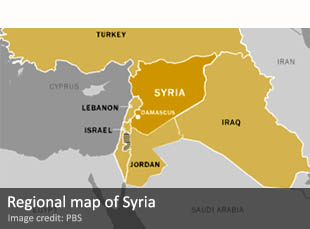
Regional map of SyriaBy JOSEPH FITSANAKIS | intelNews.org
Nearly three years into the Syrian Civil War, it is becoming increasingly clear that the opposition forces are far more fragmented than the government side. Many of the rebel factions are now largely concerned with fighting each other for control of territory and other key assets, including oil installations and cross-border trade routes. Amidst the chaos, thousands of foreign fighters are flooding into the country, motivated by ideology or money. It is estimated that between 6,000 and 11,000 foreign fighters have entered Syria since the war, causing United States intelligence officials to speak of “a growing presence of foreigners” in the ranks of armed factions. At least 300 British citizens are estimated to have traveled to Syria with the intent of joining the Civil War, according to The Times of London. Most of them are young Islamist radicals who are intent on helping topple the administration of Syrian President Bashar al-Assad, according to the paper. Another British newspaper, The Daily Telegraph, reported recently that four British citizens —all London residents— died recently in Syria’s largest city, Aleppo, while fighting alongside government troops in support of President Assad. They were fighting against the al-Nusra Front, an opposition group with strong links to al-Qaeda. Meanwhile, The New York Times said on Wednesday that “dozens of Americans” have entered or tried to enter Syria to join various rebel factions in their fight against the government. The paper cited unnamed “American intelligence officials” in alleging that the Americans are a “small subset” of a larger group of “roughly 600” Western-born Islamists who have entered Syria from Western Europe, North America and Australia since 2011. The ongoing conflict has also attracted hundreds of Russian fighters, according to reports. Foreign Policy magazine notes the “rising flow” of radical Islamists from the Russian Federation to Syria in recent months. Read more of this post

Analysis: FBI monitors foreign diplomats far more than NSA

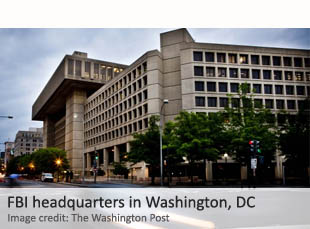
FBIBy JOSEPH FITSANAKIS | intelNews.org
Over the past several months, the Edward Snowden affair has turned the typically reclusive National Security Agency into a news media sensation. The signals intelligence agency, which is tasked by the United States government with communications interception, is said to have spied on a host of foreign government officials and diplomats. But in an article published this week in Foreign Policy, the American military historian and author Matthew Aid reminds us that American intelligence operations against foreign diplomats do not usually involve the NSA. They are typically carried out by the Federal Bureau of Investigation, which has been in the business of monitoring the activities of foreign diplomats on US soil long before the NSA even existed. The author of Intel Wars and The Secret Sentry states in his article that the FBI’s cryptologic operations targeting foreign envoys are today far more sensitive and the NSA’s. The vast majority of these operations take place on US soil. There are currently over 600 foreign embassies, consulates and diplomatic missions in the US, maintained by 176 countries. They include over 200 consulates located in cities ranging from Miami to Los Angeles and from San Francisco to Boston. New York alone hosts over 100 permanent diplomatic missions at the United Nations headquarters. Aid points out that “every one of these embassies and consulates is watched by the FBI’s legion of counterintelligence officers” in varying degrees. Additionally, the Bureau relies on the close cooperation of large American telecommunications providers in its effort to intercept the landline and cellular communications “of virtually every embassy and consulate in the United States”. FBI communications technicians also intercept the personal telephone calls and emails of foreign diplomats on a regular basis, adds Aid. Sometimes the Bureau employs specially trained teams of agents who physically break into embassies and consulates, in what is known in intelligence lingo as ‘black bag jobs’. Read more of this post

News you may have missed #854 (SIGINT edition)

NSA/GCHQ listening station in Menwith HillBy IAN ALLEN | intelNews.org
►►British ex-minister accuses GCHQ of ignoring surveillance fears. Nick Brown, a former Labour Party cabinet minister, has warned that GCHQ and Britain’s other intelligence agencies appear to be undertaking mass surveillance without parliament’s consent because the country’s coalition failed to get the communications data bill –-dubbed the “snoopers’ charter” by critics– passed into law after Liberal Democrat opposition. Brown said there was an “uncanny” similarity between the GCHQ surveillance programs exposed by the US whistleblower Edward Snowden and proposals in the first part of the bill.
►►Analysis: The NSA’s new codebreakers. Matthew Aid writes: “There was a time when the codebreakers of the National Security Agency actually took the lead in solving enemy encryption systems. These days, not so much. In today’s NSA, it’s hackers, break-in artists, corporate liaisons, and shadow salesman using front companies who are at the forefront of this effort. Even so-called “hacktivists” play an unwitting role in helping the NSA gain access to computer networks –both hostile and friendly. Just about the only place that’s somewhat immune to the NSA’s new style of codebreaking attacks? North Korea, because it’s so disconnected from the rest of the world’s networks”.
►►UKUSA treaty countries collecting data for NSA. The latest leaks from former US intelligence contractor Edward Snowden reveal a new dimension to the US-led electronic eavesdropping, with address books and ”buddy lists” from Yahoo!, Hotmail, Facebook and Gmail accounts being harvested across the globe. The documents, published by The Washington Post on Tuesday, show the clear involvement of Australia along with the US, Britain, Canada and New Zealand —the so-called “five eyes” intelligence-sharing nations.

News you may have missed #849 (analysis edition)

Edward SnowdenBy IAN ALLEN | intelNews.org |
►►Are American spies the next victims of the Internet age? The furor over the NSA’s data collection and surveillance programs has been fierce. But Daniel Prieto, of the Center for Strategic and International Studies, argues that the debate should be focusing on the US intelligence apparatus, transformed in the dozen years since 9/11, can meet the challenges and that the US faces today and into the future. He asks whether the “business model” of US intelligence –how intelligence is gathered, analyzed, and used– is sufficient and sustainable, or whether it needs to evolve to “something different or something more”.
►►What did Edward Snowden get wrong? Everything. Andrew Liepman, senior analyst at RAND Corporation, former career officer at the CIA, and former deputy director of the US National Counterterrorism Center, offers an insider’s view on the Edward Snowden case. He argues that those following the Snowden saga fail to understand that the US government “truly does make strenuous efforts not to violate privacy”. This is not simply because it respects privacy on principle, he says, but also because “it simply doesn’t have the time” to access irrelevant information that is not closely connected to possible espionage or terrorist plots against Americans.
►►Why US diplomatic missions became fortresses. Even during the Cold War, American diplomatic facilities were designed to be welcoming and to project the American values of openness and individual liberty. No more, argues John Campbell, former US Ambassador to Nigeria and Ralph Bunche Senior Fellow for Africa Policy Studies at the Council on Foreign Relations. Nowadays, US diplomatic facilities increasingly showcase “Fortress America”, he argues. And he concludes that, “the need to subordinate so much to security diminishes US soft power by undermining its traditional message of openness and welcome”.

Analysis: Why were Western diplomats evacuated from Yemen?

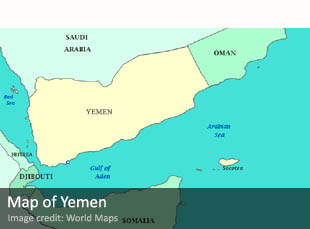
YemenBy J. FITSANAKIS and I. ALLEN | intelNews.org |
American and British embassies in Yemeni capital Sana’a were evacuated on Tuesday, soon after the United States closed 19 of its diplomatic representations in the Middle East and North Africa due to fears of a pending terrorist attack. But why exactly did the evacuations of diplomatic personnel take place in Sana’a? The Yemeni government announced on Wednesday that it had foiled a large-scale attack by al-Qaeda in the Arabian Peninsula (AQAP), which allegedly aimed to cripple the country’s frail economy. According to Yemeni government spokesperson Rajeh Badi, the attack was planned to take place in the country’s central Hadramout governorate, which includes the port cities of al-Mukkala and Ghail Ba Wazir. The Yemeni government said the AQAP forces planned to blow up several oil pipelines before proceeding to occupy the two port cities, from which the majority of Yemen’s oil exports are shipped. Badi added that AQAP planned to take several foreign oil workers hostage as part of the military operations.

However, as Foreign Policy magazine’s Dana Stuster points out, Mohammed Albasha, spokesman of the Yemeni embassy in Washington, DC, seems to dispute his own government’s claims. Early on Wednesday, Albasha tweeted that, in his view, “AQAP doesn’t have the man power nor the capabilities to capture a city the size of Mukkala in Hadramout”, let alone Ghail Ba Wazir. Read more of this post

News you may have missed #844 (analysis on Snowden leak)

Edward SnowdenBy IAN ALLEN | intelNews.org |
►►Daniel Ellsberg: Snowden was right to flee US. “Many people compare Edward Snowden to me unfavorably for leaving the country and seeking asylum, rather than facing trial as I did. I don’t agree. The country I stayed in was a different America, a long time ago”, says Pentagon Papers whistleblower Daniel Ellsberg. And he continues: “I hope that he finds a haven, as safe as possible from kidnapping or assassination by US Special Operations forces, preferably where he can speak freely”.
►►NSA ‘in bed’ with German intelligence says Snowden. The fugitive US whistleblower Edward Snowden alleged on Sunday that the National Security Agency was “in bed together” with German intelligence despite claims by politicians in Chancellor Angela Merkel’s coalition that they were shocked by the extent of American spying in Germany. Snowden claimed that the NSA provided German intelligence, with analysis tools to help the organization monitor data flowing through Germany.
►►Can Snowden fly from Moscow to Caracas without being stopped? How can Snowden get from Moscow’s Sheremetyevo Airport, where he’s been holed up for nearly two weeks, to Venezuela, Bolivia or Nicaragua, which have indicated that they are willing to offer him political asylum? Former CIA analyst Allen Thomson took to Google Earth to answer the question of whether there’s a route Snowden might take that would allow him to fly from Moscow to, say, Caracas without crossing, as he puts it jokingly, the airspaces of “los Yanquis and their running dogs”.

News you may have missed #843 (analysis on Snowden leak)

James ClapperBy IAN ALLEN | intelNews.org |
►►Countries approached by Snowden for asylum and their responses. According to a statement from WikiLeaks, former CIA/NSA employee Edward Snowden has applied for asylum in a total of 21 countries, but with little success so far. Here is a list of the countries he approached and their responses –or lack thereof– so far. Bolivia and Venezuela appear somewhat positive, but Ecuador and Russia have denied any possibility of giving Snowden political asylum. Other countries, including Cuba and China, have yet to issue a response to Snowden’s request.
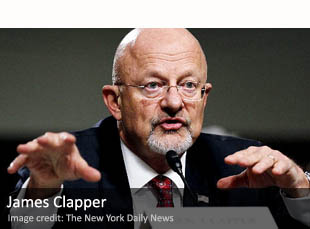
►►US ODNI admits giving ‘erroneous’ answer during Senate testimony. James Clapper, America’s most senior intelligence official, who heads the Office of the Director of National Intelligence, has told a Senate oversight panel that he “simply didn’t think” of the National Security Agency’s efforts to collect the phone records of millions of Americans when he testified in March that it did “not wittingly” snoop on their communications. He had told during his testimony that NSA did “not wittingly” collect “any type of data at all on millions or hundreds of millions of Americans”. But that was before Snowden spilled the beans….
►►Are the Europeans being hypocrites over spying? If you buy the latest reporting out of Europe, France is outraged, simply outraged, at news that the National Security Agency has been eavesdropping on the European Union through its mission in New York and embassy in Washington. All of which is pretty hilarious, given France’s penchant for stealing American defense technology, bugging American business executives and generally annoying US counterintelligence officials. And it’s not just France, either.

Analysis: PRISM revelations harm US political, financial interests

NSA headquartersBy JOSEPH FITSANAKIS | intelNews.org |
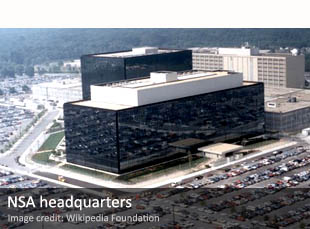
Ever since June 6, when Edward Snowden, a former United States Central Intelligence Agency (CIA) technician, exposed a vast communications spying system called PRISM, observers have focused on the ramifications of this controversy inside America. But in an excellent analysis written for ComputerWorld magazine’s New Zealand edition, Taylor Armerding points out that Snowden’s revelation could result in extensive international blowback for the United States, in both the political and economic realms. Armerding quotes Toronto University political science professor Ron Deibert, who argues that this latest revelation of massive communications interception activity by the National Security Agency (NSA) carries with it “unintended consequences […] that will undermine US foreign policy interests”. Deibert points out that the spy scandal has the potential to undercut America’s role and influence in global Internet governance. In the words of renowned security expert Bruce Schneier, many around the world are beginning to view the US as “simply too untrustworthy to manage the Internet”. Even policymakers and ordinary users friendly to Washington are worried about what they perceive as the “huge disadvantages” of their dependence on US-managed Internet networks that host the content of social media sites, cloud computing databases, or telecommunications exchanges, says Deibert. But the biggest potential damage to US interests, argues Armerding, is not political, but economic. “It is not just personal information that is being swept into the NSA’s massive databases”, he notes; “it is corporate data as well”. Indeed, the vast foreign and domestic spying represented by PRISM poses a direct threat to the global competitiveness of the American technology sector. Read more of this post

Analysis: Is US diplomat arrested in Russia a CIA case officer?

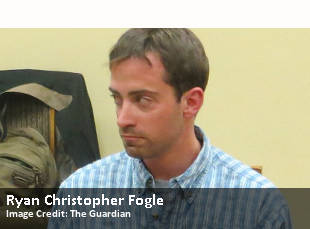
Ryan Christopher FogleBy JOSEPH FITSANAKIS | intelNews.org |
The Russian Ministry of Foreign Affairs lodged an official complaint yesterday with the United States Ambassador to Russia over the alleged espionage activities of Ryan Christopher Fogle. The Third Secretary in the Political Section of the US embassy was arrested with great media fanfare on Monday night, allegedly as he was trying to recruit a Russian intelligence officer. As can be expected, the Russian media had a field day with Fogle’s arrest; after all, it has been nearly a decade since the last time an American intelligence operative was publicly uncovered on Russian soil. Many Western observers, however, have questioned if Fogle could really be an officer of the Central Intelligence Agency, and whether the Russian Federal Security Service (FSB) simply framed an unsuspecting junior American diplomat. Much of the skepticism expressed by Western commentators focuses on the articles that were allegedly found by the FSB in Fogle’s backpack. They included several pairs of sunglasses, recording devices, as well as two wigs. Would a CIA officer be foolish enough to be carrying with him surreptitious recording devices in downtown Moscow? And do modern case officers still employ wigs when walking the streets of foreign capitals recruiting spies? The answer is, of course, yes. Read more of this post

Is Ana Montes ‘the most important spy you’ve never heard of’?

Ana Belen MontesBy IAN ALLEN | intelNews.org |
An extensive article published today in The Washington Post Magazine revisits the largely forgotten case of Ana Belen Montes, a senior United States military intelligence analyst who was convicted in 2002 of spying for Cuba. Montes, who was arrested by the Federal Bureau of Investigation in Washington, DC, on September 20, 2001, underwent trial and sentencing in the shadow of 9/11, which might help explain the relative obscurity of her case. Still, as The Post article by Jim Popkin states, many intelligence observers view her as one of the most damaging double spies in recent American history. She entered government work as a clerk typist at the Department of Justice, and quickly received top-security clearance. It was from there that she moved to the Defense Intelligence Agency, America’s premier military intelligence organization, in September 1985. She rose meteorically through the ranks of the DIA, eventually becoming the Agency’s top Cuba analyst. Montes’ former colleagues report that she was known as “the Queen of Cuba”, a witty label that rested on her indisputable reputation as one of America’s most capable intelligence analysts on Cuba. She also came from a family with strong conservative credentials and strong connections with the US counterintelligence community. Her brother and sister were both FBI agents, and her former long-term boyfriend was a Cuban intelligence specialist for the Department of Defense. Read more of this post

News you may have missed #830 (Boston bombings analysis)

Site of one of the Boston Marathon blastsBy IAN ALLEN | intelNews.org |
►►Despite WMD fears, terrorists still focused on conventional attacks. The United States has spent billions of dollars to prevent terrorists from obtaining a weapon of mass destruction even as the bombings in Boston further show that a nuclear weapon or lethal bioagent is not necessary for causing significant harm. However, experts warn that, even though there is a considerably lower probability of a WMD attack versus a conventional strike, the much higher consequences necessitate continued US investment in prevention and preparation.
►►Why isn’t terrorism in the US a whole lot more frequent? While the horrific bombing at the Boston Marathon has brought concerns about terrorism back to the forefront of national attention, it is worth remembering that terrorism inside the United States is exceedingly rare. Over the past 40 years, just over 3 people on average have been killed by acts of terrorism per year (remove 9/11, and the average is 1.4 deaths per year). After 9/11 or an event like the Boston attack, we often think “it would be so easy to [fill in the blank] and cause massive damage.” And it’s true. Then why doesn’t it happen more often?
►►Boston bomb investigators can’t decide: foreign or domestic? Even the most experienced investigators are still trying to decide whether the Boston marathon bombs were carried out at the hands of domestic or foreign attackers. The inability to settle that question is proving frustrating to investigators. Former FBI assistant director Tom Fuentes told CNN: “I’ve run bomb scenes in Iraq and also in the US”, adding that the attack in Boston “has the hallmarks of both domestic and international, and you can see either side of that”.
►►Smoke color is key clue to analyzing Boston Marathon bombs. As a team of investigators led by the FBI begins deciphering the bombs that killed three people and wounded 150 more in Boston this week, a key clue is already in plain sight on countless videos taken during the blasts: the color of the smoke. Analyzing the color of the smoke can provide information about the explosive that powered the bombs, which in turn provides clues about its sophistication —and, possibly, that of the people who made it.

Analysis: Five dangerous myths about the Boston Marathon bombings

Investigating the Boston bombingsBy JOSEPH FITSANAKIS | intelNews.org |
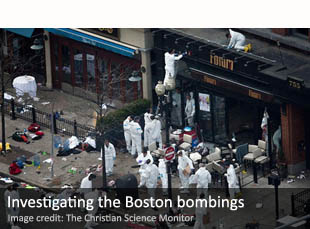
The endless opinion pieces about the Boston bombings that have flooded the media-sphere since Monday have one thing in common: they are highly speculative and, for the most part, unreliable. At this early stage, nobody outside the security or intelligence establishments has any idea about the identity or motives behind the attacks —and if they say they do, they are lying. Even those on the inside routinely refer to the ongoing investigation as one of the most complex in the country’s post-9/11 history. As the probe continues, and the nation deals with the meaning of the Boston bombings, it is critical that some of the dangerously misinformed and premature notions about the attacks are dispelled.

To begin with, the Boston Marathon bombings were not necessarily terrorism. They were clearly calculated and indiscriminate, but in order for them to qualify as terrorism, their planners must have a broad political or ideological objective. Terrorism is a tactic used to further a political goal. There is a reason why we don’t refer to school shootings, such as the one that took place on December 14, 2013, at Sandy Hook Elementary in Newtown, Connecticut, as terrorism. They are calculated and extremely violent, but they do not contain a political motive. Before we can attach a terrorist label to the Boston bombings, we have to uncover the motive of the perpetrator(s). Barring that, the incident must be treated simply as a criminal act. Read more of this post

Technical analysis offers first clues about Boston Marathon bomber(s)

Site of one of the Boston Marathon blastsBy JOSEPH FITSANAKIS | intelNews.org |
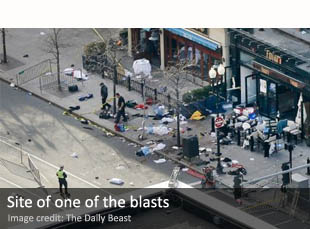
Counterterrorism experts probing Monday’s bombings at the Boston Marathon are bound to start searching for the culprits by focusing on the technical specifications of the attacks. According to the Boston Police Department, three people were killed and at least 144 were injured —many of them critically— by the blasts, which rocked downtown Boston at 2:45 p.m. local time. The second explosion was carefully timed to coincide with the initial blast, and occurred just ten seconds later, fewer than 100 yards down the road from the site of the first explosion. At least one report stated that law enforcement teams found and dismantled up to five additional devices at the site, which had failed to detonate. But one police official later denied these reports, saying that “closer examinations led [the police] to doubt that [the devices] were bombs”. If additional devices were indeed present at the site of the blast, it is likely that they failed to detonate due to the collapse of the wireless network in Boston, which was knocked down by a sudden spurt in usage following the initial blasts. If, as it appears, these bombs were types of improvised explosive devices (IEDs), and if suicide terrorism was not involved, chances are the devices were remotely triggered using the diodes commonly found inside the speakers of inexpensive cell phones. Depending on the constitution of the bombs themselves, they could contain ball bearings, screws, or other metal fragments stuffed inside a container around some type of explosive. Read more of this post

News you may have missed #827

Brigadier General Mohammed KhaloufBy IAN ALLEN | intelNews.org |
►►Analysis: The spies who fooled the world about Iraq. On the tenth anniversary of the Iraq War, the BBC flagship investigative program Panorama has aired a documentary arguing that, even before the fighting in Iraq started, intelligence from highly placed sources was available in the UK, suggesting that the administration of Iraqi President Saddam Hussein had no weapons of mass destruction.
►►Syrian officer to auction spy files as general defects. Kuwaiti daily Al-Seyassah reported this past weekend that an intelligence officer that defected is offering to auction the intelligence archives of Syrian President Bashar al-Assad’s brother-in-law, Assef Shawkat. Meanwhile, Syrian Brigadier General Mohammed Khalouf and about 20 soldiers defected from the Syrian army in two separate incidents on Saturday, according to rebel-controlled media.
►►Half a million wiretapped in Turkey in last decade. Some 470,000 people in Turkey have been subject to eavesdropping over the past 11 years, said officials from the Gendarmerie Command’s intelligence unit. In 2012 alone, over 33,000 people were eavesdropped on by the Gendarmerie, according to information given to the Turkish Parliament’s Eavesdropping Examination Commission. Notably Gendarmerie authorities said that they found no information or documents regarding the case of the wire-tapping of the Turkish Prime Minister in their examination of their own records.

Analysis: The Current State of the China-Taiwan Spy War

China and TaiwanBy JOSEPH FITSANAKIS | intelNews.org |
Last week I spoke about the current state of the espionage war between China and Taiwan with Tim Daiss, a Southeast Asia-based American journalist who has been covering the Asia-Pacific region for over a decade. Our discussion formed the basis of a comprehensive piece on the subject, published in British newspaper The Independent, in two parts (part one and part two). I told Daiss that the Ministry of State Security —China’s primary national intelligence agency— is not known for its technological prowess. However, the sheer size of Beijing’s intelligence apparatus is proving a good match for the more advanced automated systems used by its less populous regional rivals, including Taiwan. When it comes to traditional human intelligence, the Chinese have been known to employ time-tested methods such as sexual entrapment or blackmail, as was confirmed most recently in the case of Taiwanese Major-General Lo Hsien-che. Lo, who headed the Taiwanese military’s Office of Communications and Information, was convicted of sharing classified top-secret information with a female Chinese operative in her early 30s, who held an Australian passport. During his trial, which marked the culmination of Taiwan’s biggest spy scandal in over half a century, Lo admitted that the Chinese female spy “cajoled him with sex and money”. In addition to honey-trap techniques, Chinese spies collect intelligence by way of bribery, as do many of their foreign colleagues. In the case of China, however, a notable change in recent years has been the accumulation of unprecedented amounts of foreign currency, which make it easier for Chinese intelligence operatives to entice foreign assets, such as disgruntled or near-bankrupt state employees, to sell classified data. Read more of this post