German spy services had foreknowledge of Wagner mutiny, report claims
July 11, 2023 1 Comment
 CONTRARY TO EARLIER CLAIMS that the German intelligence agencies failed to anticipate last month’s showdown between PMC Wagner and the Kremlin, German intelligence did in fact have foreknowledge of the mercenary group’s uprising, a new investigative report has concluded. The report further claims that German intelligence had unique and real-time insights into the negotiations between Wagner PMC leader Yevgeny Prigozhin and Belarussian President Aleksandr Lukashenko, who intervened in the dispute.
In the days following the June 23 mutiny by soldiers of the Russian private military firm Wagner Group, German intelligence agencies were publicly criticized for allegedly failing to warn Berlin about the unprecedented incident. Specifically, it was claimed that Germany’s primary foreign intelligence agency, the Federal Intelligence Service (BND), did not issue an actual warning about the mutiny until Saturday —a full 12 hours after the first clashes had erupted between Wagner mercenaries and forces loyal to the Russian Ministry of Defense.
Much of the criticism came from the ranks of the center-left German Social Democratic Party (SPD), which is the primary political party behind the government of German Chancellor Olaf Scholz. However, criticism also came from the Green Party, which supports Scholz’s administration, and the liberal center-right Free Democratic Party (FDP), which also supports Scholz’s government. The criticism intensified after June 28, when, during a live television interview, Chancellor Scholz appeared to confirm speculation that the BND had left his administration in the dark about the Wagner mutiny until it was too late.
Late last week, however, a joint investigation by two of Germany’s most respected public television broadcasters, the Hamburg-based NDR and the Cologne-based WDR, concluded that the BND had been far more informed about the Wagner mutiny than its critics have claimed. The investigation concluded that, not only did the BND have foreknowledge of the mutiny nearly a week before it materialized, but that it was able to listen-in to the frantic telephone conversations between Prigozhin and Belarussian President Lukashenko, as the latter tried to dissuade the Wagner leader from storming the Russian capital with his heavily armed band of mercenaries.
According to the NDR-WDR report, the BND had been able to hack into Wagner’s internal communications system up for over a year. However, its operation was betrayed by “Carsten L.”, a German intelligence officer who was arrested late last year for spying for Russia. However, the German spy service was able to continue to monitor the internal affairs of Wagner through other sources and had access to channels of information within Wagner in the months leading up to the mutiny. Thus, according to the report, the BND had “vague indications of an imminent uprising by Wagner” about a week prior to June 23.
However, the agency was unsuccessful in verifying these indications through other sources, including its foreign counterpart agencies. For this reason, it chose not to notify the German Chancellery in concrete terms.
Nevertheless, the BND did issue a warning on Friday evening, a few hours before the Wagner mutiny began. The warning was issued a full day prior to the takeover of Wagner’s armed takeover of the Russian armed forces’ operational headquarters in Rostov, which occurred on Saturday. The two state broadcasters reportedly reached out to the BND for confirmation of the report’s findings. However, a BND spokesperson declined to comment on the matter, saying simply that the BND “generally does not comment publicly on matters relating to intelligence findings or operations”.
► Author: Joseph Fitsanakis | Date: 11 July 2023 | Permalink
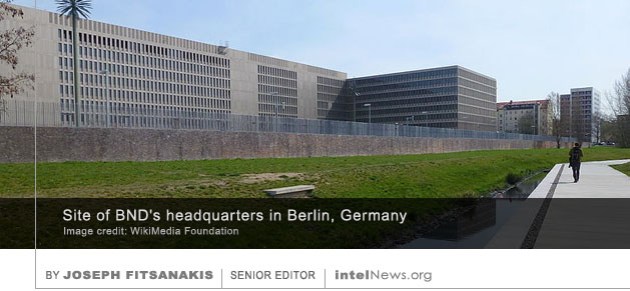 GERMANY’S EXTERNAL INTELLIGENCE AGENCY, the Federal Intelligence Service (BND), constitutes a liability for Europe’s security and is in desperate need of a drastic and immediate overhaul. That is the conclusion of a blunt
 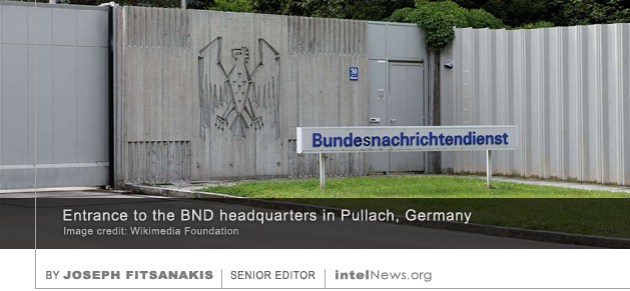 WESTERN INTELLIGENCE AGENCIES HAVE been alarmed by the arrest of a senior German intelligence official, who has been charged with spying for Russia, according to an expert in German intelligence. On December 22, the German government
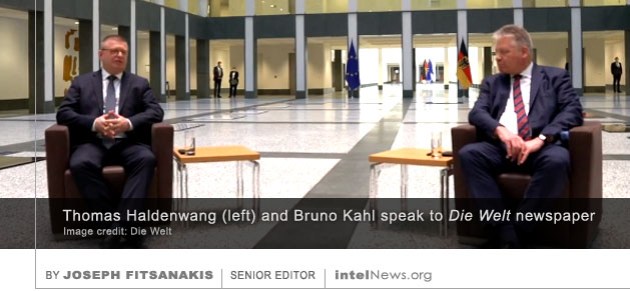

 Germany’s Federal Court of Justice has ruled that the country’s intelligence agencies are not entitled to spy en masse on the telecommunications exchanges of foreign citizens. The ruling comes in response to a lawsuit filed by several journalist groups, including the German chapter of Reporters Without Borders. The groups partnered with the German-based Society for Civil Rights and argued in their lawsuit that existing law did not prevent German spy agencies from spying at will on the communications of journalists. This could potentially allow the intelligence agencies to identify trusted sources that journalists use in their work, and even share that information with intelligence agencies of other countries, they argued.
 Switzerland’s Federal Department of Finance has filed a criminal complaint “against persons unknown” over media reports that a leading Swiss-based cryptological equipment manufacturer was secretly owned by the United States Central Intelligence Agency (CIA).
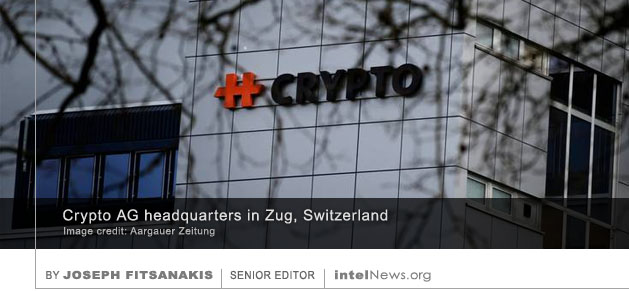 Switzerland is reeling from the shock caused by revelations last week that Crypto AG, the world’s leading manufacturer or cryptologic equipment during the Cold War, whose clients included over 120 governments around the world, was a front company owned by the United States Central Intelligence Agency.
 Israeli intelligence was likely behind the leaked video that brought down the far-right governing coalition in Austria on Monday, according to the former deputy director of Germany’s spy agency. The surreptitiously recorded video was






 intelNews.org
German intelligence agencies discuss ongoing espionage and hybrid challenges
May 6, 2024 by intelNews 1 Comment
The event (see agenda in .pdf) was organized by the Federal Ministry of the Interior and the Federal Chancellery Office. This year’s topic was: “Intelligence Agencies and Armed Conflicts”. It included the tried and tested mix of academics —predominantly legal scholars—, practitioners and heads of various government authorities. The majority of the external experts discussed the complicated and, in Germany, arduous parliamentary procedures that would arise in the event of a war.
In view of the controls increasingly being placed on German intelligence agencies by various bodies and authorities —which were also represented at the symposium— a certain discrepancy became apparent repeatedly in the presentations: How can the German intelligence agencies react adequately and quickly to hybrid threats when these types of threat do not concern themselves with administrative-legal subtleties and parliamentary procedures? Although the concept of hybrid threats was generally taken for granted and therefore hardly discussed in terms of content, those present agreed at a minimum that disinformation is part of it. All the more worrying was the statement by one speaker who explained that there was no official definition of disinformation within the German security authorities’ legal codes.
In the discussion, the panel moderated by Center for Intelligence Service Training and Further Education (ZNAF), the common training and study location of the Federal Intelligence Service (BND) and the Federal Office for the Protection of the Constitution (BfV), clearly stood out and underscored that this relatively new institution has made a name for itself in the academic intelligence landscape since its establishment in 2019.
However, the symposium also showed that the German security bureaucracy tends to reach its limits when it comes to current developments in the unconventional domain. This was demonstrated, for example, by a speaker’s demand that hybrid risks ought to be assigned to a “state area of responsibility”. The problem, however, lies precisely in the statelessness of hybrid risks. The existing regulations are also proving to be counterproductive, in view of the challenges: there would simply be highly heterogeneous participants in the so-called Cyber Defense Centre, which would also include police authorities. However, due to the strict separation in the legal domain, personal data cannot simply be passed on from the BND to the Federal Police, for example. Read more of this post
Filed under Expert news and commentary on intelligence, espionage, spies and spying Tagged with BND, conferences, Federal Office for the Protection of the Constitution (Germany), Germany, News