America’s most senior intelligence official has his phone, email hacked
January 14, 2016 8 Comments
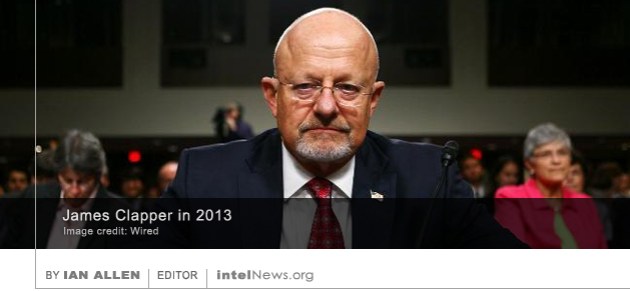 A member of a hacker group that took responsibility for breaking into the personal email account of the director of the Central Intelligence Agency last year has now hacked the email of the most senior intelligence official in the United States. In October 2015, the hacker group referred to by its members as “Crackas With Attitude” —CWA for short— claimed it was behind the hacking of an AOL personal email account belonging to John Brennan, who heads the CIA. Less than a month later, the CWA assumed responsibility for breaking into an online portal used by US law enforcement to read arrest records and share sensitive information about crimes involving shootings. Shortly after the second CWA hack, the Federal Bureau of Investigation issued an alert to all government employees advising them to change their passwords and be cautious about suspicious emails and other phishing attempts.
On Monday, an alleged member of CWA contacted Motherboard, an online media outlet belonging to Vice Media, and alleged that the group had managed to hack into the personal email account of James Clapper, Director of National Intelligence (DNI). Clapper’s job is to help synchronize the operations of US intelligence agencies and to mediate between the US Intelligence Community and the Executive. According to CWA, clapper’s personal telephone and Internet service had also been compromised, as had his spouse’s personal email, which is hosted by Yahoo! services. The alleged CWA member told Motherboard that the forwarding settings of Clapper’s home telephone had been changed. As a result, calls made to the DNI were being forwarded to the headquarters of the Free Palestine Movement in California. Shortly afterwards, Free Palestine Movement executives confirmed that they had received a number of phone calls for Clapper. Last year, when they hacked the email of the director of the CIA, the CWA dedicated their action to the Free Palestine Movement.
Motherboard said that a spokesman at the Office of the DNI, Brian Hale, confirmed that Clapper’s personal email and telephone service had indeed been hacked. He told Motherboard’s Lorenzo Franceschi-Bicchierai that Office of the DNI was “aware of the matter” and had “reported it to the appropriate authorities”. The FBI was contacted as well but did not respond.
► Author: Ian Allen | Date: 14 January 2016 | Permalink
 A security firm with headquarters in Israel and the United States says it detected and neutralized an extensive cyber espionage program with direct ties to the government of Iran. The firm, called Check Point Software, which has offices in Tel Aviv and California, says it dubbed the cyber espionage program ROCKET KITTEN. In a
 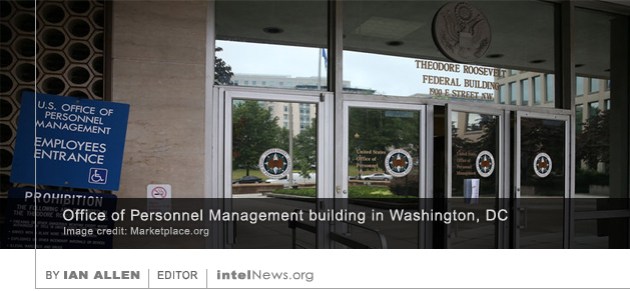 A United States Congressional review into last month’s cyber theft of millions of government personnel records has concluded that its impact will go far “beyond mere theft of classified information”. Up to 21 million individual files were
 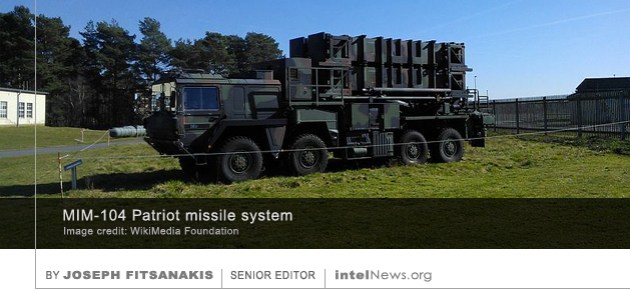 A Patriot missile system stationed in Turkey by the North Atlantic Treaty Organization (NATO) was allegedly hacked by a remote source, according to reports. German magazine Behörden Spiegel
  United States intelligence officials expressed concerns about a federal database containing details of security-clearance applications in the years prior to a massive cyber hacking incident that led to the theft of millions of personnel records. Up to
 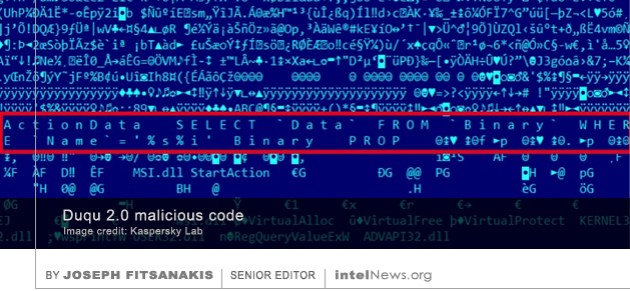 The Israeli government rejected reports yesterday that its spy agencies were behind a virus found on the computers of three European hotels, which hosted American and other diplomats during secret negotiations on Iran’s nuclear program. Cybersecurity firm Kaspersky Lab said on Wednesday that it first discovered the malware, which it dubbed “Duqu 2.0”, in its own systems. The Moscow-based firm said the sophisticated and highly aggressive virus had been designed to spy on its internal research-related processes. Once they detected the malicious software in their own systems, Kaspersky technicians set out to map Duqu’s other targets. They











 intelNews.org
German nuclear power plant found to be infected with computer viruses
April 29, 2016 by Joseph Fitsanakis 1 Comment
On Tuesday, a RWE AG spokesperson said cybersecurity experts had discovered a number of computer viruses in a part of the operating system that determines the position of nuclear rods in the power plant. The software on the system was installed in 2008 and has been designed specifically for this task, said the company. The viruses found on it include two programs known as “Conficker” and “W32.Ramnit”. Both are responsible for infecting millions of computers around the world, which run on the Microsoft Windows operating system. The malware seem to be specifically designed to target Microsoft Windows and tend to infect computer systems through the use of memory sticks. Once they infect a computer, they siphon stored files and give attackers remote access to the system when the latter is connected to the Internet. According to RWE AG, viruses were also found on nearly 20 removable data drives, including memory sticks, which were in use by employees at the power plant. However, these data drives were allegedly not connected to the plant’s main operating system.
RWE AG spokespersons insisted this week that “Conficker”, “W32.Ramnit”, and other such malware, did not pose a threat to the nuclear power plant’s computer systems, because the facility is not connected to the Internet. Consequently, it would be impossible for an attacker associated with the viruses to acquire remote access to Gundremmingen’s computer systems. The company did not clarify whether it believed that the viruses had specifically targeted at the power plant. But they insisted that cyber security measures had been strengthened following the discovery of the malware, and said that they had notified Germany’s Federal Office for Information Security (BSI), which is now looking into the incident.
► Author: Ian Allen | Date: 29 April 2016 | Permalink
Filed under Expert news and commentary on intelligence, espionage, spies and spying Tagged with computer hacking, cybersecurity, Germany, Gundremmingen nuclear power plant, News, RWE AG