News you may have missed #894: Economic warfare edition
January 26, 2018 2 Comments
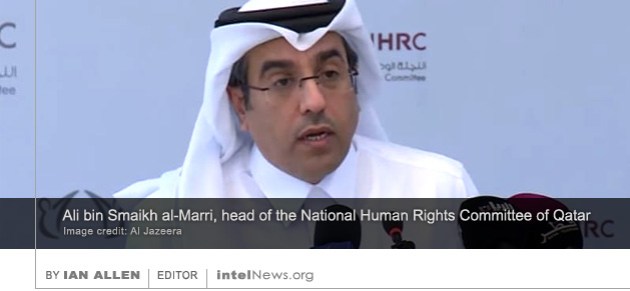 ►►This website has covered extensively the ongoing diplomatic war between Qatar, widely seen as an Iranian ally, and a coalition of Arab countries led by Saudi Arabia. In July of last year, the Saudi-led coalition —namely the United Arab Emirates, Egypt and Bahrain— broke relations with Qatar and imposed a commercial embargo on the small oil kingdom, which they accuse of supporting Iran and Iranian-backed militant groups in the region. On January 8, the National Human Rights Committee of Qatar accused Saudi Arabia and its allies of carrying out a “unilateral, abusive, arbitrary” and illegal economic blockade. The head of the committee, Ali bin Smaikh al-Marri, said that the Saudi-led blockade amounted to “economic warfare”. Does he have a point? Does economic warfare constitute a tangible part of the arsenal of modern nations, or is it a fantastical concept with little relation to reality?
►►Giuseppe Gagliano, director of the Centro Studi Strategici Carlo De Cristoforis in Italy, argues that economic warfare has been practiced for centuries. While examining the concept of economic intelligence in contemporary French strategic thinking, Professor Gagliano, explains that the concept of economic warfare has deep historical roots. He argues that, in its contemporary form, economic warfare originates in the period immediately after the end of World War II. Traditionally, it has defensive and offensive applications: Nations strive to limit outsourcing in order to preserve their industrial resources; at the same time, they seek to conquer international markets and, when able, resources. Although outsourcing has played a major role in economic warfare, the financial crisis of 2008 significantly upped the stakes and renewed the central role of the state in economic warfare theory and practice, argues Gagliano.
►►It should perhaps be noted that economic warfare does not operate simply an appendage to traditional warfare. In fact, it often takes place in the absence of traditional warfare, or indeed between wars. David Katz, senior analyst at the United States Special Operations Command and a career Foreign Service Officer, argues that economic warfare can, if used substantially and effectively, deter proxy warfare. In an article [pdf] published last year in Parameters, the quarterly journal of the United States Army War College, Katz suggests that the principles of economic warfare could be used “independently and within campaigns” by state actors. He also argues that the US should not hesitate to employ economic warfare to preempt the non-traditional warfare capabilities of its adversaries.
► Author: Ian Allen | Date: 26 January 2018 | Permalink
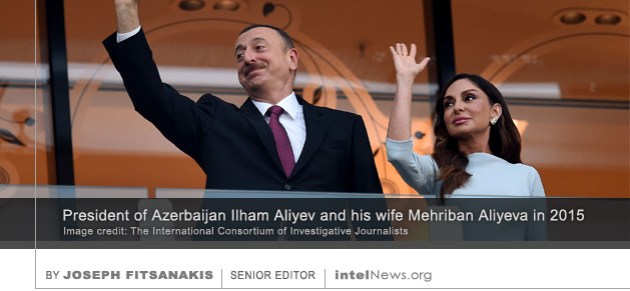 An investigation by a consortium of European newspapers has uncovered details of a massive slush fund worth nearly $3 billion, which was allegedly used by Azerbaijan’s governing elite to bribe officials, business leaders and journalists at home and abroad. The fund was operated out of Baku, the capital of the former Soviet state, which is routinely accused of human-rights abuses. Western countries, including the United States,
  Germany has launched an unprecedented investigation into three officers of Switzerland’s intelligence agency on suspicion that they spied on German tax investigators who were probing the activities of Swiss banks. News of the investigation comes three months after authorities in Germany
  American intelligence services have made use of a little-known confidentiality exception to spy on the financial activities of foreign banks who have accounts with the United States Federal Reserve, according to Reuters. Established in 1913, the Federal Reserve System is the central banking structure of the US. It oversees and regulates the nation’s financial institutions, and is tasked with —among other things— maintaining the stability of the American financial system. Additionally, however, the Federal Reserve offers a host of financial services to official (government-owned or sanctioned) foreign institutions. Thus, over 250 foreign banks (typically central banks) from dozens of countries have deposited nearly $3.3 trillion in assets at the Federal Reserve Bank of New York, one of 12 Federal Reserve Banks in the US. Depositing assets at a US Federal Reserve Bank, allows these foreign ‘depository institutions’ to use the US Federal Reserve as a ‘custodial institution’. Through it, they get direct and immediate access to American debt markets, where they can trade directly in dollars — the reserve currency of the global economy.
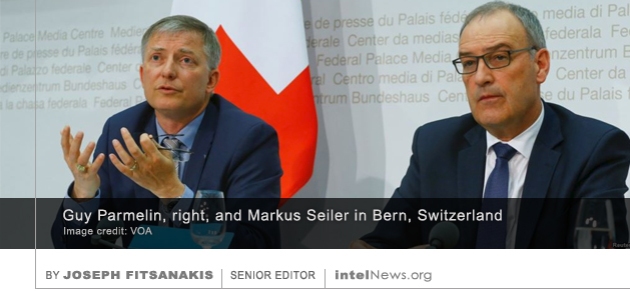 Senior Swiss government officials, including the defense minister and the director of the country’s intelligence agency, have defended Switzerland’s right to spy on European tax-fraud investigators who meddle in Swiss affairs. Earlier this week, German authorities
  Authorities in Germany have announced the arrest of a Swiss national who was allegedly spying on the activities of German tax-fraud investigators in Frankfurt. According to prosecutors in the German state of Hesse, of which Frankfurt is the largest city, the Swiss man was arrested on Friday and is currently in custody. He has been identified only as Daniel M., and is believed to be in his mid-50s. According to news reports, German counterintelligence officers had been monitoring the suspect for over a year. They were issued a warrant for his arrest in December of last year, but waited until he was on German soil to arrest him. He was arrested at Frankfurt Airport.
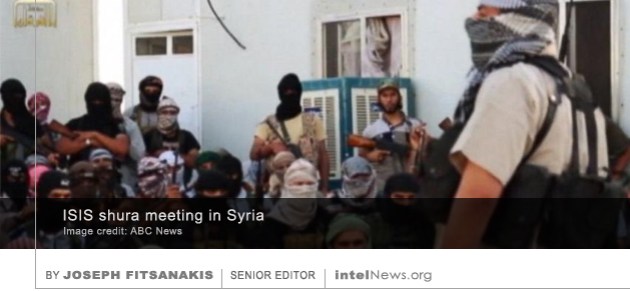 The Islamic State is facing imminent financial collapse, according to a new study conducted by a London-based research group in association with one of the world’s leading international accounting firms. The recently launched report is entitled
 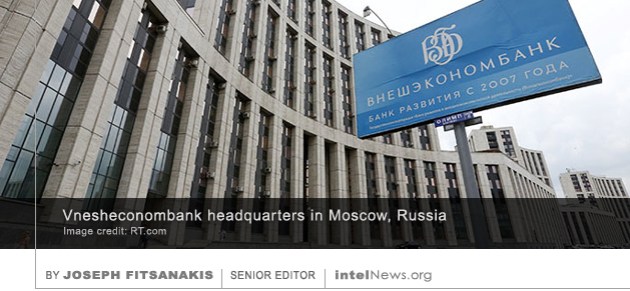 A Russian intelligence officer, who posed as a banker in the United States, has been handed a prison sentence by a court in New York. Evgeny Buryakov, 41, posed as an employee of the New York branch of Vnesheconombank, a Russian state-owned bank headquartered in Moscow. However, in January 2015, the Federal Bureau of Investigation
 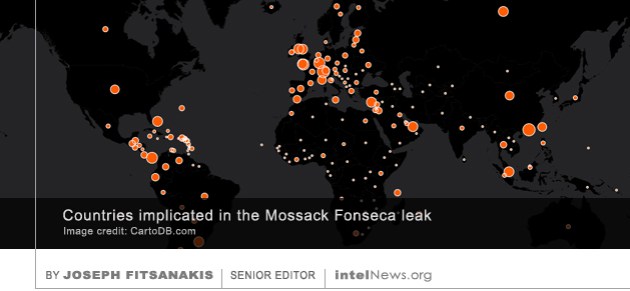 Aside from their immediate shock value, the Panama Papers reveal the enormous extent of tax evasion on a worldwide scale. This unprecedented phenomenon is inextricably tied with broader trends in globalized finance-capitalism that directly threaten the very survival of the postwar welfare state. National intelligence agencies must begin to view offshore tax evasion as an existential threat to the security of organized government and need to augment their economic role as part of their overall mission to protect and secure law-abiding citizens.
 countries. On Sunday, following a year-long analysis of the data, the reporting partners began publishing revelations from the Panama Papers, and say they will continue to do so for several days to come.
 statements, which means they have not been paying taxes in their country of citizenship or residency. Thus, there are now thousands of Mossack Fonseca clients in
  An American former supreme allied commander of the North Atlantic Treaty Organization has warned that a possible Greek exit from the Eurozone “could become a geopolitical nightmare” for the European Union and NATO. James Stavridis, a retired four-start US Navy admiral, who served as NATO’s 16th Supreme Allied Commander Europe from 2009 to 2013, said solving the Greek crisis should not be left to the central bankers. In an article
 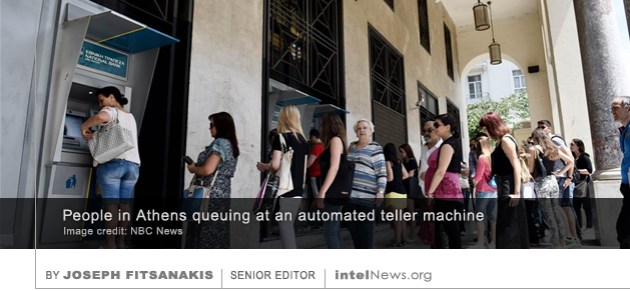 Several Western countries issued travel warnings for Greece on Sunday, as the Greek government shut down all banks and imposed capital controls following the breakdown of talks between Athens and the European Union.







 intelNews.org
Germany drops espionage case against senior Swiss intelligence official
September 4, 2018 by Joseph Fitsanakis Leave a comment
The German government believes that billions of euros have been deposited by its citizens in banking institutions in European tax-havens like Liechtenstein, Switzerland or Monaco. For the past decade, German authorities have resorted to bribing whistleblowers in offshore banks in order to acquire internal documents that reveal the identities of German citizens who are hiding their money in foreign bank accounts. It is estimated that over a hundred million dollars have been paid to whistleblowers by German authorities since 2006. The latter argue that the proceeds collected from unpaid taxes and fines more than justify the payments made out to whistleblowers. But the Swiss government has strongly criticized Berlin for encouraging Swiss banking sector employees to steal internal corporate information that often breaks Switzerland’s stringent privacy laws. It is believed that the NDB has been instructed by the Swiss government to monitor efforts by German tax-fraud investigators to approach potential whistleblowers working in the Swiss banking sector.
The man identified as “Daniel M.” appears to be one of several Swiss spies who have been collecting information on the activities of German tax investigators. For a while it appeared that German counterintelligence officials were intent on targeting Paul Zinniker (pictured), Deputy Director of the NDB. They claimed that Zinniker was the main support officer of the operation that “Daniel M.” was participating in when he was arrested in Germany in 2017. According to the Germans, it was Zinniker’s who conceived the operation in 2011. But on Monday a spokesman for Germany’s federal prosecutor told the Swiss News Agency that Berlin dropped the case against Zinniker back in June. The revelation came less than 48 hours after a report in the Sunday edition of the Swiss newspaper Neue Zürcher Zeitung claimed that the charges against Zinniker would be dropped. According to the German federal prosecutor’s office, the case against the Swiss spy official was dropped because of the lack of cooperation by Swiss authorities, which made it impossible to prove that Zinniker was indeed the mastermind of the espionage operation against Berlin.
► Author: Joseph Fitsanakis | Date: 04 September 2018 | Permalink
Filed under Expert news and commentary on intelligence, espionage, spies and spying Tagged with Daniel M., economic intelligence, economics, espionage, Germany, NDB (Switzerland), News, Newstex, Paul Zinniker, Switzerland, tax evasion