CIA to return to traditional espionage against state actors, says new director

Gina HaspelThe United States Central Intelligence Agency will return to traditional espionage against foreign states and focus less on counterterrorism against non-state actors, said its new director in her first public appearance. Gina Haspel joined the CIA in 1985 as a reports officer and completed several undercover tours overseas before serving as chief of station. She rose through the ranks to become deputy director of the National Clandestine Service and was appointed deputy director of the CIA in 2017. In May of this year, she became the Agency’s first female director, despite some controversy that arose from her role as chief of a CIA undercover facility (so-called “black site”) in Thailand. Critics alleged that Agency personnel under her command practiced enhanced interrogation, including waterboarding, on terrorism detainees.

On Monday, Haspel gave a talk at the University of Louisville, from where she graduated in 1978 with a degree in languages and journalism, having transferred there from the University of Kentucky. It was her first public appearance after being sworn in as CIA director. She told the audience that she intends to steer the Agency back to traditional intelligence collection against “current and potential […] nation-state adversaries” and away from counterterrorism operations against non-state actors. The latter took center stage after the events of September 11, 2001. Filling current “intelligence gaps” on countries like Russia and China will be “a strategic priority” for the CIA, said Haspel, adding that the Agency will seek to “sharpen its focus on nation-state adversaries”. She spoke at length about China, stating that Beijing was “working to diminish US influence” and expand its own authority “beyond their own region, in places like Africa, Latin America, the Pacific islands [and] South Asia”.

The CIA’s hiring priorities will reflect the Agency’s strategic shift, said Haspel. The Agency will seek to expand its foreign footprint by “increasing the number of [its] officers stationed overseas”. Priority for these assignments will be given to foreign-language speakers with skills in Chinese, Arabic and Farsi, among other target languages. Interestingly, the CIA director added Turkish, French and Spanish to the list. She also said that the Agency will “invest more heavily on […] counternarcotics efforts abroad”. Last but not least, Haspel spoke about the need for increased transparency, diversity and inclusion at the CIA, which last year marked its 70th anniversary.

Author: Joseph Fitsanakis | Date: 26 September 2018 | Permalink

Germany drops espionage case against senior Swiss intelligence official

Paul ZinnikerGermany has dropped a criminal case against the second-in-command of Switzerland’s intelligence agency, who was accused by Berlin of authorizing an espionage operation against the German tax collection service. A year ago, Germany launched an unprecedented investigation into three senior officials of Switzerland’s intelligence agency, the Federal Intelligence Service (NDB). The probe was launched on suspicion that the Swiss officials masterminded a spy operation against German tax investigators who were probing the activities of Swiss banks. The German probe was launched three months after authorities in Germany arrested a Swiss intelligence officer, identified only as “Daniel M.”, for engaging in espionage on German soil.

The German government believes that billions of euros have been deposited by its citizens in banking institutions in European tax-havens like Liechtenstein, Switzerland or Monaco. For the past decade, German authorities have resorted to bribing whistleblowers in offshore banks in order to acquire internal documents that reveal the identities of German citizens who are hiding their money in foreign bank accounts. It is estimated that over a hundred million dollars have been paid to whistleblowers by German authorities since 2006. The latter argue that the proceeds collected from unpaid taxes and fines more than justify the payments made out to whistleblowers. But the Swiss government has strongly criticized Berlin for encouraging Swiss banking sector employees to steal internal corporate information that often breaks Switzerland’s stringent privacy laws. It is believed that the NDB has been instructed by the Swiss government to monitor efforts by German tax-fraud investigators to approach potential whistleblowers working in the Swiss banking sector.

The man identified as “Daniel M.” appears to be one of several Swiss spies who have been collecting information on the activities of German tax investigators. For a while it appeared that German counterintelligence officials were intent on targeting Paul Zinniker (pictured), Deputy Director of the NDB. They claimed that Zinniker was the main support officer of the operation that “Daniel M.” was participating in when he was arrested in Germany in 2017. According to the Germans, it was Zinniker’s who conceived the operation in 2011. But on Monday a spokesman for Germany’s federal prosecutor told the Swiss News Agency that Berlin dropped the case against Zinniker back in June. The revelation came less than 48 hours after a report in the Sunday edition of the Swiss newspaper Neue Zürcher Zeitung claimed that the charges against Zinniker would be dropped. According to the German federal prosecutor’s office, the case against the Swiss spy official was dropped because of the lack of cooperation by Swiss authorities, which made it impossible to prove that Zinniker was indeed the mastermind of the espionage operation against Berlin.

Author: Joseph Fitsanakis | Date: 04 September 2018 | Permalink
CIA informants inside Russia are going silent, say US sources

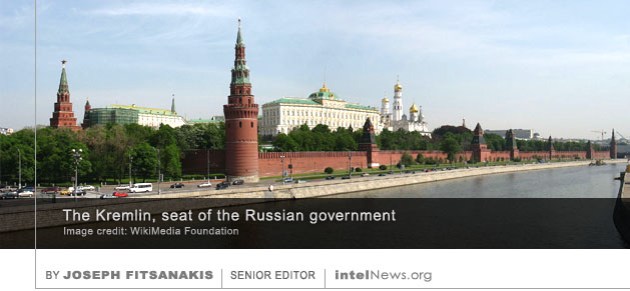
Kremlin, RussiaSecret informants inside the Russian government, which the United States has relied on in recent years for tips about Moscow’s strategy and tactics, have gone silent in recent months, according to sources. Over many years, US intelligence agencies have built networks of Russian informants. These consist of officials placed in senior positions inside the Kremlin and other Russian government institutions, who can help shed light on Russia’s political maneuvers. These informants were crucial in enabling the US Intelligence Community to issue warnings of possible Russian meddling in the American presidential elections of November 2016. Since then, US spy agencies have largely relied on these informants to produce detailed assessments of Russian intelligence activities targeting the US, and propose measures against those involved.
But on Friday, The New York Times said in an article that these vital sources of information in Moscow have been going silent in recent months. Citing “current and former officials”, the paper said that US officials did not believe that the informants have been captured or killed. Instead, they have voluntarily “gone underground” because of “more aggressive counterintelligence” practiced by Russian security agencies. Moscow has stepped up attempts to detect spies operating inside Russia since the Sergei Skripal incident, when relations between it and most Western countries sank to their lowest point since the Cold War. In turn, Western informants operating in Russia have “decided it is too dangerous to pass information” and have gone “silent for their own protection”, said The Times.

This situation, however, has left the Central Intelligence Agency and other US spy agencies “in the dark” about the intentions of Russian President Vladimir Putin, just as America is nearing its mid-term elections. The lack of information has been exacerbated by the expulsion of dozens of American diplomats from Russia in March of this year. Moscow announced the expulsions in response to Washington’s decision to expel 60 Russian diplomats in protest against the attempt —allegedly by Russia— to kill Sergei Skripal in England. Many of the diplomats who were expelled from Russia were in fact intelligence officers operating under diplomatic cover. Few of those are now left on Russian soil and, according to The Times, “are under incredible surveillance” by Russian counterintelligence agencies. Washington is still collecting information from Russia through other channels, including communication intercepts, which, according to The Times, “remain strong”. But the paper cited anonymous American officials who “acknowledged the degradation in the [overall flow of] information collected from Russia.

Author: Joseph Fitsanakis | Date: 27 August 2018 | Permalink

US announces arrest of two men charged with spying for Iran

Mujahedin-e KhalqAuthorities in the United States have announced the arrests of two men who have been charged with spying on American soil on behalf of the Islamic Republic of Iran. The men were reportedly arrested on August 9, but information about them was only released on Monday by the US Department of Justice. In a press statement published online, John Demers, US Assistant Attorney General for National Security, said the men were arrested because of concerns that they “acted on behalf of Iran”. They were identified as Ahmadreza Mohammadi Doostdar, 38, and Majid Ghorbani, 59. Doostdar is reportedly a dual citizen of the US and Iran, while Ghorbani is an Iranian citizen who lives in the US state of California. The two men are not believed to be diplomats.
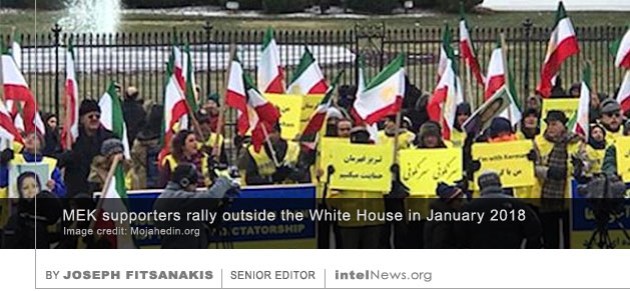
According to the US government, the men were observed “conducting surveillance of political opponents and engaging in other activities that could put Americans at risk”. The press statement alleges that Doostdar carried out surveillance of a Jewish center in Chicago, while Ghorbani attended meetings and rallies organized by Iranian opposition groups operating in the US. The press release identifies one such group as the Mujahideen-e Khalq (MEK), a militant faction that has roots in radical Islam and Marxism. Between 1970 and 1976, the group assassinated six American officials in Iran and in 1970 tried to kill the United States ambassador to the country. It initially supported the Islamic Revolution of 1979, but later withdrew its support, accusing the government of Ayatollah Khomeini of “fascism”. It continued its operations in exile, mainly from Iraq, where its armed members were trained by the Palestine Liberation Organization and other Arab leftist groups. Until 2009, the European Union and the US officially considered the MEK a terrorist organization. But the group’s sworn hatred against the government in Iran brought it close to Washington after the 2003 US invasion of Iraq. By 2006, the US military was openly collaborating with MEK forces in Iraq, and in 2012 the group was dropped from the US Department of State’s list of foreign terrorist organizations. Today the group enjoys open protection from the EU and the US.

On June 30 of this year, authorities in Belgium arrested a married Belgian couple of Iranian descent, who were found to be carrying explosives and a detonator. On the following day, July 1, German police arrested an Iranian diplomat stationed in Iran’s embassy in Vienna, Austria, while a fourth person was arrested by authorities in France, reportedly in connection with the three other arrests. All four individuals were charged with having planned a foiled plot to bomb the annual conference of the MEK-affiliated National Council of Resistance of Iran (NCRI) that took place on June 30 in Paris, France. It is not known whether the arrests in Europe are in any way connected with the cases of the two men held in the US.

Brussels will ‘not comment’ on reports Britain is spying on EU Brexit committee

Sabine WeyandRelations between the European Union and the United Kingdom hit a new low on Thursday, as the European Council refused to comment on claims that British spy agencies have spied on Brexit negotiators in Brussels. Consultations between the two sides have progressed at an alarmingly slow pace ever since June 23, 2016, when voters in the island nation elected to leave the EU during a nationwide referendum. In March of 2017, London officially invoked Article 50 of the EU Treaty, which requires that Britain’s withdrawal from the multinational body be completed within two calendar years. But there are many who think that a mutual agreement will not be reached between the two sides.
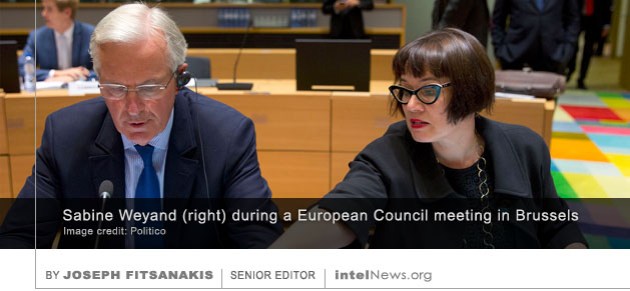
On Wednesday, British newspaper The Daily Telegraph alleged that a number of EU Brexit negotiators believe that their closed-door meetings are being spied upon by the British Secret Intelligence Service, known as MI6. According to The Telegraph, fears of espionage were raised by Sabine Weyand, a German EU official who is currently serving as Deputy Chief of the European Council’s Article 50 Working Party. On July 13, during a meeting of the European Council, Weyand reportedly said “it could not be excluded” that British intelligence agencies had found ways to listen in to the closed-door meetings of EU Brexit negotiators. According to The Telegraph, Weyand and other EU officials became suspicious after London appeared to be privy to information discussed on July 5 at a closed-door meeting of the Article 50 Working Party. Weyand told the European Council that the information had reached London “within hours” of it having been presented in Brussels. Just hours following the secret presentation, senior British government officials were reportedly lobbying in public against the information contained in it.

On Thursday, a spokesman for the European Commission, which operates as the EU’s cabinet, did not deny that concerns about espionage were raised by EU Brexit negotiators. When asked by reporters in Brussels about The Telegraph’s allegations, the spokesperson responded: “The Commission’s position today is that we cannot comment on these press reports”. As the press conference was taking place, British negotiators were arriving in Brussels in order to resume the latest round of Brexit talks with the EU’s Article 50 Working Party.

Author: Joseph Fitsanakis | Date: 17 August 2018 | Permalink

Germany arrests Jordanian intelligence operative who spied on mosque

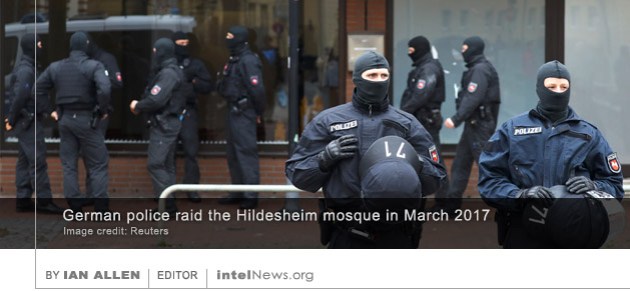
Hildesheim mosqueAuthorities in Germany announced yesterday the arrest of a German national who is accused of spying on a central German mosque on behalf of Jordan, according to media reports. The man was reportedly arrested on Tuesday at an unknown location by officers of Germany’s domestic intelligence agency, the Federal Office for the Protection of the Constitution (BfV). In a press statement, the agency said the man is a 33-year-old German national named “Alexander B.”. German privacy rules forbid the public identification of crime suspects prior to their conviction in a court of law.
According to the public statement issued by the BfV, the 33-year-old man is believed to have worked for “a Jordanian intelligence agency” —most likely the Jordanian General Intelligence Department, or GID, which is a branch of the Jordanian Armed Forces— since at least 2016. He is accused of having infiltrated a Sunni mosque in the central German city of Hildesheim, located 20 miles southeast of Hanover in Germany’s Lower Saxony region. His mission, according to the BfV, was to keep tabs on mosque goers who expressed support for the ideology of the Islamic State, and might even consider traveling to the Middle East to join the radical group. The alleged Jordanian intelligence operative was also tasked with reporting on news reaching the mosque from those of its members who had already gone to the Middle East and joined the Islamic State.

Last year, German authorities closed down the Hildesheim mosque, known in German as Deutschsprachiger Islamkreis Hildesheim e. V. (DIK), and arrested its imam, Ahmad Abdulaziz Abdullah A., known as Abu Walaa. The Iraqi-born imam was charged with supporting a foreign terrorist organization by actively recruiting young Muslims on behalf of the Islamic State. The mosque has since remained closed, because authorities believe that it had become a beehive of fundamentalist activity. Jordan is one of the Middle East’s most liberal states and has been targeted repeatedly by the Islamic State, which views its leadership as pro-Western. However, it appears that Alexander B. was spying on the Hildesheim mosque —therefore on German soil— without having informed the host country of his activities. The government of Jordan has not commented on his arrest.

Author: Ian Allen | Date: 09 August 2018 | Permalink

US fired Moscow embassy employee who may have spied for Russia

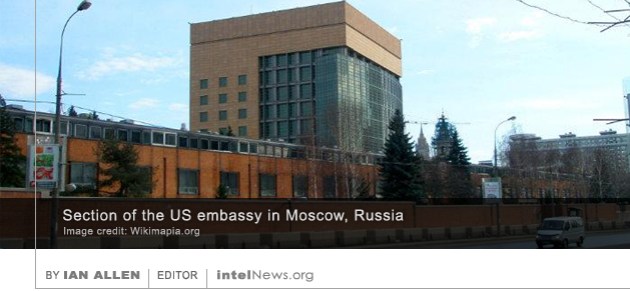
US embassy in RussiaA female Russian national who worked for the United States Secret Service in Moscow was quietly dismissed in 2017, amidst concerns that she was spying for Russia. British newspaper The Guardian, which broke the story last week, did not name the Russian woman. But it said that she had worked at the US Embassy in Moscow “for more than a decade”, most recently for the Secret Service –a federal law enforcement agency that operates within the Department of Homeland Security. The Secret Service has several missions, the most important of which is to ensure the physical safety of America’s senior political leadership.

Throughout her Secret Service career, the Russian woman is thought to have had access to the agency’s email system and intranet network, said The Guardian, citing “an intelligence source”. She could also potentially have had access to “highly confidential material”, said the paper, including the daily schedules of America’s past and current presidents and vice presidents, as well as their family members’ schedules.

The unnamed Russian national first came under suspicion in 2016, said The Guardian, during a routine security review conducted by two counterintelligence staff members at one of the Department of State’s Regional Security Offices (RSO). These reviews usually take place every five years and scan the background and activities of employees at American embassies abroad. The review showed that the unnamed Russian national was holding regular meetings with officers of the Federal Security Service (FSB), Russia’s domestic intelligence service. In January of 2017, the Department of State reportedly shared its findings with the Secret Service. But the latter waited until several months later to fire the Russian woman, having decided to do so quietly, said The Guardian.

According to the paper, instead of launching a major investigation into the State Department’s findings, the Secret Service simply dismissed the woman by revoking her security clearance. The paper said that the Russian national’s dismissal took place shortly before the US embassy in Moscow was forced to remove or fire over 750 employees as part of Russia’s retaliation against economic sanctions imposed on it by Washington. That coincidence helped the Secret Service “contain any potential embarrassment” arising from claims of espionage, said The Guardian. The paper contacted the Secret Service and was told that “all Foreign Service nationals” working for the agency “are managed accordingly to ensure that […US] government interests are protected at all times”. Their duties, therefore, are “limited to translation, interpretation, cultural guidance, liaison and administrative support. This is of particular emphasis in Russia”, said a Secret Service spokesman, who refused to discuss specific cases.

Author: Joseph Fitsanakis | Date: 07 August 2018 | Research credit: S.F. | Permalink

Revealed: British prime minister was not told about fourth Cambridge spy ring member

Anthony BluntThe Prime Minister of Britain, Sir Alec Douglas-Home, was kept in the dark by his own home secretary about the discovery of a fourth member of the infamous Cambridge Spy Ring in 1964, according to newly released files. The Cambridge Spies were a group of British diplomats and intelligence officials who worked secretly for the Soviet Union from their student days in the 1930s until the 1960s. They included Guy Burgess, Donald Maclean and H.A.R. “Kim” Philby, all of whom eventually defected to the Soviet Union. In 1964, Sir Anthony Blunt, an art history professor who in 1945 became Surveyor of the King’s Pictures and was knighted in 1954, admitted under interrogation by the British Security Service (MI5) that he had operated as the fourth member of the spy ring.
Despite his allegedly full confession, Blunt was never seriously disciplined for his espionage activities against Britain. In return for revealing his spy activities and naming others who had assisted him, he was granted immunity from prosecution. He was also allowed to remain in his academic post and retained his title of Surveyor of the Queen’s Pictures –effectively the curator of Queen Elizabeth II’s art collection. It wasn’t until 1979 when British Prime Minister Margaret Thatcher revealed in a statement to the British House of Commons that Blunt had been the fourth member of the Cambridge Spy Ring. Minutes after the prime minister’s statement entered the public record, Buckingham Palace (which had been made aware of Blunt’s espionage role back in 1964, but had been asked by Britain’s Interior Ministry to not draw attention to the scandal) stripped him of his 1954 knighthood.

It has now been revealed known that, in the days following her House of Commons statement about Blunt, Prime Minister Thatcher received several letters by Henry Brooke, who was serving as home secretary in 1964, when Blunt’s treachery was discovered. In his letters, Brooke (by then Lord Brooke of Cumnoor) expressed his support for the prime minister’s revelation. But the letters, which were previously classified but were published on Tuesday by Britain’s National Archives, also reveal that Brooke kept Blunt’s 1964 confession hidden from the then Prime Minister Sir Alec Douglas-Home. In his 1979 letter to Thatcher, Brooke states that he did not inform the prime minister in 1964 in his “well-meant effort not to add to [Douglas-Home’s] burdens”. But he adds that “I may, with hindsight, have expressed my discretion wrongly”. By that time, Blunt had voluntarily withdrawn from public life and was rarely heard of. Upon his death in 1984, his unfinished memoir was given to the British Library by the executor of his will, under the stipulation that it be kept sealed for 25 years. It was released to the public in 2009.

Author: Joseph Fitsanakis | Date: 24 July 2018 | Permalink

More spies now in Brussels than Vienna, Austrian intelligence chief says

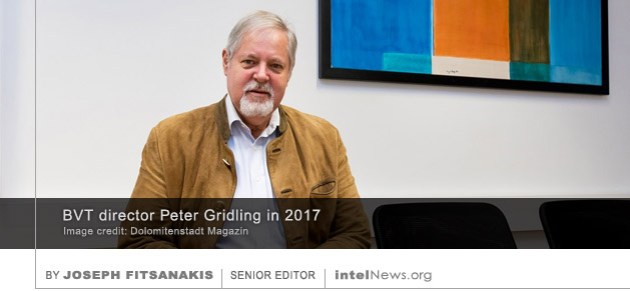
Peter GridlingThe head of Austria’s counterintelligence agency has said that Brussels has now replaced Vienna as Europe’s spy capital. For nearly a decade, this blog has published expert commentary that points to the Austrian capital being the world’s busiest spy den. In 2009, German broadsheet Die Welt explained that Vienna had “the highest density of [foreign intelligence] agents in the world”. The reasons for this are partly historic: during the Cold War, the center of Vienna was located less than an hour’s drive from the Iron Curtain, making it a central location for East-West spy intrigue. Additionally, Austria boasted then, and boasts today, an efficient transportation network that connects it to both Western and Eastern Europe.
Furthermore, Vienna hosts the headquarters of several important international agencies, including the Organization of Petroleum Exporting Countries (OPEC), the International Atomic Energy Agency (IAEA), and the Organization for Security and Co-Operation in Europe (OSCE). This gives dozens of countries the opportunity to station in Vienna large numbers of diplomats, in addition to those who staff their embassies there. Consequently, it is estimated that the Austrian capital today hosts nearly 20,000 foreign diplomats, which is a substantial number for such a small country with a permanent population of less than 9 million. Experts believe that around half of these foreign diplomats are in fact connected to a foreign intelligence agency.

But in a rare public appearance on Thursday, Peter Gridling, head of Austria’s main counterintelligence agency, said that Vienna no longer topped the list of preferred destinations for the world’s spies. Gridling heads the Vienna-based Federal Office for the Protection of the Constitution and Counterterrorism, known as BVT. He was speaking during the official presentation of the BVT’s annual Constitutional Protection Report for 2017, which was held at the headquarters of the Ministry of the Interior. Gridling told reporters that the number of foreign intelligence operatives pretending to be diplomats posted in the Austrian capital remained significant, and that Austria as a whole was still “a favored area of operations” by the world’s intelligence agencies. However, he added that Vienna had now been overtaken by the Belgian capital Brussels as the spy capital of Europe. Gridling said that, according to his agency’s calculations, there was now a greater density of spies in Brussels than in any other European capital.

Gridling thus appears to concur with numerous intelligence experts and practitioners, among them Alain Winants, former Director of Belgium’s State Security Service (SV/SE), who have claimed since 2009 that Brussels is home to more spies than any other city in the world. When asked to specify the number of foreign intelligence operatives that are active in Vienna, Gridling said it was “in the neighborhood of hundreds of people, but certainly fewer than 1,000”. The Austrian counterintelligence chief declined calls to provide further elaboration on the mater.

Author: Joseph Fitsanakis | Date: 29 June 2018 | Permalink

Ukraine, Russia, spied on Dutch investigators of MH17 plane disaster, TV report claims

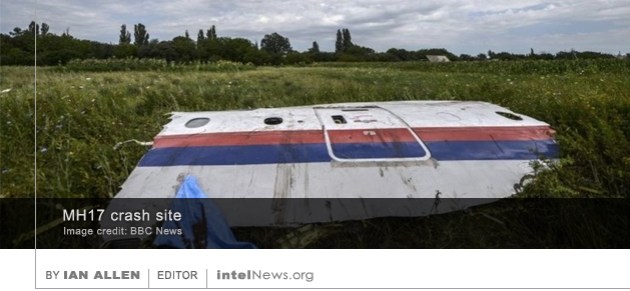
MH17 crashDozens of Dutch security officers, legal experts, diplomats and other civil servants were systematically spied on by Ukrainian and Russian intelligence services while probing the aftermath of the MH17 disaster, according to a report on Dutch television. Malaysia Airlines Flight 17, a scheduled passenger flight from Amsterdam to Kuala Lumpur, was shot down over eastern Ukraine on July 17, 2014. All 283 passengers and 15 crew on board, 196 of them Dutch citizens, were killed. In the aftermath of the disaster, the Dutch Safety Board spearheaded the establishment of the multinational Joint Investigation Team (JIT), which is still engaged in a criminal probe aimed at identifying, arresting and convicting the culprits behind the unprovoked attack on Flight MH17. As part of the JIT, dozens of Dutch officials traveled to Ukraine to initiate the investigation into the plane crash and repatriate victims’ bodies and belongings. Their activities were conducted with the support of the Ukrainian government, which is party to the JIT.
But on Tuesday, Holland’s RTL Niews broadcaster said that members of the Dutch JIT delegation were subjected to systematic and persistent spying by both Ukrainian and Russian government operatives. According to RTL, Dutch investigators found sophisticated eavesdropping devices in their hotel rooms in Ukraine, and believed that their electronic devices had been compromised. Citing “inside sources” from the Dutch government, the broadcaster said that, during their stay in Ukraine, members of the Dutch JIT delegation noticed that the microphones and cameras on their wireless electronic devices would turn on without being prompted. They also noticed that the devices would constantly try to connect to public WiFi networks without being prompted. Upon their return to Holland, Dutch officials had their wireless devices examined by Dutch government security experts. They were told that numerous malware were discovered on the devices.

RTL Niews said that the question of whether valuable information relating to the MH17 investigation was stolen by foreign spies remains unanswered. But it noted that the members of the Dutch JIT delegation were warned about possible espionage by foreign powers prior to traveling to Ukraine. During their stay there, they were not allowed to send messages in unencrypted format and were only permitted to hold sensitive conversations in especially designated rooms inside the Dutch embassy in Kiev. The Dutch government did not respond to questions submitted to it by RTL Niews. But it issued a statement saying that its security experts had briefed and trained the Dutch JIT delegation prior to its trip to Ukraine. Members of the delegation were told that foreign parties would seek to collect intelligence, because the MH17 investigation was taking place in a “conflict area with significant geopolitical interest” for many parties. They were therefore advised to “assume that they were being spied on [and] adjust [their] behavior accordingly” while in Ukraine, the Dutch government’s statement said.

Author: Ian Allen | Date: 28 June 2018 | Permalink

Singapore officials reject rumors of spy devices used at Trump-Kim summit

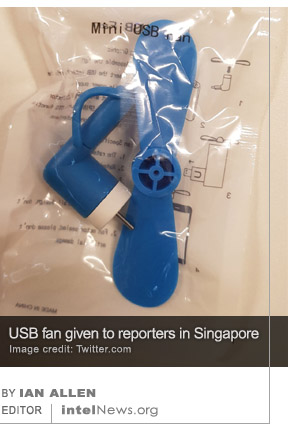
USB fan espionageSingaporean officials have dismissed reports that a promotional item given away for free during the June 12 summit between the leaders of the United States and North Korea contained an espionage device. Over 2500 reporters from nearly every country covered the meeting between US President Donald Trump and North Korean Supreme Leader Kim Jong-un. Upon arriving in Singapore’s Sentosa Island, where the summit took place, journalists were given a free promotional packet that included novelty items such as pens, notepads, a water bottle, and a USB fan. The USB fan consisted of blades connected to a miniature electric motor, which was in turn connected to a USB cable. The cable allowed the device to be powered by a computer or other electronic device with a built-in USB port.

But rumors soon emerged in the media that the free USB fans, which were made in China, contained malware. As soon as the fans were plugged into an electronic device, the malware penetrated its operating system, allowing hackers to access its contents remotely, said the reports. The allegations were first aired on Radio France Internationale, the French government’s international broadcaster. They were then picked up by the BBC, which said that many reporters covering the historic summit had been warned “not to plug [the USB fans] in to their laptops”. According to the reports, the malware installed on the USB fans was able to steal computer files and turn a laptop’s built-in camera and microphone into remotely-controlled eavesdropping devices.

But the government of Singapore has strongly rejected these reports. In a statement issued in English, Singapore’s Ministry of Communications and Information said that the USB fans had been a gift of the Sentosa Development Corporation, a Singapore government body tasked with promoting tourism in Sentosa Island, where the Trump-Kim summit took place. The ministry added that the USB fans had been produced long before Trump and Kim decided to meet in Singapore and that they had been originally manufactured as gifts for tourists visiting the island. The statement issued by the ministry also said that reporters appreciated the fans, given the tropical climate on Sentosa Island, where the temperature reached 33C (91F) on the day of the summit.

Author: Ian Allen | Date:  25 June 2018 | Permalink

Chinese shipbuilding boss gave CIA aircraft carrier secrets, reports claim

Liaoning aircraft carrier ChinaOne of China’s most senior shipbuilding executives, who has not been seen in public for nearly two weeks, has been charged with giving secrets about China’s aircraft carriers to the United States. Sun Bo, 57, is general manager of the China Shipbuilding Industry Corporation (CSIC), China’s largest state-owned maritime manufacturer, which leads nearly every major shipbuilding project of the Chinese navy. Most notably, Sun headed the decade-long retrofitting of the Liaoning, a Soviet-built aircraft carrier that was commissioned to the Chinese Navy’s Surface Force after the collapse of the Soviet Union.
The ship arrived at the CSIC’s Dalian shipyard in northeastern China in 2002. Work on the vessel was completed in 2012. Today CSIC heads the construction of so-called Type 001A, China’s first home-built aircraft carrier, which is said to be modeled largely on the Liaoning. The company is also spearheading the construction of numerous Chinese Navy frigates, latest-generation destroyers, and numerous other vessels. Earlier this year, it was announced the CSIC would build the Chinese Navy’s first nuclear-powered aircraft carrier.

As the second most senior official of China’s largest and most important shipbuilder, Sun has supervised all of the company’s projects during the past two decades. But Sun effectively disappeared after June 11, when he made his last known public appearance at a CSIC event. On June 17, a brief notice posted on the company’s website stated that Sun had been placed under investigation for “gross violation of laws and [Communist] Party [of China] discipline”. The brief notice said that the probe of Sun’s activities was led by China’s National Supervision Commission and the Communist Party of China’s Central Commissariat for Discipline Inspection, but provided no further details.

It has now been reported by multiple Chinese news websites that Sun is under investigation not simply for graft, but for far more serious activities involving espionage. Specifically, it is claimed that Sun was recruited by the United States Central Intelligence Agency because of his supervisory role in China’s aircraft carrier building programs. He is believed to have provided the CIA with information about the decade-long retrofitting of the Liaoning. More importantly, there are reports that Sun gave the CIA blueprints and other technical specifications of the Type 001A, which is currently under construction at a top-secret facility. The Hong Kong-based English-language news website Asia Times said on Thursday that, given the sensitive nature of the charges against Sun, it is unlikely that the Chinese government would reveal the outcome of the investigation of the CSIC executive.

Author: Joseph Fitsanakis | Date: 22 June 2018 | Permalink

Israel charges former cabinet minister with spying for Iran

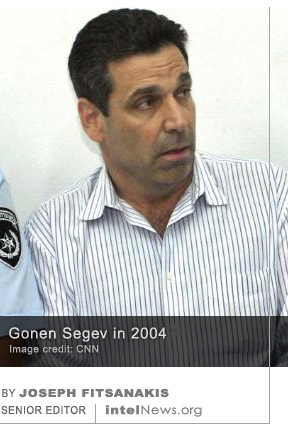
Gonen SegevIsrael has charged Gonen Segev, who served as the Jewish state’s Minister of Energy and Infrastructure, with spying for its archenemy, Iran. Segev, 62, was reportedly detained last month during a trip to Equatorial Guinea following a request by Israeli officials. He was then extradited to Israel and arrested as soon as he arrived in Tel Aviv last month, according to a statement by the Shin Bet, Israel’s domestic security service. On Monday it emerged that Israeli authorities had imposed a gag order on the case, forbidding Israeli media from reporting any information about it. The order appears to have now been lifted.

In 1992, when he was 35, Segev was elected as one of the Knesset’s youngest members, representing the conservative Tzomet party. Initially an opposition Knesset member, Segev eventually left Tzomet and joined a governing coalition with the Labor Party, in which he served as Minister of Energy and Infrastructure. After exiting politics, Segev, who is a medical doctor by training, became a businessman and traveled frequently abroad. But in 2004 he was arrested on a flight from Holland, while reportedly trying to smuggle several thousand ecstasy pills into Israel. He was jailed for five years but was released from prison in 2007, after a commendation for good conduct. Shortly after his release, Segev moved to the Nigerian city of Abuja, where he practiced medicine. It was there, the Shin Bet claims, that he was recruited by Iranian intelligence.

In a statement released on Monday, the Shin Bet said that Segev had admitted being in regular contact with Iranian intelligence agents in Nigeria and other countries around the world. He is reported to have said that he was given a fake passport by his handlers, which he used to visit Iran on two separate occasions in order to hold secret meetings with Iranian intelligence officers. He also traveled to several other countries in order to meet with his Iranian handlers and hand them information about Israel’s energy sector and the location of energy-related security sites in the country. The Shin Bet statement added that Segev introduced his Iranian handlers —who posed as foreign businessmen— to Israeli security officials on several occasions.

It is believed that Segev appeared before a court in Jerusalem on Friday. He was charged with “assisting an enemy in wartime” and with “carrying out espionage against the State of Israel”. The judge also charged him with numerous instances of transmitting classified information to a foreign power.

Author: Joseph Fitsanakis | Date: 19 June 2018 | Permalink

Belgium to probe alleged Spanish espionage against separatist Catalan leader

Carles PuigdemontBelgium will investigate whether Spanish intelligence spied on Carles Puigdemont, the separatist Catalan leader who escaped to Brussels after launching an unsuccessful independence bid last year. Puigdemont, 56, served as president of the Spanish region of Catalonia from January 2016 until October 2017. He was forcibly removed from office by the Spanish government, after he led the government of Catalonia in a unilateral declaration of independence from Spain. As soon as the Catalan Parliament declared that the region was independent, Madrid dissolved it, imposed direct rule on the country’s easternmost province, and declared fresh elections.
Amidst the chaos that ensued, Puigdemont, along with several other leading Catalan separatists, fled to Belgium where he requested political asylum. When it emerged that Puigdemont had fled abroad, Spanish authorities issued a European Arrest Warrant against him, on charges of sedition, rebellion against the state and misusing public funds. Fearing that the Belgian authorities might extradite him to Madrid, Puigdemont soon left for Germany, where he was detained by local police on March 25, 2018. He currently remains in Germany, while German authorities are deciding whether to grant Madrid’s request for his extradition.

Now authorities in Belgium are preparing to launch an investigation into whether Spain’s intelligence services carried out espionage against Puigdemont while he remained on Belgian soil. The investigation will most likely be carried out by the country’s Standing Intelligence Agencies Review Committee. Known broadly as Comité permanent R, the committee is an independent body that oversees the activities of Belgium’s security and intelligence apparatus. The investigation is to be launched as a result of an official parliamentary request submitted by the New Flemish Alliance, Belgium’s largest separatist party, which represents the country’s Dutch-speaking minority. The party has come out in support of Catalan independence and of Puigdemont in particular, and has urged Brussels to grant political asylum to the Catalan separatist leader.

Peter Buysrogge, a leading member of the New Flemish Alliance, said that his party wanted to know whether Spanish intelligence operated in Belgium with or without the knowledge of the Belgian government and intelligence services. He added that his party was especially interested in investigating allegations made in Catalan media that Spanish intelligence operatives followed Puigdemont and even installed a Global Positioning System (GPS) device under his car.

Author: Joseph Fitsanakis | Date: 14 June 2018 | Permalink

France arrests two intelligence officers on charges of spying for China

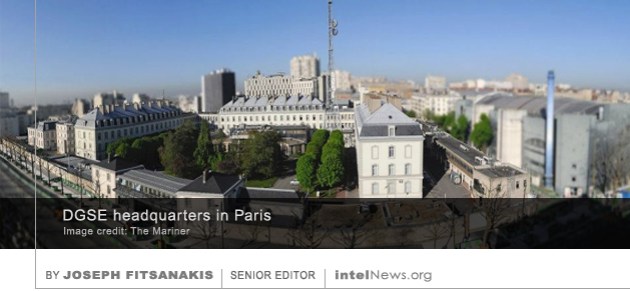
dgse franceFrance has confirmed the arrest of two French intelligence officers who are accused of spying for the Chinese government. It appears that the two officers were captured and charged in December. However, their arrests were not publicized at the time, because French counterintelligence officials wanted to avoid alerting more members of a possible spy ring, which some say may include up to five French citizens. It was only last Friday, a day after French media published leaked reports of the arrests, that the French government spoke publicly about the case.


France’s Minister of the Armed Forces, Florence Parly, told France’s CNews television on Friday that two French intelligence officers were “accused of extremely serious acts of treason” against the French state. The two officers had been charged with delivering classified information to a foreign power”, she said. Parly added that the spouse of one of the officers was also being investigated for participating in acts of espionage on behalf of a foreign country. When asked to identify the country that the two officers are accused of spying for, the minister refused to respond. But the Agence France Presse news agency cited an anonymous “security source”, who said that the two intelligence officers were being suspected of spying for China and that they had been captured following a sting operation by French counterintelligence officers.

French television station TFI1 said on Friday that both spy suspects are officers in the General Directorate of External Security (DGSE), France’s primary external intelligence agency. The station added that at least one of the two suspects was stationed at the embassy of France in Beijing when French counterintelligence became aware of the alleged espionage. According to some reports, the two suspects had retired from the DGSE by the time they were arrested, but committed their alleged espionage while still in the service of the spy agency. French government officials have refused to provide information about the length of the alleged espionage or the nature of the classified information believed to have been compromised. Additionally, no information is available about whether the two alleged spies were working in cooperation with each other. The BBC asked China last week about the arrests in France, but the Chinese Ministry of Foreign Affairs said it was not aware of the incident.

Author: Joseph Fitsanakis | Date: 28 May 2018 | Research credit: E.W. and P.C.  | Permalink


