Spy services seeking access to Angela Merkel’s medical file, reports claim

Angela MerkelForeign intelligence agencies are allegedly trying to acquire the medical file of German Chancellor Angela Merkel after she was seen trembling uncontrollably in public twice in as many weeks. Reports about foreign spy interest in Merkel’s health emerged in German and British newspapers last weekend, after the German chancellor was seen trembling during high-level meetings earlier this month. The first incident took place during an official meeting with Ukrainian President Volodymyr Zelensky on June 18. The German Chancellery said Merkel had suffered from dehydration and “felt like herself again after drinking a few cups of water”. But the tremors were back again on June 27 during the German leader’s visit to Japan for the G20 Summit. Reports stated that the chancellor was seen “clutching her arms in a failed attempt to prevent herself shaking” during the ceremonial part of the proceedings. At a press conference afterwards, Merkel told reporters that the trembling had been caused by “psychological stress” and that she was convinced it would “disappear just like it appeared”. But she avoided answering questions about whether she had sought medical attention about the trembling.

On June 30, British newspaper The Sunday Times said that foreign spies were showing interest in finding out Merkel’s medical state. The paper added that “one Western intelligence agency believed that the German leader was suffering from a ‘neurological problem’”, but did not specify the agency or the alleged condition. Two days earlier, on June 28, the German tabloid Bild claimed that foreign intelligence agencies had been detected attempting to gain access to the German leader’s private medical file. The paper said that foreign governments in Europe and beyond were suspicious of Merkel’s health state following her refusal to speak openly about it to the media. Several intelligence agencies were therefore “trying to get their hands on Merkel’s medical records” in an attempt to verify whether her trembling was caused by stress and dehydration, or whether it may denote a deeper neurological cause, it said. The paper added that the German leader’s medical records were kept “in a secure military facility” somewhere in Germany.

There has been intense speculation in the German media in the past four days about whether Chancellor Merkel will be able to stay in power until the end of her final term as leader of the country. In October 2018, the German leader announced that she would not seek reelection as Chancellor once her current term expires in 2021. She is scheduled to be replaced by Annegret Kramp-Karrenbauer, who last year also replaced her as leader of the Christian Democratic Union Party.

Author: Joseph Fitsanakis | Date: 01 July 2019 | Permalink

Turkish spy agency develops phone app to help ex-pats inform on dissidents

BfV GermanyTurkey’s spy agency has developed a smart phone application to enable pro-government Turks living in Germany inform on their compatriots who speak out against the ruling Justice and Development Party (AKP). The existence of the phone application was revealed in the annual report of the Federal Office for the Protection of the Constitution (BfV), Germany’s primary counterintelligence agency. The report covers terrorist and foreign intelligence activity that took place in 2018 in Baden-Württemberg, a state in southwest Germany that borders Switzerland and France. Deutsche Welle, Germany’s state broadcaster, which cited the BfV report, said that 2018 saw a significant increase in intelligence activities by several countries, including China, Russia, Iran and Turkey. Much of the intelligence activity by Turkish spy agencies concentrated on the Turkish expatriate community in Baden-Württemberg. The federal state is home to approximately 15 percent of Germany’s 3-million-strong Turkish population.

According to the BfV report, Turkish intelligence operations in Baden-Württemberg have focused primarily on two groups since 2015. One group consists of supporters of the Kurdistan Workers’ Party (PKK), an armed separatist group that fights for the independence of Turkey’s Kurdish population. A ceasefire between the PKK and the Turkish government collapsed in 2015, leading to the outbreak of a low-intensity war in Turkey’s southeastern regions, which is ongoing. The other group consists of sympathizers of Fethullah Gülen, a Turkish Islamic scholar who is seen by the government of Turkey as the primary instigator of a coup that unsuccessfully tried to unseat the AKP in July 2016. The BfV report also states that pro-government Turks living in Germany are known to use a smart phone application developed by Turkey’s police force, the General Directorate of Security (EGM). The application allegedly enables supporters of the AKP to inform on suspected members of the PKK or followers of Gülen who live in Germany. These individuals are then questioned or even apprehended when they travel to Turkey to visit family members and friends.

The report also names several Turkish pro-AKP organizations that allegedly operate as intelligence collectors for a host of Turkish spy agencies. Among them are civic groups like the Union of International Democrats, or religious organizations like the Turkish-Islamic Union for Religious Affairs. Known as DİTİB, the organization administers the activities of several hundred Turkish Muslim organizations and mosques throughout Germany and is believed to be closely associated with the AKP and Turkish President Recep Tayyip Erdoğan. Several German intelligence officials and reports have claimed in recent years that the DİTİB operates as an intelligence collection arm of the Turkish state in Germany.

Author: Joseph Fitsanakis | Date: 10 June 2019 | Permalink
Israel leaked video that brought down Austrian government, says German ex-spy chief

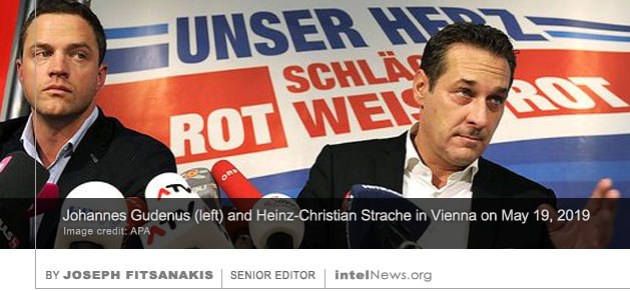
Strache GudenusIsraeli intelligence was likely behind the leaked video that brought down the far-right governing coalition in Austria on Monday, according to the former deputy director of Germany’s spy agency. The surreptitiously recorded video was leaked to two German media outlets on May 17, days before Austrian voters participated in the continent-wide elections for the European Union. In the video, two senior members of Austria’s governing far-right Freedom Party are seen conversing with an unnamed woman posing as a Russian investor. The two men in the video were Heinz-Christian Strache, the the Freedom Party’s leader and until recently Austria’s Vice Chancellor, and Johannes Gudenus, the party’s deputy leader and a member of parliament. In the video, Gudenus and Strache promise to award the woman’s firm state contracts if her uncle —a Russian oligarch— purchases an Austrian newspaper and uses it to support the Freedom Party. The video threw Austria’s political system into disarray and prompted the resignations of both Strache and Gudenus. On Monday, Austria’s Chancellor, Sebastian Kurz, was removed from power during a special parliamentary session in Vienna.
But the question is who leaked the video, and why? In an article in the Cicero, a monthly political magazine based in Berlin, a former senior official in Germany’s Federal Intelligence Service (BND) argues that Israeli intelligence was probably behind the leak. The article’s author is Rudolf Adam, who served as deputy director of the BND from 2001 to 2004, before serving as president of the Federal Academy for Security Policy of the German Ministry of Defense. Adam argues that the actions of Strache and Gudenus, as shown in the leaked video, seem “half mafia-like and half-treasonable”, and that the two should face legal consequences. But he goes on to ask “a far more interesting question”, namely “who is behind this intrigue [and] what were the intentions of its initiators?”. Adam points out that nothing is known about the woman in the video; she reportedly met Gudenus several months before the video was filmed. She posed as the Latvian niece of a Russian oligarch with ties to Russia’s President Vladimir Putin. In exchanges that lasted for several months, the woman told Gudenus that she planned to move with her daughter to Vienna and was interested in investment opportunities. She eventually invited him and Strache to a meeting in a villa in the Spanish resort island of Ibiza. It was there where the video was recorded. Read more of this post

German spy agency concerned about Russian penetration of Austrian government

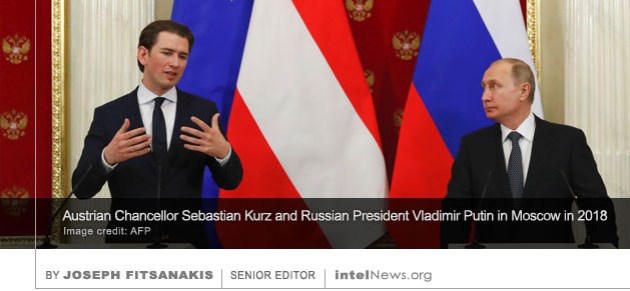
Sebastian Kurz Vladimir PutinA day after Austria’s political system was thrown into a disarray by a covert video featuring the country’s vice chancellor and a woman posing as a Russian investor, German intelligence sources have raised fears that Russia may have penetrated the Austrian government with informants. Heinz-Christian Strache, who heads Austria’s far-right Freedom Party, stepped down from the post of vice chancellor on Saturday. His resignation came a day after two German media outlets aired a covert video in which Strache appears to be promising to award state contracts in the construction sector to a woman posing as a Russian investor. In return for the state contracts, the unnamed woman said that she would have the firm of her uncle —a Russian oligarch— purchase an Austrian newspaper and use it to support Strache’s political party.

According to the German newspaper Süddeutsche Zeitung, the video was filmed in Spain in 2017, two months before the Freedom Party won a record 26 percent in Austria’s national election. This gave the party 51 seats in the Austrian parliament and propelled Strache to the post of vice chancellor. In his resignation statement, Strache said he was filmed while drunk and was engaged in “macho talk” in an atttempt to “impress the attractive hostess”. He also dismissed the airing of the covertly filmed video as “a targeted political assassination”, but added that he was resigning from the government as a matter of principle. Shortly afterwards, the Austrian Chancellor Sebastian Kurz, Chairman of the rightwing Austrian People’s Party, announced that new national elections would be held “as soon as possible”.

Meanwhile, German newspaper Die Welt am Sonntag reported on Saturday that the director of Germany’s Federal Office for the Protection of the Constitution (BfV), warned that sharing intelligence with Austria was “risky”. The Berlin-based newspaper said that BfV director Thomas Haldenwang was speaking at a closed-door meeting with German parliamentarians. He reportedly told his parliamentary audience that, due to the close relationship between the Freedom Party and Moscow, members of the Austrian government could potentially “misuse” and in some cases “forward to Russia” intelligence that they receive from other European Union member-states. This is not the first time that such warnings have come out of Germany. Last year August Hanning, who served as director of Germany’s Federal Intelligence Service (BND) openly warned Western officials to stop sharing intelligence with the government of Austria, because of its alleged proximity to the Kremlin.

Author: Joseph Fitsanakis | Date: 20 May 2019 | Permalink

German spies dismiss US warnings about Huawei threat to 5G network

Huawei 2German intelligence officials appear to be dismissing Washington’s warning that it will limit security cooperation with Berlin if China’s Huawei Telecommunications is allowed to build Germany’s 5G network. The company, Huawei Technologies, is a private Chinese venture and one of the world’s leading telecommunications hardware manufacturers. In recent years, however, it has come under scrutiny by some Western intelligence agencies, who view it as being too close to the Communist Party of China. More recently, Washington has intensified an international campaign to limit Huawei’s ability to build the infrastructure for 5G, the world’s next-generation wireless network. Along with Britain, Australia and Canada, the US is concerned that the Chinese telecommunications giant may facilitate global wiretapping on behalf of Beijing’s spy agencies.
In the past several months the United States has repeatedly warned Germany that intelligence sharing between the two countries will be threatened if the Chinese telecommunications giant is awarded a 5G contract by the German government. In March, Washington informed German officials that intelligence cooperation between the two allies would be severely impacted if Chinese telecommunications manufacturers were given the green light to build Germany’s 5G infrastructure. The warning was allegedly included in a letter to Peter Altmaier, Germany’s Minister of Economic Affairs and Energy, written by Ambassador Richard Grenell, America’s top diplomat in Germany. The letter urged the German government to consider rival bids by companies belonging to American allies, such as the Swedish telecommunications equipment manufacturer Ericsson, Finland’s Nokia Corporation, or the South Korean Samsung Corporation.

But a report by Bloomberg on Wednesday said that German authorities were not convinced by Grenell’s argument. Citing “four people with knowledge on the matter”, the news agency said that Germany’s intelligence community see Washington’s warnings as “political grandstanding”. The US and Germany “need each other’s resources to tackle global conflicts” and “rely on each other too much to risk jeopardizing crucial data sharing”, said the report. The anonymous officials told Bloomberg that Germany does benefit from America’s “vast array” of intelligence. However, German spy agencies also provide their American counterparts with crucial intelligence from several regions of the world, they said. The US Department of State did not comment on the Bloomberg report. The Chinese government has repeatedly dismissed allegations that Huawei poses an espionage threat to Western nations.

Author: Ian Allen | Date: 18 April 2019 | Permalink

US warns Germany it will end intelligence sharing if Huawei is given 5G contract

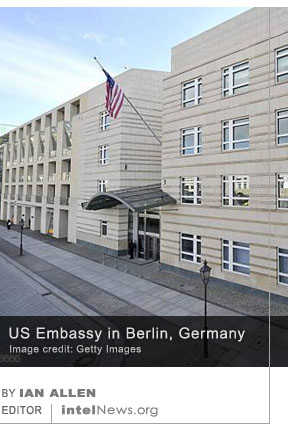
US embassy Berlin GermanyThe United States has warned Germany that intelligence sharing between the two countries will be threatened if the Chinese telecommunications giant Huawei is awarded a contract to build Germany’s 5G network. The company, Huawei Technologies, is a private Chinese venture and one of the world’s leading telecommunications hardware manufacturers. In recent years, however, it has come under scrutiny by some Western intelligence agencies, who view it as being too close to the Communist Party of China. More recently, Washington has intensified an international campaign to limit Huawei’s ability to build the infrastructure for 5G, the world’s next-generation wireless network. Along with Britain, Australia and Canada, the US is concerned that the Chinese telecommunications giant may facilitate global wiretapping on behalf of Beijing’s spy agencies.
But some American allies, including Spain, France and Germany, are not satisfied with Washington’s arguments and claim that the United States is eyeing the financial benefits that would arguably come from its domination of the global digital superhighway. German officials, in particular, have told their American counterparts that Berlin has not seen any evidence that Huawei’s telecommunications hardware come with hidden interception features. Moreover, Germany says that it plans to subject Huawei’s systems to rigorous security tests before using them. On Friday, Washington increased its pressure on Berlin by informing German officials that intelligence cooperation between the two allies would be severely impacted if Chinese telecommunications manufacturers are given the green light to build Germany’s 5G infrastructure.

According to The Wall Street Journal, the warning was included in a letter signed by Ambassador Richard Grenell, America’s top diplomat in Germany. It was allegedly sent to Peter Altmaier, Germany’s Minister of Economic Affairs and Energy. The paper says that Grenell suggests in his letter that Berlin should consider rival bids by companies belonging to American allies, such as the Swedish telecommunications equipment manufacturer Ericsson, Finland’s Nokia Corporation, or the South Korean Samsung Corporation, which is the world’s leading telecommunications hardware manufacturer. The Wall Street Journal did not reveal how it acquired Grenell’s letter, nor did it say whether the German government responded to it.

Author: Ian Allen | Date: 12 March 2019 | Permalink

German far-right party wins lawsuit against domestic intelligence agency

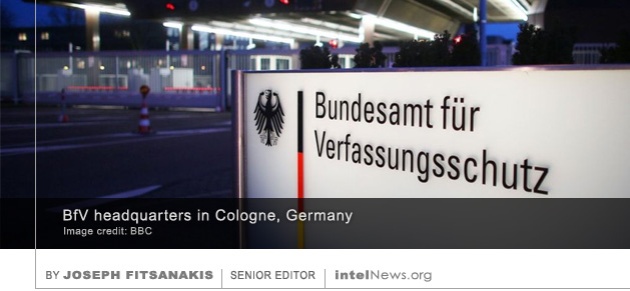
BfV GermanyGermany’s largest far-right party, Alternative for Germany, has won a lawsuit against the country’s domestic intelligence agency, which is now barred from collecting intelligence on the group’s activities. Known by its German initials AfD, which stand for Alternative für Deutschland, the party was founded in 2013 on an anti-immigration, Eurosceptic, German-nationalist, and in some cases pro-Russian, platform. In 2017 it became the third-largest political party in the country after winning 94 seats in the Bundestag, Germany’s federal parliament. Since the two leading parties formed a governing alliance, the AfD is currently Germany’s official parliamentary opposition.

Last year, however, government officials warned that elements within the AfD were actively organizing to subvert the German constitution and expressed concern about the AfD’s political views. In January of this year, the Office for the Protection of the Constitution (BfV), Germany’s primary domestic security agency, publicly announced that it would designate the AfD as a “test case” organization. According to German law, a group or organization can be designated as a “test case” when it displays “extremist elements” in its behavior, which may indicate that it “poses a threat to the constitutional order”. Once a group or organization is designated as a “test case”, the BfV is legally permitted to monitor open-source information about it. It is not allowed to resort to other methods of intelligence collection, including conducting human intelligence operations, employing informants, etc.

Shortly after the BfV disclosed the AfD’s “test case” designation, the far-right party sued the security agency, claiming that its “test case” designation amounted to public defamation. On Tuesday, Cologne’s Administrative Court ruled that the BfV had unfairly designated the AfD as a “test case” by relying on little more than “fragments of suspicion”. The court also found that the public designation of the AfD as a “test case” had unfairly defamed the party and could have a serious negative effect on its electoral performance by giving “a negative public impression”. The court decision is seen as a major symbolic victory for the far-right party ahead of several regional elections this year, in which the AfD hopes to defeat Chancellor Angela Merkel’s center-right Christian Democratic Union.

Author: Joseph Fitsanakis | Date: 27 February 2019 | Permalink

German chancellor inaugurates world’s largest spy agency headquarters in Berlin

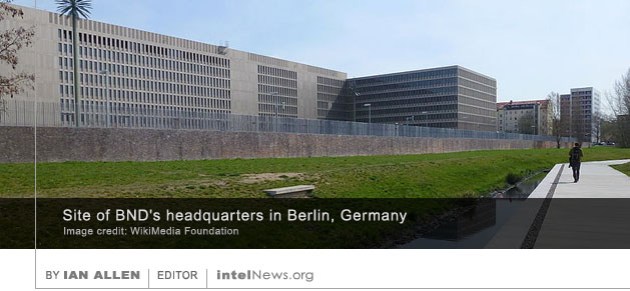
BND GermanyThe chancellor of Germany has officially inaugurated the largest headquarters of any spy agency in the world. Last Friday, Angela Merkel led the public ceremony that marked the opening of the Zentrale des Bundesnachrichtendienstes, which is the new headquarters of the German Federal Intelligence Service. Known by the initials BND, the agency operates as Germany’s primary foreign intelligence service. It employs close to 7,000 people in more than 300 locations around the world, and its annual budget is approximately €1 billion ($1.13 billion).
Until recently, the BND was headquartered in the outskirts Munich, in the southern German state of Bavaria. But as of last week, the spy agency has officially moved to its new headquarters in downtown Berlin. The massive new complex is located in the German capital’s affluent Mitte district, just a stone’s throw from a section of what used to be the Berlin War —a major symbol of the Cold War. The new complex spans 3 million sq. ft., making it the largest headquarters of any intelligence agency in the world. The United States Central Intelligence Agency’s headquarters at Langley, Virginia, comes a close second. Construction on the site in Mitte began in 2006 and was initially scheduled for completion in 2011, but was finally finished in 2017, 12 years after it began. It cost approximately €1 billion ($1.13 billion). British newspaper The Guardian reports that the new complex consists of 20,000 tons of steel and has 14,000 windows and 12,000 doors. The land on which the new BND headquarters is built used to be the site of police barracks, until it was heavily damaged by bombing carried out by the Allied forces in 1945. Following the partition of Germany, East German authorities built a sports complex and stadium on the site, which was demolished in 1999, in preparation for Germany’s unsuccessful bid to host the 2000 Summer Olympic Games.

According to reports in the German media, just over 3,000 BND employees have already relocated from Munich to the new BND headquarters, while another 800 are expected to relocate there in the coming year. During her speech on Friday, Chancellor Merkel said that the world was becoming “increasingly confusing”, which made the need for a “strong and efficient [German] foreign intelligence service […] more urgent than ever”. Interestingly, the new complex features a sizeable visitor’s center that is open to the public, making the BND the world’s first foreign intelligence agency with a public-access visitors’ facility.

Author: Ian Allen | Date: 13 February 2019 | Permalink

New clues may help locate lost intelligence files from 1938 French-British-Nazi pact

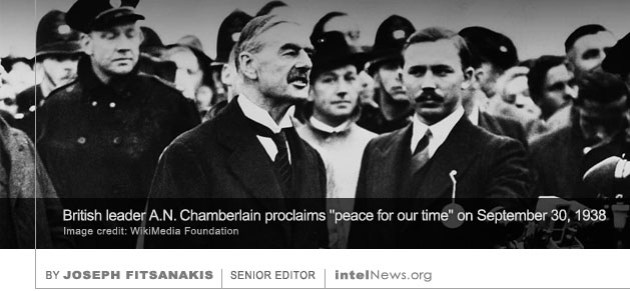
Neville Chamberlain Nearly 2,000 missing British intelligence files relating to the so-called Munich Agreement, a failed attempt by Britain, France and Italy to appease Adolf Hitler in 1938, may not have been destroyed, according to historians. On September 30, 1938, the leaders of France, Britain and Italy signed a peace treaty with the Nazi government of German Chancellor Adolf Hitler. The treaty, which became known as the Munich Agreement, gave Hitler de facto control of Czechoslovakia’s German-speaking areas, in return for him promising to resign from territorial claims against other countries, such as Poland and Hungary. Hours after the treaty was formalized, British Prime Minister Neville Chamberlain arrived by airplane at an airport near London, and boldly proclaimed that he had secured “peace for our time” (pictured above). Contrary to Chamberlain’s expectations, however, the German government was emboldened by what it saw as attempts to appease it, and promptly proceeded to invade Poland, thus firing the opening shots of World War II in Europe.
For many decades, British historians researching the Munich Agreement have indicated the absence of approximately 1,750 intelligence reports dating from May to December 1938. The missing files cover the most crucial period immediately prior and immediately after the Munich Agreement. They are believed to contain transcripts of German and other foreign diplomatic communications, which were intercepted by the Government Code and Cypher School (GC&CS), Britain’s signals intelligence agency at the time. In 1947, the documents were passed on to the GC&CS’s successor agency, the Government Communications Headquarters (GCHQ). But they subsequently disappeared, giving rise to numerous theories as to how and why. Some historians have theorized that the documents were deliberately destroyed by British officials shortly after the end of World War II. The move allegedly aimed to protect Britain’s international reputation and prevent a possible exploitation by the Soviet Union, which sharply criticized the West’s appeasement of Hitler in the run-up to the war. Another popular theory is that they were destroyed by senior civil servants connected to the Conservative Party —to which Chamberlain belonged— in order to prevent the opposition Labour Party from capitalizing on what many saw as a betrayal of British interests in September 1938 by the Conservative administration in London.

For a long time, the GCHQ’s official historians have strongly contested the view that the documents were deliberately destroyed. Now, according to The Independent newspaper, historians have found that the missing documents were still listed in GCHQ archive indexes in as late as 1968, a full 30 years after the Munich Agreement was signed. At that time it is believed that the files were temporarily transferred to another British government department in order to be used as references in an internal report about the Munich Agreement. It is very likely, some historians now say, that the documents were simply never returned to GCHQ. It is therefore possible that they may be stored in the archives of the Foreign and Commonwealth Office or the Ministry of Defence. This new clue, according to The Independent, substantially lessens the possibility that the documents may have been removed or destroyed for political reasons.

Author: Joseph Fitsanakis | Date: 01 October 2018 | Permalink

Germany’s ruling coalition in ‘permanent crisis mode’ over far-right spy row

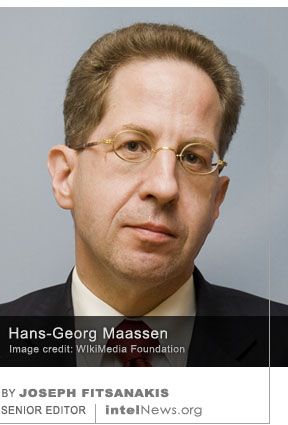
Hans-Georg MaassenGermany’s fragile ruling coalition continues to face strong criticism two days after removing the country’s domestic intelligence chief over concerns that he may harbor far-right sympathies. Hans-Georg Maassen, a career civil servant, led Germany’s Federal Office for the Protection of the Constitution (BfV) from August 2012 until his removal on Thursday of this week. His hasty removal from the BfV was caused by the so-called Chemnitz protests, a series of prolonged anti-immigrant rallies, pogroms and riots that shook the east German city of Chemnitz in the last week of August of this year. They were prompted by news of the death of a German man, reportedly during a fight with two Kurdish immigrants. Videos of the protests surfaced on social media, showing participants throwing Nazi salutes, singing Nazi-era German songs and chasing people perceived to be immigrants in the streets of Chemnitz.

The controversy deepened when Maassen appeared to dispute the authenticity of the videos in an interview. The BfV director warned that the videos may have been faked as part of a disinformation campaign aimed at stirring racial tensions in Germany. The spy chief’s motives were questioned, however, when several investigative reporters, among them a team from the German public broadcaster association ARD, insisted that the videos were genuine and were posted online by people with real —not fake— accounts. Eventually Maassen became the focus of the story, as accusations surfaced that he may have leaked BfV documents to far-right activists and that he may even have coached them on how to evade government surveillance. The claims reignited widespread fears that members of Germany’s security and intelligence agencies may harbor sympathies for the far-right Alternative for Germany (AfD), a coalition of Eurosceptic, anti-immigrant and neo-Nazi groups that has gained prominence since its establishment in 2013. Currently, the AfD is Germany’s third-largest party, having received nearly 13% of the vote in the 2017 federal elections. The AfD is also the country’s main opposition party in the Bundestag, since the two leading parties, the conservative Christian Democratic Union (CDU) and the liberal Social Democratic Party (SPD), are members of the governing coalition.

Following nearly two weeks of controversy, the German Chancellery announced on Thursday that Maassen would be removed from head of the BfV and would serve instead as second in command in the Federal Ministry of the Interior. The decision was seen as a difficult compromise between the three members of the governing coalition —the liberals of the SPD, who wanted Maassen fired, and the conservatives of the CSU and its Bavarian wing, the Christian Social Union in Bavaria, who are in favor of tighter immigration policies. But the controversy surrounding Maassen continues in light of news that the former spy chief will see his income rise in his new post. In a report from Berlin, the Reuters news agency described Maassen’s reassignment as “a clumsy compromise” that highlighted the “dysfunctional relationship” of the three “loveless partners” in Chancellor Angela Merkel’s fragile governing coalition. One critic, SPD Secretary General Lars Klingbeil, told the news agency that the Maassen controversy had caused the government to “slide into a permanent crisis mode”. Meanwhile the name of Maassen’s replacement at the helm of the BfV has not yet been announced.

Author: Joseph Fitsanakis | Date: 20 September 2018 | Permalink

Germany drops espionage case against senior Swiss intelligence official

Paul ZinnikerGermany has dropped a criminal case against the second-in-command of Switzerland’s intelligence agency, who was accused by Berlin of authorizing an espionage operation against the German tax collection service. A year ago, Germany launched an unprecedented investigation into three senior officials of Switzerland’s intelligence agency, the Federal Intelligence Service (NDB). The probe was launched on suspicion that the Swiss officials masterminded a spy operation against German tax investigators who were probing the activities of Swiss banks. The German probe was launched three months after authorities in Germany arrested a Swiss intelligence officer, identified only as “Daniel M.”, for engaging in espionage on German soil.
The German government believes that billions of euros have been deposited by its citizens in banking institutions in European tax-havens like Liechtenstein, Switzerland or Monaco. For the past decade, German authorities have resorted to bribing whistleblowers in offshore banks in order to acquire internal documents that reveal the identities of German citizens who are hiding their money in foreign bank accounts. It is estimated that over a hundred million dollars have been paid to whistleblowers by German authorities since 2006. The latter argue that the proceeds collected from unpaid taxes and fines more than justify the payments made out to whistleblowers. But the Swiss government has strongly criticized Berlin for encouraging Swiss banking sector employees to steal internal corporate information that often breaks Switzerland’s stringent privacy laws. It is believed that the NDB has been instructed by the Swiss government to monitor efforts by German tax-fraud investigators to approach potential whistleblowers working in the Swiss banking sector.

The man identified as “Daniel M.” appears to be one of several Swiss spies who have been collecting information on the activities of German tax investigators. For a while it appeared that German counterintelligence officials were intent on targeting Paul Zinniker (pictured), Deputy Director of the NDB. They claimed that Zinniker was the main support officer of the operation that “Daniel M.” was participating in when he was arrested in Germany in 2017. According to the Germans, it was Zinniker’s who conceived the operation in 2011. But on Monday a spokesman for Germany’s federal prosecutor told the Swiss News Agency that Berlin dropped the case against Zinniker back in June. The revelation came less than 48 hours after a report in the Sunday edition of the Swiss newspaper Neue Zürcher Zeitung claimed that the charges against Zinniker would be dropped. According to the German federal prosecutor’s office, the case against the Swiss spy official was dropped because of the lack of cooperation by Swiss authorities, which made it impossible to prove that Zinniker was indeed the mastermind of the espionage operation against Berlin.

Author: Joseph Fitsanakis | Date: 04 September 2018 | Permalink

German ex-spy chief tells West to stop sharing intelligence with Austria

Peter GridlingA former director of Germany’s foreign intelligence service has warned Western officials to stop sharing intelligence with the government of Austria, because of its alleged proximity to the Kremlin. August Hanning served as chief of Germany’s Federal Intelligence Service, known as BND, from 1998 to 2005. He went on to serve as the most senior civil servant in the Ministry of the Interior until his retirement in 2009. In an interview published on Wednesday in Germany’s Bild newspaper, Hanning argued that “caution is necessary with [an intelligence] service [like that of Austria,] which cannot protect its own secrets or the sources and sensitive information of its partners”. He went on to add that “there is […] now extreme caution when sharing information] with the Austrian intelligence services.
Hanning’s statement came less than a week after The Washington Post claimed in a major article that most Western intelligence services had stopped sharing sensitive information with the Austrian government. The newspaper alleged that the disruption in intelligence cooperation between Austria and other Western countries was sparked by an unprecedented police raid on the headquarters of Austria’s spy agency in February of this year. On February 28, Austrian police raided the central offices of the Office for the Protection of the Constitution and Counterterrorism (BVT), which operates as Austria’s domestic intelligence agency. By that evening, thousands of classified documents had been removed from the BVT’s headquarters and stored in police facilities in Vienna. Austrian officials claimed that the raid was sparked by allegations made by South Korean intelligence that blank Austrian passports had been acquired by the North Korean government.

However, according to The Post, the raid was politically motivated by Austria’s far-right Freedom Party, which is part of the country’s ruling coalition. The purpose of the raid, said the article, was to neutralize the BVT, whose mission includes defending the Austrian constitution from domestic threats from the far left and the far right. Many Western services were alarmed by the February 28 raid on the BVT and immediately stopped sending sensitive information to the agency’s Vienna headquarters, according to The Post. It also said that Western European powers are concerned by the seemingly close relations between some members of Austria’s government and the Kremlin. Last week, Russian Premier Vladimir Putin traveled to Austria to attend the wedding of Karin Kneissl, Austria’s Minster of Foreign Affairs, who is politically close to the Freedom Party. The Russian leader said that he attended Kneissl’s wedding on a “purely private” capacity. But that did little to appease European Union leaders.

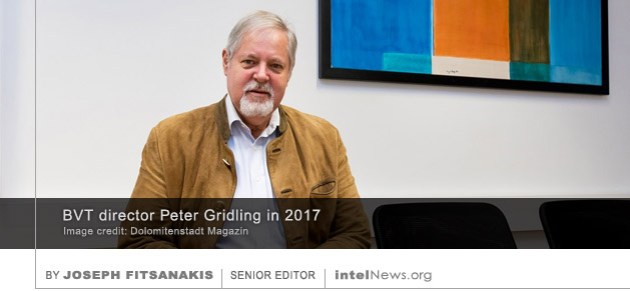
On Monday, the BVT rejected the claims made by The Post. In a statement issued to the media, BVT director Peter Gridling (pictured) said that “cooperation [between the BVT and] partner intelligence services continues to work well in key areas such as the fight against terrorism”.

Author: Joseph Fitsanakis | Date: 23 August 2018 | Permalink

Germany arrests Jordanian intelligence operative who spied on mosque

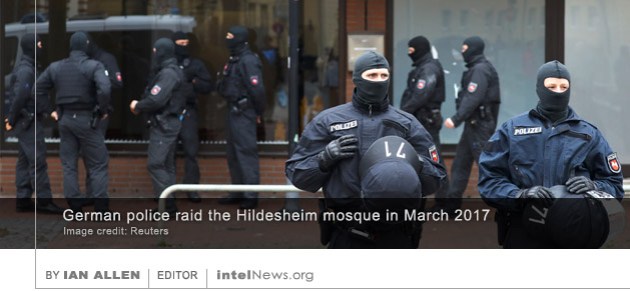
Hildesheim mosqueAuthorities in Germany announced yesterday the arrest of a German national who is accused of spying on a central German mosque on behalf of Jordan, according to media reports. The man was reportedly arrested on Tuesday at an unknown location by officers of Germany’s domestic intelligence agency, the Federal Office for the Protection of the Constitution (BfV). In a press statement, the agency said the man is a 33-year-old German national named “Alexander B.”. German privacy rules forbid the public identification of crime suspects prior to their conviction in a court of law.
According to the public statement issued by the BfV, the 33-year-old man is believed to have worked for “a Jordanian intelligence agency” —most likely the Jordanian General Intelligence Department, or GID, which is a branch of the Jordanian Armed Forces— since at least 2016. He is accused of having infiltrated a Sunni mosque in the central German city of Hildesheim, located 20 miles southeast of Hanover in Germany’s Lower Saxony region. His mission, according to the BfV, was to keep tabs on mosque goers who expressed support for the ideology of the Islamic State, and might even consider traveling to the Middle East to join the radical group. The alleged Jordanian intelligence operative was also tasked with reporting on news reaching the mosque from those of its members who had already gone to the Middle East and joined the Islamic State.

Last year, German authorities closed down the Hildesheim mosque, known in German as Deutschsprachiger Islamkreis Hildesheim e. V. (DIK), and arrested its imam, Ahmad Abdulaziz Abdullah A., known as Abu Walaa. The Iraqi-born imam was charged with supporting a foreign terrorist organization by actively recruiting young Muslims on behalf of the Islamic State. The mosque has since remained closed, because authorities believe that it had become a beehive of fundamentalist activity. Jordan is one of the Middle East’s most liberal states and has been targeted repeatedly by the Islamic State, which views its leadership as pro-Western. However, it appears that Alexander B. was spying on the Hildesheim mosque —therefore on German soil— without having informed the host country of his activities. The government of Jordan has not commented on his arrest.

Author: Ian Allen | Date: 09 August 2018 | Permalink

German far-right group is arming itself, poses serious threat, report warns

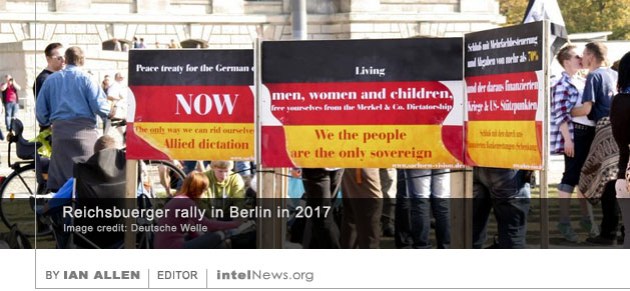
ReichsbuergerAdherents of a bizarre far-right movement in Germany, who claim to be citizens of Prussia, are arming themselves and pose a growing security threat, says a new report by the country’s domestic spy service. The members of the movement call themselves Reichsbuerger (“citizens of the Reich”) and reject the legitimacy of the Federal Republic of Germany. Instead of the modern-day German state, which emerged in 1990 from the union of East and West Germany, Reichsbuergers swear allegiance to the Deutsches Reich (German Reich), the Nazi German state that existed between 1933 and 1945. They also claim that the Deutsches Reich, which they occasionally refer to as Prussia, continues to exist in its pre-1945 state and is still governed by a provisional government in exile.
In some cases, Reichsbuerger adherents have contacted foreign embassies in Berlin and asked to be recognized as citizens of the Third Reich, but without success. In addition, some Reichsbuerger associations issue Deutsches Reich identification cards and Deutsches Reich car license plates. But these are dismissed as “fantastical” by German authorities, who have historically refused to take Reichsbuerger adherents seriously. But now the Federal Office for the Protection of the Constitution (BfV), Germany’s main domestic security agency, has said that the Reichsbuerger movement is growing and needs to be viewed as a potential security threat. According to the BfV’s annual report, which was published on Tuesday, the Reichsbuerger movement has grown by more than 65 percent since 2016 and currently consists of approximately 20,000 committed members.

In its report, the BfV notes that the numerical growth of Reichsbuerger adherents may be partly attributed to the heightened attention that German authorities have been paying to far-right organizations in recent years. The agency also states that only about five percent of Reichsbuergers may be described as violent or potentially violent extremists. However, violent Reichsbuergers have risen from 500 in 2016 to 900 in 2017, an 80% increase in a year, according to the report. Moreover, says the BfV, many core members of the Reichsbuerger movement maintain close contacts with German far-right criminal networks, whose members include current and former supporters of the National Socialist Underground (NSU). Earlier this month, several NSU members were found guilty of having participated in 10 politically motivated killings of immigrants between 2000 and 2007. The BfV report states that Reichsbuergers increasingly view the NSU’s violent acts as examples to follow, and that they are systematically attempting –and usually succeeding– to obtain gun licenses. In a report published earlier this year, the BfV had warned that the Reichsbuerger movement was trying to build an army.

Author: Ian Allen | Date: 25 July 2018 | Permalink

Israel says it foiled Iranian-sponsored bomb attack in France

MossadIsrael helped foil an alleged Iranian-sponsored bomb attack in Paris, which involved arrests of several Iranian agents and at least one diplomat in France, Belgium and Germany, according to media reports. As intelNews reported earlier this month, the arrests began on June 30, when members of Belgium’s Special Forces Group arrested a married Belgian couple of Iranian descent in Brussels. The couple were found to be carrying explosives and a detonator. On the following day, July 1, German police arrested an Iranian diplomat stationed in Iran’s embassy in Vienna, Austria. On the same day, a fourth person, who has not been named, was arrested by authorities in France, reportedly in connection with the three other arrests.

All four individuals appear to have been charged with a foiled plot to bomb the annual conference of the National Council of Resistance of Iran (NCRI) that took place on June 30 in Paris. The NCRI is led by Mujahedin-e Khalq (MEK), a militant group with roots in radical Islam and Marxism. The MEK was designated as a terrorist group by the European Union and the United States until 2009 and 2012 respectively. But it has since been reinstated in both Brussels and Washington, reportedly because it provides the West with a vehicle to subvert the Iranian government.

On Thursday, authorities in Israel announced the lifting of a blanket censorship decree that prevented local media from discussing the country’s role in helping the Europeans foil the alleged bomb attack in Paris. According to Israel’s Channel 2, a private television station based in Jerusalem, the Iranian attack was prevented after the Israeli agency Mossad detected the whereabouts of several suspects involved in it. The Mossad then supplied Germany, Belgium and France with intelligence that led to the arrests of some of those suspects. However, Channel 2 said that the Israeli government did not give a reason for the initial censorship imposed on the country’s media, nor did it explain why it had decided to lift it. On July 4, Israeli Prime Minister Benjamin Netanyahu appeared to hint that Israel had a role in the foiling of the alleged bomb attack in Paris. Speaking during a commemoration ceremony in Acre, Israel, Netanyahu said it was “no coincidence” that the attack in Paris had been stopped. But the Israeli leader did not expressly indicate that the Mossad had a role in the operation.

Following news of the arrests in Europe, the Iranian government said that it had no connection to the alleged plot in Paris and called the incident a “false flag” operation staged by Tehran’s enemies at home and abroad.

Author: Joseph Fitsanakis | Date: 20 July 2018 | Permalink