Germany arrests Jordanian intelligence operative who spied on mosque
August 9, 2018 1 Comment
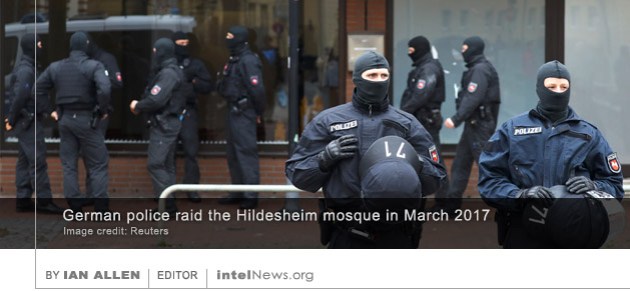 Authorities in Germany announced yesterday the arrest of a German national who is accused of spying on a central German mosque on behalf of Jordan, according to media reports. The man was reportedly arrested on Tuesday at an unknown location by officers of Germany’s domestic intelligence agency, the Federal Office for the Protection of the Constitution (BfV). In a press statement, the agency said the man is a 33-year-old German national named “Alexander B.”. German privacy rules forbid the public identification of crime suspects prior to their conviction in a court of law.
According to the public statement issued by the BfV, the 33-year-old man is believed to have worked for “a Jordanian intelligence agency” —most likely the Jordanian General Intelligence Department, or GID, which is a branch of the Jordanian Armed Forces— since at least 2016. He is accused of having infiltrated a Sunni mosque in the central German city of Hildesheim, located 20 miles southeast of Hanover in Germany’s Lower Saxony region. His mission, according to the BfV, was to keep tabs on mosque goers who expressed support for the ideology of the Islamic State, and might even consider traveling to the Middle East to join the radical group. The alleged Jordanian intelligence operative was also tasked with reporting on news reaching the mosque from those of its members who had already gone to the Middle East and joined the Islamic State.
Last year, German authorities closed down the Hildesheim mosque, known in German as Deutschsprachiger Islamkreis Hildesheim e. V. (DIK), and arrested its imam, Ahmad Abdulaziz Abdullah A., known as Abu Walaa. The Iraqi-born imam was charged with supporting a foreign terrorist organization by actively recruiting young Muslims on behalf of the Islamic State. The mosque has since remained closed, because authorities believe that it had become a beehive of fundamentalist activity. Jordan is one of the Middle East’s most liberal states and has been targeted repeatedly by the Islamic State, which views its leadership as pro-Western. However, it appears that Alexander B. was spying on the Hildesheim mosque —therefore on German soil— without having informed the host country of his activities. The government of Jordan has not commented on his arrest.
► Author: Ian Allen | Date: 09 August 2018 | Permalink
 Adherents of a bizarre far-right movement in Germany, who claim to be citizens of Prussia, are arming themselves and pose a growing security threat, says a new report by the country’s domestic spy service. The members of the movement call themselves Reichsbuerger (“citizens of the Reich”) and reject the legitimacy of the Federal Republic of Germany. Instead of the modern-day German state, which emerged in 1990 from the union of East and West Germany, Reichsbuergers swear allegiance to the Deutsches Reich (German Reich), the Nazi German state that existed between 1933 and 1945. They also claim that the Deutsches Reich, which they occasionally refer to as Prussia, continues to exist in its pre-1945 state and is still governed by a provisional government in exile.
 Israel helped foil an alleged Iranian-sponsored bomb attack in Paris, which involved arrests of several Iranian agents and at least one diplomat in France, Belgium and Germany, according to media reports. As intelNews
  An Iranian diplomat and members of what authorities described as an “Iranian sleeper cell” were arrested this week in Belgium, Germany and France, as they were allegedly planning to a bomb a high-level meeting in Paris. The arrests came after a complex investigation by several European intelligence agencies and were announced by Belgium’s Minister of the Interior, Jan Jambon.
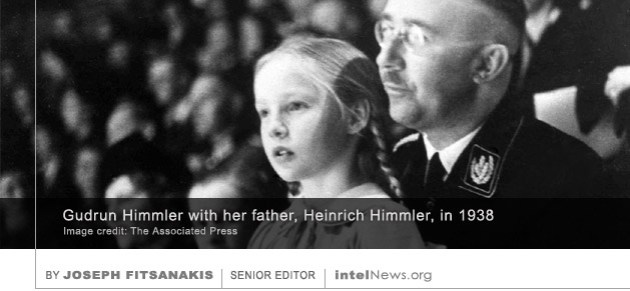 The daughter of Heinrich Himmler, who was second in command in the German Nazi Party until the end of World War II, worked for West German intelligence in the 1960s, it has been confirmed. Gudrun Burwitz was born Gudrun Himmler in 1929. During the reign of Adolf Hitler, her father, Heinrich Himmler, commanded the feared Schutzstaffel, known more commonly as the SS. Under his command, the SS played a central part in administering the Holocaust, and carried out a systematic campaign of extermination of millions of civilians in Nazi-occupied Europe. But the Nazi regime collapsed under the weight of the Allied military advance, and on May 20, 1945, Himmler was captured alive by Soviet troops. Shortly thereafter he was transferred to a British-administered prison, where, just days later, he committed suicide with a cyanide capsule that he had with him. Gudrun, who by that time was nearly 16 years old, managed to escape to Italy with her mother, where she was captured by American forces. She testified in the Nuremberg Trials and was eventually released in 1948. She settled with her mother in northern West Germany and lived away from the limelight of publicity until her death on May 24 of this year, aged 88.
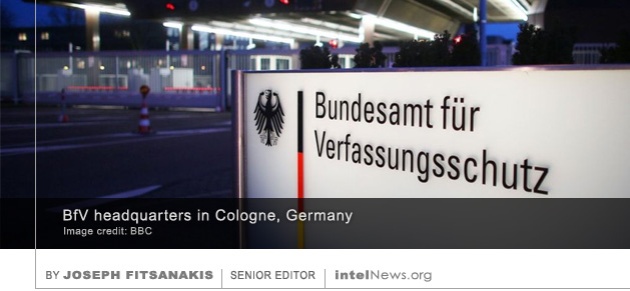 The head of Germany’s domestic security agency has publicly blamed the Russian government for a large-scale cyberattack that has targeted German energy providers. The comments follow a June 13 announcement on the subject by Germany’s Federal Office for Information Security (BSI), which is charged with securing the German government’s electronic communications. According to the BSI, a widespread and systematic attack against Germany’s energy networks has been taking place for at least a year now. The attack, which the BSI codenamed BERSERK BEAR, consists of various efforts by hackers to compromise computer networks used by German companies that provide electricity and natural gas to consumers around the country.
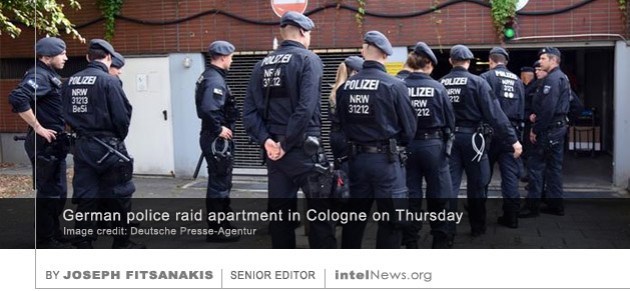 German authorities have charged a Tunisian citizen with building a biological weapon, after finding significant quantities of the highly toxic substance ricin in his apartment. The 29-year-old man is referred to in public reports only as “Sief Allah H.”, in compliance with German law that forbids the naming of suspects until they are found guilty in court. German officials said last Thursday that the man remains in custody and has been charged with violating Germany’s War Weapons Control Act (known as Kriegswaffenkontrollgesetz) and “preparing a serious act of violence against the state”.
 Some North Atlantic Treaty Organization (NATO) member states obtained access to the Soviet Union’s so-called ‘Novichok’ nerve agents in the 1990s, through an informant recruited by German intelligence, according to reports. NATO countries refer to ‘Novichok-class’ nerve agents to describe a series of weaponized substances that were developed by the Soviet Union and post-Soviet Russia from the early 1970s to at least 1993. They are believed to be the deadliest nerve agents ever produced, but Moscow denies their very existence. A type of Novichok agent, described by British scientists as A234, is said to have been used in March of this year by the person or persons who
 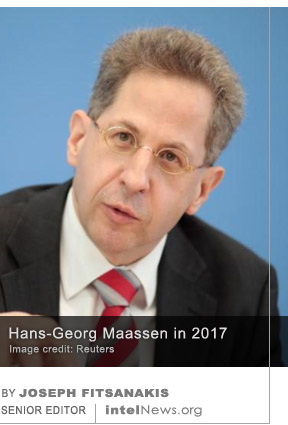 The head of Germany’s domestic intelligence agency has warned of security risks resulting from Chinese direct investment in high-technology German and other European companies. Since 2012, Hans-Georg Maassen has served as director of the Federal Office for the Protection of the Constitution, Germany’s domestic security and counterintelligence agency.
 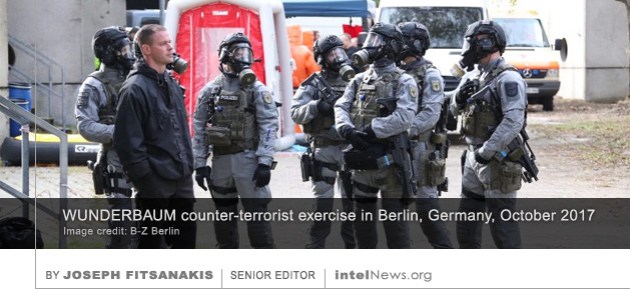 A German newspaper reported last week that at least one European intelligence agency has already warned that the Islamic State is exploring the use of chemicals for attacks in Europe. Such an eventuality would be a radical departure from prior attacks by the Islamic State in the West. In the past, the militant group has shown a strong preference for low-tech means of dispensing violence, such as firearms, vehicles and knives. But it has utilized chemical substances in Iraq and Syria, and its technical experts have amassed significant knowledge about weaponized chemicals.
 A senior German intelligence official has warned that foreign powers, including Russia, could try to shape the outcome of talks by German parties to form a governing coalition, following last week’s national elections. The elections resulted in a major shakeup of Germany’s political landscape, as Chancellor Angela Merkel’s Christian Democratic Union lost nearly 10 percentage points compared to its 2013 election result. It is now forced to seek the participation of other conservative or centrist political parties in a broad governing alliance. Meanwhile, the far-right Alternative for Germany (AfD) won 12.6 percent, propelling it to third place and giving it 91 seats in the Bundestag. The AfD result marks the first time since 1945 that a German far-right party has managed to secure parliamentary representation.
 Germany’s most famous living spy is on trial this week for hiding assets totaling $50 million in offshore bank accounts. He claims the money was given to him by unspecified “Western intelligence agencies” for his services. Werner Mauss became widely known in 1997, when he was arrested in Colombia for using a forged passport. He had traveled to the Latin American country to secure the release of a German woman who had been kidnapped by leftist guerrillas. The Colombian authorities eventually released him, following heavy diplomatic pressure from the German government. But the German media began investigating his background, and it soon became apparent that he was working for the German Federal Intelligence Service.
 Germany has launched an unprecedented investigation into three officers of Switzerland’s intelligence agency on suspicion that they spied on German tax investigators who were probing the activities of Swiss banks. News of the investigation comes three months after authorities in Germany








German ex-spy chief tells West to stop sharing intelligence with Austria
August 23, 2018 by Joseph Fitsanakis Leave a comment
Hanning’s statement came less than a week after The Washington Post claimed in a major article that most Western intelligence services had stopped sharing sensitive information with the Austrian government. The newspaper alleged that the disruption in intelligence cooperation between Austria and other Western countries was sparked by an unprecedented police raid on the headquarters of Austria’s spy agency in February of this year. On February 28, Austrian police raided the central offices of the Office for the Protection of the Constitution and Counterterrorism (BVT), which operates as Austria’s domestic intelligence agency. By that evening, thousands of classified documents had been removed from the BVT’s headquarters and stored in police facilities in Vienna. Austrian officials claimed that the raid was sparked by allegations made by South Korean intelligence that blank Austrian passports had been acquired by the North Korean government.
However, according to The Post, the raid was politically motivated by Austria’s far-right Freedom Party, which is part of the country’s ruling coalition. The purpose of the raid, said the article, was to neutralize the BVT, whose mission includes defending the Austrian constitution from domestic threats from the far left and the far right. Many Western services were alarmed by the February 28 raid on the BVT and immediately stopped sending sensitive information to the agency’s Vienna headquarters, according to The Post. It also said that Western European powers are concerned by the seemingly close relations between some members of Austria’s government and the Kremlin. Last week, Russian Premier Vladimir Putin traveled to Austria to attend the wedding of Karin Kneissl, Austria’s Minster of Foreign Affairs, who is politically close to the Freedom Party. The Russian leader said that he attended Kneissl’s wedding on a “purely private” capacity. But that did little to appease European Union leaders.
On Monday, the BVT rejected the claims made by The Post. In a statement issued to the media, BVT director Peter Gridling (pictured) said that “cooperation [between the BVT and] partner intelligence services continues to work well in key areas such as the fight against terrorism”.
► Author: Joseph Fitsanakis | Date: 23 August 2018 | Permalink
Filed under Expert news and commentary on intelligence, espionage, spies and spying Tagged with August Hanning, Austria, BVT (Austria), Germany, intelligence cooperation, News, Peter Gridling, Russia