Israel’s chief of staff says Hezbollah killed its own commander in Syria

Mustafa Amine BadreddineAn Israeli military official has repeated claims in the Arab media that the Lebanese Shiite group Hezbollah killed its own military commander in Syria, following a dispute with Iran. Mustafa Amine Badreddine, 55, an expert in explosives and former bomb-maker, was a senior military commander in the military wing of Hezbollah. He rose through the ranks of the organization to become a trusted adviser to Hezbollah’s Secretary General, Hassan Nasrallah. In 2011, the Special Tribunal for Lebanon, set up by the United Nations, charged Badreddine with organizing the assassination of Lebanese Prime Minister Rafik Hariri. Hariri was killed with over 20 other people in a massive bomb blast in Beirut, in February of 2005.

Soon after the outbreak of the Syrian Civil War, the leadership of Hezbollah dispatched Badreddine to the Syrian capital Damascus. His stated mission was to command thousands of Hezbollah troops, who fought under Iranian guidance in support of the Syrian President Bashar al-Assad. But on May 13, 2016, Badreddine was reportedly killed in Damascus, causing observers to describe his death as the biggest setback for the Shiite militant group since the 2008 assassination of its leading commander, Imad Mughniyeh. Initial reports in Hezbollah-controlled Lebanese media suggested that Badreddine might have been killed in an Israeli air attack. But a press statement issued later by Hezbollah said the commander had been killed as a result of an armed attack by Sunni rebels. However, on March 8 of this year, the Saudi-owned pan-Arab television network al-Arabiya said it had conducted its own investigation into Badreddine’s death, and had concluded that he was killed by Hezbollah itself. The network claimed that Hezbollah’s Secretary General Nasrallah had ordered Badreddine’s killing, after the Iranians demanded it. Apparently the Iranians wanted him killed because he disputed the authority of Major General Qasem Soleimani, commander of Iran’s Revolutionary Guard Corps, who is often credited with having saved the Syrian government from demise during the Civil War.

The claim that Badreddine was killed by Hezbollah was echoed on Tuesday by Lieutenant General Gadi Eisenkot, Chief of the General Staff of the Israel Defense Forces. Speaking to the Associated Press, Lt Gen Eisenkot said that reports from Arab media that Badreddine was killed by his own forces agreed “with intelligence we have”, referring to the Israeli military. It is worth noting that Israeli officials rarely comment on intelligence operations, including assassination operations, choosing instead to adhere to a “refuse to confirm or deny” policy.

Author: Joseph Fitsanakis | Date: 22 March 2017 | Permalink

Lebanon claims arrests of five Israeli spies holding third country passports

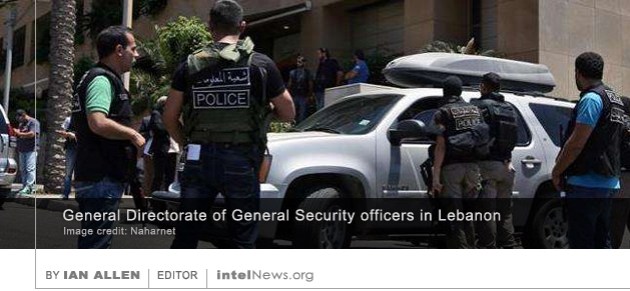
GDGS LebanonThe security services of Lebanon announced on Wednesday that they had arrested five foreign nationals who were allegedly spying of Israel. A brief statement issued by Lebanon’s General Directorate of General Security (GDGS, also known as the General Security Directorate) said the five individuals were members of a “spy ring” set up by the Mossad, Israel’s external intelligence agency. The five —three men and two women— are accused of contacting Israeli embassies in countries in the Middle East, Europe and Asia, with the aim of passing information about domestic Lebanese affairs.

The statement from the GDGS said the alleged spy ring consisted of two male holders of Lebanese passports, a Palestinian Arab man (passport not specified), and two women with Nepalese passports. It said that the five foreigners were interrogated and “confessed to the charges”, which include “spying for Israeli embassies abroad”. According to articles in the Lebanese media, the members of the alleged spy ring admitted that they had dialed telephone numbers that were operated by the embassies of Israel in: Amman, Jordan; Ankara, Turkey; London, United Kingdom; and Kathmandu, Nepal. The reports state that the five foreigners said the reason they contacted the Israeli embassies was to “pass on information”, but no specifics were offered.

According to An Nahar, Lebanon’s leading daily newspaper, the two Nepalese women had been tasked with recruiting other Nepalese women working in Israel as maids or nannies. The recruits were allegedly instructed to call telephone numbers belonging to Israel’s embassy in Nepal and share information about their employers’ activities. No information has been given about the identity and occupation of those who employed the domestic workers. The GDGS statement said that the agency was seeking to arrest “the rest of the culprits”, but did not specify whether these were members of the same alleged spy ring.

Author: Ian Allen | Date: 26 January 2017 | Permalink

Israeli officials were advised not to share intelligence with Trump’s White House

Donald TrumpAmerican intelligence officials allegedly warned their Israeli counterparts not to share intelligence with Washington once Donald Trump becomes president of the United States. The reason was that, according to the US officials, there was no guarantee that the intelligence would not be leaked to Russia. There was also the danger, they claimed, that the compromised intelligence would end up in the hands of Russia’s ally Iran, a regional adversary of Israel. The claim was made on Thursday by Ronen Bergman, senior political and military analyst for Israel’s largest-circulation daily newspaper, Yedioth Ahronoth.
According to Bergman, the American intelligence officials spoke in depth with their Israeli counterparts during a recent meeting between the two sides. He did not give details about the time and location of the meeting, so as “to protect the sources of the report”, he said. During the meeting, the US officials allegedly “voiced despair” over Trump’s electoral victory and his apparently poor relationship with the US Intelligence Community. They also suggested that Israeli intelligence officials should “be careful” when sharing intelligence with the White House or the US National Security Council, which is chaired by the president. The reason was that the intelligence —including sources and methods— might end up in the hands of the Kremlin, they said, and from there to Israel’s regional adversaries, such as Iran —and presumably Syria, though Bergman does not mention that.

The American officials further recommended that the Israelis wait until a clearer picture emerges of the alleged connections between Russia and the Trump campaign. It was also implied during the meeting that Trump may be subject to blackmail by Moscow and forced to reveal sensitive information relating to America and its allies, including Israel. According to Bergman, the Israelis are concerned about the Trump-Russia controversy and there are even some in Tel Aviv who raise fears of exposure of information given to the US by the Israeli intelligence community “over the past 15 years”. There has been no comment on the subject from Israel or Trump’s transition team.

Author: Joseph Fitsanakis | Date: 13 January 2017 | Permalink

Israeli military says Hamas lured its soldiers using online profiles of women

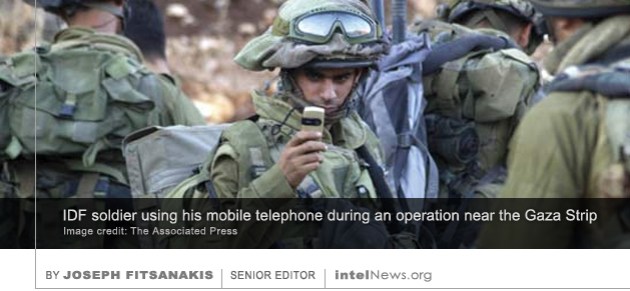
Cellular telephoneThe Israel Defense Forces told a press conference on Wednesday that hackers belonging to the Palestinian militant group Hamas lured Israeli soldiers by posing as young women online. Wednesday’s press conference was led by an IDF spokesman who requested to remain anonymous, as is often the case with the Israeli military. He told reporters that the hackers used carefully crafted online profiles of real Israeli women, whose personal details and photographs were expropriated from their publicly available social media profiles. The hackers then made contact with members of the IDF and struck conversations with them that in many cases became intimate over time. At various times in the process, the hackers would send the Israeli soldiers photographs of the women, which were copied from the women’s online public profiles.
The anonymous IDF spokesman said that, if the soldiers continued to show interest, they were eventually asked by the hackers posing as women to download an application on their mobile telephones that would allow them to converse using video. Once the soldiers downloaded the application, the ‘women’ would find excuses to delay using the application, or the relationships would abruptly end. But the soldiers would leave the application on their telephones. It would then be used by the Hamas hackers to take control of the camera and microphones on the soldiers’ mobile devices. According to the IDF spokesman, dozens of Israeli soldiers were lured by the Hamas scam. No precise number was given.

Media reports suggest that the Hamas hackers were primarily interested in finding out information about IDF maneuvers around the Gaza Strip, the narrow plot of densely inhabited territory that is controlled by the Palestinian militant group. They were also interested in collecting information about the size and weaponry of the Israeli forces around Gaza. Media representatives were told on Wednesday that the operation “had potential for great damage”. But the IDF claims that the harm to its operations was “minimal”, because it primarily targeted low-ranking soldiers. Consequently, according to the Israeli military, the hackers were not able to acquire highly sensitive information.

In 2009, dozens of members of Sweden’s armed forces serving with NATO’s International Security Assistance Force in Afghanistan were found to have been approached via Facebook, and asked to provide details on NATO’s military presence in the country. The Afghan Taliban are believed to have carried out the operation.

Hamas has not commented on the allegations by the IDF.

Author: Joseph Fitsanakis | Date: 12 January 2017 | Permalink

Lebanese president says Israel is behind businessman’s murder in Angola

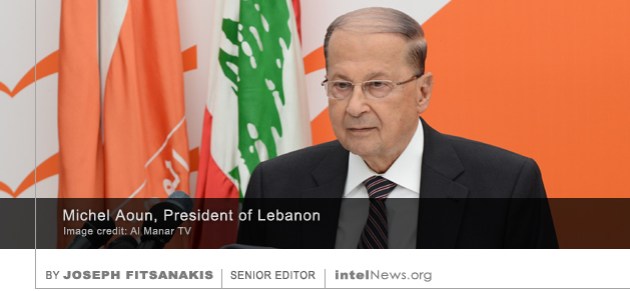
Michel AounThe president of Lebanon said on Wednesday that Israeli intelligence was behind the killing of a Lebanese businessman who was shot dead by a team of assailants last weekend in southwestern Africa. Amine Bakri, 54, who was from southern Lebanon, had lived and worked in Angola since his mid-20s. He was a well-known businessman in the Angola capital Luanda, where he owned a number of factories that make furniture and various medical equipment. On Sunday, Bakri was driving on an unpaved road in the Angolan capital, when his vehicle was ambushed by a group of three armed assailants. According to media reports, one of the men shot the windshield of Bakri’s car and then proceeded to shoot him in the head at close range. The men fled the scene and Bakri was transported to a local hospital, where he soon died from his wounds.
Initial reports stated that Bakri’s killing resulted from a botched robbery by a local gang of youths. But the murdered man’s nephew and business partner, Mohammad Maatuk, told Lebanese media that the men who ambushed his uncle were not interested in money. Maatuk told the Lebanese news website an-Nahar that the men did not give Bakri an opportunity to offer them money or other valuables. Instead they opened fire almost immediately and fled the scene in a calm, pre-arranged, professional manner, said Maatuk.

On Wednesday, the newly elected President of Lebanon, Michel Aoun, opened the weekly meeting of the Lebanese government by announcing that there was “information that the [Israeli intelligence agency] Mossad was behind this operation” to kill Bakri in Lebanon. He added that the Lebanese Ministry of Foreign Affairs and Immigration was “collecting information” in light of new evidence about Israel’s alleged involvement. According to media reports, Aoun did not provide details about the evidence that the Mossad was behind Bakri’s murder. Nor is there any information about the reasons why Israel might want Bakri dead.

Angola is home to a sizeable Lebanese community, whose members concentrate mostly in Luanda. As of this morning there has been no information about whether Amine Bakri was in any way related to Imad Bakri. Bakri, a Shiite Lebanese merchant in Luanda, has been identified in several intelligence reports as a link between the Shiite Lebanese militant group Hezbollah and UNITA, the Western-supported right-wing rebel group that lost in the Angolan Civil War and today is the country’s second-largest political party. Bakri’s body is expected to arrive in Lebanon today. It will be transported to the Iraqi Shiite city of Najaf, where he will be buried.

Author: Joseph Fitsanakis | Date: 05 January 2017 | Permalink

Mossad identified Hamas drone expert as principal target ‘years ago’: expert

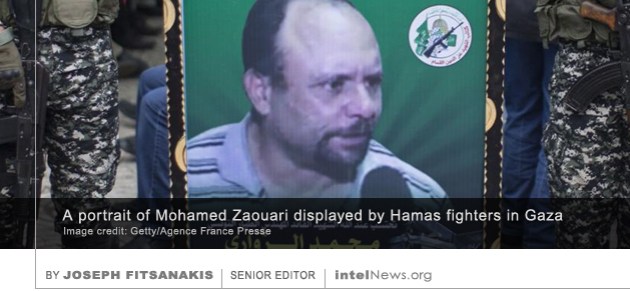
Mohamed ZaouariDespite persistent silence from Tel Aviv, commentators there seem increasingly convinced that Israeli spies were behind last week’s killing of an aviation engineer who worked for the Palestinian militant group Hamas. The man, Mohamed Zaouari, 49, was a Tunisian national who had spent over a decade creating an innovative aerial drone program for the Palestinian group that controls the Gaza Strip. He was reportedly shot dead outside his home in east-central Tunisia by an unidentified group of assailants carrying guns equipped with silencers. A statement issued on Saturday by the Qassam Brigades, the armed wing of Hamas, blamed Zaouari’s killing on the Mossad, Israel’s external intelligence agency.

Writing for the Israeli newspaper Yedioth Ahronoth, the veteran security correspondent Ronen Bergman said on Monday that Israeli spies had identified Zaouari “years ago” as a potential target. Bergman claims that Israeli intelligence agencies monitored Zaouari “as soon as he left Tunisia for [the Syrian capital] Damascus” over a decade ago. Eventually, the Israelis began to see Zaouari as a major contributor to efforts by Hamas and the Lebanese Shiite group Hezbollah to develop unmanned aerial vehicle programs. Through constant surveillance, Israeli intelligence was able to confirm that Zaouari was in regular contact with other Palestinian and Lebanese technical experts. The latter allegedly included Hassan Lakkis, a leading Hezbollah commander, who was one of the Shiite militant group’s primary weapons procurer and developer. Lakkis was killed on the evening of December 3, 2013, outside his home in Beirut, in circumstances that appear to be similar to last week’s killing of Zaouari in Tunisia.

Bergman argues that, if Israeli intelligence was indeed behind Zaouari’s killing, he was targeted because he was seen “as an increasingly dangerous element” and the Israelis believed that his death would cause Hamas “considerable damage”. The decision to target him in a distant location like Tunisia bore considerable risk, says Bergman, given that Zaouari was almost certainly aware that he was under threat from rival intelligence agencies and was taking precautions. Additionally, as the Mossad found out in the aftermath of the killing of Mahmoud al-Mabhouh in Dubai in 2010, the world is now “filled with cameras and biometric systems” that make covert operations dangerous. Consequently, these types of high-risk operations are reserved for principal targets whose removal will subtract strategic abilities from Israel’s adversaries. Bergman notes that, if Zaouari was killed by Israeli operatives, his death will mark one of the first major operations by the Mossad under the new leadership of Yossi Cohen, who was appointed as head of the secretive agency a year ago.

Author: Joseph Fitsanakis | Date: 20 December 2016 | Permalink

Hamas drone expert shot dead in Tunisia by assailants using gun silencers

Mohamed ZouariA senior aviation engineer who headed the unmanned aerial vehicle program of the Palestinian militant group Hamas, has been shot dead outside his home in Tunisia by a group of assailants using gun silencers. Mohamed Zaouari, 49, was a Tunisian national who had spent over a decade creating an innovative aerial drone program for Hamas, the Palestinian group that today controls the Gaza Strip. He had lived outside of Tunisia for much of his life, most recently in Syria, where he is believed to have worked as an engineer in a private firm, while also consulting with the Palestinian group. He had returned to Tunisia in 2011, following the upheaval in the country that sparked the so-called Arab Spring.
Zaouari was reportedly shot on Thursday in his hometown of Sfax, Tunisia’s second-largest city, located 170 miles southeast of the capital Tunis. Local media said he was shot dead at the wheel of his car, which was parked outside his home. His body was riddled with over 20 bullets, according to a police statement. On Friday, Tunisia’s Deputy Prosecutor General, Mourad Turki, said during a radio interview that several people are believed to have participated in Zaouari’s killing. Eight people had been arrested in connection with the crime, while at least two others were still at large, said Turki. All ten are believed to be Tunisian citizens. Among them is a woman, claiming to be a journalist, who has reportedly interviewed Zaouari in the past. She was allegedly arrested as she was boarding a flight from the Tunis-Carthage International Airport to the Hungarian capital Budapest. Additionally, officials from Tunisia’s Interior Ministry said that four rental vehicles had been seized in connection with Zaouari’s killing, and that two weapons equipped with silencers had been found in one of the vehicles.

A statement issued on Saturday by the Qassam Brigades, the armed wing of Hamas, said Zaouari had been a part of Hamas for a decade, and blamed his killing on the Mossad, Israel’s external intelligence agency. Hamas leaders said that Zaouari’s contribution to the organization would be celebrated during a specially designated “day of mourning”, and that his killing would be avenged. “The enemy must know the blood of the leader Zaouari will not go in vain”, said a statement issued by Hamas on Saturday. Israel has not responded to Hamas’ accusations. Tzachi Hanegbi, the Minister in the Prime Minister’s Office in charge of National Security and Foreign Affairs, said late on Saturday that Israel was “not connected” with Zaouari’s killing and added that “none of those people arrested are our allies”.

Author: Joseph Fitsanakis | Date: 19 December 2016 | Permalink

US, British intelligence agencies spied on Israelis and Palestinians, files show

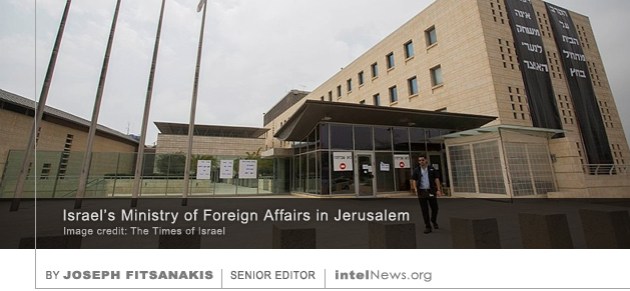
Israel’s Ministry of Foreign AffairsDocuments accessed by a French newspaper show that American and British intelligence agencies worked together to spy on diplomats, academic researchers and defense contractors in Israel and the Palestinian territories. Last year, the German newsmagazine Der Spiegel and the American newspaper The Wall Street Journal reported that the United States National Security Agency spied on senior Israeli politicians throughout the last decade, including Prime Minister Ehud Olmert and his successor, Benjamin Netanyahu. Now French daily Le Monde has alleged that the NSA teamed up with its British equivalent, the Government Communications Headquarters to spy on Israeli foreign service officials and diplomats, academic researchers and defense contractors. The newspaper also alleged that British and American spies targeted Palestinian government officials.

According to Le Monde, the information came from documents leaked by Edward Snowden, a former employee of the NSA and the Central Intelligence Agency, who is currently living in Russia. Snowden defected there in June 2013, after initially fleeing to Hong Kong with millions of stolen US government documents in his possession. In a leading article on Wednesday, the newspaper claimed that British and American spy agencies have systematically targeted senior officials in Israel’s Ministry of Foreign Affairs in Jerusalem. Several Israeli foreign service officials stationed abroad have also been targeted, said Le Monde, including Israel’s ambassadors to Nigeria and Kenya. But the Anglo-American intelligence alliance has also targeted Palestinian government institutions, including the Office of the Secretary General of the Palestinian Liberation Organization. Senior Palestinian officials that have been spied on include Ahmed Qurei, a former prime minister of the Palestinian National Authority, and Ahmad Tibi, a member of the Israeli Knesset who served as an advisor to Palestinian leader Yasser Arafat in the 1990s.

Palestinian diplomats stationed around the world have also been targeted by the NSA and the GCHQ, said Le Monde, in cities such as Paris, Brussels, Lisbon, Islamabad, Pretoria, and Kuala Lumpur. The documents also show that the two intelligence agencies have spied on Israeli defense contractors, including a company named Ophir Optronics, which works in the areas of laser and fiber optic technologies. Finally, the French newspaper said that research centers throughout Israel had been targeted, including scientific laboratories located at the Jerusalem-based Hebrew University.

Author: Joseph Fitsanakis | Date: 08 December 2016 | Permalink

Mossad had prior knowledge of Six-Day War plans, says Israeli ex-spy chief

first-post-hIsrael’s intelligence services had access to recordings of secret talks between Arab heads of state in 1965, which helped the Jewish state win the Six-Day War, according to the former director of the country’s Military Intelligence Directorate. The brief but important conflict, which is also known as the Third Arab-Israeli War, broke out on June 5, 1967, when the Egyptian, Syrian and Jordanian armies attacked Israel. But within hours the Jewish state had managed to decimate the assailants’ air forces, and went on to deliver fatal blows to its adversaries. By the end of the war, Israel’s territory had increased threefold and Israeli troops were in control of the West Bank, the Gaza Strip and the Sinai Peninsula, among other areas.

But according to Major General Shlomo Gazit, who directed Israel’s Military Intelligence Directorate in the 1970s, Israel’s victory was sealed in September 1965. At that time, a conference of Arab heads of state was held in Casablanca, Morocco, with the participation of senior Arab military commanders and intelligence chiefs. The centerpiece of the conference was a secret meeting where preparations were made for a war with the Jewish state. Participants discussed plans for setting up a joint Arab military command to coordinate the war and shared insights on the strength and state of readiness of their respective militaries.

Major General Gazit told the Israeli newspaper Yedioth Ahronoth that Morocco’s King Hassan II, who was mistrustful of his fellow Arab heads of state, invited the Israeli intelligence services to monitor the conference. Speaking to Yedioth Ahronoth’s military correspondent Ronen Bergman, Gazit said that a team of spies from the Mossad, Israel’s external intelligence service, and the Shin Bet, its domestic equivalent, arrived in Casablanca prior to the start of the conference. Acting on the King’s orders, Moroccan authorities designated an entire floor in the luxury hotel where the conference was held for the use of the Israelis. After the conference ended, King Hassan gave the Mossad copies of secret recordings of all closed-door meetings. These were promptly transcribed and translated into Hebrew by the Research Unit of Israel’s Military Intelligence Directorate, said Gazit.

According to the former spy chief, these transcripts produced “massive amounts of intelligence”. They were combined with other sources of information and crucially helped Israel anticipate the Six-Day War. Thanks to these recordings, said Gazit, Israel “was in full knowledge of how unprepared [the Arab forces] were for war”, especially the Egyptian forces, which were “in a terrible shape”. Israeli military commanders were thus certain that the Jewish state would prevail in an armed conflict with its Arab neighbors.

The public disclosure of the fact that the Mossad had access to the content of the secret negotiations between Arab leaders in 1965 is not new. Bergman and his fellow author Shlomo Nakdimon revealed it in a 2015 article about the broader intelligence relationship between Israel and Morocco in the 1960s and 1970s. But the latest revelation highlights the significance of the secret recordings for Israel’s military posture during the Six-Day War. Indeed, Bergman reports that, after the end of the war, Meir Amit, who was the then director of the Mossad, drafted a letter to Israel’s Prime Minster Levi Eshkol, in which he described the Casablanca operation as “one of the greatest moments of Israeli intelligence”.

Author: Joseph Fitsanakis | Date: 17 October 2016 | Permalink

Palestinian leader Mahmoud Abbas was KGB agent, researchers claim

Mahmoud Abbas

Mahmoud Abbas

Two Israeli researchers claim that a document from the archives of the Cold-War-era KGB identifies the current president of the Palestine Authority, Mahmoud Abbas, as a Soviet agent. The document was found in the United Kingdom, and was smuggled out of Russia by a former senior archivist of the Soviet KGB. Abbas is the leader of the largely secular Palestinian group Fatah, which controls the West Bank. Unlike Hamas, which is designated a terrorist group by Israel and its allies, Fatah is seen by Tel Aviv as the legitimate representative of the Palestinian people. That is disputed by Hamas, a religiously inspired group, which controls the Gaza Strip and maintains a tense relationship with Fatah and Abbas himself.

The allegation about Abbas’ past emerged on Wednesday in the Israeli media, after two local academic researchers disclosed the contents of a KGB document discovered at Cambridge University’s Churchill Archives Centre in Britain. The researchers, Gideon Remez and Isabella Ginor, of the Truman Institute at the Hebrew University of Jerusalem, said the document dates from 1983. It was found among thousands of similar documents that were secretly smuggled out of Russia in the early 1990s by British intelligence, following the defection of Vasili Mitrokhin, an archivist in the First Chief Directorate of the KGB during the Cold War. Some of the documents later formed the basis of a two-volume edition on the activities of Soviet intelligence, which was edited by Cambridge University Professor Christopher Andrew.

According to Remez and Ginor, the document identifies Mahmoud Abbas as a “KGB agent” based in Damascus, Syria, codenamed krotov, which in Russian means ‘mole’. Abbas was born in Palestine in 1935, but his family fled to Syria in 1948, following the establishment of the state of Israel and the outbreak of the first Arab-Israeli war. The young Abbas grew up in Damascus, where he went to university and joined the local branch of the PLO, the Palestinian Liberation Organization, of which Fatah is a member. If true, the allegation that Abbas worked for the KGB will not come as a surprise to observers of Palestinian politics. For most of the Cold War, the PLO was known to be close to Moscow, while Abbas was intimately involved with the Palestinian-Soviet Friendship Association, a pro-Moscow group that was widely seen as an agent of communist influence in the Palestinian territories. But the document from the Mitrokhin archives may be the first concrete evidence that Abbas was handled by the KGB.

Palestinian officials quickly dismissed the document on Wednesday as a fabrication and a deliberate slander. Mohammed al-Madani, a member of the central committee of Fatah, and a close associate of Abbas, said the allegation was part of a “clear effort to damage [Abbas] by various actors, including the government of Israel”.

Author: Joseph Fitsanakis | Date: 08 August 2016 | Permalink

American spy for Israel released after 30-year sentence ‘still a threat to US’

Pollard - aSenior United States intelligence officials have filed parole documents arguing that an American Navy analyst, who was recently released from prison after serving a 30-year sentence for spying for Israel, continues to pose a threat to national security. Jonathan Jay Pollard is a former intelligence analyst for the United States Navy, who has was jailed in 1985 for selling American government secrets to Israel. During his trial, the US government successfully argued that Pollard was one of the most damaging spies in American history, having stolen a high volume of classified documents in a relatively short period of time.
But Pollard was recently released from prison, having served his full 30-year sentence. However, as part of the conditions of his release, Pollard must consent to the US government having constant access to the hard drive of his personal computer and internet browsing history. He is also obligated to wear a GPS device at all times, which tracks his daily movements in New York, where Pollard has been living since his release from prison. Some intelligence observers, including Newsweek correspondent Jeff Stein, have voiced concerns that Pollard may be tempted to travel abroad in order to collect funds that his Israeli spy handlers may have deposited for him in offshore bank accounts as payment for his past acts of espionage.

Now Pollard’s lawyers have filed a legal brief arguing that his parole conditions are unnecessary and excessive, and that the US government should ease them considerably. However, documents filed late last week with the US Parole Commission by senior intelligence officers acting on behalf of the US Intelligence Community, make the case that Pollard’s parole conditions should continue unchanged. In a report published on Tuesday, the Daily Beast’s Shane Harris says the intelligence officers argue “forcefully” in the documents that Pollard “still poses a risk to national security”. One of the documents (.pdf), filed by Jennifer Hudson, Director of the Information Management Division at the Office of the Director of National Intelligence, uses particularly stark language in support of maintaining Pollard’s parole conditions. Hudson argues that “some of the sources and methods used to develop some of the intelligence exposed by Mr. Pollard not only remain classified but are still in use by the Intelligence Community today”.

Harris quotes an unnamed “former senior US intelligence official familiar with Pollard’s case”, who argues that the spy may have known which “up-and-coming” Israeli or other Middle Eastern leaders US intelligence had recruited or was trying to recruit as agents in the early 1980s. These individuals may today be in positions of prominence, and Pollard may be able to harm them. In her declaration filed with the Parole Commission, the ODNI’s Hudson argues that Pollard could also compromise information gathered from US agents in Israel and elsewhere, which could potentially reveal their identities. “Even in cases where [these agents are] no longer alive, such disclosure can place in jeopardy the lives of individuals with whom the source had contact”, she writes.

There is, of course, another reason too, says Harris, for the resistance put up by the US Intelligence Community against easing Pollard’s restrictions: “US spies don’t easily forgive, and they don’t forget”, he says. Pollard’s former colleagues are still angry about his monumental betrayal. The Daily Beast says it contacted one of Pollard’s lawyers for a comment, but there was no response.

Author: Ian Allen | Date: 22 June 2016 | Permalink

Elite Hamas military commander reportedly defects to Israel

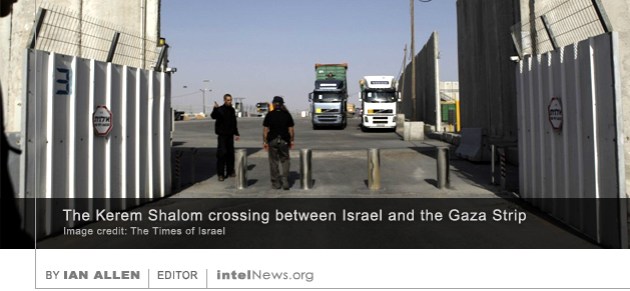
Kerem Shalom border crossingA senior member of the military wing of Hamas, the Palestinian militant group that governs the Gaza Strip, is believed to have defected to Israel. News of the rumored defection first appeared on the website of Al-Hayat al-Jadida, the official newspaper of the Palestinian Authority, which is based in the West Bank. On Tuesday, Al-Hayat said that the man, a member of the Izz ad-Din al-Qassam Brigades, Hamas’ military wing, had not been seen for several days.
The alleged defector was later named as Bassam Mahmoud Baraka, and reportedly comes from a well-known family in Kahn Younis, on the southern sector of the Gaza Strip. Baraka’s father is believed to be a religious judge that serves in Gaza under Hamas’ jurisdiction. According to Al-Hayat, the missing man is an elite member of the al-Qassam Brigades and specializes in operating inside the numerous underground tunnels that are said to span the entirety of the Palestinian enclave. The tunnels are of strategic importance to Hamas, as they secretly connect it with the outside world, despite Israeli efforts to prevent the trafficking of goods and people to and from the Gaza Strip. Some Israeli military officials believe that Hamas operatives are able to travel from one end of the Strip to the other without having to emerge from the ground. Since the 2014 Israeli invasion of Gaza, Tel Aviv has said that it views the elimination of Hamas’ vast underground tunnel network as a national security priority.

According to Palestinian websites, Baraka told members of his family that he was stepping out for a brief hike but never returned. He is believed to have voluntarily approached the border fence that separates Gaza from Israel and surrendered himself to a group of Israeli soldiers. Al-Hayat reports that Baraka’s family has already been informed from representatives of the Red Cross that he is in Israeli hands. Palestinian sources suggest that the Israeli soldiers that took in Baraka were aware of his pending defection and were waiting for him at the border. He was also reportedly carrying a laptop computer with him.

Israel is known to aggressively recruit informants in the Gaza Strip, many of them affiliated with Hamas. In 2010 it was revealed that Mosab Hassan Yousef, whose father is a senior Hamas official, was a secret informant for Shin Bet, Israel’s domestic security agency. Yousef defected to Israel and is now believed to be living in the United States.

Author: Ian Allen | Date: 15 June 2016 | Permalink

Ex-Mossad chief calls on Israel to speak with Hamas

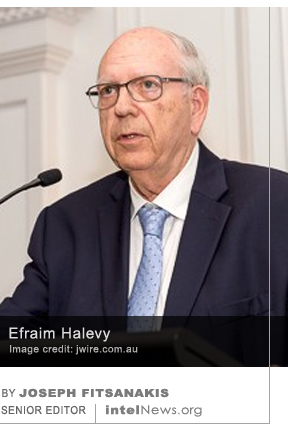
Efraim HalevyA former director of Israel’s Mossad intelligence agency has called on the Israeli government to reach out to Hamas, arguing that the Palestinian group is now ready to accept a peace settlement. Efraim Halevy directed the Mossad, Israel’s primary external intelligence agency, for five years before retiring in 2002. He is best known for helping forge a historic peace treaty between Israel and Jordan in 1994, which made the Hashemite Kingdom the second Arab country, after Egypt, to sing a peace accord with the Jewish state.
Halevy was speaking last week at an annual conference hosted in New York by the Israel-based newspaper The Jerusalem Post. During a panel entitled “Does the World Have an Answer to Islamic Terror?”, Halevy said it was time for Israel to speak to Hamas about the possibility of a peace treaty. The former Mossad director said he knew that “senior figures in the United States” had already established contacts with the Palestinian militant group, which controls the Gaza Strip. He also said that he knew “with certainty” that the leadership of Hamas was prepared to consider some kind of a “temporary settlement” based on the promise of the establishment of a Palestinian state along the pre-1967 Six-Day War borders. “The leadership of Hamas knows that they have no chance of destroying Israel”, said Halevy, adding that “now is the time to talk to Hamas”. According to the retired spy, a temporary settlement between Israel and Hamas that seeks to establish a Palestinian state would amount to a start in negotiations for a recognition of the state of Israel by Hamas. Halevy criticized Israel for refusing to speak with Hamas, saying that “as long as Israel refuses to talk with Hamas, and in the absence of any other alternative, [Hamas] has no option but to do what it does now”.

Last week was not the first time that Halevy has called for Israel to negotiate with Hamas. In July 2014, he told the American television network CNN that there were numerous radical groups in the Gaza Strip that were more threatening to Israel’s security than Hamas, not to mention Sunni Islamist groups like the Islamic State, which posed a much more pertinent challenge to regional stability. Two years earlier, n 2012, Halevy had issued a public call for dialogue between Israel and Iran, saying that “the Iranians, in their heart of hearts, would like to get out of their conundrum”, referring to Tehran’s nuclear program.

Author: Joseph Fitsanakis | Date: 01 June 2016 | Permalink

Israel, Egypt, Jordan, enter ‘unprecedented’ intelligence-sharing agreement

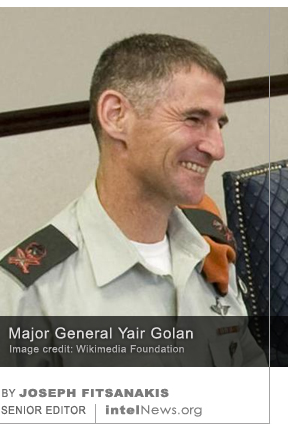
Yair GolanThe governments of Israel, Egypt and Jordan have entered an intelligence-sharing agreement aimed at joining forces against the Islamic State, which a senior Israeli military commander has described as “unprecedented”. The comment was made on Wednesday by Major General Yair Golan at a press conference hosted by Israel’s Foreign Press Association. General Golan has been serving as Deputy Chief of the General Staff of the Israel Defense Forces since late 2014.

Speaking to reporters in Jerusalem, General Golan said that intelligence was “the most important element in the whole system” when fighting an insurgency of the kind that the Islamic State is conducting in the Middle East. He went on to point out that Egypt is currently engaged in a war against Islamic State forces in the Sinai Peninsula, while “Jordan is terrified by the presence of the Islamic State in [its] cities and towns”. At the same time, Israel tries to “work with them in order to contribute something to their security”, he added, referring to Egypt and Jordan.

The two nations represent the only Arab countries that have signed peace treaties with the Jewish state. A peace treaty between Israel and Egypt was signed in 1979, whereas a similar agreement was struck between Israel and Jordan 15 years later, in 1994. General Golan cited the peace treaties between the three nations as the basis for the intelligence-sharing agreement. But he added that he would not describe the latter as “some sort of reconciliation” between Israel and the people of Egypt and Jordan. However, the agreement is “a good starting point”, he said, adding that he is “quite optimistic” about the future of Israel’s relations with Jordan and Egypt.

Author: Joseph Fitsanakis | Date: 21 April 2016 | Permalink

Romania arrests four Israelis on espionage charges

DIICOT RomaniaDIICOT RomaniaA Romanian agency tasked with security and counterterrorism has announced the arrest of four Israeli citizens on charges of hacking the email accounts of Romanian government officials. The arrests were announced on Thursday by Daniel Horodniceanu, chief of Romania’s Directorate for the Investigation of Organized Crime and Terrorism, known as DIICOT). In a press statement, Horodniceanu said the Israeli citizens are all employees of Black Cube, an Israeli security firm that is known for hiring former members of Israel’s intelligence and and special forces agencies. Among the company’s most high-profile board members was Meir Dagan, the former director of Israel’s Mossad intelligence agency, who died in March after a long illness.


Reports in the Romanian press have named two of the four Israeli citizens as Avi Yanus and Dan Zorella, both former members of the Israeli intelligence community, who are believed to be the founders of Black Cube. Two other Israelis, David Geclowicz and Ron Weiner, are accused of having hacked three email accounts belonging to a high-profile Romanian government agency tasked with anti-corruption efforts. Romanian media claim that the primary target of the Black Cube employees was Laura Codruta Kovesi, director of Romania’s National Anticorruption Directorate. Referred to as DNA, the agency was created in 2003 with the aim of combating serious organized crime and corruption in Romanian politics. The latter is seen by many in Romania as endemic and harmful to the country’s efforts to integrate fully into the European Union.

According to DIICOT, the arrests of the four Israelis were “preventive” and were prompted by an initial complaint filed against them by a former public prosecutor, Ion Lascu, who is Kovesi’s father. When approached by Israeli media, Black Cube confirmed that four of its employees had been arrested in Romania. However, it said its employees were careful to follow Romanian law and dismissed the espionage allegations against them as “unfounded and untrue”. In a statement, the company said it was recently hired to work on a project to collect intelligence on large-scale corruption in Romanian politics. The statement added that Black Cube employees were arrested “after having made significant discoveries” relating to the aforementioned project.

Late on Thursday, Romanian investigators said they were still trying to find out who hired Black Cube to work in Romania.

Author: Ian Allen | Date: 07 April 2016 | Permalink