Revealed: Decorated Nazi commander became Mossad assassin

Otto SkorzenyA notorious lieutenant colonel in the Waffen SS, who served in Adolf Hitler’s personal bodyguard unit, worked as a hitman for the Israeli intelligence agency Mossad after World War II, it has been revealed. Austrian-born Otto Skorzeny became known as the most ruthless special-forces commander in the Third Reich. Having joined the Austrian branch of the National Socialist German Workers’ Party at 19, at age 23 Skorzeny began serving in the Waffen SS, Nazi Germany’s conscript army that consisted largely of foreign-born fighters. In 1943, Hitler himself decorated Skorzeny with the Knight’s Cross of the Iron Cross, in recognition of his leadership in Operation EICHE, the rescue by German commandos of Italian fascist dictator Benito Mussolini, who had been imprisoned at a ski resort in the Apennine Mountains following a coup against his government.

Skorzeny survived the war and ended up living in Spain under the protection of the country’s far-right dictator, Francisco Franco. The Mossad, Israel’s covert-action agency, which had made it a priority to arrest or kill senior Nazis who had survived the war, intended to kill Skorzeny. However, two veteran Israeli intelligence observers, Dan Raviv and Yossi Melman, revealed on Sunday that, instead of killing Skorzeny, the Mossad decided to recruit him. Based on “interviews with former Mossad officers and with Israelis who have access to the Mossad’s archived secrets”, Raviv and Melman allege that Isser Harel, who directed the Mossad from 1952 to 1963, decided that the former Waffen SS commander would be a useful asset against other Nazis operating in Europe and the Middle East. Specifically, Harel planned to use Skorzeny as a trap to lure a number of Nazi scientists who were secretly working for Egypt’s missile program.

According to Raviv and Melman, a Mossad team was sent to Spain to meet Skorzeny. After a tense incident that involved Skorzeny pointing a loaded weapon at two Mossad operatives, the former Nazi soldier agreed to cooperate with Israel in return for assurances that his name would be removed from the Mossad’s assassination list. Raviv and Melman claim that one of Skorzeny’s most high-profile operations as an agent of the Mossad culminated in the assassination of Heinz Krug in Munich in 1962. Krug was a German rocket scientist who was working for the Egyptian government under the tutelage of Dr Wolfgang Pilz, another rocketry expert who had put together a top-secret missile program for Cairo. Krug was targeted for assassination by Yitzhak Shamir, Israel’s future prime minister, who was then commander of the Mossad’s clandestine operations service.

Krug, who was worried for his life after receiving threatening messages from individuals he believed were connected with the Mossad, reached out to Skorzeny in hopes that the former Waffen SS commander could give him advice on enhancing his personal security. But Skorzeny, operating on orders of the Mossad, shot dead the German scientist in a remote wooded area outside Munich. A Mossad team then poured acid on Krug’s body before burying it in a grave that had been dug in preparation for his killing. According to Raviv and Melman, Skorzeny also sent German scientists in Egypt a number of mail bombs designed by the Mossad, which killed a number of people. Raviv and Melman also state that they received oral confirmation from Rafi Eitan, a legendary Mossad operations officer, that he “met and ran Skorzeny” on behalf of the Israeli intelligence agency.

Skorzeny died of cancer in Spain in 1975. He was 67. It is believed that the Mossad never tried to kill or kidnap him.

Author: Joseph Fitsanakis | Date: 29 March 2016 | Permalink

NSA director made secret visit to Israel last week

Michael RogersThe head of the United States’ largest intelligence agency secretly visited Israel last week, reportedly in order to explore forging closer ties between American and Israeli cyber intelligence experts. Israeli newspaper Ha’aretz said on Sunday that Admiral Michael Rogers, who directs the United States National Security Agency (NSA), was secretly in Israel last week. The NSA is America’s signals intelligence (SIGINT) agency, which is responsible for electronic collection, as well as protecting US government information and communication systems from foreign penetration and sabotage.

According to Ha’aretz, Rogers was hosted in Israel by the leadership of the Israel Defense Forces’ SIGINT unit, which is known as Intelligence Corps Unit 8200. The secretive group, which is seen as Israel’s equivalent to the NSA, is tasked with collecting SIGINT from Middle Eastern locations and protecting Israel’s electronic information infrastructure from adversaries. According to the Israeli newspaper, Rogers’ visit was aimed at exploring ways in which the NSA and Unit 8200 can enhance their cooperation, especially against regional Middle Eastern powers like Iran or non-state groups like Hezbollah.

IntelNews readers will recall that the IDF’s Unit 8200 is viewed by some Middle East observers as the creator of the Stuxnet virus. Stuxnet is a sophisticated malware that is believed to have been designed as an electronic weapon against Iran’s nuclear program. Among these observers is New York Times correspondent David Sanger; in his 2012 book, Confront and Conceal, Sanger claimed that Stuxnet was designed by NSA and Unit 8200 programmers as part of a joint offensive cyber operation codenamed OLYMPIC GAMES. According to Sanger, the two agencies collaborated very closely between 2008 and 2011 in order to bring about Stuxnet and other carefully engineered malware, including Flame.

Ha’aretz said that Rogers’ visit was meant to solidify US and Israeli cooperation on offensive cyber operations, based on the legacy of Stuxnet and Flame. During his visit to Israel, the US intelligence official also met with the heads of other Israeli intelligence agencies, said Ha’aretz.

Author: Joseph Fitsanakis | Date: 28 March 2016 | Permalink
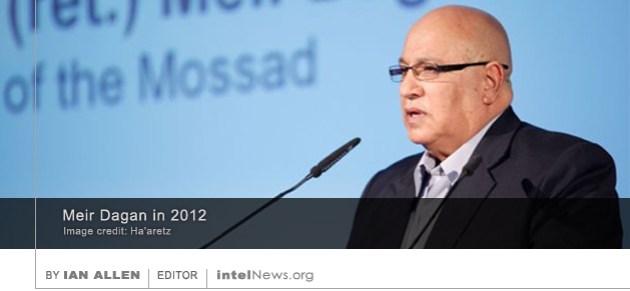
Controversial ex-Mossad director Meir Dagan dies in Tel Aviv

Meir DaganMeir Dagan, who directed the Israeli intelligence agency Mossad for a decade and emerged as a vocal critic of the Israeli government after his retirement, has died. A statement from his family said he died of liver cancer, a disease that prompted him to undergo a complex liver transplant operation in Belarus in 2012. But he suffered constant complications following his return to Israel, which led to his death on Thursday in Tel Aviv. Dagan was born Meir Hubermann in 1945 in Soviet Ukraine, and arrived with his family to Israeli in 1950. At age 18, he enlisted in the Israel Defense Forces and saw action in the 1967 Arab-Israeli war. In 2002, a few years after his retirement from the military with the rank of major general, Israeli Prime Minister Ariel Sharon appointed him to direct the Mossad, Israel’s primary intelligence agency.

During Dagan’s tenure, which spanned the rule of three Israeli prime ministers, the Mossad focused intensely on combating the Iranian nuclear program, using a variety of means ranging from alleged assassinations of Iranian scientists to cyber sabotage of Iranian nuclear facilities. However, like many other senior Israeli intelligence commanders, Dagan was strongly opposed to plans by the government of Benjamin Netanyahu to launch military strikes on Iran. Shortly after his retirement in 2011, Dagan spoke publicly against Netanyahu and senior members of his cabinet, including Minister of Defense Ehud Barak, who openly advocated the use of military force against Iran. In May 2011, Dagan condemned a possible Israeli attack on Iran as an act that would be “patently illegal under international law” and “the stupidest thing [he had] ever heard”. In June, hawkish Israeli Prime Minister Benjamin Netanyahu effectively stripped Dagan of his diplomatic passport, after the longtime Mossad Director called Israel’s leaders “reckless and irresponsible” people, who will not hesitate to engage in military adventurism in Iran to ensure their political primacy at home.

But Dagan continued to openly criticize the Israeli government, refusing to describe the Iranian nuclear program as an existential threat to Israel and calling instead for the establishment of a peace treaty with the Palestinians. He said in an interview in 2012 that, when he directed the Mossad, he could “block any perilous adventurism” in the Middle East; but after his retirement from the senior ranks of the agency, he feared that there was “no one to stop Barak and Bibi”, referring to Prime Minister Netanyahu by his nickname.

Dagan was 71. His burial took place on Sunday with full military honors in the town of Rosh Pina, in Israel’s northern district.

Author: Ian Allen | Date: 21 March 2016 | Permalink

Germans bill Israeli embassy after Mossad car gets stuck in mud

Mossad sealAuthorities in a northern German town have called on the Israeli embassy in Berlin to pay for the cost of extricating a car belonging to two Israeli spies, which was stuck in a mud pit in a restricted area. According to the Hamburg-based television station NDR, the incident occurred last December in Quarnbek, a coastal town in Germany’s Schleswig-Holstein state with a population of under 2,000. Two men were reportedly spotted late one afternoon driving a Ford Focus near a restricted area that is surrounded by a fence by the banks of the Kiel Canal. The men came across a locked gate to the restricted area, which, according to NDR, is clearly marked with “no trespassing” signs. However, they reportedly picked the lock and drove through the gate into the restricted area. Shortly afterwards, however, the Ford Focus got stuck in a mud pit inside the Kiel Canal restricted area.

As the two men unsuccessfully tried to get their car unstuck, night began to fall. An elderly resident spotted them and asked them if they were government employees. The men responded that they were there to survey the area in preparation for a sailing contest that was to take place in the Kiel Canal in the summer. But the resident became suspicious and called Quarnbek’s Mayor, Klaus Langer. In turn, the mayor called the police, which sent a team of officers to the restricted site. According to NDR, as soon as the two men spotted the police vehicle, they came out of their car and identified themselves as Israeli consular personnel with diplomatic immunity. They presented their credentials and informed the police officers that they were armed; indeed, two handguns were found in the Ford Focus.

German media reports said the police soon confirmed that the two men were officers of the Mossad, Israel’s primary external intelligence agency, and were in the region to accompany the transfer of the ThyssenKrupp submarine to Israeli hands. Known in Israel as the INS Rahav, the submarine was built in the Kiel shipyard on orders of the Israeli government. According to Mayor Langer, a team of local firefighters was dispatched to help extricate the Mossad officers’ car from the mud. Earlier attempts by a local farmer to extricate the car using a forklift had apparently failed. The Ford Focus was eventually extricated and the two Mossad agents were allowed to leave. Shortly afterwards, Mayor Langer, who was elected as a member of the Green Party, sent the Israeli embassy in Berlin a bill for $1392.28 to cover the cost of the extrication. According to recent reports, the Israelis said they intend to pay up.

Author: Joseph Fitsanakis | Date: 09 March 2015 | Permalink

Israel says it foiled attempt to smuggle spy drones into Gaza

spy droneAuthorities in Israel said on Sunday that they foiled a plan to smuggle dozens of spy drones from Israel into the Gaza Strip. The Israeli Ministry of Defense said in a statement late on Sunday that the drones had been detected by members of the Shin Bet, Israel’s security police. The incident reportedly took place at Kerem Shalom, a major border crossing in to Gaza, a Palestinian enclave that is controlled by Hamas. The Defense Ministry statement also said that Sunday’s incident was only the latest in a string of recent attempts to smuggle spy drones into Gaza, all of which had been stopped by the Shin Bet since January.
According to the Israeli government report, the spy drones were found hidden inside boxes of toys that had been marked for export to Gaza. The drones were of different sizes, types and capabilities, but all were equipped with sophisticated cameras and related software, said the report. Israeli media reported on Sunday that, according to Israeli government sources in Tel Aviv, the drones were almost certainly going to be used by Hamas to spy on possible targets inside Israel. A source in the Israeli Department of Defense said Hamas was known to employ drones in order to explore and map the terrain that is adjacent to the Gaza Strip.

In March of last year, Egyptian authorities reported seeing several spy drones flying out of the Gaza Strip and conducting reconnaissance over Egyptian airspace in the Sinai Peninsula, which borders Gaza. According to some reports, a number of the spy drones that flew out of Gaza were seen as far as 50 kilometers (35 miles) inside Egyptian territory. The latest information from Israel is that the government in Tel Aviv believes that the pattern and frequency of attempts to smuggle spy drones into the Gaza Strip justify an investigation, which is now underway.

Author: Ian Allen | Date: 22 February 2016 | Permalink

Concerns about Israeli spying prompt debate on EU security measures

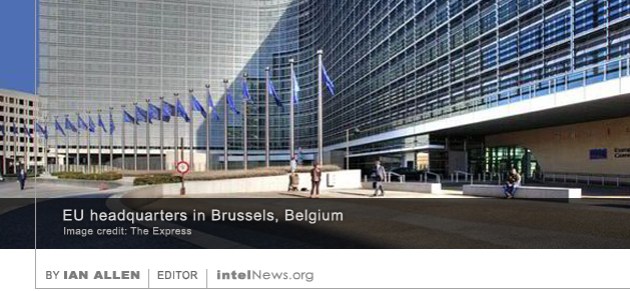
EU headquartersA debate on information security measures in the European Union was prompted last week after some officials voiced concerns that the proceedings of a closed-door meeting were secretly monitored by Israel. The meeting took place on January 15 as part of regular proceedings by the EU’s Political and Security Committee (PSC). The main item on the agenda was the EU’s Middle Eastern policy. According to some meeting participants, Israeli diplomats appeared to be aware of a statement discussed during the PSC meeting “in real time”, which prompted a wider debate on EU information security policies.
According to the Brussels-based EU Observer, which reported on the story, EU member state ambassadors present at the meeting worded a statement that contained a sentence deemed critical to Israel’s policy on Palestine. The sentence allegedly stated: “The EU will continue to unequivocally and explicitly make the distinction between Israel and all territories occupied by Israel in 1967”. According to some ambassadors who were present at the PSC meeting, “Israeli contacts sent text messages to them with requests to alter wording shortly after each new draft [of the PSC statement] went around”. Further suspicions were raised when, at the conclusion of the meeting, the Greek delegate vetoed the contentious line, standing alone against the remaining 27 delegates who had earlier supported it.

Last week, sources told the EU Observer that Israel may have placed bugs in the room where the PSC meeting took place. They added that the committee was debating whether to begin holding meetings in a secure room located in the EU headquarters building in Brussels, where the use of cell phones by meeting participants is not possible. They also said that a stricter classification policy should apply to PSC documents. Others, however, said that the source of the leak may have been the Greek delegate —the sole participant at the meeting who assumed a seemingly pro-Israeli stance. The Greek ambassador may have shared the details of the proceedings with Israeli officials, thus effectively spying on the conference on behalf of Israel, speculated the EU Observer. Another PSC meeting delegate told the paper that “the spy theory” was effectively concocted “in order to avoid confrontation” with the Greek delegation.

The EU Observer contacted the Greek mission to the EU, but was told that the Greek ambassador would never spy on the EU “as a matter of principle”. The Israeli mission to the EU declined to comment.

Author: Ian Allen | Date: 15 February 2016 | Permalink

Joint British-American operation hacked Israeli drones, documents show

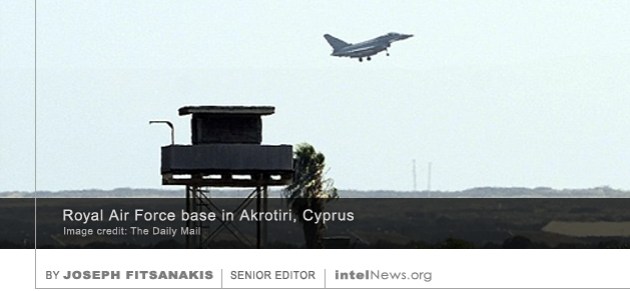
RAF base CyprusBritish and American intelligence services worked together to hack Israeli unmanned aerial vehicles in order to acquire information on the Jewish state’s military intentions in the Middle East, according to documents leaked last week. Online publication The Intercept, said the operation was code-named ANARCHIST and was a joint project of Britain’s General Communications Headquarters (GCHQ) and America’s National Security Agency (NSA). The publication said it acquired documents about the operation from former NSA contractor Edward Snowden, who defected to Russia in 2013 and was offered political asylum by Moscow.

In an article published on Thursday, The Intercept said the joint GCHQ-NSA operation was headquartered in a Royal Air Force military facility high on the Troodos Mountains in the Mediterranean island of Cyprus. The documents provided by Snowden suggest that British and American spies were able to collect footage captured by the Israeli drone for at least two years, namely in 2009 and 2010. It is not clear whether that period included the first three weeks of January 2009, when the Gaza War was fought between Israel and Hamas. During that time, there were persistent rumors that Tel Aviv was seriously considering launching air strikes against Iran.

According to The Intercept, the main goal of operation ANARCHIST was to collect information about Israeli “military operations in Gaza” and watch “for a potential strike against Iran”. Additionally, the UK-US spy program “kept tabs on the drone technology Israel exports around the world”, said the article. According to one GCHQ document cited by The Intercept, the access to Israeli drone data gained through ANARCHIST was “indispensable for maintaining an understanding of Israeli military training and operations”.

Speaking on Israel’s Army Radio on Friday, Israel’s Minister for National Infrastructure, Energy and Water, Yuval Steinitz, said he was not surprised by the revelations. “We know that the Americans are spying on the whole world, including their friends”, said Steinitz. But it was “disappointing”, he said, given that Israel had “not spied” on the US “for decades”. Israeli intelligence agencies had “not collected intelligence or attempted to crack the encryption of the United States”, said the Minister, implying that recent revelations of US spying on Israel may cause a change of strategy in Israeli intelligence policy.

Author: Joseph Fitsanakis | Date: 01 February 2016 | Permalink

Switzerland made secret deal with PLO in the 1970s, new book alleges

Yasser ArafatSwitzerland secretly agreed in the 1970s to support calls for Palestinian statehood, in return for not being targeted by Palestinian militants, according to a new book. Written by Marcel Gyr, a journalist with the Zurich-based Neue Zürcher Zeitung, the book alleges that the Swiss government took the unprecedented step of contacting Palestinian militants in 1970. According to Gyr, the move followed a series of attacks against Israeli targets in Switzerland by several Palestinian armed groups. In February 1969, Palestinian militants fired on an El Al airliner at Zurich’s Kloten Airport, killing the pilot. A year later, a Swissair Flight 330 from Zurich to Hong Kong with a stopover In Tel Aviv, Israel, exploded in mid-air, killing nearly 50 passengers and crew. The Syrian-backed Palestinian group Popular Front for the Liberation of Palestine – General Command (PFLP-GC) later claimed responsibility for the attack. In September 1970 another Swissair flight, headed to the United States, was hijacked and diverted to Jordan, where its passengers were held hostage.

It was during the latter incident, claims Gyr, that Switzerland’s Minister of Foreign Affairs, Pierre Graber, clandestinely contacted the Palestine Liberation Organization (PLO), the umbrella group that coordinated the activities of a multitude of Palestinian armed groups. Gyr alleges that Graber reached out to the PLO without informing his colleagues in the cabinet, and that he used a junior Swiss parliamentarian as an envoy and intermediary. Eventually, the PLO, which at the time was led by Yasser Arafat, agreed to release the hostages. He also offered to stop launching armed attacks, hijackings, and other violent operations on Swiss soil. In return, claims Gyr, Switzerland would agree to quietly abandon the investigation into the bombing of Swissair Flight 330, and to push for diplomatic recognition of the PLO as the legal representative of the Palestinian people.

Gyr claims that both sides kept their side of the bargain. The Swiss government gradually abandoned the investigation into the bombing of Swissair Flight 330. The country also led European efforts to offer diplomatic status to the PLO. Meanwhile, although the war between the PLO and Israel continued throughout Europe, no Palestinian attacks ever took place again on Swiss soil. Responding to Gyr’s book, Switzerland’s current Minister of Foreign Affairs, Didier Burkhalter, said he had no idea about the secret agreement and that he was “very surprised indeed” to know about it. Some Swiss political figures have asked for the establishment of a parliamentary inquiry to investigate Gyr’s allegations. It is unclear whether such a committee would have access to hundreds of thousands of pages about the Palestinian attacks in Switzerland, which today remain classified.

Author: Joseph Fitsanakis | Date: 25 January 2016 | Permalink

US ‘spied on Israeli prime minister’ during Iran nuclear talks

Netanyahu and ObamaAmerican intelligence agencies spied on Israeli Prime Minister Benjamin Netanyahu during the negotiations between the United States and Iran over the Islamic Republic’s nuclear program, according to officials. Tehran entered a deal, referred to as ‘the Geneva pact’, following drawn-out negotiations with a group of nations that came to be known as P5+1, representing the five permanent members of the United Nations Security Council plus Germany. The government of Israel, however, strongly criticized the negotiations. Prime Minister Netanyahu called the pact a “historic mistake” that would enable “the most dangerous regime in the world” to get closer to “attaining the most dangerous weapon in the world”. Israel’s strong reaction, which included open criticism of US President Barack Obama, caused some in the US to accuse Tel Aviv of trying to “manipulate American institutions”, while the White House did not hide its frustration with the Israeli leader.
Last week, The Wall Street Journal said in a leading article that the Obama administration spied systematically on Prime Minister Netanyahu, whom it suspected of actively trying to kill the Geneva pact. Citing interviews with “over two dozen past and present US officials”, The Journal claimed that the National Security Agency, America’s leading signals-intelligence collector, intercepted the communications between the Israeli prime minister and his senior advisors. The main purpose of the spy program was to find out whether the government of Israel was considering launching military strikes on Iran without first notifying Washington. Such a possibility was eventually ruled out. But in the process the NSA was able to listen in to private conversations between a number of senior Israeli government officials and American lawmakers. The latter were critical of the White House’s efforts to strike a deal with Iran, and were specifically asked by Israeli officials whether Israel could count on them to vote against the Geneva pact in Congress.

The NSA was also able to intercept conversations between Israeli leaders and American members of pro-Israel groups operating in the US. The newspaper implies that the Israeli leaders coached the Americans on how to campaign against the Geneva pact. Ironically, the NSA intercepts showed that Israel was itself spying on America in an effort to access inside information on the negotiations with Iran. The paper said that the Israelis would then regularly leak the information they acquired through espionage, in an effort to sabotage a possible deal. The Journal said it contacted the US National Security Council for a comment, and was told by a media representative that the US does “not conduct any foreign intelligence surveillance activities unless there is a specific and validated national security purpose. This applies to ordinary citizens and world leaders alike”, said the spokesman, refusing to elaborate.

Author: Joseph Fitsanakis | Date: 04 January 2016 | Permalink

Israel silent after assassination of key Hezbollah figure in Damascus

Samir Kuntar Israel has refused comment following the death of a senior official of Lebanese militant group Hezbollah, who was killed on Saturday in a missile strike in Syria. Samir Kuntar (also spelled Qantar) was a Druze who joined the Syrian-backed, Lebanese-based, Palestine Liberation Front (later Popular Front for the Liberation of Palestine – General Command) at a young age. In 1979, Kuntar was jailed for an attack on an apartment block in Israel’s northern coastal town of Nahariya, which resulted in the death of four Israeli civilians and two of the attackers. However, he was freed after nearly three decades in prison in exchange for the bodies of two Israel Defense Force soldiers, who had been captured and executed by Hezbollah in 2006.

Since his high-profile release, Kuntar was believed to have risen in the ranks of Hezbollah, and to have become a major operational figure in the Lebanese militant group. In September of this year, the United States Department of State officially designated Kuntar a Specially Designated Global Terrorist. This designation, under US Executive Order 13224, denoted that Kuntar posed a significant and immediate terrorist threat to American interests. A statement issued by the US State Department at the time described Kuntar as one of Hezbollah’s “most visible and popular spokesmen”, and said he also had an operational role in the organization.

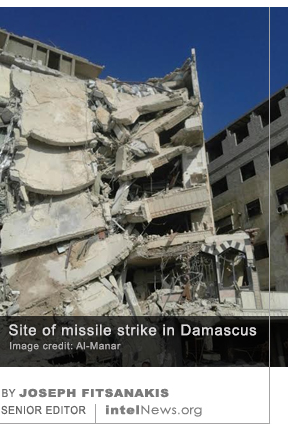
Kuntar was reportedly killed alongside eight other people when a barrage of missiles hit a residential building in the Damascus suburb of Jaramana. A statement by Hezbollah-controlled television station Al-Manar said four long-range missiles were fired by two “Israeli warplanes” that appeared to target the residential building. Based on footage aired by Al-Manar, the multi-story building appears completely destroyed. Moreover, at least one other Hezbollah senior commander, Farhan al-Shaalan, is said to have died in the strike.

Although Hezbollah officially accused “the Zionist entity” for the missile strikes, Israel has refused comment on Kuntar’s killing. When asked for a response by reporters on Sunday morning, Israeli Minister for Construction and Housing Yoav Gallant said he was happy that Kuntar was dead, but stopped short of confirming that Israel was behind the killing.

Author: Joseph Fitsanakis | Date: 21 December 2015 | Permalink

Speculation ends as Israeli prime minister appoints new Mossad chief

Yossi Cohen and Benjamin NetnayahuMonday brought an end to weeks of speculation in Israel, as Prime Minister Benjamin Netanyahu appointed the new director of the Mossad, the Jewish state’s national intelligence agency. At a hastily announced press conference in Jerusalem, Netanyahu said he had chosen Yossi Cohen for the post. A 30-year veteran of the Mossad, Cohen left the intelligence agency in 2013 to chair Israel’s National Security Council and advise the prime minister. Cohen, 54, who has four children, grew up in Jerusalem and became a fighter pilot before joining the Mossad. He gradually rose through the ranks to become deputy director at the agency. Prior to that, he led for several years the Mossad’s Department of Collections, which handles operations officers around the world.
More recently, Cohen led the agency’s Political Action and Liaison Department, which is tasked with facilitating cooperation between the Mossad and foreign intelligence agencies. From that position, he witnessed the worsening relations between Israel and the United States, as Washington struck closer relations with Iran despite Tel Aviv’s strong objections. That unprecedented development sparked a fierce internal debate between the Israeli intelligence community and the executive. The debate culminated when the Mossad’s outgoing Director, Tamir Pardo, objected to Prime Minister Netanyahu’s hardline stance on Iran. In 2011, Pardo, who will be stepping down from his post in January after 5 years at the helm, opined that the Iranian nuclear program was not an existential threat to Israel and that the Jewish state should concentrate instead on its dispute with the Palestinians.

Cohen, who is one of Netanyahu’s most trusted advisers, is expected to bring the Mossad closer to the prime minister’s office. He was reputedly one several candidates for the post, and was chosen from a list that included the Mossad’s former Deputy Director Rami Ben-Barak —currently at the helm of Israel’s Ministry of Intelligence Affairs— and the agency’s second-in-command, who is known publicly only as “N”. Following Monday’s announcement by Netanyahu, which came after an unexplained hour-long delay, there were rumors of last-minute complications with Cohen’s appointment. But The Times of Israel quoted an unnamed “senior diplomatic official” as saying that there had been “no last minute drama [or] pressures” prior to Netanyahu’s announcement.

Author: Joseph Fitsanakis | Date: 08 December 2015 | Permalink

Marcus Klingberg, highest-ranking Soviet spy ever caught in Israel, dies

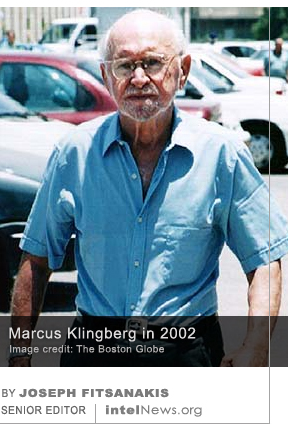
Marcus KlingbergMarcus Klingberg, who is believed to be the highest-ranking Soviet spy ever caught in Israel, and whose arrest in 1983 prompted one of the largest espionage scandals in the Jewish state’s history, has died in Paris. Born Avraham Marek Klingberg in 1918, Klingberg left his native Poland following the joint German-Soviet invasion of 1939. Fearing persecution by the Germans due to his Jewish background, and being a committed communist, he joined the Soviet Red Army and served in the eastern front until 1941, when he was injured. He then received a degree in epidemiology from the Belarusian State University in Minsk, before returning to Poland at the end of World War II, where he met and married Adjia Eisman, a survivor of the Warsaw Ghetto uprising. Together they moved to Sweden, from where they emigrated to Israeli in 1948. It is believed that Klingberg was recruited by the Soviet KGB while in Sweden, and that he moved to Israel after being asked to do so by his Soviet handlers –though he himself always denied it.

Soon after arriving to Israel, Klingberg joined the Israel Defense Force, where he advanced to the rank of Lieutenant Colonel. In 1957, he joined the Israel Institute for Biological Research (IIBR), a government outfit that conducted classified research for Israel’s biological and chemical weapons program. Klingberg worked at Ness Ziona, a top-secret government facility that conducted research on some of the most advanced chemical and biological weapons in the world. Eventually, he rose to the position deputy scientific director at IIBR, a post that he held until 1972. Additionally, Klingberg enhanced his international profile as a leading epidemiologist and conducted research in universities in Europe and the United States. Throughout that time, he was regularly passing classified information to the KGB at meetings with his handlers in Europe.

The Soviets had painstakingly trained Klingberg in espionage tradecraft, a set of skills that came in handy in the early 1960s, when the Shin Bet, Israel’s counterintelligence agency, began suspecting him of spying for a foreign intelligence service. The Shin Bet began systematically monitoring Klingberg. After failing to get results, the agency gave Klingberg a lie detector test, which he passed on the first try. Meanwhile, the Soviet government secretly awarded Klingberg the Order of the Red Banner of Labor, in recognition of the quality of the information he had passed on to the KGB. In 1982, a Soviet defector to Israel confirmed that Klingberg was indeed a KGB spy. Shortly afterwards, the Shin Bet approached Klingberg and asked him to accompany a top-secret team of Israeli technical experts to Malaysia, where a chemical plant had exploded. But instead of taking the scientist to the airport en route to Malaysia, the government car that picked him up from his house drove him to a Shin Bet safe house. After being interrogated there for nearly two weeks, Klingberg confessed to being a Soviet spy, saying he had decided to join the KGB for ideological reasons. However, in a 2014 interview with British newspaper The Observer, Klingberg claimed that he felt morally indebted to the USSR “for saving the world from the Nazis”.

Klingberg was tried in secret and sentenced to 20 years in prison. He then disappeared inside Israel’s prison system, having been given a false name and occupation by the Israeli authorities. He spent the first 10 years of his prison sentence in solitary confinement. In 1998, following pressure from human-rights groups, the Israeli government agreed to place Klingberg under house arrest, providing he was able to cover the financial cost of his detention. In 2003, having served his 20-year sentence, Klingberg was allowed to leave Israel and settle in France, where his daughter and son-in-law were living. He spent the last years of his life in Paris, where he died on November 30. He was 97.

Author: Joseph Fitsanakis | Date: 3 October 2015 | Permalink

US to release Israeli spy after 30 years in prison

Jonathan PollardA United States Navy intelligence analyst, who has served 30 years of a life sentence for spying on America for Israel, is set to be freed on Friday. Many in US counterintelligence consider Pollard, who acquired Israeli citizenship in 1995, as one of the most damaging double spies in American history. But he is widely viewed as a hero in Israel, and many Israelis, as well as pro-Israel Americans, have pressured the US administration of President Barack Obama to release him. There is intense speculation in Washington that Pollard is being released in order to quieten Israeli criticism of a recently struck international agreement on Iran’s nuclear program.

The Wall Street Journal published an article in July of this year, suggesting that the Obama administration was “preparing to release” Pollard. Citing unnamed US officials, the paper claimed Washington hoped that the move would “smooth [America’s] relations with Israel in the wake of the Iran nuclear deal”. The latter was signed last summer between Tehran and the so-called P5+1 nations, namely the five permanent members of the United Nations Security Council plus Germany. The New York Times added to the speculation soon afterwards with a detailed front-page article, which confirmed that “some in Washington appeared to be highlighting” Pollard’s upcoming 30-year parole hearing in November. It added that the White House had been contemplating using Pollard’s release to appease, not only Tel Aviv, but also pro-Israel supporters in Congress, many of whom have campaigned for years in favor of Pollard’s release.

As intelNews reported back in July, Newsweek’s veteran intelligence correspondent Jeff Stein responded to the news of Pollard’s release by posing an interesting question: when Pollard is released, will he have access to close to $1 million in spy wages that his Israeli handlers are reputed to have deposited for him in a Swiss bank account? In his article, Stein wondered whether Israel had continued to deposit $30,000 a year in Pollard’s reputed Swiss bank account, which is a standard practice for intelligence agencies. If the answer is yes, then the amount available today would be in the neighborhood of $1 million. If Pollard moves to Israel following his release on Friday, as many believe he will, will he then have access to the money he earned by spying on the US government as an unregistered agent of a foreign power? And if so, how should this be expected to affect the already rocky relations between Washington and Tel Aviv?

Stein quoted Pollard’s New York lawyer, Eliot Lauer, who called the rumors of a secret Swiss bank account “poppycock” and added that Pollard had “secured employment and housing […] in the New York area”. Additionally, there are some who speculate that Pollard may not be allowed to leave the US as part of the conditions of his parole. At this stage, however, nobody knows for sure.

Author: Joseph Fitsanakis | Date: 20 November 2015 | Permalink

Israeli military warns its soldiers against recruitment attempts by the CIA

First Post HIsrael’s military intelligence agency has issued a warning to all soldiers in the Israeli armed forces to resist attempts by the United States Central Intelligence Agency (CIA) to recruit them. The existence of the highly unusual warning was revealed on Sunday by Chanel 2, one of Israel’s most popular television stations. According to the report, the communique was sent to every member of the Israel Defense Forces (IDF) by the Military Intelligence Directorate (MID). It cautioned Israeli troops to “be alert and report any unusual incidents” involving American intelligence personnel. The warning made specific reference to the CIA, saying it might be trying to recruit Israeli soldiers as informants.
The communique references a real-life case that is believed to have taken place three years ago, involving several Israeli citizens who had served in the MID. According to media reports, the Israelis, who were traveling to the US, were stopped during passport control and questioned at length by American officials. The latter, who were presumed to be CIA personnel, were alleged to have tried to persuade the Israelis to provide information about their military duties and knowledge of Israeli military affairs. But the Israelis reportedly refused to cooperate with the Americans and reported the incidents to their superiors in the Israeli military.

It is not unusual for the MID to issue warnings regarding soldiers’ use of online social media, or on topics such as confidentiality and discretion when using non-encrypted telephone networks. However, such warnings are typically only communicated to MID personnel and never mention foreign intelligence agencies by name, opting for generic language instead. It is highly unusual for such warnings to identify foreign intelligence agencies, and allied ones at that. The recent move has thus prompted intense speculation in Israel that the MID may have reacted to actual attempts by the CIA to recruit IDF personnel.

An Israeli military spokesperson told Channel 2 that the MID had indeed sent soldiers a written warning about possible recruitment attempts by the CIA. But the representative refused to discuss why the CIA was mentioned in the letter, or why the warning was issued last week.

Author: Joseph Fitsanakis | Date: 02 November 2015 | Permalink

Israeli nuclear whistleblower recalls his 1986 capture by the Mossad

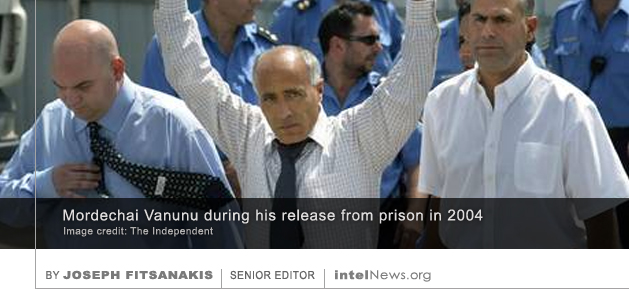
Mordechai VanunuIsraeli nuclear whistleblower Mordechai Vanunu, who spent 18 years in prison for revealing the existence of Israel’s nuclear program, has spoken for the first time about his 1986abduction by the Mossad in Rome. Vanunu was an employee at Israel’s top-secret Negev Nuclear Research Center, located in the desert city of Dimona, which was used to develop the country’s nuclear arsenal. But he became a fervent opponent of nuclear proliferation and in 1986 fled to the United Kingdom, where he revealed the existence of the Israeli nuclear weapons program to the The Times of London. His action was in direct violation of the non-disclosure agreement he had signed with the government of Israel; moreover, it went against Israel’s official policy of ‘nuclear ambiguity’, which means that the country refuses to confirm or deny that it maintains a nuclear weapons program.


Soon after Vanunu settled in London, the Israeli intelligence agency Mossad began making plans to capture him. The spy agency sent one of its American-born female officers, Cheryl Bentov, to befriend Vanunu. The decision was taken after Mossad psychologists determined that Vanunu was lonely and longed for female companionship. Masquerading as an American tourist by the name of ‘Cindy’, Bentov convinced Vanunu to go with her on Vacation to Rome, Italy. Soon after the couple arrived in the Italian capital, Vanunu was abducted by a Mossad team who injected him with a paralyzing drug before taking him away in a van. Vanunu was then transferred onboard the INS Noga, an Israeli signals-intelligence ship masquerading as a merchant vessel, which transported him to Israel. He was convicted to 18 years in prison and was released in 2004, after having spent 11 years in solitary confinement.

On Wednesday, Israel’s Channel 2 television showed excerpts of Vanunu’s first-ever interview to an Israeli media outlet. The interview, which is to be aired in full on Friday, includes Vanunu’s personal account of his capture by the Mossad. He told the interviewer that ‘Cindy’ first spoke to him as she walked alongside him while the two of them were crossing a London street. But he said that it was he who “initiated the relationship” with the woman posing as an American tourist. That was a critical moment in the whole process, said Vanunu, because “if she initiates you’ll suspect her”. The nuclear whistleblower insisted, however, that he did not “fall in love with her”, as some accounts of the Mossad operation have suggested, though he was “definitely attracted” to her, he said.

Vanunu added that the thought of ‘Cindy’ being a Mossad officer had initially crossed his mind; but he disregarded it and did not realize he was being tricked “until the very last moment”. He told Channel 2 that even after several days after his capture, he still believed that ‘Cindy’ had also been abducted. It was only later that he “reached the conclusion that she was part of the plan”, he said. At another point in the interview, Vanunu said that ‘Cindy’ was not the only Mossad officer who had tried to befriend him while he was in London, but that he was able to detect every other attempt by Israeli intelligence operatives.

Author: Joseph Fitsanakis | Date: 03 September 2015 | Permalink