Police investigate mysterious disappearance of close WikiLeaks associate
September 5, 2018 1 Comment
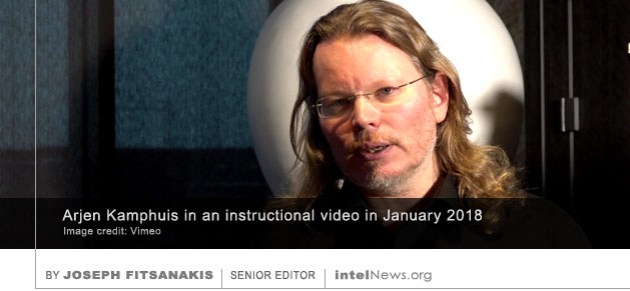 Police in Norway and Holland have opened formal investigations into the whereabouts of a Dutch cybersecurity expert and senior associate of WikiLeaks, who disappeared without trace on August 20. Arjen Kamphuis, a 47-year-old online privacy specialist, is known for his book Information Security for Journalists, which offers advice on investigative reporters working on national security and intelligence matters. Additionally, Kamphuis, who has Dutch citizenship, is a close associate of Julian Assange, founder of the international whistleblower website WikiLeaks.
According to reports, Kamphuis was last seen in Bodo, a town of 50,000 people located in Norway’s arctic region. Witnesses say that on August 20, Kamphuis checked out of his hotel in the center of Bodo and headed on foot to the town’s main railway station, where he planned to catch a train to Trondheim, Norway’s third largest city. From there he was scheduled to fly to the Dutch capital Amsterdam on August 22. However, it is not known whether Kamphuis ever boarded the 10-hour, 500-mile train ride to Trondheim. He certainly did not board his flight to Amsterdam and has not been heard from since he left his Bodo hotel on August 20. The French news agency Agence France Presse cited Norwegian police spokesman Tommy Bech, who said that Norwegian authorities were unaware of Kamphuis’s current whereabouts. He refused to speculate about what may have happened to Kamphuis after he left his hotel in Bodo, but said that the Norwegian police had opened a formal investigation into his disappearance, in association with police in Holland.
The Dutch cybersecurity expert’s disappearance comes as the fate of his close associate and WikiLeaks founder Julian Assange appears increasingly uncertain. The Australian-born Assange has been living in self-confinement inside the Ecuadorian embassy in London for six years. During that time, the Ecuadorian government has offered Assange protection against charges of rape and sexual assault that have been filed against him in Sweden, which the WikiLeaks founder dismisses as a political conspiracy against him. This past summer, however, Ecuador’s new President, Lenin Moreno, said that Assange would need to leave his embassy quarters soon. Assange is also wanted in the United States for leaking classified government documents through the WikiLeaks platform.
► Author: Joseph Fitsanakis | Date: 05 September 2018 | Permalink
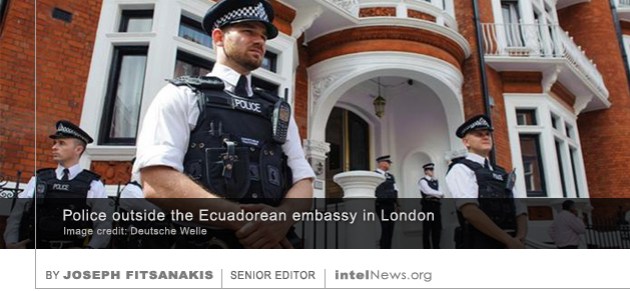 Police in London will no longer physically monitor the embassy of Ecuador in the British capital, where WikiLeaks founder Julian Assange has been living for over two years, fighting against extradition to Sweden. Assange was granted political asylum by the government of Ecuador in June of 2012, after Swedish authorities charged him with rape. But the Australian-born Assange claims that the charges are part of a plot to extradite him to the United States, where he is wanted for having leaked hundreds of thousands of documents belonging to the Department of Defense and the Department of State.
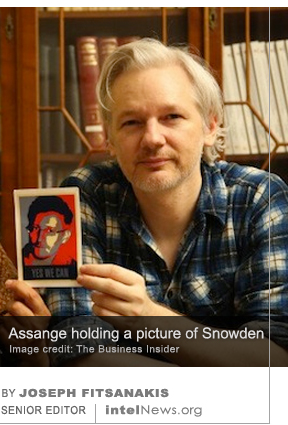 Leaders from all sides of the French political spectrum urged the French government on Thursday to offer political asylum, and even French citizenship, to the American defector Edward Snowden and to WikiLeaks founder Julian Assange. The calls were made in response to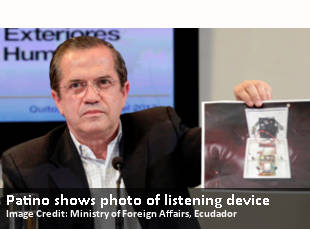
 By IAN ALLEN | intelNews.org |








 intelNews.org
Russia planned to smuggle Julian Assange from Ecuador’s embassy in London
September 24, 2018 by Joseph Fitsanakis 2 Comments
Last week, the British newspaper The Guardian said that Russian and Ecuadorean officials devised a complex operation to smuggle the WikiLeaks founder out of the Ecuadorean embassy, which is closely monitored by British security agencies. The London-based paper said it spoke to “four separate sources” who confirmed that a small team of Russians and Ecuadoreans met several times to plan the operation. The Ecuadorean side was allegedly represented by Fidel Narváez, a close friend and supporter of Assange, who previously served as Ecuador’s consul in London and continues to live there with his family. The Kremlin was reportedly represented by an unnamed “Russian businessman”, said The Guardian, who served as an intermediary between the Ecuadoreans and Moscow. The plan consisted of several steps, said the paper. The first step was for Assange to receive Ecuadoran citizenship and then be given diplomatic status by the government of Ecuador. That would give the WikiLeaks founder diplomatic immunity and shield him from British laws. A diplomatic vehicle would then secretly transport Assange from the Ecuadorean embassy to an unknown location. From there he would be transported to Ecuador via ship, or to Russia, where he would serve as a member of staff of the Ecuadorean embassy in Moscow. If British security services managed to intercept Assange during the operation, all they could do was expel him from the country. They would not be able to arrest him because of his diplomatic status.
The plan, said The Guardian, was scheduled for December 24, 2017. On December 15, Rommy Vallejo, the head of Ecuador’s national intelligence agency, Secretaría Nacional de Inteligencia (SENAIN), traveled secretly to London to supervise the operation. Two days later, on December 17, Assange was granted Ecuadorian citizenship as part of the plan. But the plan was aborted at the last moment after the British government refused to recognize Assange’s diplomatic status. According to British law, a foreign diplomat does not receive immunity from British law unless the British government officially accepts his or her diplomatic credentials. Although that is typically a formality, the British government reserves the right to refuse a diplomat’s credentials. That was seen by the Russians as a stumbling block and the operation was called off, said the paper.
Narváez spoke with The Guardian and strongly denied that he had any involvement with a joint Russian-Ecuadorean plan to smuggle Assange out of London. The Ecuadorean government did not return messages with questions about the paper’s allegations. The Russian embassy in the British capital tweeted late last week that The Guardian’s claims were “another example of disinformation and fake news from the British media”.
► Author: Joseph Fitsanakis | Date: 24 September 2018 | Permalink
Filed under Expert news and commentary on intelligence, espionage, spies and spying Tagged with Ecuador, Ecuadorean embassy in the UK, Fidel Narváez, Julian Assange, News, Russia, Secretaría Nacional de Inteligencia (Ecuador), UK, Wikileaks