WikiLeaks document to expose Swedish Foreign Minister as US spy
February 23, 2012 4 Comments
 By JOSEPH FITSANAKIS | intelNews.org |
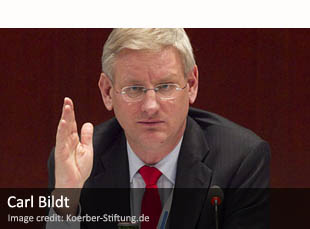
International whistleblower website WikiLeaks says it intends to publish a classified document that allegedly exposes Sweden’s current Foreign Minister as a spy for the United States. According to Swedish newspaper Expressen, which says it has seen the document in question, Carl Bildt, Sweden’s Minister of Foreign Affairs, is shown to have operated as an informant for the United States since the mid-1970s. The revelation, which is allegedly included in a classified diplomatic cable sent from the American embassy in Stockholm to the US Department of State, is likely to cause a major political crisis in Sweden and end the career of Carl Bildt, a popular politician who served as Sweden’s Prime Minister between 1991 and 1994. In an article published on Wednesday, Expressen cites an anonymous WikiLeaks source that claims Bildt “cooperated with the American government in a manner that is in direct violation of Swedish law”. The paper also states that, according to the incriminating document, Bildt was initially recruited by US intelligence through Republican political strategist Karl Rove, who is known to have been “an old personal friend” of the Swedish politician. According to the Expressen report, WikiLeaks has decided to publicize the leaked diplomatic cable as a warning against the Swedish government, which is said to be considering extraditing WikiLeaks founder Julian Assange to the United States. Read more of this post
 By IAN ALLEN | intelNews.org |

 By IAN ALLEN | intelNews.org |
 By IAN ALLEN | intelNews.org |








News you may have missed #684
February 23, 2012 by Ian Allen Leave a comment
►►Pakistan sacks health workers who helped CIA locate bin Laden. Seventeen local health workers have been fired in Abbottabad for their part in a CIA scheme to try to confirm the presence of Osama bin Laden in the northern Pakistani town. The low-ranking health department employees were punished for helping Dr Shakil Afridi, who was assigned by the CIA to set up a fake vaccination scheme in Abbottabad, ahead of the US military operation that found and killed the al-Qaida leader there.
►►Estonia arrests couple for spying for Russia. Estonian prosecutors said Aleksei Dressen, who works for Estonia’s security police, and his wife, Viktoria Dressen, were arrested at Tallinn airport as she was boarding a flight to Moscow on February 22. Aleksei Dressen allegedly went to the airport to give his wife a folder that contained classified information. Meanwhile, in neighboring Lithuania, the government has released the names of 238 citizens who were reservists for the KGB during the Cold War.
►►KGB defector talks to British newspaper. Since fleeing to Britain in the late 1990s Boris Karpichkov has preferred to keep a low profile —unlike another, better-known Moscow agent who fled to London, one Alexander Litvinenko. He says he ran audacious disinformation operations against the CIA and broke into and planted bugs in the British embassy in Riga. But in 1995 he grew unhappy with the increasingly corrupt FSB (the KGB’s successor), which, he says, failed to pay him. He spent several months in a Moscow prison before slipping into Britain on one of the false passports he was given as a KGB officer. He hasn’t been back to Russia since.
Filed under Expert news and commentary on intelligence, espionage, spies and spying Tagged with 0 Estonia arrests couple for spying for Russia, 0 KGB defector talks to British newspaper, 0 Pakistan sacks health workers who helped CIA locate bin Laden, Abbottabad (Pakistan), Aleksei Dressen, Boris Karpichkov, CIA, Cold War, covert action, defectors, espionage, Estonia, history, KGB, Lithuania, News, news you may have missed, Osama bin Laden, Pakistan, Russia, Shakil Afridi, Tallinn (Estonia), UK, USSR, Viktoria Dressen