Pakistan’s spy chief visits Kabul in an effort to unify rival Taliban factions
September 6, 2021 Leave a comment
 THE DIRECTOR OF PAKISTAN’S powerful intelligence agency paid a surprise visit to the Afghan capital Kabul on Saturday, reportedly in an effort to mediate between rival factions of the Taliban. Lieutenant General Faiz Hameed, director of the Inter-Services Intelligence (ISI) directorate, was accidentally spotted by a British television crew in a Kabul hotel on Saturday. When asked about the purpose of his visit, Hameed said he planned to hold a meeting with Pakistan’s ambassador to Afghanistan. He did not respond to questions about whether he would also meet with the leadership of the Taliban, with whom the ISI has traditionally had close relations.
On Sunday, however, it emerged that Hameed had met with Gulbuddin Hekmatyar, the Pakistan-supported Pashtun leader and founder of Afghanistan’s Hezb-e-Islami Gulbuddin party. There are rumors that Hekmatyar, who served twice as Afghanistan’s prime minister in the 1990s, will be asked by the Taliban to join a coalition government. There are rumors that Islamabad is pressuring the Taliban to include non-Taliban figures in their cabinet, and thus form a governing partnership with non-Taliban elements.
Additionally, numerous reports claim that serious differences have emerged between the two strongest factions of the Taliban, which concern the appointment of cabinet officials. One faction is led by the group’s co-founder, Mullah Abdul Ghani Baradar, and the other by the Taliban deputy leader, Anas Haqqani. The latter is the brother of Sirajuddin Haqqani, who leads the powerful Haqqani Network —a militant group that works closely with the Taliban but has retained its operational independence. There were even reports that Haqqani militia members exchanged gunfire with Taliban units in Kabul last Friday, though these were dismissed as untrue by the Taliban.
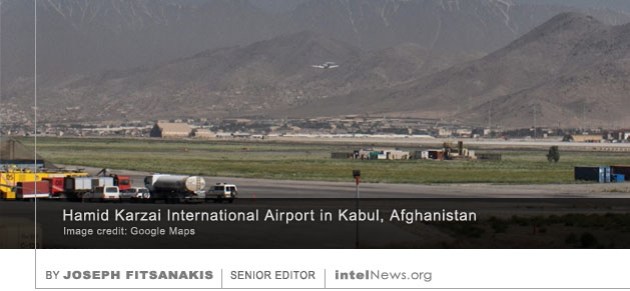
Many observers believe that the differences between the various Taliban factions are real, and that Hameed traveled to Kabul in an effort to help them resolve their differences with the help of Pakistan’s mediation. The Reuters news agency cited an anonymous Pakistani senior official as saying that Hameed’s visit was also aimed to help the new Afghan government organize its military, and to ensure that the airport in the Afghan capital will become operational soon.
► Author: Joseph Fitsanakis | Date: 6 September 2021 | Permalink
 THE CONSENSUS VIEW OF British intelligence in the weeks leading to the fall of Kabul to the Taliban was that the Afghan government would be challenged, but that the rebels were unlikely to take over the country in 2021. This was revealed on Wednesday in the House of Commons by Britain’s Foreign Secretary, Dominic Raab.

 A new documentary aired on Tuesday by the BBC offers new evidence of extensive involvement in Libya by the Wagner Group, a secretive security firm believed to operate on behalf of Russian military intelligence. After first appearing in Ukraine in 2014, the company has been seen to operate around the world as a private paramilitary entity. Its mission is allegedly to afford the Kremlin “plausible deniability” capabilities for operations in the Middle East, Africa and Eastern Europe. As intelNews has









High-level American, Russian intelligence delegations visit India on the same day
September 8, 2021 by Joseph Fitsanakis 2 Comments
India’s Ministry of External Affairs announced on Tuesday that General Nikolai Patrushev (pictured), Secretary of the Security Council of the Russian Federation, would be in Delhi “for high-level consultations on Afghanistan” between September 7 and 8. General Patrushev —Russia’s highest-ranking security official— is traveling to India at the invitation of his Indian counterpart, National Security Adviser Ajit K. Doval, according to the announcement. He was scheduled to meet with, aside from Doval, Indian Prime Minister Narendra Modi and External Affairs Minister S. Jaishanka.
Late yesterday, however, the Chennai-based English-language newspaper The Hindu reported that “an American delegation of intelligence and security officials” had visited Delhi on Tuesday, and had “held consultations” with officials there. According to the newspaper, the American delegation was led by Central Intelligence Agency (CIA) Director William Burns, who is touring the region and is also expected to visit Islamabad in the coming days. The report also said that Burns spoke at length with Doval about “issues arising from the Afghanistan evacuation effort and Taliban government formation”.
It is worth noting that India’s Ministry of External Affairs and the embassy of the United States in Delhi declined to confirm or deny the news about the CIA director’s visit to the country.
► Author: Joseph Fitsanakis | Date: 08 September 2021 | Permalink
Filed under Expert news and commentary on intelligence, espionage, spies and spying Tagged with Afghan Taliban, Afghanistan, CIA, India, News, Nikolai Patrushev, Russia, United States, William Burns