Man caught with pistol and ammunition is Turkish spy, German prosecutor says
October 4, 2021 Leave a comment

GERMAN AUTHORITIES ARE TREATING the arrest of a Turkish citizen, who was found with a pistol and 200 rounds of ammunition, “as a case of suspected espionage on behalf of the Turkish state” according to reports. The case was revealed late last week by Germany’s Federal Prosecutor General, Peter Frank, who said that the suspected spy was arrested at a hotel in the western German city of Düsseldorf during a raid that took place on September 17.
Local reports said the hotel raid was carried out by members of the Spezialeinsatzkommando (SEK), a police tactical unit, who stormed the building and used an armored vehicle to barricade its front door. They emerged from the hotel with the suspect, who has been identified in German media reports only as “Ali D.”, a Turkish citizen. He is now under investigation for collecting information on alleged supporters of the so-called Gülen movement. The Gülen movement consists of supporters of Muslim cleric Fethullah Gülen, who runs a global network of schools, charities and businesses from his home in the United States. The government of Turkey has designated Gülen’s group a terrorist organization and claims it was behind the failed 2016 coup against Turkey’s President, Recep Tayyip Erdoğan.
The Federal Prosecutor General’s office has said that Ali D. was acting “on behalf of and under the guidance” of the National Intelligence Organization (MİT), which is the state intelligence agency of Turkey. It also claims that “sufficient evidence” has emerged to establish this case as a “counterintelligence matter”. In his statement to the press, Frank said Ali D. was found in possession of a pistol, 200 rounds of ammunition and documents containing names and other personal information of alleged supporters of the Gülen movement. Some reports suggest that the police has linked this case with a suspected planned attack against Gülen supporters in Düsseldorf and Cologne.
The investigation of Ali D. has now officially been moved from the Düsseldorf Prosecutor’s office to the office of the Federal Prosecutor General.
► Author: Joseph Fitsanakis | Date: 04 October 2021 | Permalink


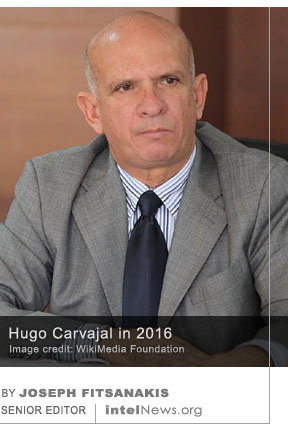 THE FORMER DIRECTOR OF Venezuela’s military spy agency has been captured in Madrid after two years on the run, and is now likely to be extradited to the United States, where he will face drug trafficking charges. Hugo Carvajal is a retired general and former diplomat, who was a member of the late Venezuelan President Hugo Chávez’s inner circle. From 2004 to 2011, under Chávez’s tutelage, Carvajal headed Venezuela’s Directorate General of Military Counterintelligence (DGCIM).
 THE SOMALI CAPITAL MOGADISHU remains tense today, after the country’s president and prime minster, who are supported by rival militias, leveled accusations at each other over an intelligence officer’s disappearance. Ikran Tahlil, 25, who works for the Somali National Intelligence and Security Agency (NISA), disappeared in June. She was reportedly last seen entering a government vehicle outsider her home in Mogadishu. The NISA said that Tahlil had been abducted and probably executed by al-Shabaab, an East African affiliate of al-Qaeda.
 Three former employees of American spy agencies, who helped the United Arab Emirates hack targets around the world, including United States citizens, have agreed to cooperate with the investigation into their activities. The US Department of Justice said on Tuesday that it had reached a “deferred prosecution agreement” with the three Americans, Ryan Adams, Marc Baier and Daniel Gericke. At least two of them are believed to have worked for the US National Security Agency before transferring their skills to the private sector.
 AMERICAN INTELLIGENCE AGENCIES ARE noticing early signs that al-Qaeda may be regrouping in Taliban-controlled Afghanistan, according to the deputy director of the United States Central Intelligence Agency. The presence of al-Qaeda in Afghanistan was the primary reason behind the invasion of the country by the United States in 2001. In subsequent years, the militant group, which was behind the terrorist attacks of September 11, 2001, suffered heavy losses, and saw its members disperse across the region. Many others were captured or killed.











Iran denies murder plot after alleged assassin caught with gun and silencer in Cyprus
October 5, 2021 by Joseph Fitsanakis 2 Comments
ISRAEL HAS ACCUSED IRAN of being behind a plot to kill Israeli citizens in the Republic of Cyprus, following the arrest of a man who was reportedly found carrying a gun fitted with a silencer in the Cypriot capital Nicosia. The man reportedly entered Cyprus on a flight that landed at Larnaca International Airport last week. He is believed to be a 38-year-old Azeri national, who allegedly entered Cyprus using a Russian passport.
Cypriot police kept tabs on the suspected assassin as soon as he entered Cyprus, according to reports. IntelNews hears that the Israeli intelligence agency Mossad may have been behind a tip given to the Cypriots about the man’s presence on the island. In the days following his arrival, the suspect crossed several times into the Turkish-occupied northern region of Cyprus, using his Russian passport and “trying to keep a low profile”, according to Israeli media reports.
The Azeri man was eventually arrested in Nicosia, shortly after entering from northern Cyprus at the Agios Dometios checkpoint. Some local news reports suggest that he was found to be carrying a gun fitted with a silencer, and that he was planning to target a number of prominent Israeli business people who live on the island. Reports in Israel claim that the alleged assassin’s primary target was Teddy Sagi, an Israeli investor who owns online gambling platforms, as well as properties in the United Kingdom and Cyprus. He is believed to be among Israel’s richest citizens.
Iran has vehemently denied Israel’s claim that Cypriot police averted “an act of terror [that] was orchestrated by Iran against Israeli business people” in Cyprus. However, the Israeli government’s announcement did not go into details, while Israeli officials refused to confirm that Teddy Sagi was the target of the alleged operation.
► Author: Joseph Fitsanakis | Date: 05 October 2021 | Permalink
Filed under Expert news and commentary on intelligence, espionage, spies and spying Tagged with assassinations, Cyprus, Iran, Israel, Mossad, News, Nicosia, Teddy Sagi