Experts see nation-state behind sophisticated computer virus attack

Ahmadinejad

By IAN ALLEN | intelNews.org |
Computer forensics specialists are split as to the purpose and initial target of a sophisticated computer virus that infected computers used in the Iranian government’s nuclear energy program. The virus, named Stuxnet, was discovered in Iran in June by a Belarusian computer security firm doing business in the Islamic Republic. It has since infected at least 100,000 computer systems in countries such as Brazil, India, Russia and the United States. But the primary target of the virus appears to have been the Iranian nuclear energy program, specifically computers located at the Islamic Republic’s nuclear reactor facility in Bushehr and the uranium enrichment plant in Natanz. Several commentators, including Wired magazine, dispute the existence of any evidence pointing to a clear target inside Iran.  But Israeli media maintain that computers at Natanz were the primary target of Stuxnet, and that subsequent infections at computer labs at Bushehr were in fact an unintended side effect. Read more of this post

News you may have missed #412

Bookmark and Share

News you may have missed #411

  • Third Lebanese telecom worker charged with spying for Israel. A Lebanese prosecutor has charged a third state telecommunications employee with spying for Israel. Milad Eid, who worked at the state-owned fixed-line operator Ogero, is accused of “dealing with the Israeli enemy [and] giving them technical information in his position as head of international communications at the Telecommunications Ministry”.
  • Author Roald Dahl was British spy, new book claims. A new book by Donald Sturrock, entitled Storyteller: The Life of Roald Dahl, claims that children’s author worked for British Security Coordination (BSC), a 1940s secret service network based in the United States, and was ‘run’ from New York by Canadian industrialist William Stephenson.
  • Israeli nuclear whistleblower wants to leave country. Nuclear whistle-blower Mordechai Vanunu has been released from prison after serving a 10-week sentence for violating the terms of his parole by speaking to a foreign journalist. Upon his release, he asked that he be allowed to leave the country.

Bookmark and Share

Senior Russian nuclear expert found dead in Malta

Alexander Pikayev

Alexander Pikayev

By JOSEPH FITSANAKIS | intelNews.org |
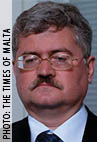
Authorities in Malta have reported the death of a senior Russian expert on nuclear disarmament, whose body was discovered in his holiday apartment. Dr. Alexander Pikayev, 48, was the director of the Department of Disarmament and Conflict Resolution at the Moscow-based Institute of World Economy and International Relations. His work on nuclear armaments policy is internationally recognized and he was among Russia’s most visible media commentators on issues relating to nuclear proliferation. But last Wednesday, Dr. Pikayev’s body was discovered lying on the floor of an apartment he owned in Bugibba, Malta, where he had been holidaying since earlier this month. The German Press Agency reports that the Russian scientist appeared to have “accidentally slipped” and hit his head on a door. Read more of this post

Documents show Israel offered nukes to apartheid South Africa

Sasha Polakow-Suransky

Polakow-Suransky

By JOSEPH FITSANAKIS | intelNews.org |
Apartheid-era government documents unearthed by an American doctoral researcher reveal that the government of Israel offered to sell nuclear warheads to the racist regime in South Africa, and could possibly provide the first documentary evidence of the existence of Israel’s purported nuclear arsenal. Successive Israeli governments have followed what is often called ‘a policy of ambiguity’, refusing to either confirm or deny the nuclear weapons’ rumored existence. But the documents, which date from 1975, contain detailed minutes of meetings between senior Israeli and South African cabinet officials, including then South African defense minister P.W. Botha and then Israeli defense minister –and Israel’s current President– Shimon Peres. Sasha Polakow-Suransky, the American academic who requested the declassification of the controversial documents, says the Israeli government tried but ultimately failed to prevent the South African government of Jacob Zuma from releasing them. Read more of this post

News you may have missed #358

  • Ex-CIA analyst to lead US declassification center. Sheryl Jasielum Shenberger, who currently serves as a Branch Chief at the CIA Declassification Center, has been named as the first director of the recently established US National Declassification Center. The Center’s aim is to eliminate the backlog of over 400 million pages of classified records by the end of 2013.
  • Hamas expels Egyptian spy from Gaza. A senior Egyptian intelligence officer, who had allegedly “infiltrated the region to collect information on residents and the Hamas government” was arrested and expelled from Gaza on Monday.
  • Israeli nuclear whistleblower back in prison. More than six years after his release from 18 years in solitary confinement, Israeli nuclear whistleblower Mordechai Vanunu has been sentenced to another three months in prison for allegedly “contacting foreign agents”.

Bookmark and Share

US asked for Egypt’s spy help on Algerian nuclear reactor

Document cover page

Cover page

By IAN ALLEN | intelNews.org |
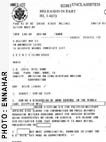
A US consular document, acquired by a leading Algerian newspaper, reveals that Washington asked Egypt’s help in collecting intelligence on the Algerian nuclear energy program. The document, which dates from May 1991, was drafted by officials in the US embassy in Cairo, Egypt; it is not known how it came to the possession of Algerian daily Ennahar, which published it on Tuesday. It contains a summary of a May 1991 meeting in Cairo between Richard Clarke, who was then the US Department of State’s deputy secretary for political and military affairs, and a senior Egyptian official whose name is in redacted in the document, but appears to have been Amr Moussa, Egypt’s minister of foreign affairs at the time. The document, which is classified ‘top secret’, reports that the US delegation asked the Egyptians to help them gather information on Algeria’s Es Salam nuclear reactor, located in the city of Ain Oussera, in the province of Djelfa, in north-central Algeria. Read more of this post

News you may have missed #338

  • US intel on Iran suffering from information overload? The US National Intelligence Estimate was due last fall but has been delayed at least twice amid efforts to “incorporate information from [Iranian] sources who are still being vetted”. Some say that significant new material has come from Iranian informants, who are motivated by antipathy toward the Iranian government and its suppression of the opposition.
  • Canada’s ex-intel boss slams new anti-terrorism measures. Reid Morden, the former director of the Canadian Security Intelligence Service, has urged the country’s Conservative government to re-think its plans to re-introduce controversial anti-terrorism measures initially adopted in the wake of 9/11.
  • Wiretapping scandals continue in Colombia. Caracol TV reports that Colombian security agency DAS has asked opposition Senator Piedad Cordoba to hand over evidence of her claims that President Alvaro Uribe ordered DAS to spy on her.

Bookmark and Share

News you may have missed #337

  • Another Iranian nuclear researcher reportedly defects. An academic linked with Iran’s nuclear program has defected to Israel, according to Ayoub Kara, Israel’s deputy minister for development in the Negev and Galilee. Kara said it “is too soon to provide further details”, adding that the defector is “now in a friendly country”.
  • Dutch spies to become more active abroad. The Dutch secret service, the AIVD, has announced a shift in strategy, deployed increasingly more officers abroad: “in Yemen, Somalia, and the mountains between Afghanistan and Pakistan”.
  • Why did the CIA destroy waterboarding evidence? It has been established that Porter J. Goss, the former director of the CIA, in 2005 approved the destruction of dozens of videotapes documenting the brutal interrogation of two terrorism detainees. But why did he do it? Former CIA officer Robert Baer examines the question.

Bookmark and Share

News you may have missed #330

  • Pakistan released captured Taliban behind CIA’s back. IntelNews has not joined the chorus of commentators who have been claiming that the relationship between Pakistan’s Inter-Services Intelligence (ISI) directorate and the CIA has warmed up. It now appears that even as the ISI was collaborating with the CIA, it quietly freed at least two captured senior Afghan Taliban figures.
  • Kiwi activists accuse police of spying. New Zealand’s Peace Action Wellington has submitted an Official Information Act (OIA) request relating to domestic police surveillance, after accusing the police of “heavily spying on and running operations on protest groups”. It is not the first time that similar accusations have been directed against the country’s police force.
  • CIA suspected existence of Israeli nukes in 1974. Israel will neither confirm nor deny the rumored existence of its nuclear arsenal. But the CIA, which has kept an eye on Israel’s nuclear weapons project since at least the early 1960s, was convinced of its existence by 1974, according to a declassified report.

Bookmark and Share

Analysis: Can the CIA sabotage the Iranian nuclear weapons program?

Shahram Amiri

Shahram Amiri

By JOSEPH FITSANAKIS | intelNews.org |
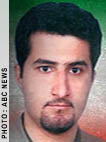
There is no doubt that the CIA has been actively trying to sabotage Iran’s nuclear weapons program since at least February of 2008, when US President George W. Bush authorized Langley to intensify its covert efforts against Tehran. It is also true that the US was able to partially sabotage Iran’s nuclear program by eliminating the A.Q. Khan nuclear proliferation network, and by employing scientific front companies and cooperative suppliers, who gave the Iranians faulty hardware. The defection to Washington of senior Iranian nuclear scientist Shahram Amiri provides recent evidence of the existence of a covert US project to “decapitate” the Iranian nuclear weapons program, by luring away leading Iranian researchers. On the other hand, it is worth wondering why the CIA chose to remove Amiri from the Iranian nuclear program, instead of asking him to remain an agent-in-place, which would have been far more beneficial for Langley. Read more of this post

Senior Iranian scientist defected to CIA: report

Shahram Amiri

Shahram Amiri

By JOSEPH FITSANAKIS| intelNews.org |
ABC News appears to confirm earlier rumors, which intelNews reported on last December, that a senior Iranian nuclear scientist has defected to the CIA. The Iranian government had initially accused American and Saudi intelligence agencies of kidnapping Shahram Amiri, a central figure in the Iranian nuclear research program, who disappeared last June during a hajj pilgrimage in Mecca, Saudi Arabia. However, as intelNews reported last year, French intelligence sources  claimed that Amiri’s defection was facilitated through a carefully planned intelligence operation involving the CIA, as well as French and German operatives. Moreover, the alleged defector was said to have secretly briefed International Atomic Energy Agency inspectors in Frankfurt, Germany, before they traveled to Iran to inspect a previously undeclared Iranian nuclear facility near the city of Qum. According to ABC News, which cites “people briefed on the operation by intelligence officials”, not only has Amiri defected to the CIA, but he has already been “extensively debriefed” since his defection. Read more of this post

News you may have missed #315

  • Nuclear bunker spy comes out of hiding. A British retiree named Mike Lesser has revealed he was one of the so-called “spies for peace”, a group of peace activists who in the 1960s helped uncover Britain’s secret network of underground bunkers built to protect the government in case of nuclear war.
  • Aussie spy agency spied on little girls. Secret files kept by the Australian Security Intelligence Organisation reveal spooks tailed the teenage children of suspected socialists and communist sympathizers during the late 1960s, and anyone with whom they associated, including school friends and boyfriends.
  • Analysis: Under Panetta, a more aggressive CIA. Expectations among CIA hardliners were low when Leon Panetta arrived at the Agency’s headquarters in February 2009. But almost from the first week, Panetta positioned himself as a strong advocate for the CIA, to the extent that critics worry that Panetta has become a captive of the agency he leads.

Bookmark and Share

News you may have missed #0253

  • Iran undecided on nukes, says US military spy chief. The US Pentagon’s top intelligence official, Lieutenant General Ronald Burgess, has said what intelNews has been pointing out again and again, namely that the key finding of the 2007 National Intelligence Estimate, that Iran has not yet committed itself to nuclear weapons production, is still valid.
  • Nobel winner demands Germany uncover Romanian ex-spies. Herta Mueller, the Romanian-born German winner of the 2009 Nobel Prize for Literature, has called on Germany to find and prosecute former agents of Romania’s Securitate secret police, large numbers of whom have resettled in Germany after communism ended in Romania 20 years ago.

Bookmark and Share

More on Iranian physicist’s assassination

Blast site

Blast site

By JOSEPH FITSANAKIS| intelNews.org |
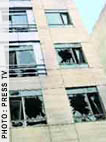
American intelligence and State Department officials, some anonymous, have denied any connection with the assassination yesterday of Iranian physicist Masoud Ali-Mohammadi, in Tehran. Meanwhile, The Washington Post reports that Ali-Mohammadi was among several Iranian researchers who had regular contacts with Israeli and Arab physicists, through a United Nations-sponsored scientific collaboration project based in Amman, Jordan. The program, known as Synchrotron-light for Experimental Science and Applications in the Middle East (SESAME), was focused on non-nuclear physics applications in the medical industry and nanotechnology. To further complicate the issue, the Iranian opposition issued a report late last night saying that photographs taken at the scene of the bombing shortly after the blast, reveal the presence at the site of Abu Nasser Hossein, assistant to Manif Ashmar, who is Hezbollah’s public face in Iran. Read more of this post