News you may have missed #812

Yasser ArafatBy IAN ALLEN | intelNews.org |
►►Russia to help probe Yasser Arafat’s death. Russia will join an international investigation to determine whether the first Palestinian president, Yasser Arafat, was murdered, the current Palestinian leader, Mahmoud Abbas, has said. French and Swiss experts are due to exhume Arafat’s body in Ramallah later this month in an attempt to discover how he died after an al-Jazeera documentary in July suggested he was killed by a rare radioactive poison. Abbas asked Russian foreign minister Sergei Lavrov for Moscow’s help during talks in Jordan, Palestinian sources said.
►►Revisiting the foiled 1984 Nigerian kidnap plot. In London in 1984, a team of Nigerians and Israelis attempted to kidnap and repatriate the exiled former Nigerian minister Umaru Dikko. Mr. Dikko, who had fled Nigeria after a military coup, was accused of stealing $1bn (£625m) of government money. The plot was foiled by a young British customs officer and, as a result, diplomatic relations between the UK and Nigeria broke down and were only fully restored two years later. The Nigerian and Israeli governments have always denied involvement in the kidnapping.
►►Putin congratulates KGB double spy on his birthday. Russian President Vladimir Putin has congratulated famous double agent George Blake on his 90th birthday, the Kremlin press office has said. Blake betrayed British intelligence starting in the 1950s; he was found out in 1961 and sentenced to 42 years in prison. But he escaped five years later using a ladder of rope and knitting needles, made his way to the Soviet Union and has been living out his last years serenely in a cottage outside Moscow. After his escape from the Wormwood Scrubs prison in London, he was smuggled to Berlin in a wooden box in the back of a van. In the interview published last week, he said he then presented himself to border guards in East Berlin, asked to speak to a Soviet officer, and when told to wait, immediately fell into a deep sleep.

Israel admits assassinating Palestinian commander in Tunisia

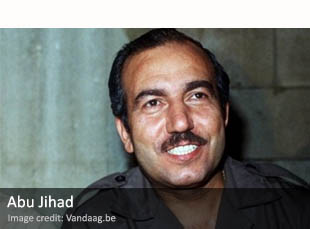
Abu JihadBy JOSEPH FITSANAKIS | intelNews.org |
Authorities in Israel have authorized the publication of an interview acknowledging Israel’s role in the assassination of a senior Palestinian military commander in Tunisia in 1988. The target of the assassination was Khalil al-Wazir, better known as Abu Jihad, one of the co-founders of Fatah, the secular wing of the Palestinian Liberation Organization chaired by Yasser Arafat. In the 1960s and 1970s, Abu Jihad rose within the ranks of Fatah and eventually became commander of its armed wing, known as al-Assifa. However, he was killed on April 16, 1988, when a group of unidentified gunmen stormed his villa in Tunisian capital Tunis, before managing to slip away. In the past 23 years, the Israeli intelligence services have been repeatedly singled out as prime suspects in Abu Jihad’s assassination. Nearly 15 years ago, Israeli newspaper Yedioth Ahronot announced that it had secured an interview with an Israeli commando who had a leading role in the operation and had been the one who fired the shots that killed the Fatah commander. But the interview was blocked from publication by the Israeli military censors, who, under Israeli law, have the power to prevent the airing of information that might harm national security. In 2000, however, the commando, Nahum Lev, died in a motorcycle accident, which prompted the Israeli newspaper to renew its application for the ban on the interview to be lifted. This week, Israeli authorities officially lifted the ban, which allowed Yedioth Ahronot to run the interview with Lev. The airing of the interview was coupled by a more substantial account of the operation, which appeared in the specialist Israel Defense magazine. According to the article, the operation was planned over several months by the Israeli covert action agency Mossad and the Sayaret Matkal, a special forces unit of the Israel Defense Forces. It involved 26 commandos who allegedly reached the Tunisian shore on rubber boats. Several of them walked the streets of Tunis disguised as women tourists. Read more of this post
News you may have missed #793

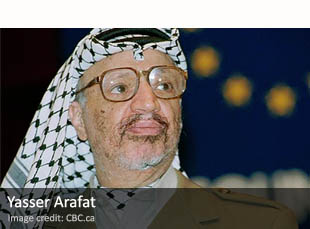
Yasser ArafatBy IAN ALLEN | intelNews.org |
►►Britain recruits tech start-ups for spy gadgets. British security services seem to have decided to widen the net for suppliers of state-of-the-art spyware for “covert surveillance”. Traditionally, British intelligence organizations including MI5 and GCHQ, have relied on a network of trusted contractors. But the change in approach represents an opportunity for burgeoning technology companies. According to a senior Whitehall official, who spoke to The Financial Times, these agencies “are appealing to a wide range of innovators, small and large, and saying: ‘Here are some problems we encounter. Can you solve them?’”.
►►French investigators to exhume Arafat’s remains. Three French investigating magistrates will travel to Ramallah in the West Bank to exhume the remains of the late Palestinian President Yasser Arafat so they can take tissue samples to determine what killed him. New evidence emerged from an investigation in July by the Al Jazeera television network when the Institut de Radiophysique, in Lausanne, Switzerland, said it had discovered significant traces of the rare radioactive element polonium-210 on the late leader’s clothing and toothbrush.
►►Panetta speaks out against book on bin Laden killing. As former US Navy SEAL Matt Bissonnette continues to make headlines about his book, No Easy Day, about the killing of al-Qaeda founder Osama bin Laden, US Defense Secretary Leon Panetta has spoken out publicly on the subject for the first time. The former Director of the CIA said “the American people have a right to know about this operation”. But, he added, “people who are a part of that operation, who commit themselves to the promise that they will not reveal the sensitive operations and not public anything […] when they fail to do that, we have got to make sure that they stand by the promise that they made to this country”.

France opens murder inquiry into Palestinian leader Yasser Arafat’s death

Yasser ArafatBy JOSEPH FITSANAKIS | intelNews.org |
French prosecutors have opened an official murder inquiry into the 2004 death of Palestinian statesman Yasser Arafat, following allegations that he may have been poisoned. The decision, announced Tuesday, comes less than two months after the results of a lengthy forensic toxicological investigation raised the possibility that the Palestinian leader may have been poisoned with polonium-210. The nine-month study was commissioned by Qatari news channel Al Jazeera and was conducted by the Institut de Radiophysique (IRA) in Lausanne, Switzerland. According to the results, announced in early July, significant traces of the radioactive substance were discovered on the personal artifacts that Arafat used during his final days while in hospital in Paris, France. According to the IRA, some of the Fatah founder’s personal belongings, including his underwear and his toothbrush, contained levels of polonium that were as many as ten times higher than those in random samples used as control subjects in the study. Shortly following the IRA study, Arafat’s wife and daughter filed an official complaint with French judicial authorities, who in turn decided to open an official murder investigation. The decision was taken despite the fact that many in the medical profession appear cautious about the claims of the IRA study. But one British observer told the BBC that the French government was obliged to take the request by the two women “very seriously because of its diplomatic aspect”. Last week, IRA officials in Switzerland said they had received permission from Arafat’s family and the Palestinian National Authority to travel to Ramallah, West Bank, and examine Arafat’s exhumed remains for traces of polonium-210. Read more of this post

Research sheds light on famed psychoanalyst’s espionage activities

Max EitingonBy JOSEPH FITSANAKIS | intelNews.org |
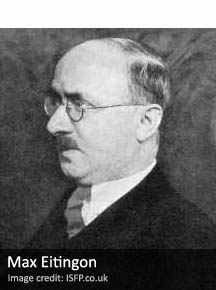
An early student of Sigmund Freud, who introduced psychoanalysis in what is today Israel, was likely an agent of Soviet intelligence, according to historical evidence stemming from his life and the lives of his close relatives and friends. Max Eitingon, who was a member of Freud’s inner circle of students, funded and directed the Psychoanalytic Institute and polyclinic in Berlin, Germany, in the 1920s and early 1930s. In 1933, the rise of German national socialism prompted Eitingon, who was Jewish, to emigrate to Palestine, where he continued his psychoanalytic work. The view that Eitingon may have actively collaborated with Soviet intelligence in both Germany and Palestine was famously discussed in a lengthy letter exchange in The New York Review of Books in the summer of 1988. Although the debate continues among intelligence historians, two researchers, Isabella Ginor and Gideon Remez, both of the Hebrew University’s Truman Institute, believe that there is “a preponderance of circumstantial evidence” that Eitingon did collaborate with Soviet intelligence in Germany and Palestine. In a paper published in March of this year, the two researchers argue that Eitingon’s services to the Soviets included dispatching messages and providing safe houses for Moscow’s operatives. But in a fascinating research update, published yesterday in online journal Tablet, Ginor and Remez contend that historical evidence pertaining to the activities of Eitingon’s Russian-born wife, Mirra, and other relatives and friends, adds credence to the view that the famed psychoanalyst was working for Soviet intelligence. The two scholars point out that Mirra Eitingon, née Burovsky, had a son from a previous marriage, named Yuli Borisovich Khariton. Yuli, who remained close to his mother even after she left Russia, grew up to become the principal designer of the Soviet atomic bomb. Additionally, Ginor and Remez call attention to the role of two of Eitingon’s professional acquaintances: Adolf Yoffe, the Soviet Union’s first ambassador to Germany, and his successor, Viktor Kopp, both of whom shared Eitingon’s psychoanalytic interests. Specifically, Kopp was second-in-command at the Soviet Psychoanalytic Association, while Yoffe had been mentored by Alfred Adler, one of the psychoanalytic movement’s co-founders in Austria. In this sense, Ginor and Remez argue that psychoanalysis and intelligence work were “intertwined” in Eitingon’s life and career. Read more of this post

Medical tests suggest Yasser Arafat may have been poisoned

Yasser ArafatBy JOSEPH FITSANAKIS | intelNews.org |
A nine-month forensic toxicological investigation into the death of Yasser Arafat has raised the possibility that the Palestinian leader may have been poisoned with a radioactive substance. The Institut de Radiophysique (IRA) in Lausanne, Switzerland, has announced the discovery of significant traces of polonium-210 on the personal artifacts that Arafat used during his final days. Speaking at a press conference in Switzerland on Monday, IRA Director Dr. Francois Bochud said that the Institute could “confirm that we measured an unexplained, elevated amount of unsupported polonium-210 in the belongings of Mr. Arafat that contained stains of biological fluids”. According to the IRA, some of the Fatah founder’s personal belongings, including his underwear and his toothbrush, contained levels of polonium that were as many as ten times higher than those in random samples used as control subjects in the study. The findings of the investigation, which was sponsored by the Qatari news channel Al-Jazeera, may eventually shed light into the cause of Arafat’s death, which remains a medical mystery. Doctors in the West Bank and France have confirmed that the Palestinian leader was in sound health until he suddenly fell ill in mid-October 2004, and that his body showed no symptoms of any known disease. Polonium-210 made news headlines in a major way in November 2006, when it was identified as the poison used to kill Alexander Litvinenko. Read more of this post

News you may have missed #747

Israeli athletes at the 1972 Munich OlympicsBy TIMOTHY W. COLEMAN | intelNews.org |
►►Dutch media reportedly spied on China. Dutch media participated in a clandestine intelligence collection effort on behalf of the Netherlands General Intelligence and Security Service (AIVD) during the 2008 Summer Olympic Games in Beijing. According to Dutch sources, at least seven reporters attending the Olympics were coaxed into, and were paid for, collecting information and taking photos of targeted Chinese officials interested in speaking with Dutch company and industry representatives. The AIVD did not comment on the allegations but did remark that Dutch law allows them to contact anyone who could provide or has access to intelligence.
►►Nicaragua arrests Colombian national for espionage. According to the Spanish-language weekly newspaper Semana, General Julio Cesar Aviles, the head of Nicaragua’s Army, announced the arrest of Colombian national Luis Felipe Rios, for seeking to “obtain Nicaraguan state documents about defense and national security”. The 34-year old Rios was apparently captured in Managua on Tuesday after having been under the surveillance of Nicaraguan counterintelligence officials for over a year. Rios was in Nicaragua under the guise of being a Spanish national working for a media outlet. The lead prosecutor in Nicaragua, Armando Juarez, claimed that there was “sufficient proof” to prosecute Rios. Colombian officials, including President Juan Manuel Santos, have stated they are investigating the matter.
►►Neo-Nazi linked to 1972 Munich Olympic terrorists. Recently released files by Germany’s security service, the Federal Office for the Protection of the Constitution (BfV), links neo-Nazi Willi Pohl to forged passports provided to Black September terrorists who perpetrated the 1972 attack at the Munich Olympics. The attack resulted in the deaths of 11 Israeli athletes. According to German magazine Der Spiegel, over 2,000 documents were released in which the BfV asserts that Pohl assisted and even chauffeured one Black September member around Germany in the weeks leading up to the attack. German police arrested Pohl in 1972 for “unauthorized possession of firearms” and sentenced him to two years’ incarceration for possessing grenades and weapons. He was released only a few days after his conviction and he fled the country, ending up in Lebanon.

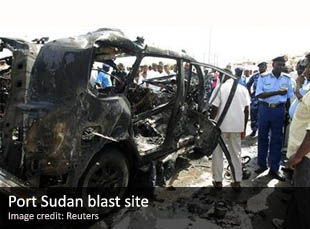
Car explosion in Port Sudan linked to Israel

Blast site in Port SudanBy IAN ALLEN | intelNews.org |
A powerful car explosion, which rocked Sudan’s main port on Tuesday, killing one person, has been linked to Israel by Sudanese government officials. The car was blown up by what appears to have been a missile attack, in Port Sudan, a city of over half a million people on the Red Sea. A local reporter told Reuters news agency that the blast site featured “two small but deep holes” and “another hole beneath” what was left of the gutted car. Many observers consider Port Sudan, an ancient city that has traditionally connected Sudan with Egypt in the north and Saudi Arabia across the Red Sea, as a major link in the complex smuggling network that supplies goods and weapons to the Gaza Strip. Israel has long asserted that the smuggled items are secretly carried from Port Sudan into Egypt, before eventually ending up in the Palestinian enclave that is controlled by militant group Hamas. The government of Sudan vehemently denies these charges. But a “local security source” in Port Sudan told Reuters that the car’s driver, Nasser Awadallah Ahmed Said, who was killed in the blast, was an eminent member of the Red Sea’s Ababda Bedouin tribe, whose members have a long history of smuggling weapons and goods to and from Sudan. Speaking on Tuesday, Sudan’s Minister of Foreign Affairs, Ali Ahmed Karti, stopped just short of directly fingering Israel as the culprit of the attack. Karti, who is Sudan’s most senior government official to have so far commented on the blast, told local news media that “the style of the car explosion was similar to Israel’s attack on [Sudan’s] Red Sea State [province] last year”. He was referring to a similar incident that took place in April of last year in the very same province where Port Sudan is located. At that time, Khartoum directly blamed Israel for the strike. Read more of this post

Research: Spies increasingly using Facebook, Twitter to gather data

Spying on social networkingBy JOSEPH FITSANAKIS | intelNews.org |
During the past four years, this blog has reported several incidents pointing to the increasing frequency with which spy agencies of various countries are utilizing social networking media as sources of tactical intelligence. But are we at a point where we can speak of a trend? In other words, is the rapid rise of social networking creating the conditions for the emergence of a new domain in tactical intelligence collection? This past week saw the publication of a new research paper (.pdf), which I co-authored with Micah-Sage Bolden, entitled “Social Networking as a Paradigm Shift in Tactical Intelligence Collection”. In it, we argue that recent case studies point to social networking as the new cutting edge in open-source tactical intelligence collection. We explain that Facebook, Twitter, YouTube, and a host of other social networking platforms are increasingly viewed by intelligence agencies as invaluable channels of information acquisition. We base our findings on three recent case studies, which we believe highlight the intelligence function of social networking. The first case study comes out of the Arab Spring, which, according to one report, “prompted the US government to begin developing guidelines for culling intelligence from social media networks”. We also examine NATO’s operations during the 2011 Libyan civil war (Operation UNIFIED PROTECTOR), when Western military forces systematically resorted to social networking media to gather actionable intelligence, by utilizing open sources like Twitter to pinpoint targets for attack. Finally, we examine the sabotage by Israeli security services of the 2011 “Welcome to Palestine Air Flotilla” initiative, a campaign organized by several European groups aiming to draw worldwide attention to the travel restrictions imposed by Israeli authorities on the Occupied Territories. Read more of this post

News you may have missed #643 (Israel edition)

Mosab Hassan Yousef

Yousef/Joseph

►►Hezbollah uncovers more Israeli spy devices. Lebanese media reported on Friday that two people were wounded in a blast that occurred in the south of the country, between the towns of Srifa and Deir Kifa. According to some of the reports, the blast targeted espionage devices which were destroyed by Israel after being exposed by Hezbollah. This is not the first time such devices have been discovered in Lebanon: see here and here for previous such incidents.
►►PLO subpoenas Palestinian who spied for Israel. The Palestine Liberation Organization served Mosab Hassan Yousef, who says he is a former spy for Israeli domestic intelligence agency Shin Bet, with a subpoena in the United States last month. The Palestinian group says it wants his notes and details of his spy work for the Israeli government.
►►Analysis: The complex relationship between the Mossad and Israeli media. “Former Mossad chief Meir Dagan’s crusade this week against an Israeli strike on Iran took on a new dimension with his several media interviews. His campaign also reflects the Mossad’s attitude toward journalists, something along the lines of respect them, suspect them and use them. The degree shifts from one Mossad head to the next”. An enlightening analysis by veteran Israeli intelligence correspondent Yossi Melman.

German spy helped facilitate Israel-Hamas prisoner exchange

BND seal

BND seal

By JOSEPH FITSANAKIS | intelNews.org |
Amidst the ongoing media frenzy over the release of Israeli soldier Gilad Shalit by Hamas, in exchange for hundreds of Palestinians held in Israeli prisons, few noticed that Germany was expressly thanked by the Israelis for its role in the deal. Speaking to journalists right after Shalit’s release, Israeli Prime Minister Benjamin Netanyahu said his government was “grateful [to] German negotiators for helping facilitate the exchange. Commenting on Netanyahu’s statement, Germany’s Minister of Foreign Affairs, Guido Westerwelle, said simply that he was pleased because the German government was “able to contribute to Shalit’s release”. But what exactly was Germany’s role in arranging the deal? The answer was given on Tuesday by Ernst Uhrlau, director of Germany’s intelligence service, the Bundesnachrichtendienst (BND). Uhrlau hinted that BND officers had assisted Israel and Hamas in securing the unlikely agreement. Now Germany’s Suedeutsche Zeitung newspaper claims that it knows the identity of the BND officer who acted as the foremost mediator between Israel and Hamas. According to the paper, the officer’s name is Gerhard Konrad; he is 50 years old, six feet tall, and has a PhD in Islamic Studies from Germany’s prestigious Heidelberg University. He speaks fluently French, English and Arabic, which he perfected while working in the Middle East “for several years”. He began his career with BND by representing the agency in German embassies in countries such as Syria and Lebanon. It was there, says Suedeutsche Zeitung, that Konrad cultivated relationships of trust with Hamas and Palestine Liberation Organization-affiliated groups, such as Fatah. He also developed a strong reputation for negotiating with militant groups in adversary conditions. Read more of this post

News you may have missed #606

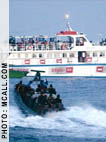
Gaza Freedom Flotilla raid

2010 Flotilla raid

►►N. Korea planned to trade nukes for full ties with US. North Korea in 2008 indicated it would retain its nuclear bombs until the end of the six-party talks as a final bargaining chip for attaining full diplomatic relations with the United States, according to US diplomatic cables leaked recently by the anti-secrecy group WikiLeaks.
►►Judge refuses to sanction CIA for destroying torture tapes. A federal judge won’t hold the CIA in contempt for destroying videotapes of detainee interrogations that included the use of a torture technique known as waterboarding, ruling instead that the spy agency merely committed “transgressions” for its failure to abide by his court order. The Obama administration has kept its promise to the CIA.
►►Turkey says NATO members will not share intelligence with Israel. Turkey has says it is certain that NATO member states will keep their promise of not sharing the Alliance’s intelligence within with Israel. Turkish-Israeli relations badly damaged last year, after Israeli naval commandos stormed a Turkish ship carrying humanitarian aid to Gaza to breach the naval blockade, killing nine Turkish civilians.

News you may have missed #603

Syed Ghulam Nabi Fai

Syed Fai

►►Turkey has names of Israeli soldiers who attacked Gaza Flotilla. According to Turkish media, government officials succeeded in amassing the list of 174 names of officers and soldiers involved in the 2010 MV Mavi Marmara attack, by planting intelligence agents inside Israel. Turkish government officials have denied the reports.
►►Ex-MI5 chief to hear deportation case of alleged spy. A British judge has ruled that Sir Stephen Lander, former director of MI5, Britain’s domestic intelligence service, can help to decide whether Katia Zatuliveter should be deported from the UK for allegedly spying for Russia. Zatuliveter, a Russian citizen who worked as an assistant to former British Member of Parliament Mike Hancock, may be deported on the basis of espionage evidence gathered by MI5.
►►Analysis: Pakistan’s spy plot to influence Washington. Syed Ghulam Nabi Fai came to the US on Saudi money with hopes of helping people in the disputed Indian territory of Kashmir. But he found himself spending millions on behalf of Pakistan’s notorious Inter-Services Intelligence and, now, under arrest. An excellent article by The Atlantic‘s Kim Barker, Habiba Nosheen, and Raheel Khursheed.

News you may have missed #574

CIA documents

CIA documents

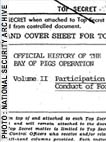
►►CIA told Kennedy Cuba invasion was ‘unachievable’. [Never mind. It turns out that the original article on Foreign Policy has been corrected to state that the meeting was not with Kennedy after all — see reader’s comment below]. More revelations from the newly declassified CIA Official History of the Bay of Pigs Invasion. According to the multi-volume history (pictured), a CIA team told President-Elect John F. Kennedy during a meeting in 1960 that toppling the Cuban government of Fidel Castro would not be feasible, considering the small invasion force that Kennedy insisted upon for the Bay of Pigs operation, in order to maintain plausible deniability.
►►NATO bombs home of Libyan intel chief. A compound in Tripoli destroyed overnight by NATO air strikes was the home of Abdullah Al-Senussi, former head of Libyan intelligence. This information allegedly comes from al-Senussi’s neighbor, oil engineer Omar Masood, who said he has lived across the street for 35 years. Meanwhile, several news outlets report that Abdel Salam Ahmed Jalloud, prime minister of Libya between 1972 and 1977, has defected to Italy.
►►Palestinian attacks took Israeli intel by surprise. The triple attacks, attributed by Israel to a Palestinian splinter group from the Gaza Strip, took Israel’s intelligence and security services by surprise, judging by the ensuing confusion and inaccuracy of initial reports. Between 15 and 20 Arab gunmen, some wearing Egyptian army fatigues, are believed to have taken part in the operation.

Israel used Facebook to stop European pro-Palestine activists

Facebook

Facebook

By JOSEPH FITSANAKIS | intelNews.org |
Israeli intelligence services managed to stop dozens of European pro-Palestine activists from flying to Israel, by gathering open-source intelligence about them on social media sites, such as Facebook. According to Israeli Foreign Ministry spokesman Yigal Palmor, intelligence gathered on Facebook formed the basis of a blacklist containing over 300 names of European activists, who had signed up on an open-access Facebook page of a group planning nonviolent actions in Israel this summer. Israeli intelligence agencies forwarded the names on the lists to European airline carriers, asking them not to allow the activists onboard their flights, as they were not going to be allowed into the country. This action prompted airline carriers to prevent over 200 activists from boarding scheduled flights to Israel. Israeli security officers detained over 310 other activists, who arrived in Israel on several European flights last week. Of those, almost 70 were denied entry to the country, while more detentions are expected to take place later this week, according to Israeli Interior Ministry spokeswoman Sabine Hadad. Read more of this post