Analysis: Will the mass expulsion of diplomats affect Russia’s spy capabilities?

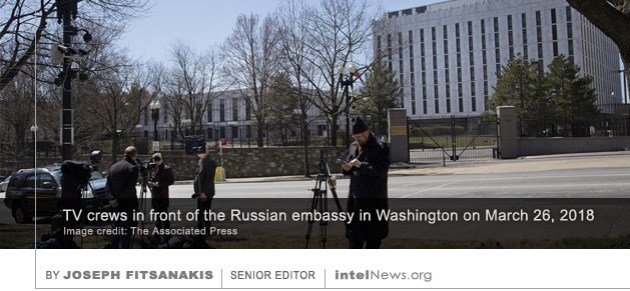
Russian embassy in WashingtonRelations between Russia and much of the West reached a new low on Monday, with the expulsion of over 100 Russian diplomats from two dozen countries around the world. The unprecedented expulsions were publicized on Monday with a series of coordinated announcements issued from nearly every European capital, as well as from Washington, Ottawa and Canberra. By the early hours of Tuesday, the number of Russian diplomatic expulsions had reached 118 —not counting the 23 Russian so-called “undeclared intelligence officers” that were expelled from Britain last week. Further expulsions of Russian diplomats are expected in the coming days.

It is indeed difficult to overstate the significance of this development in the diplomatic and intelligence spheres. Monday’s announcements signified the largest collective expulsion of Russian intelligence personnel (intelligence officers working under diplomatic cover) in history, and is remarkable even by Cold War standards. In the United States, the administration of President Donald Trump expelled no fewer than 60 Russian diplomats and shut down the Russian consulate in Seattle. Such a move would have been viewed as aggressive even for Mr. Trump’s predecessor, Barack Obama, and his Secretary of State Hillary Clinton, who is known for her hardline anti-Russian stance. In Europe, the move to expel dozens of Russian envoys from 23 different countries —most of them European Union members— was a rare act of unity that surprised European observers as much as it did the Russians.
RUSSIA’S ESPIONAGE CAPABILITY

However, in considering the unprecedented number of diplomatic expulsions from an intelligence point of view, the question that arises is, how will these developments affect Russia’s espionage capabilities abroad? If the Kremlin did indeed authorize the attempted assassination of the Russian defector Sergei Skripal, it must be assumed that it expected some kind of reaction from London, possibly in the form of limited diplomatic expulsions. The resulting worldwide wave of expulsions must have caught Russian intelligence planners by surprise. There is little question, therefore, that these are difficult hours for the GRU, Russia’s military-run Main Intelligence Directorate, and the SVR, Russia’s Foreign Intelligence Service. These agencies will be losing as much as two thirds of their official-cover officers in Europe and North America. The last time this happened on such a massive scale was during World War II, as Soviet embassies across Europe were unceremoniously shut down by the advancing Nazi forces. Read more of this post

Russian double agent Sergei Skripal wrote to Putin seeking to return, says friend

Vladimir PutinSergei Skripal, the Russian double agent who was poisoned with a military-grade nerve agent in England earlier this month, wrote to the Kremlin asking to return to Russia, according to one of his old school friends. Skripal, 66, and his daughter Yulia, 33, remain in critical condition in hospital, three weeks after being poisoned with a nerve agent that British scientists say belongs to Russia’s Cold-War-era chemical stockpiles. Moscow has angrily rejected claims that Skripal, who spied for Britain in the early 2000s, was on a Kremlin-approved hit-list of defectors. On March 17, the Kremlin expelled 23 British diplomats from Moscow in response to London’s earlier expulsion of 23 Russians, which the British government said were “undeclared intelligence officers”.
On Saturday, the BBC said it contacted one of Skripal’s friends from his school days, who said that he was contacted by the double spy in 2012. Vladimir Timoshkov told the BBC that he was a childhood friend of Skripal when the two were in school together, but lost contact later in life. In 2006, when he learned through the media that Skripal had been convicted of espionage, Timoshkov said he managed to contact Skripal’s daughter, Yulia, after finding her on a social media platform. He remained in contact with her, and in 2012 he received a telephone call from Skripal himself. By that time, the double spy was living in England, having relocated there after the Kremlin swapped him and three others for 10 Russian spies who had been caught in the United States.

Timoshkov said that he and Skripal spoke for half an hour, during which Skripal told him he was “not a traitor” to the Soviet Union, the country that he had initially promised to protect. According to Timoshkov, Skripal also said that he had “regretted being a double agent” because his life had “become all messed up”. He also said that he felt isolated from his old classmates and friends, who shunned him following his arrest and conviction for espionage. During the telephone conversation, Skripal allegedly told Timoshkov that he had written a personal letter to the Russian President Vladimir Putin, asking for a full pardon. He did so because he missed his mother, brother, and other relatives who were living in Russia, and he wanted to visit them. In the letter to President Putin, Skripal denied that he betrayed his country and asked for “complete forgiveness” from the Russian leader, said Timoshkov.

But on Sunday, the Russian government denied that a letter from Skripal had been received by the Kremlin. The BBC report was also denied by the Russian embassy in London. In a tweet quoting the Kremlin, the embassy said: “There was no letter from Sergei Skripal to President Putin to allow him to come back to Russia.”

Author: Joseph Fitsanakis | Date: 26 March 2018 | Permalink

EU recalls envoy to Moscow over Skripal poisoning, more expulsions may follow

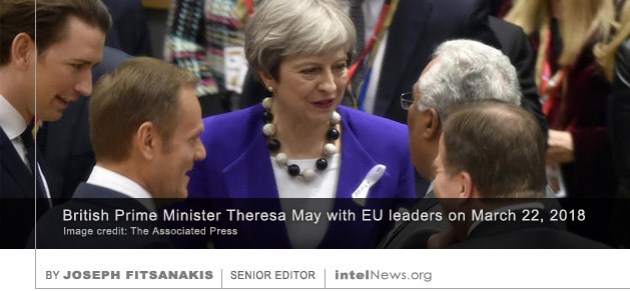
Theresa MayThe European Union has recalled its ambassador to Moscow in an apparent response to the poisoning of Sergei Skripal, a Russian double agent, who was attacked with a nerve agent in England earlier this month. Skripal, 66, and his daughter Yulia, 33, remain in critical condition in hospital, nearly three weeks after being poisoned with a nerve agent that British scientists say belongs to Russia’s Cold-War-era chemical stockpiles. Moscow has angrily rejected claims that Skripal, who spied for Britain in the early 2000s, was on a Kremlin-approved hit-list of defectors. But British Prime Minister Theresa May traveled to Brussels on Thursday to brief European Union heads of state about the attack on Skripal.
The summit concluded in the early hours of Friday with the publication of a joint statement, signed by every participating head of state, backing the British claims and expressing outrage at Moscow’s alleged use of a military-grade nerve agent on British soil. The statement said that EU leaders “agree with the United Kingdom government’s assessment that it is highly likely that the Russian Federation is responsible” for the attack on the Skripals. “There is no plausible alternative explanation”, said the statement, and described the attack on the two Russians as a “grave challenge to our shared security”. The statement will be seen as a foreign-policy triumph by London, as Britain has been contacting EU governments seeking from them a direct condemnation of Russia and possible diplomatic actions in response to the alleged attack.

The jointly authored statement also said that the EU would recall its ambassador to Moscow, effective immediately. Markus Ederer, a German diplomat who represents the EU in the Russian capital, will be leaving Russia “for a month of consultations”, in what appears to be a symbolic act of protest by the Europeans. However, some EU members threatened further action and said that they would “coordinate on the consequences to be drawn in the light of” future Russian actions on the matter of the Skripals. In statements made to reporters early on Friday, German Chancellor Angela Merkel said that there may be “further punitive measures” against Russia, adding that they would be coordinated among EU states.

Some media reported that at least five EU member states were considering expelling undeclared Russian intelligence officers from their soil in response to the alleged Russian attack in England. They are said to include France, Lithuania and Poland. The London-based newspaper Daily Telegraph reported that Russia was in danger of having its Western European spy network dismantled in response to the attack on the Skripals. Some EU countries, however, including Italy and Greece, appeared less interested in taking action against Russia. The Greek Prime Minister, Alexis Tsipras, said on Thursday that his government expressed its “solidarity with the United Kingdom”, but that the EU had to investigate what happened in England on March 4.

Author: Joseph Fitsanakis | Date: 23 March 2018 | Permalink

Analysis: Decoding Britain’s response to the poisoning of Sergei Skripal

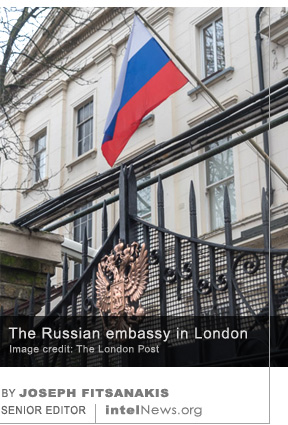
Russian embassy LondonAs expected, Moscow snubbed the British government’s demand for information into how a Russian-produced military-grade nerve agent ended up being used in the streets of Salisbury, England. As British Prime Minister Theresa May addressed the House of Commons on Wednesday afternoon, Sergei Skripal continued to fight for his life in a hospital in southern England. His daughter, Yulia, was also comatose, having been poisoned with the same Cold-War-era nerve agent as her father. This blog has followed the case of Sergei Skripal since 2010, when he arrived with his family in the United Kingdom after he was released from a Russian prison, having served the majority of a 13-year sentence for spying for Britain.

Just hours after the attack on the Skripals, British defense and intelligence experts concluded that it had been authorized by the Kremlin. On Wednesday, Prime Minister May laid out a series of measures that the British government will be taking in response to what London claims was a Russian-sponsored criminal assault on British soil. Some of the measures announced by May, such as asking the home secretary whether additional counter-espionage measures are needed to combat hostile activities by foreign agents in the UK, are speculative. The British prime minister also said that the state would develop new proposals for legislative powers to “harden our defenses against all forms of hostile state activity”. But she did not specify what these proposals will be, and it may be months —even years— before such measures are implemented.

The primary direct measure taken by Britain in response to the attack against Skripal centers on the immediate expulsion of 23 Russian diplomats from Britain. They have reportedly been given a week to leave the country, along with their families. When they do so, they will become part of the largest expulsion of foreign diplomats from British soil since 1985, when London expelled 31 Soviet diplomats in response to revelations of espionage against Britain made by Soviet intelligence defector Oleg Gordievsky. Although impressive in size, the latest expulsions are dwarfed by the dramatic expulsion in 1971 of no fewer than 105 Soviet diplomats from Britain, following yet another defection of a Soviet intelligence officer, who remained anonymous.

It is important to note, however, that in 1971 there were more than 500 Soviet diplomats stationed in Britain. Today there are fewer than 60. This means that nearly 40 percent of the Russian diplomatic presence in the UK will expelled from the country by next week. What is more, the 23 diplomats selected for expulsion are, according to Mrs. May, “undeclared intelligence officers”. In other words, according to the British government, they are essentially masquerading as diplomats, when in fact they are intelligence officers, whose job is to facilitate espionage on British soil. It appears that these 23 so-called intelligence officers make up almost the entirety of Russia’s “official-cover” network on British soil. This means that the UK Foreign Office has decided to expel from Britain nearly every Russian diplomat that it believes is an intelligence officer. Read more of this post

Russian spy may have been poisoned by nerve agent smeared on car’s door handle

Sergei SkripalThe nerve agent that poisoned a Russian double spy in England last week may have been smeared on his car’s door handle, according to sources. Sergei Skripal, 66, and his daughter Yulia, 33, are in critical condition after being poisoned on March 4 by unknown assailants in the English town of Salisbury. Skripal, a Russian former military intelligence officer, has been living there since 2010, when he was released from a Russian prison after serving half of a 13-year sentence for spying for Britain. The British government said on Monday that it believes Skripal and his daughter were poisoned by a military-grade nerve agent, thought to have been built in the Soviet Union during the Cold War. Britain’s counterterrorism experts continue to compile evidence on the case. Moscow denies any involvement.

On Tuesday, Neil Basu, spokesman for the Metropolitan Police Service, which houses Britain’s counterterrorism force, said that the investigation into the Skripals’ poisoning was complex and painstaking. Speaking to reporters in London, Basu said that hundreds of witnesses had been contacted and nearly 400 items had been collected from various crime scenes that related to the March 4 attack on the two Russians. He added that investigators were still looking into the whereabouts of the Skripals during a 40-minute period when they were driving in Mr. Skripal’s car. According to British newspaper The Daily Mail, Mr. Skripal’s dark red BMW is now “at the center of the investigation” into his poisoning. There are claims, said the paper, that the former spy and his daughter came in physical contact with the nerve agent by touching the door handles of the BMW as they entered the car on the evening of March 4. Some investigators appear to believe that the nerve agent may have been smeared on the car’s door handles.

The Metropolitan Police are now appealing for witnesses who may have seen the Skripals driving around downtown Salisbury in the red BMW, or arriving at the car park of Sainsbury’s, part of a British nationwide supermarket chain, on the early afternoon of March 4. Basu said that it was not known whether the pair met anyone during those 40 minutes. The police spokesman said that the Skripals were still fighting for their lives at a local hospital. He added that the inquiry into their poisoning would “take many weeks”.

Author: Joseph Fitsanakis | Date: 14 March 2018 | Permalink

UK blames Russia, says it will not invoke NATO Article 5 in attack on ex-spy

Theresa MayThe British prime minister said on Monday that it was “highly likely” the nerve agent used to attack a Russian defector in England last week was developed by Russia. But sources in London told the BBC that the British government would not invoke Article 5 of the North Atlantic Treaty Organization (NATO), which states that an attack on one member of the alliance is an attack on all. Theresa May was referring to an assassination attempt carried out on March 4 by unknown assailants against former KGB Colonel Sergei Skripal. The 66-year-old former spy and his daughter were found in a catatonic state in the town of Salisbury. It was later determined that they were attacked with a nerve agent.
Speaking in the British House of Commons, Mrs. May said that “world-leading experts” in chemical weapons had concluded Mr. Skripal had been attacked with a “military-grade nerve agent”. It was, she added, part of a group of nerve agents developed by the USSR in the 1970s and 1980s, known collectively as novichok (newcomers). The existence of these nerve agents took place in secret, but was later revealed by Russian government agents who defected to the West. British officials also disclosed yesterday that the British Foreign Office summoned the Russian Ambassador to London, Alexander Yakovenko, to seek an explanation about the attack. Additionally, London has called on Moscow to provide a “full and complete disclosure” of its novichok nerve agent program to the Organization for the Prohibition of Chemical Weapons, an intergovernmental agency based in the Netherlands, which oversees the 1997 Chemical Weapons Convention.

Meanwhile NATO Secretary General Jens Stoltenberg told reporters on Monday that the alliance viewed the use of a military-grade nerve agent on British soil as “horrendous and completely unacceptable” and that it was in contact with British officials about the matter. But British government officials told the BBC that London had no intention of invoking Article 5 of the NATO treaty, which requires all member-states to rally to the defense of a member under attack. The only time that Article 5 has been invoked by a member was by the United States, in response to the September 11, 2001, attacks. In Washington, White House Press Secretary, Sarah Huckabee Sanders said on Monday that the United States was “monitoring the incident closely” and took it “very seriously”. Mrs. Sanders described the attack on Mr. Skripal as “reckless, indiscriminative and irresponsible”, and extended the American government’s “support […] to our closest ally”, the United Kingdom. But she refused to respond to questions about whether the Russian government was behind the attack, saying that British experts were “still working through […] some of the details” of the case.

On Monday, during an official visit to the southern region of Krasnodar, Russian President Vladimir Putin was asked by a BBC reporter to comment on the attack on Skripal. He responded to the British reporter saying that the government in London would first have to “sort this out for yourselves first, then come talk to us”. He then walked away. Commenting from Moscow on Mrs. May’s allegations, Russian Foreign Ministry spokeswoman Maria Zakharova said that her statement in the British Parliament had been “a circus show”.

Author: Joseph Fitsanakis | Date: 13 May 2018 | Permalink

British intelligence to tighten security protection for Russian defectors

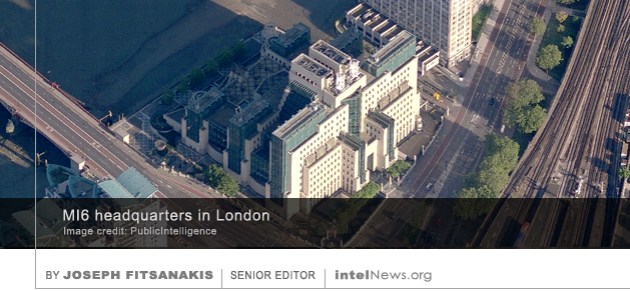
MI6The British secret services have begun tightening the physical security of dozens of Russian defectors living in Britain, a week after the attempted murder of former KGB Colonel Sergei Skripal in southern England. The 66-year-old double spy and his daughter, Yulia, were found in a catatonic state in the town of Salisbury on March 4. It was later determined that they had been attacked with a nerve agent. Russian officials have vehemently denied that the Kremlin had any involvement with the brazen attempt to kill Skripal. But, according to The Times, the British intelligence community has concluded that Skripal and his daughter were attacked on Moscow’s orders —most likely the GRU, Russia’s military intelligence agency, where Skripal worked until his arrest for spying for Britain in 2004.
Citing an unnamed source from Whitehall, the administrative headquarters of the British government, The Times said that initial assessments of Skripal’s poisoning were damning for Britain’s intelligence community. They raised questions, said the source, about the ability of Britain’s two primary spy agencies, the Security Service (MI5) and the Secret Intelligence Service (MI6), to provide security to their assets. The source told The Times that it was “impossible to reduce […] to zero” the risk of serious physical harm against individuals like Skripal, and before him Alexander Litvinenko, a former KGB officer who was poisoned to death in London in 2006. But the attack on Skripal is being viewed as an intelligence failure, said the source, and part of the response to it involves a comprehensive review of risk to British-based Russian double spies and defectors from “unconventional threats”. The latter include attacks with chemical and radiological weapons, said The Times.

The report came as another British-based Russian defector, Boris Karpichkov, told The Daily Mirror newspaper that the Kremlin has tried to poison him three times since 2006. Karpichkov, 59, joined the KGB in 1984, but became a defector-in-place for Latvian intelligence in 1991, when the Soviet Union disintegrated. He claims to have also spied on Russia for French and American intelligence. In 1998, carrying two suitcases filled with top-secret Russian government documents, and using forged passports, he arrived in Britain with his family. In 2006, while living in the UK, Karpichkov says he was warned by MI5 to leave the country because his life may be in danger. He temporarily relocated to New Zealand, where he says he was attacked with an unidentified nerve agent. He told The Mirror that he lost nearly half his weight during the following weeks, but survived due to good medical care. However, he was attacked again, he said, four months later, while still living in New Zealand.

Karpichkov told The Mirror he had been warned that his name was on a shortlist of eight individuals that the Kremlin wanted to kill. He also claimed that he was told by a source to watch out for people carrying electronic cigarettes, because Russian intelligence had developed nerve-agent weapons that were disguised as e-cigarette devices.

Author: Joseph Fitsanakis | Date: 12 March 2018 | Permalink

Analysis: All evidence points to professionals behind Skripal poisoning

Skripal SalisburyMost state-sponsored assassinations tend to be covert operations, which means that the sponsoring party cannot be conclusively identified, even if it is suspected. Because of their covert nature, assassinations tend to be extremely complex intelligence-led operations, which are designed to provide plausible deniability to their sponsors. Consequently, the planning and implementation of these operations usually involves a large number of people, each with a narrow set of unique skills. But —and herein lies an interesting contradiction— their execution is invariably simple, both in style and method. The attempted assassination of Sergei Skripal last Sunday in England fits the profile of a state-sponsored covert operation in almost every way.

Some have expressed surprise that Skripal, a Russian intelligence officer who was jailed in 2004 for selling Moscow’s secrets to British spies, would have been targeted by the Russian state. Before being allowed to resettle in the British countryside in 2010, Skripal was officially pardoned by the Kremlin. He was then released from prison along with four other Russian double agents, in exchange for 10 Russian deep-cover spies who had been caught in the United States earlier that year. According to this argument, “a swap has been a guarantee of peaceful retirement” in the past. Thus killing a pardoned spy who has been swapped with some of your own violates the tacit rules of espionage, which exist even between bitter rivals like Russia and the United States.

This assumption, however, is baseless. There are no rules in espionage, and swapped spies are no safer than defectors, especially if they are judged to have caused significant damage to their employers. It is also generally assumed that pardoned spies who are allowed to resettle abroad will fade into retirement, not continue to work for their foreign handlers, as was the case with Skripal, who continued to provide his services to British intelligence as a consultant while living in the idyllic surroundings of Wiltshire. Like the late Russian defector Alexander Litvinenko, who died in London of radioactive poisoning in 2006, Skripal entrusted his personal safety to the British state. But in a country that today hosts nearly half a million Russians of all backgrounds and political persuasions, such a decision is exceedingly risky.
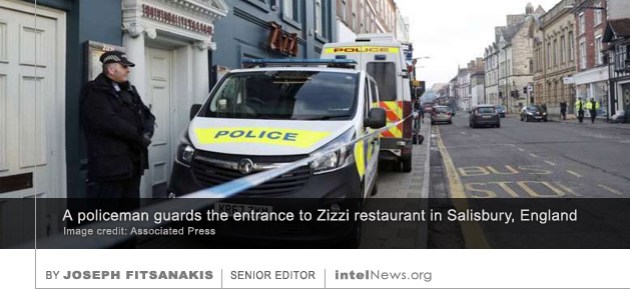
On Wednesday, the Metropolitan Police Service announced that Skripal, 66, and his daughter Yulia, 33, had been “targeted specifically” by a nerve agent. The official announcement stopped short of specifying the nerve agent used, but experts point to sarin gas or VX. Both substances are highly toxic and compatible with the clinical symptoms reportedly displayed by the Skripals when they were found in a catatonic state by an ambulance crew and police officers last Sunday. At least one responder, reportedly a police officer, appears to have also been affected by the nerve agent. All three patients are reported to be in a coma. They are lucky to have survived at all, given that nerve agents inhaled through the respiratory system work by debilitating the body’s respiratory muscles, effectively causing the infected organism to die from suffocation.

In the past 24 hours, at least one British newspaper stated that the two Russians were “poisoned by a very rare nerve agent, which only a few laboratories in the world could have produced”. That is not quite true. It would be more accurate to say that few laboratories in the world would dare to produce sarin or VX, which is classified as a weapon of mass destruction. But no advanced mastering of chemistry or highly specialist laboratories are needed to manufacture these agents. Indeed, those with knowledge of military history will know that they were produced in massive quantities prior to and during World War II. Additionally —unlike polonium, which was used to kill Litvinenko in 2006— nerve gas could be produced in situ and would not need to be imported from abroad. It is, in other words, a simple weapon that can be dispensed using a simple method, with little risk to the assailant(s). It fits the profile of a state-sponsored covert killing: carefully planned and designed, yet simply executed, thus ensuring a high probability of success.
By Wednesday, the British security services were reportedly using “hundreds of detectives, forensic specialists, analysts and intelligence officers working around the clock” to find “a network of highly-trained assassins” who are “either present or past state-sponsored actors”. Such actors were almost certainly behind the targeted attack on the Skripals. They must have dispensed the lethal agent in liquid, aerosol or a gas form, either by coming into direct physical contact with their victims, or by using a timed device. Regardless, the method used would have been designed to give the assailants the necessary time to escape unharmed. Still, there are per capita more CCTV cameras in Britain than in any other country in the world, which gives police investigators hope that they may be able to detect the movements of the attackers. It is highly unlikely that the latter remain on British soil. But if they are, and are identified or caught, it is almost certain that they will be found to have direct links with a foreign government.

Author: Joseph Fitsanakis | Date: 08 March 2018 | Permalink

British intelligence already sees Kremlin behind ex-spy’s poisoning, say sources

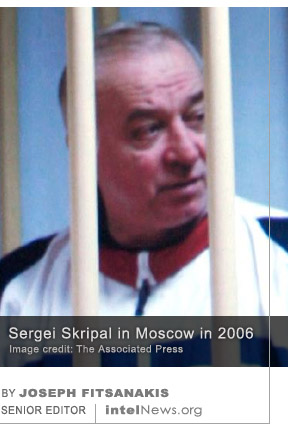
Sergei SkripalBritain’s counterintelligence service is nearing the conclusion that a foreign government, most likely Russia, tried to kill a Russian double spy and his daughter, who are now fighting for their lives in a British hospital. Sergei Skripal, 66, and his daughter Yulia Skripal, 33, are said to remain in critical condition, after falling violently ill on Sunday afternoon while walking in downtown Salisbury, a picturesque cathedral city in south-central England. Skripal arrived in England in 2010 as part of a large-scale spy-swap between the United States, Britain and Russia. He was among four Russian citizens that Moscow released from prison and allowed to resettle in the West, in exchange for 10 Russian deep-cover intelligence officers, who had been arrested earlier that year by the Federal Bureau of Investigation in the United States.
Since Skripal’s poisoning made headlines on Monday morning, the basic details of his story have been reported extensively. He is believed to have served in Soviet and Russian military intelligence for several decades, rising to the rank of colonel. But in 2004 he was arrested and eventually convicted by Russian authorities for spying on behalf of the British Secret Intelligence Service (MI6). He had served nearly 7 years of a 13-year sentence in 2010, when he was pardoned by then-Russian President Dmitry Medvedev and allowed to resettle in England with his immediate family. He did so in Salisbury, where he was found in a near-fatal state last Sunday, slumped on a street bench next to his equally catatonic daughter. Inevitably, the story brought back memories of the assassination of Alexander Litvinenko, a former officer in the Soviet and Russian intelligence services, who defected to Britain but was poisoned to death with a radioactive substance in 2006. His murder prompted London to expel four Russian diplomats from Britain, a move that was countered by Moscow, which also expelled four British diplomats from the country.

Despite the close parallels between Litvinenko and Skripal, the British government has not publicly blamed Russia for Sunday’s attempted killing. But according to The Times newspaper, officials at the Security Service (MI5), Britain’s counterintelligence agency, are already pointing to Russia as the culprit of the attempt on Skripal’s life. The London-based paper cited anonymous sources in Whitehall, the administrative headquarters of the British government, who said that MI5 experts were already briefing government officials about the details of the assassination attempt by Russian government agents.

Actions taken by the British government in the past 24 hours also point to Whitehall viewing the attempt on Skripal’s life as an operation sponsored by a state, most likely by Russia. The investigation of the incident is now being led by the counterterrorism branch of the Metropolitan Police Service in London. Additionally, samples of the victims’ tissue, as well as blood and other bodily fluids, have been sent for examination by toxicologists at the Ministry of Defence’s top-secret Science and Technology Laboratory in Porton Down. It also emerged last night that British Home Secretary Amber Rudd has called an emergency meeting of the British government’s Cabinet Office Briefing Rooms (COBR, also known as Cobra) group, which she chairs. The group consists of cabinet ministers, senior civil servants, and the leadership of the Metropolitan Police and the intelligence services, who meet to respond to developing emergencies of a national scale.

Author: Joseph Fitsanakis | Date: 06 March 2018 | Permalink

Discovery of cocaine in Russian diplomatic luggage leads to numerous arrests

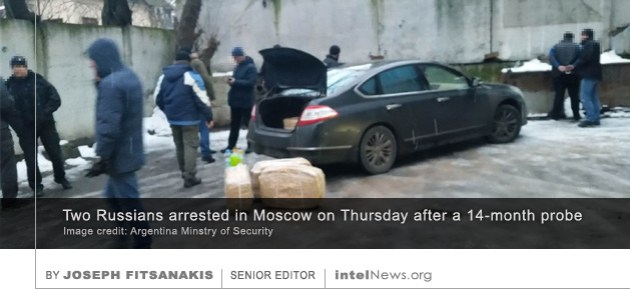
FSB drug arrestsA Russian former diplomatic employee and an Argentine police officer are among six people arrested following the discovery of nearly 1000 pounds of cocaine inside the Russian diplomatic compound in Buenos Aires. The arrests took place last Thursday and were announced in Argentina by the country’s Security Minister Patricia Bullrich. She told reporters that the arrests came after a 14-month investigation in Argentina, Russia and Germany. She added that the investigation unveiled “one of the most complex and extravagant drug-dealing operations” in Argentina’s history.
The 14-month probe dates to December of 2016, when Victor Koronelli, Russia’s ambassador to Argentina, and thee members of Russia’s Federal Security Service, discreetly approached Argentinian authorities. They informed the Argentinians that they had discovered 16 pieces of luggage filled with drugs inside an annex of the Russian embassy in Buenos Aires. Argentinian authorities were given permission to secretly enter the embassy grounds and inspect the suitcases. They confirmed that they contained more than 850 pounds (390 kilos) of cocaine, with a street value of more than $60 million. The suitcases were intended for transfer to Russia via a diplomatic flight. Cargo transferred on diplomatic flights cannot be searched by international customs officials due to the privilege of diplomatic immunity.

According to Bullrich, diplomatic counter-narcotics officers secretly transferred the bags to a separate location, where they replaced the cocaine with flour and fitted the suitcases with GPS tracking devices, before returning them to the Russian embassy annex. The luggage was eventually transferred to Russia via airplane in December 2017, a year after it was bugged by the Argentinians. Several Argentinian customs officers traveled to Russia to monitor the transfer of the shipment, in coordination with Russian authorities. The latter arrested two Russian citizens who tried to collect the suitcases. Another Russian citizen, and former staff member of the Russian embassy in Argentina, Alia Abyanov, was arrested in Moscow. Officials said Abyanov helped plan the transfer of the suitcases to Russia.

Two Argentines with dual Russian citizenship were also arrested in Buenos Aires. One of them has been named as Iván Blizniouk, a police officer, who is believed to have mediated between the drug smugglers and corrupt Argentine customs officers. A seventh suspect, identified only as “Señor K.” by the Argentine authorities, remains at large. He is believed to be living in Germany and is currently wanted by Interpol pursuant to an international warrant that has been issued for his arrest.

Author: Joseph Fitsanakis | Date: 27 February 2018 | Permalink

Conflicting reports of Russian fighters killed by US forces in Syria

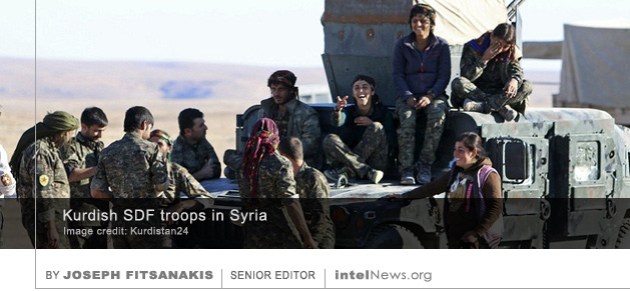
Kurdish SDF There are conflicting reports of Russian and Ukrainian fighters having been killed by American forces in northeastern Syria, with some sources claiming that up to 200 Russians and Ukrainians, most of them private contractors working for the Syrian government, were left dead in clashes last week. If such reports are accurate, they could point to the most lethal American-Russian confrontation since the end of World War II.
According to the United States Department of Defense, the armed confrontation took place on February 7. On that day, a 500-strong Syrian government force crossed the Euphrates River and entered Kurdish-controlled territory in northeastern Syria. A Pentagon spokesman, Colonel Thomas F. Veale, told reporters last week that the pro-government forces crossed the Euphrates near the town of Khursham, in Syria’s Deir al-Zour region. The town is firmly held by the Syrian Democratic Forces (SDF), a Kurdish armed faction that is supported by the US. Veale said that the Syrian government forces advanced in a “battalion-sized formation supported by artillery, tanks, multiple-launch rocket systems and mortars”. The SDF force in the area, which includes embedded American troops, responded with artillery fire, while US military aircraft also launched strikes on the government forces. The latter withdrew across the Euphrates after suffering heavy losses. The US side estimates that over 100 attackers were left dead, with another 200-300 injured. There were allegedly no SDF fatalities during the clash.

On February 8, CBS News cited an unnamed US Pentagon official, who claimed that Russians were among the dead in Deir al-Zour. The BBC said that “at least two Russians” were killed in the attack, while The New York Times raised the toll to “perhaps dozens”. But US news network Bloomberg claimed that over 200 Russians and pro-Russian Ukrainian mercenaries were among the dead. Citing anonymously “three Russians [and] one US official […] familiar with the matter”, the network said that most of the fatalities were Russian and Ukrainian private contractors who were fighting in Syria in support of the government of President Bashar al-Assad. These reports mark the first known instance of Russian citizens killed by American forces in Syria. If the Bloomberg account is accurate, the Deir al-Zour clash could be the most extensive armed confrontation between Americans and Russians since the end of World War II.

Bloomberg said that it spoke by phone to one Russian military contractor who said that “dozens of his wounded men” were still receiving treatment at military hospitals in Russia. On February 8, the Syrian government accused Washington of carrying out a “brutal massacre” in Deir al-Zour, but said nothing about foreign fighters. A statement by the Russian Ministry of Defense said that 25 Syrian troops were hurt in the attack, but denied that Russian soldiers had participated in the February 7 clashes. Speaking on behalf of the Kremlin, Russian government spokesman Dmitry Peskov said that Moscow only tracked casualty data about its official military forces stationed in Syria. He added that no Russian forces were stationed in Deir al-Zour. At a press conference last week, US Secretary of Defense James Mattis refused to discuss the matter, which he referred to as “perplexing”. Bloomberg said that American officials were “in talks” with Russian counterparts “in search of an explanation for what happened”.

Author: Joseph Fitsanakis | Date: 14 February 2018 | Research credit: N.L. | Permalink

Latvian citizen arrested for allegedly spying for Russia

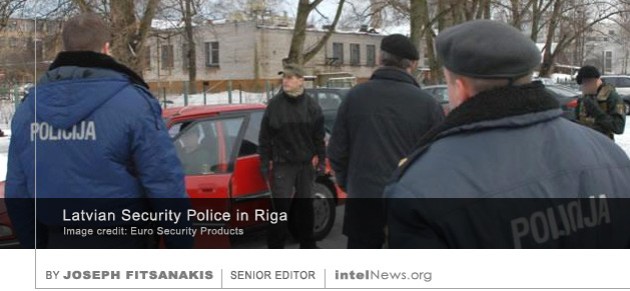
Latvian Security PoliceThe Latvian Security Police have announced the arrest of a man who is suspected of spying for a foreign country, with some reports claiming it is Russia. The Latvian state-owned news agency, LETA, said late last month that the man, who has not been named, was arrested by Security Police officers on Tuesday, December 19, 2017. However, the arrest was not announced by Latvian authorities until recently. A statement issued by government authorities in Riga said that the man’s arrest had been followed by searches at several different properties in the Latvian capital.
The detainee, who is reportedly a Latvian national, is being investigated for espionage and has already been charged with illegally possessing a firearm. A court in the Latvian capital ruled last week that the suspect should be remanded in custody. Initially, the Security Police refused to identify the detainee or reveal the name of the country that he allegedly spied for. But some private Latvian news outlets, who are believed to be close to the government, said on the morning of February 7 that the detainee worked for the Russian state. One report claimed that the man was tasked with collecting military-related information from the region of Latvia that borders Russia. He would then share the information with his Russian handlers, according to the report. On February 8, the Security Police confirmed that the detainee was indeed suspected of working for Russia. According to the agency, he gave his Russian handlers information about the National Armed Forces, Latvia’s military force.

Also on February 8, Latvian authorities warned the country’s citizens that they should remain vigilant. A government statement said that Moscow was intensely interested in collecting classified information about Latvia and that the Russian secret services preferred to recruit Latvians when the latter visited Russia. Reports late last week said that, if found guilty of spying, the detained man could face up to 14 years in prison.

Author: Joseph Fitsanakis | Date: 12 February 2018 | Permalink

Dutch spies identified Russian hackers who meddled in 2016 US election

Cozy BearDutch spies identified a notorious Russian hacker group that compromised computer servers belonging to the Democratic Party of the United States and notified American authorities of the attack, according to reports. In 2016, US intelligence agencies determined that a Russian hacker group known as Cozy Bear, or APT29, led a concerted effort to interfere in the US presidential election. The effort, which according to US intelligence agencies was sponsored by the Russian government, involved cyber-attacks against computer systems in the White House and the Department of State, among other targets. It also involved the theft of thousands of emails from computer servers belonging to the Democratic National Committee, which is the governing body of the Democratic Party. The stolen emails were eventually leaked to WikiLeaks, DCLeaks, and other online outlets. Prior descriptions of the Russian hacking in the media have hinted that US intelligence agencies were notified of the Russian cyber-attacks by foreign spy agencies. But there was no mention of where the initial clues came from.

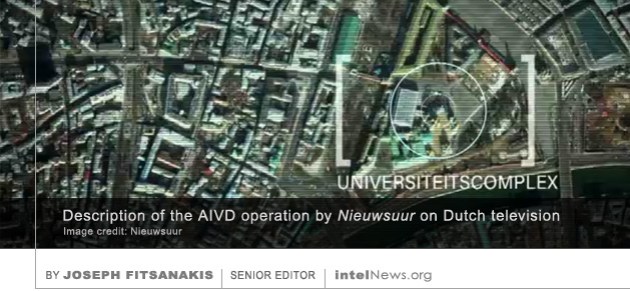
Last Thursday, the Dutch current affairs program Nieuwsuur, which airs daily on Holland’s NPO 2 television, said that the initial tipoff originated from the AIVD, Holland’s General Intelligence and Security Service. On the same day, the Dutch newspaper De Volkskrant published a detailed account of what it described as AIVD’s successful penetration of Cozy Bear. According to these reports, AIVD was able to penetrate Cozy Bear in mid-2014, before the hacker group intensified its campaign against political targets in the US. Citing “six American and Dutch sources who are familiar with the material, but wish to remain anonymous”, De Volkskrant said that the AIVD was able to detect the physical base of the Cozy Bear hackers. The latter appeared to be working out of an academic facility that was adjacent to Moscow’s Red Square. The AIVD team was then able to remotely take control of security camera networks located around the facility. Eventually, the Dutch team hacked into another security camera network located inside the buildings in which the hackers worked. They soon began to collect pictures and footage of Cozy Bear members, which they then compared with photos of “known Russian spies”, according to De Volkskrant.

The paper said that the AIVD team continued to monitor Cozy Bear’s activities until at least 2017, while sharing intelligence with the Central Intelligence Agency and the National Security Agency in the US. The intelligence was allegedly instrumental in alerting US spy agencies about Russian government-sponsored efforts to meddle in the 2016 presidential election. Several newspapers, including The Washington Post in the US and The Independent in Britain, contacted the AIVD and the MIVD —Holland’s military intelligence agency— over the weekend. But the two agencies said they would not comment on reports concerning Cozy Bear.

Author: Joseph Fitsanakis | Date: 29 January 2018 | Research credit: E.J. & E.K. | Permalink

Russian-trained Serb separatists are forming paramilitary group in Bosnia

Serbian Honor militiaA group of hardline Bosnian Serbs, some of whom have been trained in military tactics by Russian instructors, are secretly creating a paramilitary group to undermine the territorial integrity of Bosnia, according to reports. Information about the alleged paramilitary group was published on the Friday edition of Žurnal, a nonpartisan investigative newsmagazine. The allegations exposed by Žurnal were later repeated by Dragan Mektić, Bosnia and Herzegovina’s Minister for Security, who is himself a Bosnian Serb. Žurnal’s revelations came just days after hardline Serb separatists, dressed in dark-colored combat gear, staged a military-style rally in Banja Luka. The city of 200,000 is the administrative center of the Republika Srpska, the semi-autonomous Serb entity in Bosnia and Herzegovina. The entity was established under the terms of the 1995 Dayton peace agreement, which ended the Bosnian War that began in 1992.

The rally was held despite an earlier decision by the Constitutional Court of Bosnia and Herzegovina, which ruled that military-style marches by separatist organizations were unconstitutional. According to Žurnal, the rally was organized by Srbska čast (Serbian Honor), a militia made up of hardline Serb separatists. The group strongly supports Milorad Dodik, a Serb nationalist who has served as president of Republika Srpska since 2010. The investigative news site said that several members of Srbska čast’s were trained by Russian paramilitary instructors in the Russian-Serbian Humanitarian Center, a Russian-funded disaster relief center based in southern Serbia, which Western officials claim is really an intelligence base. Žurnal also said that one of Srbska čast’s leading figures, Bojan Stojković, a former commando, was trained in military schools in Russia and has been decorated by the Russian military.

Friday’s report by the investigative news outlet quoted extensively from a leaked report by Bosnia and Herzegovnia’s intelligence agency. The report allegedly states that Srbska čast leaders, including Stojković, met secretly with Dodik and discussed the formation of a new, heavily armed paramilitary unit, which will operate as an extrajudicial force in support of Dodik’s administration in Republika Srpska. One quote from the document said that the paramilitary force would engage in “possible intervention if the opposition [i.e. those opposed to Dodik] seeks to obstruct the functioning of the authorities” in the Republika Srpska. Bosnia and Herzegovina has been seeking to join the North Atlantic Treaty Organization since 2006. The country has gone through a series of stages in negotiations with NATO and ratified a membership action plan in 2010. Bosnia’s application is heavily supported by Turkey, NATO’s only predominantly Muslim member state, but is fiercely opposed by Russia and by the Balkan country’s Serb minority.

Author: Joseph Fitsanakis | Date: 15 January 2018 | Permalink

Russian hackers behind US election attacks also targeted hundreds of journalists

Fancy BearThe Russian hacker group that targeted the United States presidential election in 2016 also attacked hundreds of reporters around the world, most of them Americans, an Associated Press investigation shows. The group is often referred to in cyber security circles as Fancy Bear, but is also known as Pawn Storm, Sednit, APT28, Sofacy, and STRONTIUM. It has been linked to a long-lasting series or coordinated attacks against at least 150 senior figures in the US Democratic Party. The attacks occurred in the run-up to last year’s presidential elections in the US, which resulted in a victory for Donald Trump. The hacker group’s targets included Democratic Party presidential candidate Hillary Clinton and her campaign chairman John Podesta. But its hackers also went after senior US diplomatic and intelligence officials, as well as foreign officials in countries like Canada and the Ukraine.

Now a new investigation by the Associated Press news agency, based on data collected over a period of two years by the cyber security firm Secureworks, appears to show that Fancy Bear also attacked journalists. In a leading article published last week, the Associated Press said that journalists appeared to be the third largest professional group targeted by Fancy Bear, after politicians and diplomats. The investigation shows that nearly half of all journalists that were systematically targeted by the hacker group worked for a single newspaper, The New York Times. At least fifty Times reporters feature on the hacker group’s target list. The latter includes another 50 reporters working for Russian outlets that known to be critical of the Kremlin, and dozens of Eastern European reporters based in the Baltics, Moldova, Armenia, Georgia and Ukraine.

The Associated Press said that prominent names on the Fancy Bear target list include The Washington Post’s Josh Rogin, The Daily Beast’s intelligence correspondent Shane Harris, CNN’s security correspondent Michael Weiss, and Ellen Barry, the former Moscow bureau chief for The New York Times. The report also said that some American journalists were not only targeted online, but also physically. One of them, The New Yorker’s Masha Gessen, claims that she was routinely followed by Russian-speaking men in the period leading up to the 2016 presidential election. In April of this year, a study by the Tokyo-based cybersecurity firm Trend Micro showed that Fancy Bear was behind systematic efforts to subvert recent national elections in France and Germany. And a few weeks ago, Russian media reported that Konstantin Kozlovsky, a member of the prolific Russian hacker group Lurk, alleged that he had been hired by the Kremlin to help target the US Democratic Party.

Author: Ian Allen | Date: 26 December 2017 | Permalink