Russian spy services raid bomb lab in Moscow, foil large-scale suicide plot
August 14, 2017 Leave a comment
 Russian intelligence services say they have foiled a large-scale bomb plot, after raiding an explosives laboratory belonging to the Islamic State and arresting four suspects. The four men were allegedly planning to target the Moscow Metro transit system and a busy shopping center in the Russian capital. In a statement released to the media this morning, the Russian Federal Security Service (FSB) did not specify the intended targets of the plotters. But it said it had arrested four people during an early morning raid at an explosives laboratory located in the Moscow suburbs. The FSB said that its officers confiscated large quantities of peroxide-based explosives that resemble the material used by the Islamic State in the November 2015 attacks in Paris, the March 2016 attacks in Brussels, and last May’s suicide bombing in Manchester.
One of the men arrested has been named by the FSB as Akbarzhon A. Dzhalilov, 22, a Kyrghyz-born Russian citizen. The other three men, who have not yet been named, are all from former Soviet Republics of Central Asia. Russian media reported that the Moscow cell was being commanded and directed by the Islamic State in Syria. Two Russian-speaking men from the Russian Caucasus, who are located in Syria, are thought to have been handling the cell’s activities. Russian intelligence services estimate that at least 2,500 Russian citizens have move to the Middle East to join jihadist groups in the past three years.
Had it been carried out, the attack would have been added to a growing list of terrorist incidents against Russia since 2015, which are related to the Kremlin’s decision to enter the Syrian Civil War. In October of that year, the Islamic State claimed responsibility for the bombing of Metrojet Flight 9268, a chartered commercial flight operated by Russian company Kogalymavia. The chartered airliner went down over Egypt’s Sinai Peninsula, killing all 217 passengers and crew on board —the worst disaster in Russian aviation history. In November of 2016, the FSB reportedly foiled another attack by five members of the Islamic State in Moscow. In February of this year, a seven-member Islamic State cell was busted in Yekaterinburg, Russia’s fourth-largest city, while it was planning attacks in several metropolitan areas, including Moscow and St. Petersburg. In April, the North Caucasus-based Imam Shamil Battalion claimed responsibility for a suicide attack in the St. Petersburg Metro transit system, which killed 15 train passengers. The group, whose existence was unknown before the St. Petersburgh attack, said it supported al-Qaeda and perpetrated the attack in retaliation for Moscow’s involvement in the Syrian Civil War.
► Author: Ian Allen | Date: 14 August 2017 | Permalink
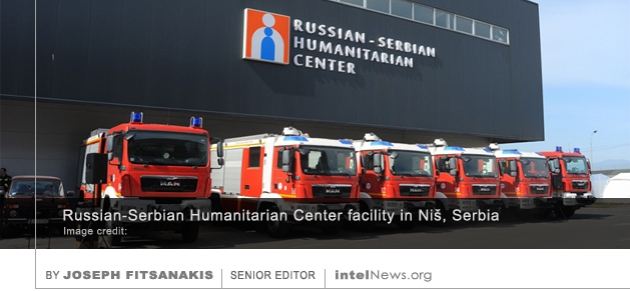 Staff at a Russian disaster relief center in southern Serbia have rejected claims by American officials that the facility operates as an espionage arm of Moscow’s foreign policy in the Balkans. The Russian-Serbian Humanitarian Center was built in 2012, at a cost of nearly $40 million, following an agreement between Belgrade and Moscow. Its
  Russia is planning to expel approximately 30 American diplomats from its territory, and seize buildings and property belonging to the United States Department of State, according to Russian media reports. The expulsions will be in response to the expulsion last December of 35 Russian diplomats stationed in the US by the administration of President Barack Obama. In addition to expelling the diplomats, Washington also reclaimed two “recreational facilities” (in reality intelligence outposts) that were used by the Russians in New York and Maryland. The White House said that the expulsions were ordered in response to alleged efforts by Russia to interfere in the 2016 US presidential election.
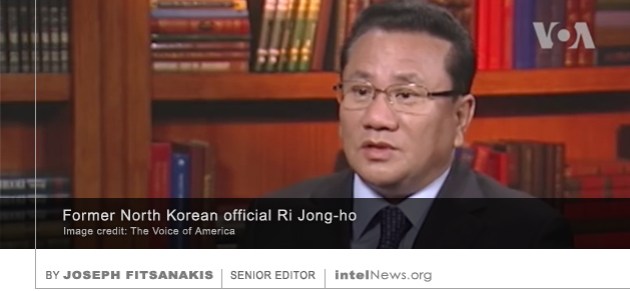 The government of North Korea uses intermediary firms in Singapore to import thousands of tons of Russian oil each year, according to a senior North Korean defector who has spoken publicly for the first time since his defection. Ri Jong-ho was a senior official in the Democratic People’s Republic of Korea under its previous leader, the late Kim Jong-il. He rose through the ranks of the Workers’ Party of Korea and was directly mentored by Kim, who personally appointed him to a post in Bureau 39. The powerful body is in charge of securing much-needed foreign currency for Pyongyang —often through illegal activities— and partly funds the personal accounts of the ruling Kim dynasty.
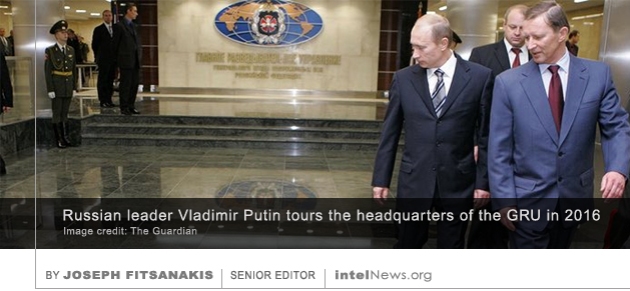 New information about carefully targeted attempts by Russian operatives to compromise the November 2016 presidential elections in the United States have emerged in a newly published intelligence document. The document, which dates from May of this year, was produced by the US National Security Agency and
  Russian espionage in the United States has become increasingly sophisticated and brazen, and American counterintelligence professionals are finding it difficult to contain it “after years’ worth of inattention” according to sources.
  Ukrainian security service personnel raided the offices of a Russia-based internet search engine firm in two cities on Tuesday, as part of a treason investigation. The probe is reportedly related to the ongoing dispute between Kiev and Moscow, which intensified after 2014, when Russia unilaterally annexed the Russian district of Crimea. The Ukrainian government also accuses the Kremlin of clandestinely supporting pro-Russian insurgents in southeastern Ukraine, something that Moscow denies.
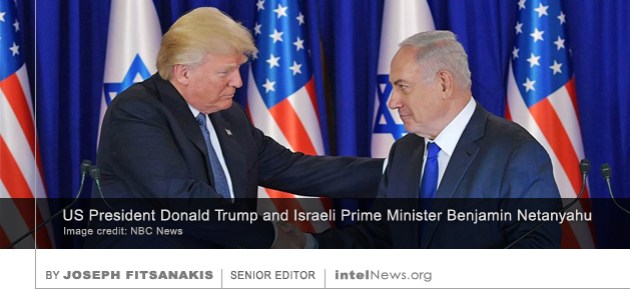 Authorities in Israel have revised their intelligence-sharing protocols with the American government after it became known that United States President Donald Trump inadvertently exposed Israeli secrets to Russia. The alleged exposure of Israeli secrets came earlier this month, during a meeting between Mr. Trump and a delegation of Russian government officials, which included Foreign Minister Sergey Lavrov and Sergey Kislyak, Moscow’s Ambassador to Washington.
 The same group cyber-spies that attacked the campaign of French presidential candidate Emmanuel Macron is now attacking German institutions that are connected to the country’s ruling coalition parties, according to a report by a leading cyber-security firm. The Tokyo-based security software company Trend Micro published a 41-page report on Tuesday, in which it tracks and traces the attacks against French and German political targets over the past two years. The report, entitled
 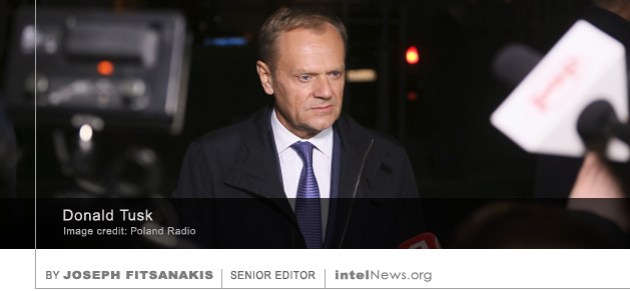 Senior European Union official Donald Tusk was grilled for several hours on Wednesday, in the context of a Polish government probe into an intelligence agreement between Warsaw and Moscow. But Tusk, who is the current president of the European Council, and served as Poland’s prime minister from 2007 to 2014, dismissed the probe as politicized and said it was deliberately designed to harm his political career. The investigation was launched by the government of Poland earlier this year. Its stated goal is to investigate an agreement that was struck in late 2013 between Poland’s Military Counterintelligence Service (MCS) and the Federal Security Service (FSB) of the Russian Federation. The agreement allegedly took place in secret, but was never implemented. The government of Poland canceled it in 2014, after accusing Moscow of illegally annexing the Ukrainian region of Crimea.
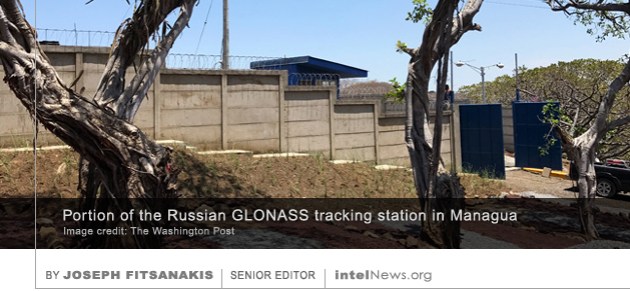 A Russian facility built on a hillside facing the United States embassy in the Nicaraguan capital Managua is seen by some experts as symptomatic of Russia’s renewed presence in the Americas. The official Russian explanation for the heavily protected facility, which is surrounded by high walls, is that it is meant to operate as a tracking station for GLONASS, Russia’s version of the global positioning system (GPS). The Russians do not use GPS, because it is owned by the US government and operated by the US Air Force. But some believe that only part of the compound is dedicated to GLONASS activities, and that a major portion is a Russian listening base that sweeps US communications from throughout the region.
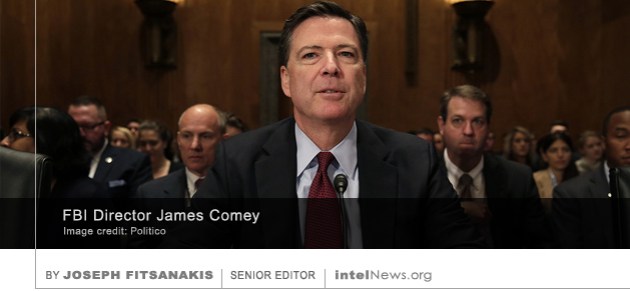 Monday’s official announcement that an investigation is underway into alleged Russian involvement in the 2016 United States presidential election was an important moment in American political history. It exposed the chaotic state of American politics and added yet another layer of complexity in an already intricate affair, from which the country’s institutions will find it difficult to recover for years to come. This is regardless of the outcome of the investigation, which is being conducted by the Federal Bureau of Investigation. Even if it fails to produce a ‘smoking gun’, the very fact that the country’s chief counterintelligence agency is examining the possibility that a US president was elected with help from Russia, is an astonishing development without parallel in modern American history.
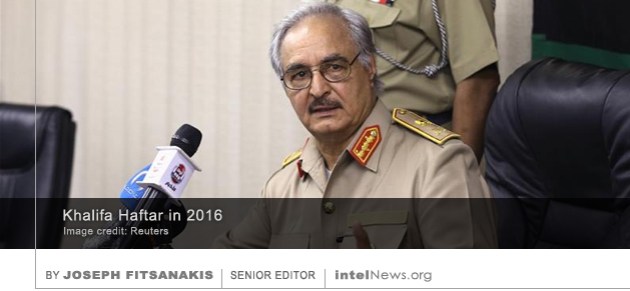 Russia may have become the latest country to deploy special forces soldiers in Libya, according to news reports citing anonymous United States officials. Late on Tuesday, the Reuters news agency
 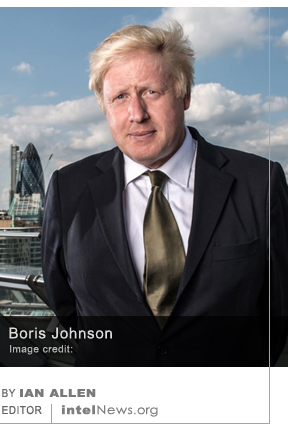 Boris Johnson, the British foreign secretary has said in an interview that Russian spies may have orchestrated last year’s failed attempt to kill the then-prime minister of Montenegro, Milo Dukanović. Mr. Johnson, a senior figure in the Conservative Party of the United Kingdom, was a major contender for the prime minister’s position in 2016, after the administration of David Cameron collapsed under the weight of the Brexit vote result. Speaking on Sunday morning to reporter Robert Peston, of Britain’s ITV television network, Mr. Johnson said that the West should “engage” with Russia, but warned that it should also “beware” of Moscow’s “dirty tricks” in Europe and the United States.






 intelNews.org
Russia jailed senior intelligence officers for helping CIA nab notorious hackers
August 25, 2017 by Joseph Fitsanakis 2 Comments
But in December 2016, Mikhailov and one of his trusted deputies in the CIB, Dmitry Dokuchaev, were suddenly removed from their posts and arrested. The arrests marked some of the highest-profile detentions of intelligence officers in Russia since the demise of the Soviet Union. Russian authorities refused to reveal the reasons for the arrests, but confirmed that the two men had been charged with treason. Reports soon surfaced in the Russian media, claiming that Mikhailov and Dokuchaev were arrested for their involvement in a Russian criminal hacker gang. Some Western media, including The New York Times, speculated that the two men may have been arrested for helping US intelligence investigate Russian interference in the 2016 US presidential election.
But now a new report alleges that Mikhailov and Dokuchaev were charged with treason after helping the US Central Intelligence Agency catch two prolific Russian hackers. The report was aired on Russian television station TV Dozhd, also known as TV Rain, a privately owned channel based in Moscow, which broadcasts in Russia and several other former Soviet Republics. One of the hackers, Roman Seleznev, known in hacker circles as Track2, reached worldwide notoriety for defrauding major credit card companies of tens of millions of dollars. He was arrested in 2014 in the South Asian island country of Maldives and eventually extradited to the US to stand trial. He was sentenced to 27 years in prison, which he is currently serving. The other hacker, Yevgeniy Nikulin, was arrested in the Czech Republic in 2016, pursuant to a US-issued international arrest warrant. He is now awaiting extradition to the US, where he is expected to be tried for hacking several high-profile companies, including DropBox and LinkedIn.
TV Dozhd said that Russian authorities are also suspecting the men of being members of hacker gangs, but that their main charges relate to their close cooperation with American intelligence agencies, reportedly in exchange for cash.
► Author: Joseph Fitsanakis | Date: 25 August 2017 | Permalink
Filed under Expert news and commentary on intelligence, espionage, spies and spying Tagged with computer hacking, Dmitry Dokuchaev, FSB, FSB Center for Information Security, News, Roman Seleznev, Russia, Sergey Mikhailov, United States, Yevgeniy Nikulin