Germany and Holland investigated Russian physicist for espionage
July 28, 2015 Leave a comment
 The German and Dutch governments allegedly joined forces to investigate a Russian supercomputer specialist, who studied in Germany and Holland, suspecting him of passing technical information to Russian intelligence. German weekly newsmagazine Der Spiegel, which published the report in its current issue, identified the physicist only as “Ivan A.” and said that the 28-year-old man was a member of a physics laboratory affiliated with the Max Planck Institute in the western German city of Bonn. According to Spiegel, Ivan A. studied in Bonn between 2009 and 2011, conducting research on quantum physics and nanophotonics, an area of study that examines the behavior of light on the nanometer scale. Much of the research in this specialized field relates to supercomputers and cutting-edge quantum computing applications.
Citing unnamed government sources, Spiegel said that Germany’s Office for the Protection of the Constitution, which is the country’s top counterintelligence agency, started to monitor the scientist once he began meeting regularly with a Russian diplomat. The diplomat, who was stationed at the consulate of the Russian Federation in Bonn, had been identified by German intelligence as a member of the Russian secret services. German counterintelligence officials thus began suspecting Ivan A. of channeling restricted technical information to Moscow via the Russian diplomat.
However, in 2013 Ivan A. relocated to the Dutch city of Eindhoven to study at the Eindhoven University of Technology, at which point German counterintelligence officers reached out to their Dutch colleagues. During one of his trips from Germany to Holland, Ivan A. was detained for several hours along with this wife at the Düsseldorf International Airport. He was questioned and his personal electronic devices were confiscated. Upon his release Germany and Holland jointly launched against him a formal investigation for espionage. Eventually his European Union residence visa was cancelled and he was expelled by the Dutch government as a danger to national security. Der Spiegel said Ivan A. returned to Russia and today denies that he was a spy.
Espionage scandals frequently rock German-Russian relations. In 2013, a German court convicted a married couple, Andreas and Heidrun Anschlag, of having spied for the Soviet Union and Russia since at least 1990. The two had used forged Austrian passports to enter West Germany from Mexico in 1988 and 1990.
► Author: Joseph Fitsanakis | Date: 28 July 2015 | Permalink: https://intelnews.org/2015/07/28/01-1744/
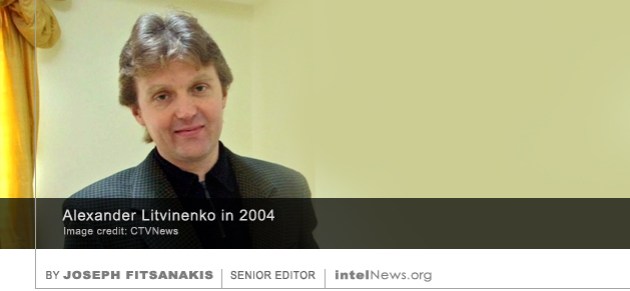 A Russian former intelligence officer, who is accused by the British government of having killed a former KGB spy in London, has agreed to testify at a public inquiry to be held in the British capital next month. British government prosecutors believe Russian businessman Dmitri Kovtun, who worked for the KGB during the Cold War, poisoned his former colleague in the KGB, Alexander Litvinenko, in 2006. Litvinenko was an officer in the Soviet KGB and one of its successor organizations, the FSB, until 2000, when he defected with his family to the United Kingdom. He soon became known as a vocal critic of the administration of Russian President Vladimir Putin. In 2006, Litvinenko came down with radioactive poisoning soon after meeting Kovtun and another former KGB officer, Andrey Lugovoy, at a London restaurant. He was dead less than two weeks later.
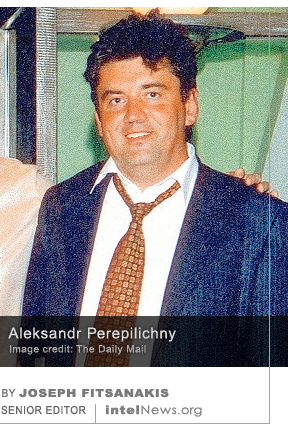 A Russian businessman, who died in London while assisting a Swiss probe into a massive money-laundering scheme, may have been poisoned with a substance derived from a highly toxic plant, an inquest has heard. Aleksandr Perepilichny was an influential Moscow investment banker until he fled Russia in 2009, saying that his life had been threatened after a disagreement with his business partners. A few months later, having moved to an exclusive district in Surrey, south of London, Perepilichny began cooperating with Swiss authorities who were investigating a multi-million dollar money-laundering scheme involving senior Russian government officials. The scheme, uncovered by a hedge fund firm called Hermitage Capital Management (CMP), and described by some as the biggest tax fraud in Russian history, defrauded the Russian Treasury of at least $240 million. The case made international










 intelNews.org
Sweden conducts spy flights over Russia amidst heightened tensions
August 13, 2015 by Ian Allen 2 Comments
This year, however, the stakes are different, since relations between Stockholm and Moscow have deteriorated dramatically. The Scandinavian country has issued numerous formal complaints against what it says were illegal infiltrations of its airspace by Russian military jets since 2014. Carl Bildt, Sweden’s Minister of Foreign Affairs, said earlier this year that some of these alleged airspace infiltrations represented “the most serious aerial incursions by the Russians in almost 10 years”. In October of last year, Swedish authorities shut down airspace over Stockholm while searching for a misery foreign vessel seen off the coast of the Swedish capital, said to be a Russian spy submarine. The mystery vessel was never detected, but some Swedish media sites claimed that its mission had been to either “pick up or drop off a Russian spy” without alerting Swedish authorities. In March of this year, the Swedish Security Service, known as SAPO, said that Russia was Sweden’s greatest short-term threat, adding that nearly a third of all Russian diplomats stationed in Sweden were in fact intelligence officers.
Swedish media quoted Swedish Armed Forces Colonel Carol Paraniak, who said that Russia was and would always remain an intelligence target for Sweden. This is especially true today, as the “security and political situation […] has changed a lot compared to last year. Tensions have increased dramatically”, said Paraniak.
► Author: Ian Allen | Date: 13 August 2015 | Permalink
Filed under Expert news and commentary on intelligence, espionage, spies and spying Tagged with aerial reconnaissance, Carl Bildt, Carol Paraniak, News, Russia, Sweden, Swedish Air Force, Treaty on Open Skies