Arafat ‘may have been poisoned’, claims Swiss forensic report
November 7, 2013
 By JOSEPH FITSANAKIS | intelNews.org
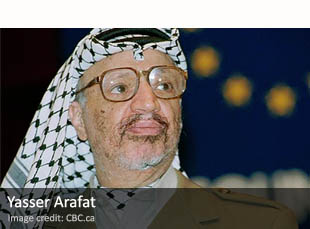
A forensic investigation by Swiss researchers into the death of Yasser Arafat states that the data “moderately suggests” that the Palestinian statesman may have been poisoned with a deadly radioactive substance. The founder of Palestinian nationalist group Fatah, who led the Palestine Liberation Organization for over three decades before becoming the first president of the Palestinian Authority, passed away in November 2004 at the Percy military hospital in Paris, France. His official records indicate that he died from a stroke, which he suffered as a result of a blood disorder known as disseminated intravascular coagulation. However, a year-long investigation by a team of forensic pathologists at the Vaudois University Hospital Centre in Lausanne, Switzerland, suggests that the late Palestinian leader is likely to have been poisoned with radioactive polonium. According to the results of the study, published by Qatari news channel Al Jazeera, tests on Arafat’s bones and on soil samples from around his corpse, showed “unexpected high activity” of polonium 210. Traces of the same substance were discovered on the personal artifacts that Arafat used during his final days while in hospital in Paris. According to the study, some of the Fatah leader’s personal belongings, including his underwear and his toothbrush, contained levels of polonium that were as many as ten times higher than those in random samples used as control subjects in the study. The BBC spoke to Dr. Paddy Regan, of the University of Surrey, United Kingdom, who specializes in the detection and measurement of radiation. He said the Swiss study had delivered “a pretty strong statement” in support of the theory that Arafat was poisoned. Read more of this post










 intelNews.org
Senior Iranian aide defects during nuclear talks in Lausanne
March 30, 2015 by Joseph Fitsanakis Leave a comment
A media advisor to the Iranian president, who was in Switzerland to cover the ongoing international negotiations on the country’s nuclear program, has defected. Amir Hossein Motaghi is credited with having helped secure the impressive ascent of Hassan Rouhani to Iran’s presidency in 2013. Rouhani, who swept to power with over 50 percent of the vote, over 30 percentage points ahead of his nearest rival, owes much of his victory to his popularity among the youth. Motaghi led the media team that promoted Rouhani’s image among younger voters by cleverly employing online platforms such as Facebook and Twitter.
Following Rouhani’s victory, however, Motaghi repeatedly voiced impatience with the slow pace of social and political reforms in Iran. Recently he spoke in favor of the release of Jason Rezaian, the Iranian-American Tehran bureau chief for The Washington Post, who has been denounced as a spy and imprisoned by the Iranian government. There have been rumors in the Iranian media that Motaghi had been ordered to report once a week to Iran’s Ministry of Intelligence; some say he had been privately warned that he faced arrest upon his return to Iran.
Motaghi had reportedly been sent to the Swiss city of Lausanne by the Iran Student Correspondents Association (ISCA). His task was to cover the ongoing talks that aim to bring an end to the dispute between the Islamic Republic and a group of nations that have come to be known as P5+1, representing the five permanent members of the United Nations Security Council plus Germany. However, according to Iranian opposition sources, the media aide resigned from his ISCA post before filing an application for political asylum in Switzerland.
Soon afterwards, Motaghi gave an interview to Irane Farda, a pro-reform Iranian television station based in London, in which he explained the reasons for his defection. He accused the Iranian government of controlling Iranian media reports about the talks, by staffing its reporter entourage in Lausanne with undercover intelligence officers. He also said he could no longer pursue his profession conscientiously because he was only allowed to report approved news items. Furthermore, he accused the American delegation to the talks as “mainly speak[ing] on Iran’s behalf with […] the 5+1 countries [so as to] convince them to consent to an agreement”.
Late on Sunday, ISCA, the press agency believed to have sent Motaghi to Switzerland, released a statement claiming it did not employ the journalist and that his job had been terminated prior to the nuclear talks in Lausanne.
Filed under Expert news and commentary on intelligence, espionage, spies and spying Tagged with Amir Hossein Motaghi, defectors, Iran, Iran Student Correspondents Association, Iranian nuclear program, Jason Rezaian, Lausanne (Switzeralnd), News, political asylum, Switzerland