CIA helping Turkey, Saudi Arabia, smuggle weapons into Syria: sources

Turkish-Syrian borderBy JOSEPH FITSANAKIS | intelNews.org |
A growing team of United States Central Intelligence Agency personnel is currently in Turkey overseeing a multinational effort to secretly deliver weapons to Syrian anti-government rebels, according to The New York Times. Quoting “American officials and Arab intelligence officers”, the paper said last week that the weapons are being smuggled into Syria primarily through the Turkish border. The financial cost of smuggling into Syria such weapons as antitank explosives, rocket-propelled grenades, and automatic rifles, has so far been covered by the governments of Turkey, Qatar and Saudi Arabia, according to the article. The funds are partly required to bribe members of what The Times describes as “a shadowy network of intermediaries”, which reportedly includes forces loyal to the Syrian Muslim Brotherhood. The latter is a Sunni group that is widely viewed as the most dominant of the anti-government factions that make up the rebel side in the ongoing Syrian uprising. The paper quotes an “Arab intelligence official”, who says the CIA contingent in Turkey “is trying to make new sources and recruit people” along the porous Turkish-Syrian border. But its presence in the volatile region, which has been constant for “several weeks”, according to The Times, is also aimed at keeping the smuggled weapons out of the reach of Syrian anti-government forces that are allied with militant Islamist groups, including al-Qaeda. The article notes that American support for the Syrian rebels has been minimal, when compared with that in Libya in 2011, mostly because of staunch Russian support for the government forces of Syrian president Bashar al-Assad. Read more of this post

Western spy agencies ‘sharing intelligence’ with Syrian rebels

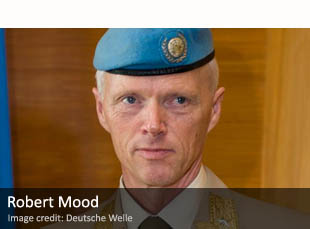
Robert MoodBy JOSEPH FITSANAKIS | intelNews.org |
A British newspaper has cited defense sources claiming that British and American intelligence agencies are passing vital information to Syrian rebels fighting to overthrow the country’s government. British tabloid The Daily Star quoted “a British defense source” who said that most of the raw intelligence on Syria is picked up by sophisticated British and American satellites monitoring Syrian communications. Once gathered and assessed by intelligence analysts in Washington and London, the information is passed on to operatives of the United States Central Intelligence Agency and Britain’s MI6, who are allegedly operating on the ground in Syria. They in turn communicate actionable intelligence to rebel leaders in Syria, who are fighting the government of Syrian President Bashar al-Assad. According to the British tabloid, information passed on to rebel leaders includes detailed satellite imagery of Syrian pro-government troop movements around the country, as well as the contents of intercepted communications between senior Syrian military commanders and their subordinates in the field. The Star quotes one unnamed British government source who claims that the satellites are so sophisticated that they allow British and American eavesdroppers to identify the individuals whose voices are heard in the intercepted communications, with the aid of advanced voice recognition systems. The intelligence has reportedly enabled rebel commanders to evacuate locations targeted by government forces, and may also have allowed the rebels to organize successful counterstrikes in response to offensives conducted by troops loyal to Damascus. Washington-based publication The Hill contacted the CIA and the White House but their spokespersons refused to comment on what they called “an ongoing intelligence operation” in Syria. A spokesman from the British Foreign and Commonwealth Office would only tell The Star that “all actions remain on the table”.   Read more of this post
News you may have missed #735

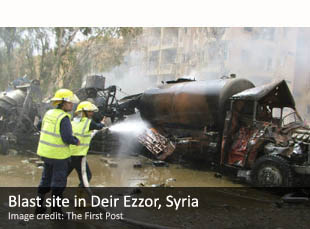
Blast site in Deir Ezzor, SyriaBy IAN ALLEN | intelNews.org |

►►Pakistan imposes new restrictions on CIA operatives. The government of Pakistan has issued a set of new rules and regulations for officials, ambassadors and contractors of the United States Central Intelligence Agency (CIA). According to Pakistani news reports, Pakistan and the US finalized these new rules in the course of 13 meetings between representatives of both countries. Under the new rules, CIA officers deployed in Pakistan “must prove their identity” to Pakistani counterintelligence officials. Some officials, including former Pakistani ambassador to the United States Sherry Rehman, are already talking of a “new beginning for US-Pakistani relations”.
►►Car bomb strikes near Syrian intelligence agency. The Syrian Observatory for Human Rights confirmed reports on Saturday of an explosion in the Ghazi Ayyash neighborhood of the eastern Syrian city Deir al-Zour. The site of the blast, which killed at least seven people and injured 100 others, was close to the city branches of the Military Intelligence Directorate and Air Force Intelligence, the London-based activist group reported. There has been no immediate claim of responsibility for the attack.
►►China denies US cyberespionage claims. The Chinese government has hit back at a US Pentagon report that said it is carrying out aggressive cyber-spying as part of a military build-up. Chinese Foreign Ministry spokesman Hong Lei said “China’s justified and normal military development” had been unjustly criticized in the annual report, which was released on Friday. The development of China’s “limited” military force was only geared towards safeguarding its independence, sovereignty and territorial integrity, said the spokesman.

News you may have missed #714

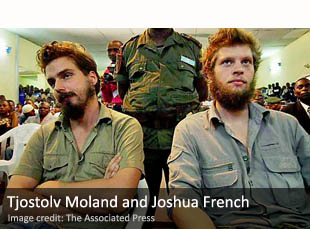
Tjostolv Moland and Joshua FrenchBy IAN ALLEN | intelNews.org |

►►British PM urged to intervene in Congo spy case. The mother of Joshua French, who has dual British and Norwegian nationality, and is facing execution in the Democratic Republic of Congo, has urged British Prime Minister David Cameron to ask Congolese authorities to pardon him. French, and his Norwegian friend Tjostolv Moland, were sentenced to death for murder and spying in the vast central African country in 2009. A prison official claimed in August last year that the pair had tried to escape, but their lawyer denies this.
►►Computers of Syrian activists infected with Trojan. Since the beginning of the year, pro-Syrian-government hackers have steadily escalated the frequency and sophistication of their attacks on Syrian opposition activists. Many of these attacks are carried out through Trojans, which covertly install spying software onto infected computers, as well as phishing attacks which steal YouTube and Facebook login credentials. According to the Electronic Frontier Foundation, the latest surveillance malware comes in the form of an extracting file which is made to look like a PDF if users have their file extensions turned off. The PDF purports to be a document concerning the formation of the leadership council of the Syrian revolution and is delivered via Skype message from a known friend.
►►Report claims Australian government spied on anti-coal activists. The leader of the Australian Greens, Bob Brown, says he is outraged at reports that the Australian Security Intelligence Organisation (ASIO) is spying on mining protesters, and says such action is a misuse of the spy agency’s resources. The revelations were reported in Australian newspapers yesterday, and are based on a Freedom of Information request to the Department of Resources, Energy and Tourism that was reportedly rejected because it involved “an intelligence agency document”. The ASIO says it cannot confirm whether it has conducted surveillance of anti-coal protesters, but it says it does not target particular groups or individuals unless there is a security-related reason to do so.

Breaking News: Russian troops land in Syria

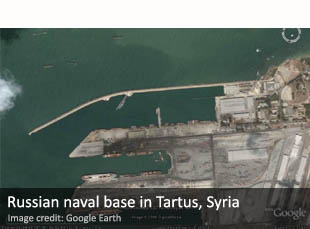
Russian naval base in Tartus, SyriaBy JOSEPH FITSANAKIS| intelNews.org |
The Russian service of the BBC has confirmed that a contingent of Russian “antiterrorist special forces” have landed in Syria. The news first appeared on Monday on the websites of several Russian news agencies, including Interfax and RIA Novosti. The latter claimed that the Russian troops, who were said to be Marines, arrived in the Syrian port of Tartus onboard the tanker Iman, which is part of Russia’s Black Sea fleet. According to the report, the tanker is strictly tasked with performing “logistical tasks [including] the replenishment of fuel and food [and] providing maritime anti-piracy security in the Gulf of Aden”. According to a statement from the Russian Black Sea Command, the special forces had landed in Syria in order to “demonstrate the Russian presence in the turbulent region and possibly evacuate Russian citizens”. Shortly after the initial reports of the troops’ landing in Tartus, ABC News spoke to an anonymous source at the United Nations Security Council, who described the news as “a bomb” that was “certain to have serious repercussions” on the situation in Syria. Soon afterwards, however, an unnamed source in the Syrian Ministry of National Defense told the SANA news agency in Damascus that the reports of Russian troops landing in Syria were “completely devoid of truth” and said the presence of the Russian tanker was connected with an anti-piracy mission. The Russian Ministry of Defense also told reporters that the Iman is not a warship and that its crew is composed entirely of civilian personnel. But a separate report on the Russian-language service of the BBC claims that, although the vessel is indeed hydrographic —designed to collect undersea topographic data— it contains sophisticated dual-use hardware that can easily be used for intelligence collection. The BBC report repeats earlier claims by the Interfax news agency that the Russian ship arrived in Tartus with a large contingent of marine brigade and airborne assault battalion members. It also quotes sources from the Syrian opposition, which allege that Russian troops were indeed seen disembarking in Taurus. Read more of this post

News you may have missed #692

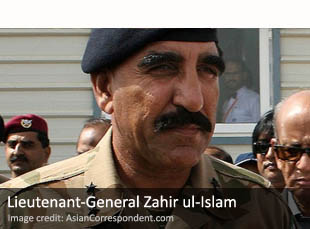
Lieutenant-General Zahir ul-IslamBy IAN ALLEN| intelNews.org |
►►Mole theory over MI6 codebreaker’s death. It is one of Britain’s most baffling spy mysteries. In 2010, the body of expert code breaker Gareth Williams was found locked in a large sports bag in the bathtub of his London flat. There were no obvious signs of how he died or who was responsible —with many claiming a “wall of silence” surrounding his death points to a cover-up at the very heart of the British establishment. And now it has been revealed Gareth may have been betrayed by a British double agent.
►►Pakistan picks new director for spy agency. The prime minister of Pakistan appointed a new general to run the country’s most powerful intelligence agency on Friday, signaling an important change in the military leadership at a pivotal moment in relations with the United States. Lt. Gen. Zahir ul-Islam will take over as the director general of the Inter-Services Intelligence Directorate, or ISI, on March 18, replacing Lt. Gen. Ahmed Shuja Pasha, who has held the post since 2008.
►►Russian diplomat alleges 15,000 foreign fighters in Syria. Addressing a one-day humanitarian forum on Syria at the United Nations in Geneva, Russia’s deputy ambassador Mikhail Lebedev said rebels had recently committed large-scale attacks against Syrian infrastructure, including schools and hospitals. Asked by Reuters how many foreign fighters were believed to be in Syria, he said: “how many got in through illegal routes? The border there is not demarcated, not delimited, so nobody knows. But at least 15,000”.

News you may have missed #685

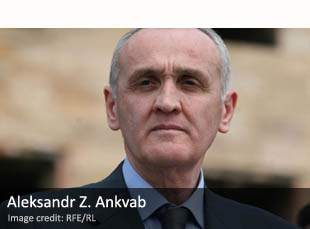
Aleksandr Z. AnkvabBy IAN ALLEN| intelNews.org |
►►Abkhazia President survives assassination attempt. Unidentified assassins tried on Wednesday to kill Aleksandr Z. Ankvab, the president of Abkhazia, a Russian-backed rebel enclave of Georgia. The assailants used automatic rifles, grenade launchers and a powerful roadside bomb in an attack that raised fresh questions about Moscow’s ability to preserve order there.
►►Groups object to CIA declassification charges. Open government advocates are protesting a recently adopted CIA policy that allows the agency to charge up to $72 an hour to review requests to declassify secret records. The effect “will be to price the public out of submitting” requests for “mandatory declassification review,” the American Library Association, Sunlight Foundation and more than 30 other organizations said in a letter Thursday to CIA Director David Petraeus.
►►Analysis: Fallout from Syrian colonel’s abduction in Turkey. The smokescreen surrounding the abduction of Syrian Col. Hussein Harmush, who defected to Turkey in June 2011 before being handed over to the Syrian secret service in September 2011, has begun to clear in recent weeks following a judicial probe. Claims that Turkey’s spy agency, the National Intelligence Organization (MİT), was involved in handing Harmush over to Syria were finally confirmed on February 2 when the Adana Chief Public Prosecutor’s Office issued a written statement saying one MİT agent had been arrested for questioning and further MİT officials had been called to testify as “suspects” in the scandalous repatriation case.

Turkey denies reports of intelligence officers arrested in Syria

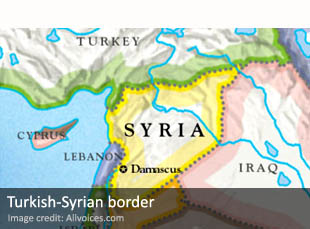
Turkish-Syrian borderBy JOSEPH FITSANAKIS | intelNews.org |
The Turkish government has denied reports in the Israeli media that dozens of Turkish intelligence officers have been arrested and are under interrogation in neighboring Syria. Israeli newspaper Ha’aretz reported over the weekend that at least 40 Turkish intelligence officers had been captured by the Syrian military and were being questioned. The paper also claimed that Syrian military interrogators had extracted “confessions” from the captured Turkish officers, according to which they were operating on instructions to “carry out bombings” in Syria, and other operations aimed to “undermine the country’s security”. Citing Syrian sources, Ha’aretz also said that the Turkish intelligence officers “admitted” having been trained by Israeli intelligence agency Mossad, and that the Mossad also trains members of the opposition Free Syrian Army. The Israeli daily also said that Ankara and Damascus have been involved in “intensive negotiations” over the fate of the 40 Turkish intelligence officers. According to Ha’aretz, Syria has offered to release the Turks, providing Ankara extradites scores of Syrian defectors —most of them from the military— who have been given political asylum in Turkey during the past few months. Damascus reportedly also insists that Turkey takes immediate steps to prevent the smuggling of weapons and military supplies to the Free Syrian Army through its territory. But in a brief press statement on Monday, a Ministry of Foreign Affairs spokesman said that the report in Ha’aretz was “incorrect”. Turkish newspaper Zaman also quoted anonymous Turkish intelligence sources who flatly refuted the reports from Israel. Read more of this post

Spy activity heats up in Berlin, recent arrests show

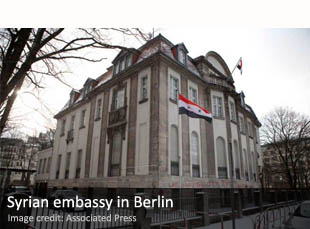
Syrian embassy in BerlinBy IAN ALLEN | intelNews.org |

During the Cold War, Berlin was considered one of the world’s paramount intelligence hotspots —a gathering place for spies from Western Europe, the Soviet bloc, America, and beyond. But recent developments in the German capital show that the city’s illustrious espionage heritage is far from over. On Wednesday, German authorities announced the arrest of a 56-year-old man on charges of spying on Western Saharan opposition activists operating on German soil. The man, who has been identified only as “Mohammed B.”, is reportedly a German-Moroccan dual citizen, and the statement by the German prosecutor’s office hints that he is an accredited intelligence officer. According to the official press release by the prosecutor, Mohammed B. was arrested for operating as an unregistered agent of the Moroccan intelligence services. His main targets appear to have consisted of activists involved with the POLISARIO Front, the main political vehicle of the Western Saharan independence movement, which seeks to separate the territory from Moroccan control. POLISARIO, along with its military wing, the Sahrawi People’s Liberation Army, was founded after 1975, when Morocco unilaterally annexed the former Spanish colony. A police spokesman in Berlin said German authorities searched Mohammed B’s apartment, as well as businesses and houses belonging to “two other suspects”, who do not appear to have been apprehended. The arrest took place exactly a week after the German government summarily expelled four Syrian diplomats, whom it accused of engaging in “activities incompatible with their diplomatic status” —code language for espionage. Read more of this post

Turkish intel officer arrested for abducting Syrian defector

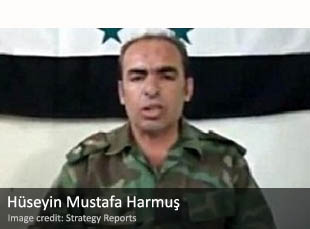
Hüseyin Mustafa HarmuşBy JOSEPH FITSANAKIS | intelNews.org |
There seems to be no end in sight to the troubles of Turkey’s spy service. According to reports from Ankara, an employee of the country’s National Intelligence Agency (MİT) has been arrested for orchestrating the abduction of a leading Syrian military defector, who had sought refuge in Turkey. According to authorities in Ankara, the MİT employee, who has been identified only by his initials, Ö.S., had been under surveillance for nearly half a year, along with four of his collaborators. Last week, Turkish police arrested Ö.S. in connection with the abduction of Colonel Hüseyin Mustafa Harmuş, one of the most senior Syrian military officials to have defected to the opposition, and the founder of the Free Syrian Army. Harmuş, who defected from the Syrian military in June of 2011, had crossed the border into Turkey and was living in a camp set up and supervised by the Turkish government in Hatay, a province in south-central Turkey. Following his defection, Harmuş became one of the most vocal and media-savvy members of the Syrian opposition, frequently directing strong public criticism of the Syrian regime led by President Bashar al-Assad. The Syrian government responded by declaring Harmuş a traitor and offering a $100,000 reward for his capture. Then, all of a sudden, Harmuş disappeared without a trace on August 29. After a detailed investigation, Turkish authorities found that Ö.S. had assembled a team of four people who collaborated to kidnap Harmuş, deliver him to the Syrian government, and pocket the hefty reward. By utilizing his access to Turkish government communications, Ö.S. forged a letter authorizing him permission to escort Harmuş to another camp in Turkey’s Anatolia region. Upon gaining custody of the Syrian defector, Ö.S. delivered him to two of his collaborators, who in turn handed him over to the Syrian authorities. Read more of this post

News you may have missed #678

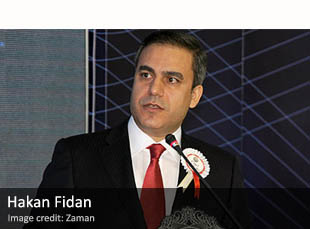
Hakan FidanBy IAN ALLEN | intelNews.org |
►►Russia ‘exposed 199 spies’ last year. Outgoing Russian President Dmitry Medvedev said Tuesday that Russian counterintelligence had exposed 199 spies working for foreign powers last year. He was speaking at a meeting of the Federal Security Service. He also urged the FSB to “take extra measures to protect Russian interests” and reinforce the country’s borders in the Arctic.
►►Germany expels four Syrian diplomats. As tensions mount between Western nations and Syria, the German authorities said Thursday that they had ordered the expulsion of four Syrian diplomats after arresting two men accused separately of spying on opponents of President Bashar al-Assad. The four diplomats —three men and a woman who were not identified by name— have been given three days to leave Germany.
►►Turkey summons spy chief over talks with Kurds. Prosecutors have summoned Hakan Fidan, head of Turkey’s National Intelligence Agency (MİT), as well as his predecessor, Emre Taner, for questioning, over reports of secret peace talks in Norway between Turkish intelligence agents and Kurdish militant leaders. Predictably, MİT has appealed the move.

Germany summons Syrian ambassador following spy arrests

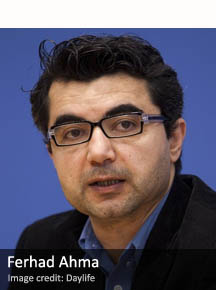
Ferhad AhmaBy JOSEPH FITSANAKIS | intelNews.org |
The government of Germany has summoned the Syrian ambassador to Berlin after German counterintelligence officers arrested two Syrian nationals on espionage charges. The two men, believed to be employees of Syrian intelligence, have been identified as 34-year-old Akram O., a Syrian national, and Mahmoud El A., a German citizen of Lebanese descent. Both were arrested early on Tuesday morning, during a sting operation involving over 70 German counterintelligence operatives, who searched the suspects’ apartments. According to a statement by the German Federal Prosecutor’s Office, the two men are “strongly suspected” of having engaged “for years” in systematic surveillance against Syrian political figures in Germany, with particular focus on expatriate groups critical of the government of Syrian President Bashar al-Assad. The statement added that German authorities are investigating the apartments of six alleged accomplices, suspected of assisting the two alleged spies. According to media reports, the counterintelligence operation was authorized after Ferhad Ahma, a Syrian-born elected official of the Green Party, was severely beaten at his apartment on December 26, by two men posing as German police officers. The Green Party launched a complaint with German police, suspecting that the two thugs were in fact Syrian government agents trying to intimidate Ahma, who is known in Germany for his strong criticism of the al-Assad regime. In announcing the diplomatic protest, German Minister of Foreign Affairs Guido Westerwelle told journalists that “any apparent activity against the Syrian opposition in Germany is in no way tolerable and a violation of [German] law”. Read more of this post

News you may have missed #675

Maria del Pilar HurtadoBy IAN ALLEN | intelNews.org |
►►Panama refuses to extradite Colombian ex-spy chief. Panama’s foreign ministry cited the Inter-American Convention on Human Rights, an international accord on asylum and Panamanian law, as reason for denying Colombia’s request to extradite Maria del Pilar Hurtado, who faces charges in Bogota over an illegal wiretapping scandal. Currently enjoying asylum in Panama are former presidents of Guatemala, Jorge Serrano Elias; and Ecuador, Abdala Bucaram; as well as erstwhile Haitian military strongman Raoul Cedras.
►►Russian spy chief to visit Syria. Russian Foreign Minister Sergei Lavrov said on Saturday he and Foreign Intelligence Service (SVR) head Mikhail Fradkov will visit Syria and meet with President Bashar al-Assad on February 7. The visit will be made on instructions from Russian President Dmitry Medvedev. Lavrov did not reveal any details of the upcoming the visit.
►►US spy chief: ‘we don’t know if Iran is building a bomb’. At a hearing of the Senate Select Committee on Intelligence last Tuesday, James Clapper, the US Director of National Intelligence, released the following statement: “We assess Iran is keeping open the option to develop nuclear weapons, in part by developing various nuclear capabilities that better position it to produce such weapons, should it choose to do so.  We do not know, however, if Iran will eventually decide to build nuclear weapons”.

Senior army defector says Syrian military near collapse

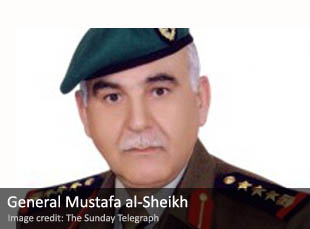
Mustafa al-SheikhBy JOSEPH FITSANAKIS | intelNews.org |
The most senior defector from the ranks of the Syrian military has said in his first full-length media interview that the Syrian armed forces are too weak and demoralized to continue fighting after the end of this month. General Mustafa al-Sheikh served in the Syrian military for 37 years, before he made the decision last November to join several other senior Syrian defectors, who have crossed into Turkey, where they have been given refuge. General al-Sheikh told British newspaper The Sunday Telegraph that, if not handled properly, the imminent collapse of the regime of Bashar al-Assad will “explode across the whole region, like a nuclear reaction”. Commenting on the current condition of the Syrian military, he said that today it relies on only about 40 percent of its hardware and 32 percent of its human personnel. The remaining two thirds of its troops consist of mostly Sunni officers, who have either been arrested, have defected to the so-called Free Syrian Army, or not permitted to participate in combat, due to mistrust by the government. This situation has forced the Assad regime to rely primarily on members of its own Alawite minority for its military operations. Because of their small numbers and untrained members, the Alawites tend to operate more as a militia than an army, according General al-Sheikh. The dramatic reduction in the size of the Syrian army is preventing the Syrian government from asserting control over several towns in the country, and there are allegedly even suburbs of Damascus now being effectively controlled by anti-government forces. The Telegraph correctly notes, however, that, his detailed knowledge of the Syrian military aside, General al-Sheikh is far from a neutral observer. Read more of this post

News you may have missed #674

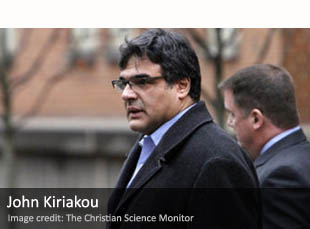
John KiriakouBy IAN ALLEN | intelNews.org |
►►Ex-CIA officers blast Kiriakou. Two former CIA intelligence officials, who spoke to The Washington Times, have rejected the image of John Kiriakou as a high-minded whistleblower who sought to expose official wrongdoing or a botched intelligence operation. Bruce Klingner, who worked as an analyst at the Defense Intelligence Agency and the CIA, called Mr. Kiriakou’s alleged actions “a betrayal of the trust the US government placed in him”. Bart Bechtel, a former CIA clandestine officer, said he considered Kiriakou’s actions “egregious”.
►►US air strikes in Yemen go largely unreported. Last Tuesday’s attacks in southern Yemen were among the biggest carried out by the United States in Yemen since airstrikes began there in November 2002. These strikes underline how the Americans are escalating covert operations against two Islamist groups in the region –al-Qaida in the Arabian Peninsula and Somalia’s al-Shabaab.
►►West explores prospects for Assad’s exile. The United States, European governments and Arab states have begun discussing the possibility of exile for Bashar al-Assad despite skepticism the defiant Syrian president is ready to consider such an offer, Western officials said on Wednesday. While talks have not progressed far and there is no real sense that Assad’s fall is imminent, one official said as many as three countries were willing to take him as a way to bring an end to Syria’s bloody 10-month-old crisis.