Location of UK’s ‘above top-secret’ Middle East spy base revealed
June 4, 2014 4 Comments
 By JOSEPH FITSANAKIS | intelNews.org
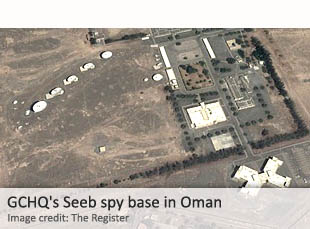
The location of a British listening base in the Middle East, which is classified by the British government as “three levels above top-secret”, has been revealed by a technology website. The information had been previously leaked by American defector Edward Snowden to several British newspapers, but the latter refrained from airing it following pressure by the British government. However, the highly classified material was published on Tuesday in online technology review The Register. The author of the revelatory article is Duncan Campbell, a longtime investigative journalist and researcher who has been reporting on intelligence matters for over three decades. In his article, Campbell alleges that the secret British spy base is located in Seeb, in northeast Oman, and is operated by the General Communications Headquarters (GCHQ), Britain’s signals intelligence agency. The base’s primary operational goal is to monitor undersea telecommunications cables serving the Arabian Sea and the Persian Gulf, which pass through the Strait of Hormuz. According to Campbell, the listening facility was initially constructed with British funding as a joint intelligence center with the Omani authorities, with the purpose of intercepting the signals of civilian communications satellites orbiting in the wider region. But it has since developed into one of three high-value GCHQ locations in Oman (referred to as Overseas Processing Centres —OPCs). The three locations, codenamed TIMPANI, GUITAR and CLARINET, form part of a region-wide communications interception program codenamed CIRCUIT. Through CIRCUIT, London has allegedly managed to gain access to nearly a dozen underwater cables passing through the Strait of Hormuz, which link a host of Arab countries, including Iraq, Iran, Saudi Arabia, the United Arab Emirates and Kuwait. Interestingly, GCHQ relies on the close cooperation of several telecommunications service providers to meet its interception targets, says Campbell. These include British Telecom, codenamed REMEDY in internal GCHQ documents, and Vodafone, the world’s second-largest mobile telecommunications company, which GCHQ has codenamed GERONTIC. Read more of this post

 By JOSEPH FITSANAKIS | intelNews.org

 By IAN ALLEN | intelNews.org


 By IAN ALLEN | intelNews.org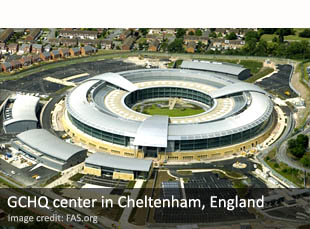







 intelNews.org

UK military scrambling to rehire retired Russian-language analysts
June 10, 2014 by Joseph Fitsanakis 1 Comment
The crisis in Ukraine is causing the British military to reach out to hundreds of retired Russian-language analysts who left the service at the end of the Cold War, according to media reports. British newspaper The Daily Telegraph said on Saturday that Russia’s actions in the Ukraine had exposed significant shortages of Russian-language analysts in the British Armed Forces. The paper said it had seen internal government documents that detailed efforts by military officials to contact associations of retired intelligence personnel in search of qualified Russia experts. The article referenced one recent memorandum from an unnamed senior officer in a military intelligence brigade, which asks retired military personnel to help by contacting retired Russian-language analysts, most of whom are now in their 60s. Other documents suggest that, in addition to analysts, the British military is in need of experts that can help monitor and translate information collected from open-source Russian information channels. The Telegraph places the blame for the shortage on budget cuts implemented by successive British governments on the nation’s Armed Forces. It also faults the defense and security agencies’ “recent focus on the Middle East and Asia”, which is said to have occurred at the expense of Russian linguistic and analytical expertise. The article quotes an unnamed “intelligence source” as saying that Britain’s Ministry of Defense used to offer “extremely good” Russian-language courses, but that “after 9/11” a focus on Arabic displaced Russian and other languages associated with the Cold War. There are also complaints by Russian experts in the British Army that they were “openly derided as being nothing more than a ‘language club’” in the years following 9/11. Read more of this post
Filed under Expert news and commentary on intelligence, espionage, spies and spying Tagged with British Armed Forces, Defence Academy of the United Kingdom, intelligence analysis, military intelligence, News, Russia, UK, Ukraine