In rare public comments, Taiwan spy chief points to 2027 as key in China’s plans
May 5, 2023 1 Comment
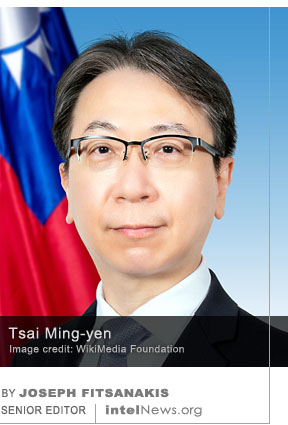 IN A SERIES OF rare public comments, the director of Taiwan’s primary intelligence agency has singled out 2027 as a year of paramount significance for China’s military plans for Taiwan. On Thursday, Tsai Ming-yen (pictured), director-general of Taiwan’s National Security Bureau (NSB) since February, spoke to an audience of graduating students at Taiwan’s National Chung Hsing University in Taichung City. According to reports, it was the first time in a quarter of a century that an NSB director-general had addressed a university audience.
In addition to his speech at the Chung Hsing University, Director-General Tsai, a former deputy foreign minister and diplomat, gave a rare interview to the United States-based Bloomberg news agency. He refused to weigh in on the ongoing discussion about a timeframe for a possible Chinese invasion of Taiwan. But he singled out the year 2027 as a significant one for Chinese Premier Xi Jinping’s plans to modernize the People’s Liberation Army (PLA).
The Chinese leader first introduced his “PLA Modernization 2035” plan in 2017, describing it as a whole-of-government effort to significantly improve the PLA’s combat capabilities as a step toward achieving China’s long-term goal of becoming a major global military power. Tsai pointed out that the year 2027 will be the 10-year mark into President Xi’s 18-year program of military reforms. Additionally, Xi will most likely be campaigning for a fourth presidential term that year, Tsai said.
In his interview with Bloomberg, Tsai said that President Xi “doesn’t allow any kind of different voice in the Chinese political system”. In essence, therefore, the Chinese leader has been surrounding himself with “a coterie of like-minded officials”. This resulting ‘groupthink’ means that “the risk of making a wrong decision” on pressing issues like Taiwan “will become much higher” in the coming years, he warned. To counter that threat, and to monitor China’s military intentions, Tsai said Taiwan is systematically deepening its real-time cooperation with its “international friends”, especially with the so-called “Five Eyes” alliance, an intelligence-sharing coalition comprising of the United States, United Kingdom, Canada, Australia, and New Zealand.
In a separate development, the United States Director of National Intelligence Avril Haines said on Thursday that the Taiwan Semiconductor Manufacturing Company Ltd (TSMC) would be a major cause for concern in a possible Chinese invasion of Taiwan. The United States and other countries rely overwhelmingly on the TSMC’s production output for the use of semiconductors in civilian and military hardware. Should a Chinese military invasion of Taiwan prevent the TSMC from producing those semiconductors, the resulting impact on the global economy would be “enormous”, possibly in the neighborhood of “between $600 billion to $1 trillion on an annual basis for the first few years”, Haines said.
► Author: Joseph Fitsanakis | Date: 05 May 2023 | Permalink
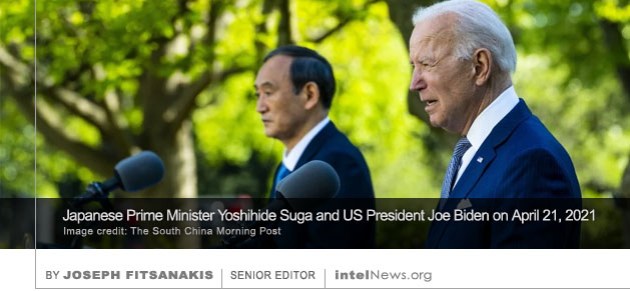 JAPAN’S AMBASSADOR TO AUSTRALIA has said he feels optimistic his country could join the Five Eyes intelligence alliance in “the near future”, adding to growing speculation on the topic. Japanese diplomat Shingo Yamagami, who has held the post of ambassador to Australia since late 2020,
  The United States has warned that it might be forced to stop sharing intelligence with Australia if the country’s second most populous state enters into a much-heralded investment agreement with China. The Australian state of Victoria has said it intends to join Beijing’s Belt and Road Initiative, a worldwide investment venture that was announced with much fanfare by Chinese President Xi Jinping in 2013.
 China’s influence in New Zealand is so extensive that it threatens the traditionally close intelligence contacts between New Zealand and its Western allies, according to a report written by the Canadian spy agency. Since World War II, New Zealand has been a member of what is sometimes referred to as the UK-USA Security Agreement. Known also as the UKUSA Agreement or the Five Eyes alliance, the pact, which was strengthened in 1955, provides a multilateral framework for intelligence cooperation between the United Kingdom, the United States, Canada, Australia, and New Zealand. But a new report produced by Canadian intelligence warns that Chinese political and economic influence in New Zealand is making it difficult for the Pacific Ocean island country to continue to operate within the framework of the agreement.
 The British government may relocate Sergei Skripal, the Russian double spy who appears to have survived an assassination attempt in England, to the United States, in an effort to protect him from further attacks. The BBC
  Canada says it will stop sharing certain types of intelligence with some of its closest international allies until it ensures that Canadian citizens’ information is not included in the data given to foreign spy agencies. The announcement follows an official admission, made earlier this week, that a Canadian intelligence agency failed to remove Canadian citizens’ data from information it shared with member-agencies of the so-called Five Eyes Agreement. The pact, which is sometimes referred to as the UK-USA Security Agreement, has been in existence since World War II. It provides a multilateral framework for cooperation in signals intelligence (SIGINT) between the United Kingdom, the United States, Canada, Australia, and New Zealand.
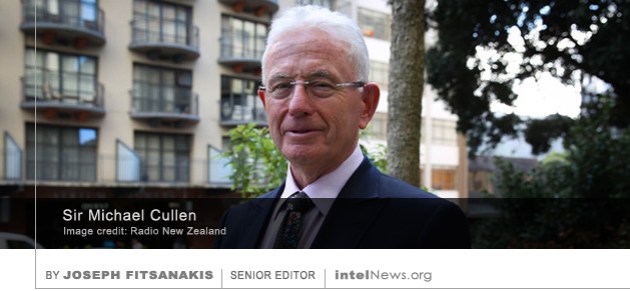 A former deputy prime minister of New Zealand, who is heading a major review of intelligence practices in the country, has said in an interview that spy agencies hurt their mission by practicing excessive secrecy. Sir Michael Cullen served as finance minister, education minister and attorney-General before serving as deputy prime minister of New Zealand, from 2002 to 2008. He was recently appointed by the government to co-chair a broad review of state intelligence agencies, with particular focus on updating the applicable legislative framework and evaluating the oversight exercised by lawmakers and the executive. The review is expected to affect the work of New Zealand’s two most visible intelligence agencies, the Security Intelligence Service and the Government Communications and Security Bureau.










 intelNews.org
US-led ‘Five Eyes’ alliance dismantled Russia’s ‘premier espionage cyber-tool’
May 11, 2023 by Joseph Fitsanakis 3 Comments
Turla is believed to be made up of officers from Center 16, a signals intelligence unit of Russia’s Federal Security Service (FSB), one of the Soviet-era KGB’s successor agencies. Since its appearance in 2003, Turla has used a highly sophisticated malware dubbed ‘Snake’ to infect thousands of computer systems in over 50 countries around the world. Turla’s victims include highly sensitive government computer networks in the United States, including those of the Department of Defense, the National Aeronautics and Space Administration, and the United States Central Command.
The Snake malware has also been found in computers of privately owned firms, especially those belonging to various critical infrastructure sectors, such as financial services, government facilities, electronics manufacturing, telecommunications and healthcare. For over two decades, the Snake malware used thousands of compromised computers throughout the West as nodes in complex peer-to-peer networks. By siphoning information through these networks, the Turla hackers were able to mask the location from where they launched their attacks.
On Tuesday, however, the United States Department of Justice announced that the Federal Bureau of Investigation (FBI), along with its counterparts in the United States-led ‘Five Eyes’ intelligence-sharing alliance, had managed to dismantle Snake. This effort, codenamed Operation MEDUSA, was reportedly launched nearly 20 years ago with the goal of neutralizing the Snake malware. In the process, Five Eyes cyber-defense experts managed to locate Turla’s facilities in Moscow, as well as in Ryazan, an industrial center located about 120 miles southeast of the Russian capital.
The complex cyber-defense operation culminated with the development of an anti-malware tool that the FBI dubbed PERSEUS. According to the Department of Justice’s announcement, PERSEUS was designed to impersonate the Turla operators of Snake. In doing so, it was able to take over Snake’s command-and-control functions. Essentially, PERSEUS hacked into Snake and instructed the malware to self-delete from the computers it had compromised. As of this week, therefore, the worldwide peer-to-peer network that Snake had painstakingly created over two decades, has ceased to exist, as has Snake itself.
► Author: Joseph Fitsanakis | Date: 11 May 2023 | Permalink
Filed under Expert news and commentary on intelligence, espionage, spies and spying Tagged with computer hacking, cyberespionage, FBI, News, Operation MEDUSA, Russia, Snake malware, Turla, UKUSA, United States