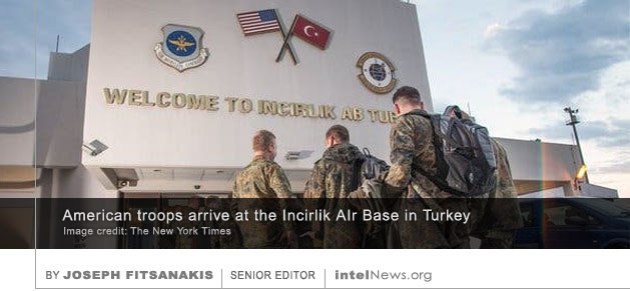
United States quietly scraps joint anti-terrorist intelligence project with Turkey

Incirlik TurkeyThe United States has indefinitely suspended a longstanding military intelligence-sharing program with its North Atlantic Treaty Organization ally Turkey. The program, which targets a Kurdish separatist group, is believed to have been in place since 2007. According to the Reuters news agency, which published the story on Wednesday, it has never before been reported on by news media.

The joint intelligence-sharing program targets the Kurdistan Workers Party (PKK), a militant organization that campaigns for a separate homeland for Turkey’s Kurdish minority. Washington and Ankara have both designated the group a terrorist organization, and have been working jointly to combat it since at least 1997. According to Reuters, the United States military has been carrying out surveillance on the PKK using unmanned surveillance drones that fly out of Turkey’s Incirlik air base. Much of the surveillance focuses on the regions of Turkey that border with Iraq and Syria, where the PKK has a strong grassroots presence.

But Washington decided to suspend the program indefinitely last October, said Reuters. The decision was allegedly taken after Turkish troops invaded Syria in order to push back Kurdish rebels and establish a Kurdish-free buffer zone along the Turkish-Syrian border. The news agency cited four American officials, who did not wish to identify themselves, “due to the sensitivity of the matter”. It also cited an unnamed Turkish official, who confirmed that the intelligence-collection program had been terminated.

The American officials told Reuters that the suspension of the program would place strains on the ability of the Turkish military to respond to the challenges of its ongoing guerrilla war against Kurdish militants in northern Syria, as well as within Turkey. It will also make “the anti-PKK campaign more […] costly for Turkey”, one of the officials told the news agency.

Reuters said it contacted the United States Department of Defense, but was told by a spokeswoman that the Pentagon would “not provide details on operational matters”. A spokesperson from the United States Department of State told Reuters that its representatives could “not comment on intelligence matters”. The Turkish Ministry of Defense did not return requests for comment.

Author: Joseph Fitsanakis | Date: 06 February 2020 | Permalink
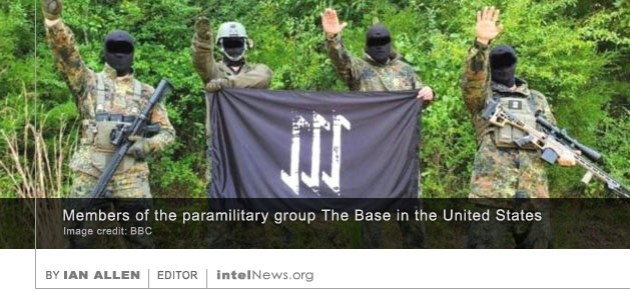
Leader of American far-right paramilitary group is based in Russia

The BaseThe mysterious leader of an American far-right paramilitary group, which authorities say is seeking to overthrow the United States government, runs the organization from Russia, according to a probe conducted by the BBC. The group, which calls itself The Base, is thought to have been formed in the summer of 2018. Since then, it is believed to have recruited dozens of members using encrypted messaging applications.
The Base urges its members to undergo paramilitary training and learn how to evade surveillance by government agencies. It also instructs them to create and use ciphers for communication and trains them to use encrypted applications to exchange messages so that government agencies cannot access their content. The Federal Bureau of Investigation describes The Base as a “racially motivated violent extremist group” that “seeks to accelerate the downfall of the United States government, incite a race war, and establish a white ethno-state”. Earlier this month, authorities arrested three alleged members of the organization, which are accused of engaging in a conspiracy to commit murder.

Despite the attention that The Base has received from American authorities, almost no information is available about the group’s leader and founder. This individual goes by the aliases “Norman Spear” and “Roman Wolf”. But a recent investigation alleged that his name is Rinaldo Nazzaro and that he is a 46-year-old American man from New York. Prior to founding The Base, Nazzaro is believed to have purchased land in a remote area of America’s Pacific Northwest region with the goal of creating a white-only enclave.

Now the BBC has said that Nazzaro is living in Russia, from where he is allegedly running The Base. He is thought to have married a Russian woman in 2012 in the New York borough of Manhattan. The couple probably relocated to the Russian city of St. Petersburg “less than two years ago”, according to the BBC. In an article published on Friday, the BBC said that its researchers had been able to identify Nazzaro from his online activity and from photographs and videos he had posted online in the past year.

Author: Ian Allen | Date: 27 January 2020 | Permalink

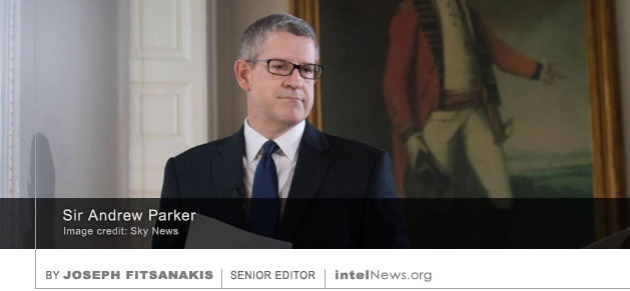
MI5 director plays down US threat to end intelligence sharing over Huawei

Sir Andrew ParkerThe director of Britain’s domestic intelligence agency has dismissed warnings by the United States that intelligence sharing between the two allies will be impeded if London decides to use Chinese-made telecommunications hardware. The British government has come under relentless pressure by Washington to bar Huawei Technologies, one of the world’s leading telecommunications hardware manufacturers, from competing for contracts to build the United Kingdom’s 5th generation cellular communications infrastructure.
In recent years, Huawei has come under scrutiny by some Western intelligence agencies, who view it as being too close to the Communist Party of China. More recently, Washington has intensified a worldwide campaign to limit Huawei’s ability to build the infrastructure for 5G, the world’s next-generation wireless network. Along with some if its allies, notably Australia and Canada, the US is concerned that the Chinese telecommunications giant may facilitate global wiretapping on behalf of Beijing’s spy agencies. Last year, Washington warned two of its main European allies, Britain and Germany, that it would stop sharing intelligence with them if they allowed Huawei to compete for 5G contracts.

But in an interview with The Financial Times, Sir Andrew Parker, head of the Security Service (MI5), said on Sunday that he didn’t believe Britain’s intelligence-sharing relationship with America would be impacted by the decision. When asked whether Washington would stop sharing intelligence with London if the British government allowed a bid by Huawei, Sir Andrew said he had “no reason today to think that”. He added that Britain’s intelligence relations with the US, and with other close allies, such as Canada and Australia, were “the strongest they’ve ever been”. Britain’s intelligence partnership with America “is, of course, of great importance to us”, said Sir Andrew, and went on: “I dare say, to the US too, though that’s for them to say. It is a two-way street”.

Meanwhile was reported over the weekend that a high-level delegation from the National Security Agency —America’s largest intelligence agency— and the US National Economic Council would be in London today, in what appears to be a final effort to persuade London not to cooperate with Huawei. Prior to her resignation last year, British Prime Minister Theresa May had reportedly decided to allow the Chinese firm to compete for 5G contracts. Her successor, Prime Minister Boris Johnson, is reputed to be in agreement with that decision. Last April, German intelligence official also dismissed American warnings that intelligence sharing with Berlin would end if Huawei built any part of the German 5G network.

Author: Joseph Fitsanakis | Date: 13 January 2020 | Permalink

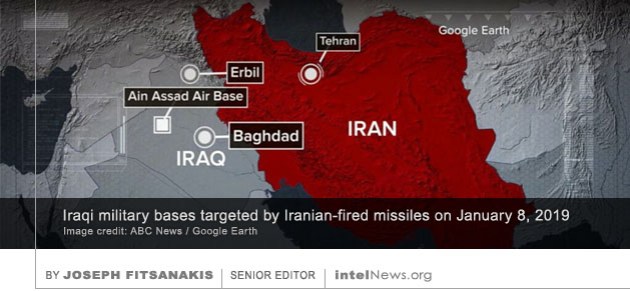
Assessing the implications of Iran’s missile attack on Iraqi military bases

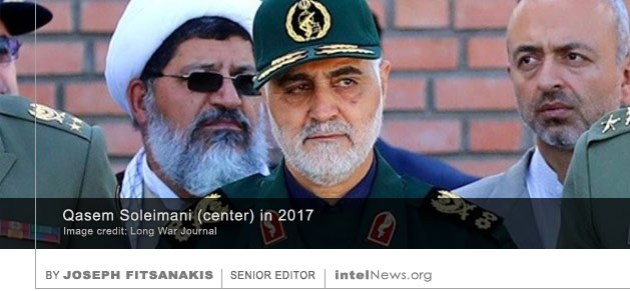
Iran IraqThe missiles that targeted American troops in Iraq a few hours ago offer significant clues about the evolving confrontation between Iran and the United States. The attack appears to have been largely symbolic —a somewhat rushed attempt to restore some of Iran’s wounded prestige following the assassination of its military commander, Qasem Suleimani. At the same time, however, it is also the prelude to a broader regional conflict that appears increasingly unavoidable.
There are two notable aspects in the attack. First, the fact that Tehran did not —as many expected— take aim at American targets using its proxies in Iraq, Lebanon, or Yemen. Instead, not only did the attack come directly from Iran, but the Islamic Revolutionary Guard Corps (IRGC), of which Soleimani was a leading commander, openly claimed responsibility for it. This is a major paradigm shift for the Iranians, who in the past have taken great care to avoid giving any indication of their direct involvement in military or paramilitary attacks on their opponents. It is clear that Q QuoteSoleimani’s killing is viewed by Tehran as too insulting to be responded to indirectly. This does not mean that Tehran will not revert to its standard method of employing proxies in the future. But the fact that it consciously chose to deviate from that time-tested method is in itself extremely important.
The second notable aspect of the attack is that it was markedly muted, especially considering the many options that are available to the Iranians. According to reports, 22 ballistic missiles were fired, most of which struck two military bases housing US troops in western and northern Iraq. The number of missiles fired is surprisingly low, given that Iran possesses the largest ballistic-missile force in the entire Middle East. Additionally, it is interesting that Tehran directed its attacks against the most obvious and predictable American target in the region —uniformed US personnel stationed in what is essentially Iranian-controlled territory. These troops have been on high alert since the moment Soleimani was assassinated. It is therefore highly unsurprising that no American casualties have been reported (although Iranian state media are apparently telling their domestic audiences that “80 terrorists” died in the attack).

The fact remains that, if Iran’s leaders truly wanted to cross the point of no return, they could have attacked American diplomatic facilities in over a dozen countries in the region, including Iraq, Israel, Jordan, and many others. Alternatively, they could have directed their ire against American political and commercial targets in Saudi Arabia, of which there are countless. They could have also sent an unmistakably ominous message to the global financial markets by attacking energy facilities in the region, or by blocking maritime traffic in the Strait of Hormuz. Or they could have carried out all of the above simultaneously, thus virtually ensuring a US response, which would in turn ignite an all-out war. But they didn’t —which should be interpreted that the IRGC is not, for now, interested in going to war. Read more of this post

Analysis: Middle East on verge of new regional war as US kills top Iran general

Qasem SoleimaniIn an act whose implications are impossible to overstate, the United States has assassinated General Qasem Soleimani, arguably Iran’s second most powerful official. In the early hours of this morning, the entire Middle East stood on the verge of a regional war as the US Department of Defense announced it killed Soleimani in a “defensive action […] aimed at deterring future Iranian attack plans”. But Soleimani’s killing will be seen by the Iranian government as nothing short of an official declaration of war. Tehran’s next move will determine the precise form this new war will take.
The United States, Israel and Saudi Arabia have targeted Soleimani for assassination for over a decade. In 2019 alone, Iran reported over half a dozen alleged plots to kill the general, the most recent of which was in early October. Soleimani’s killing is therefore not surprising. Moreover, Washington’s move rests on a number of crucial calculations by the White House, which help explain why US President Donald Trump made the decision to kill Soleimani, and why he did so now.
In the not-too-distant past, some of America’s tactical security goals aligned with Soleimani and his Quds Force —an elite unit inside the Islamic Revolutionary Guard Corps, which is tasked with exporting the Iranian Revolution abroad. The Iranian paramilitary unit helped Washington deal with the Afghan Taliban in the days after the 9/11 attacks, and its proxies in Iraq and Syria helped the US and its allies deliver fatal blows to the Islamic State. But in doing so, Tehran solidified its power within Iraq, turning its government into a satellite of Iran. The rise of the Popular Mobilization Forces (PMF), the Iranian-supported militias in Iraq, is largely a replay of the rise of Hezbollah, Iran’s paramilitary proxy in Lebanon, in the 1980s. Having painted themselves into a corner, America’s political leadership had to act. It chose to do so by essentially ‘decapitating’ the Quds Force, which is the main conduit between Iran and the PMF. It is worth noting that Abu Mahdi al-Muhandis, the deputy head of the PMF, was also killed in the same strike. Washington’s hope is that these killings can somehow prevent —or at least curtail— the Lebanization of Iraq. Read more of this post

US expels Chinese diplomats for the first time since 1987

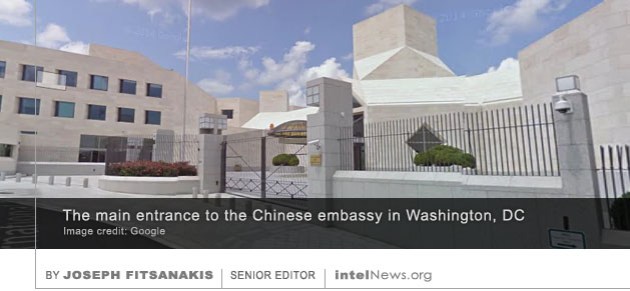
Chinese embassy in the United StatesThe United States quietly expelled two Chinese diplomats in October of this year, a move that neither Washington nor Beijing chose to make public, according to a report published on Sunday. If true, the incident would signify the first known expulsions of Chinese diplomatic personnel from the US since 1987.
The incident was reported by The New York Times, which cited “six people with knowledge of the expulsions”. It said that the expulsions were triggered by an incident that took place in September in the US state of Virginia. It involved at least two Chinese diplomats stationed in Washington, who allegedly attempted to enter “a sensitive installation” near the city of Norfolk. The paper did not name the installation, but said that it belongs to the US Armed Forces and is also used by members of Special Operations forces.

According to the American side, a car carrying the Chinese diplomats and their spouses drove up to one of the checkpoints of the military installation. Upon realizing that the car’s passengers did not have permission to enter the base, the guard at the checkpoint asked the driver to proceed through the gated entry and immediately turn around, thus exiting the base. But the car allegedly drove straight into the base and did not slow down after military personnel pursued it. It came to a stop only after several fire trucks blocked its way.

Once apprehended, the car’s passengers claimed that their knowledge of English was limited and had thus misunderstood the instructions given to them by the guard at the entrance to the base. The New York Times reported that this explanation was echoed by associates of the Chinese diplomats, who said that they were on “a sightseeing tour when they accidentally drove onto the base”.

But US officials told The Times they are skeptical of that explanation, and suspect the Chinese diplomats were trying to assess the physical security of the installation. Moreover, at least one of the Chinese diplomats was allegedly an intelligence officer operating under diplomatic cover —a clue that heightened the skepticism of American officials.

Interestingly, although it complained about the expulsions of its diplomats following the incident in Virginia, Beijing did not retaliate, as is customary in such cases. Therefore, no American diplomats or intelligence officers have been expelled from China in response to Washington’s move. The last time the US expelled Chinese diplomats from its soil was in 1987, when two employees of the Chinese embassy in Washington —almost certainly intelligence officers operating under diplomatic cover— were declared personae non gratae.

Author: Joseph Fitsanakis | Date: 16 December 2019 | Permalink

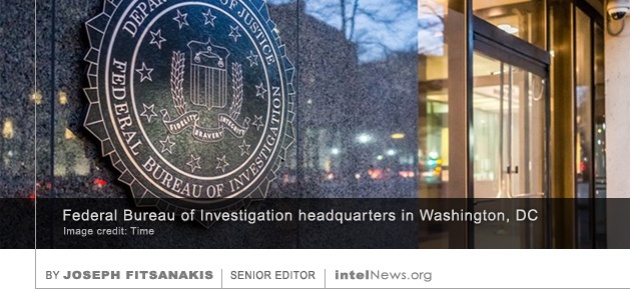
FBI examining FaceApp over potential counterintelligence concerns

FBIThe United States Federal Bureau of Investigation says it is examining possible counterintelligence threats in connection with the popular online application FaceApp, which is headquartered in Russia. The application first made its appearance in January of 2017 and quickly became popular among smartphone users around the world. It allows users to upload a photograph of their face and then edit it with the help of artificial-intelligence software. The software can change the user’s photograph to make it look younger or older, or make it look as if it is from the opposite gender. The result can be impressively realistic and life-like.
The St. Petersburgh-based company behind FaceApp, Wireless Lab, claims that the photos of users are uploaded to cloud servers situated in New Zealand, Australia and Singapore. They are then deleted within two days from the moment they are uploaded by users, without ever being transferred to servers located in the territory of Russia. But the FBI does not seem to believe these assurances. In a letter sent late last month to the Minority Leader of the US Senate, Charles Schumer (D-NY), the Bureau said it was examining FaceApp as part of its counterintelligence mission.

In the letter, which was published on Monday, Jill Tyson, Assistant Director of the FBI’s Office of Congressional Affairs, said the fact that Wireless Lab is based in Russia raised a number of counterintelligence concerns. These relate to the types of data Wireless Lab collects on its customers and the privacy policies that apply to Russian Internet companies. According to Tyson, the Russian Federal Security Service (FSB) has the right to “remotely access all communications and servers on Russian networks without making a request” to network providers. He added that, if the FBI found that FaceApp was involved in activities meant to interfere with upcoming elections in the United States, the Bureau would investigate the matter further, and possibly involve the Foreign Influence Task Force, an FBI-led body that was established after the 2016 US presidential elections.

The FBI’s letter was written in response to an earlier letter sent to the Bureau by Senator Schumer in July, which expressed concerns about potential threats posed by FaceApp to the privacy of American Internet users and to the nations’ security as a whole.

Author: Joseph Fitsanakis | Date: 03 December 2019 | Permalink

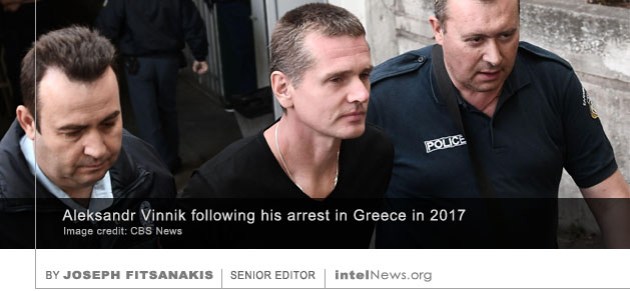
Extradition fight over Russian man held in Greece may point to spies’ use of bitcoin

Aleksandr VinnikAn intense fight between the United States and Russia over the extradition of a Russian cryptocurrency tycoon being held in Greece, is raising questions about the possible use of cryptocurrencies by spies. The tycoon in question is Aleksandr Vinnik, 39, who in 2011 co-founded BTC-e, an international cryptocurrency-trading platform. BTC-e allowed users to buy or sell several popular cryptocurrencies, including bitcoin and litecoin, using Russian rubles, United States dollars, or European Union euro currencies. Although headquartered in Russia, BTC-e’s servers were located in Bulgaria, while its operations were conducted through its offshore components in Cyprus and the Seychelles.
By 2015, BTC-e was reportedly facilitating just over 3 percent of the worldwide daily volume of cryptocurrency trading. But, according to some sources, the company was also facilitating up to 70 percent of worldwide criminal activity involving cryptocurrencies. Washington alleges that the company was built on a model that relied heavily on the activities of criminal entities, as the latter sought the ability to conduct online monetary transactions without being tracked by governments.

In 2017, American authorities seized BTC-e’s website —a move that terminated the company’s operations. Washington also prompted authorities in Greece to arrest Vinnik, while he was vacationing at a Greek resort with his family. The Russian co-founder of BTC-e is today in a Greek prison, awaiting a decision by the Greek authorities to extradite him to the United States. If this happens, he will be tried on 21 counts of international money laundering and a host of other criminal charges.

Interestingly, however, shortly after Vinnik’s arrest, the Russian government filed a court order to have Greece extradite him to Russia, where he is reportedly wanted for relatively minor fraud-related charges. What is more, the Greek government was directly lobbied by no other than the Russian President Vladimir Putin —an unusually high-level approach, when one considers Vinnik’s trivial charges in Russia. France has also sought to have Vinnik extradited there, instead of the United States.

What lies behind these moves? There are many who believe that American authorities moved against BTC-e after realizing that Russian spies used the company to hide their traces while trying to meddle with the 2016 presidential elections in the United States. A recent report by the State Department’s RFE/RL news website claims that a number of London-based observers from groups such as Global Witness and Elliptic Enterprises believe there are strong links between Russian spy agencies and BTC-e. American authorities have managed to access information about the inner workings of BTC-e’s website. They are probably viewing Vinnik as an intelligence asset, who can potentially shed light on the company’s alleged role as a money laundering mechanism for Russian spies —and probably others as well.

Author: Joseph Fitsanakis | Date: 29 November 2019 | Permalink

Venezuelan ex-spy chief disappears as Spain seeks to extradite him to US

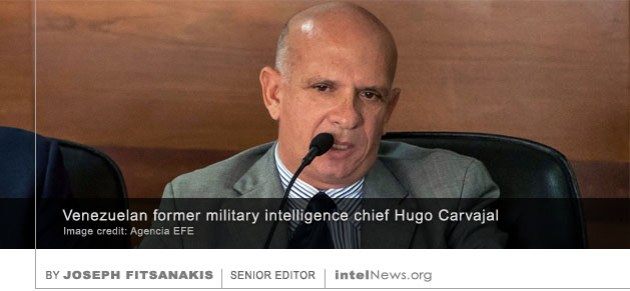
Hugo CarvajalThe former director of Venezuela’s military spy agency, who is wanted in the United States for drug trafficking, reportedly disappeared in Spain as authorities there were attempting to extradite him to Washington. Hugo Carvajal is a retired general and former diplomat, who was a member of the late Venezuelan President Hugo Chávez’s inner circle. From 2004 to 2011, under Chávez’s tutelage, Carvajal headed the Directorate General of Military Counterintelligence (DGCIM).

In 2008 the US named Carvajal as a major facilitator of international drugs trafficking and imposed financial sanctions on his assets around the world. Washington accused Carvajal of assisting the paramilitary group known as the Revolutionary Armed Forces of Colombia (FARC) transport drugs from Latin America to Mexico and from there to the US.

Things took an interesting turn, however, when in February of this year Carvajal posted a video on social media in which he denounced Chávez’s successor, President Nicolás Maduro, and sided with his arch-nemesis, Juan Guaido, the President of the National Assembly of Venezuela. In his video, Carvajal urged the Venezuelan armed forces to stop siding with Maduro and support Guaido as Venezuela’s acting president. Guaido is openly supported by the United States and dozens of other Western countries.

Soon after making his announcement, Carvajal fled to Spain, where he was arrested in April, after the US Department of Justice filed a formal request for the former spy chief’s extradition to America. But in September, Spain’s top criminal court ruled that Carvajal would not be extradited to the US. The former spy chief was released minutes after the court made its decision known.

Last Friday, however, the same court accepted an appeal by the Office of the Public Prosecutor and overturned its earlier decision. Shortly after the court’s decision, Spanish media reported that Carvajal had already been arrested and was due to be transported to the US in a matter of days. But three days later, the former spy chief posted a message on his personal Twitter account saying that neither he nor his lawyers had been approached by Spanish police. It appeared, then, that Carvajal had not been detained.

Spanish newspaper El Pais reported on Tuesday that Carvajal was nowhere to be found when Spanish police officers went to his residence in Madrid to arrest him. His whereabouts are currently unknown, said the paper. The US Department of Justice has not commented on the case.

Author: Joseph Fitsanakis | Date: 13 November 2019 | Permalink

Saudi king hosts CIA director a day after US charges two Saudis with espionage

Gina HaspelA day after the United States Department of Justice charged two Saudi citizens with engaging in espionage on American soil, Saudi officials hosted the director of the Central Intelligence Agency in Riyadh, reportedly to discuss “the longstanding Saudi-US partnership”.

According to the Federal Bureau of Investigation, two Saudi men, both employees of the US-based company Twitter, were instructed by a member of the Saudi royal family to surrender the personal information of at least 6,000 Twitter users who posted criticism of the Saudi government on social media. As intelNews reported on Thursday, one of the men is under arrest, while the other managed to evade US authorities and is thought to be sheltered by the Saudi government.

It is believed that the member of the Saudi royal family who instructed the two men to carry out espionage was no other than Mohammed bin Salman, the oil kingdom’s crown prince. Wednesday’s developments marked the first time that US authorities have publicly filed espionage charges against Saudi nationals in America.

A day after the charges were filed in the US state of California, Gina Haspel, the director of the Central Intelligence Agency, was reportedly hosted by Saudi Arabia’s king Salman in Riyadh. In addition to Salman and Haspel, the meeting was attended by several senior Saudi officials, including Khalid al-Humaidan, who directs the kingdom’s General Intelligence Directorate. Saudi Arabia’s foreign minister, Prince Faisal bin Farhan, was also present at the meeting.

A tweet by the Saudi Arabian embassy in Washington said that the meeting between Haspel and the Saudi officials revolved around “the longstanding Saudi-US partnership”. It also said that participants discussed “a number of regional and international developments”, but gave no further information. The state-owned Saudi Press Agency said simply that the meeting focused on “a number of topics of mutual interest”, but did not elaborate.

Author: Joseph Fitsanakis | Date: 08 November 2019 | Permalink

FBI charges Twitter employees with working as spies for Saudi Arabia

TwitterUnited States authorities have charged two employees of the social media firm Twitter and a member of staff of Saudi Arabia’s royal family with spying for Riyadh. The Federal Bureau of Investigation filed a complaint on Wednesday in San Francisco, accusing the three men of “acting as unregistered agents” for Saudi Arabia. The phrase is used in legal settings to refer to espionage.
According to the FBI, the charges stem from an investigation that lasted several years and centered on efforts by the oil kingdom to identify and silence its critics on social media. In 2015, the Saudi government allegedly reached out to Ali Alzabarah, a 35-year-old network engineer working for Twitter, who lived in San Francisco. The complaint alleges that Ahmed Almutairi (also known as Ahmed Aljbreen), who worked as a “social media advisor” for Saudi Arabia’s royal family, arranged for Alzabarah to be flown from San Francisco to Washington to meet with an unidentified member of the Saudi dynasty.

Alzabarah, along with another Twitter employee, 41-year-old Ahmad Abouammo, were given money and gifts by the Saudi government in return for supplying it with private information about specific Twitter users, according to the complaint. The information provided by the two Twitter employees to the Saudi authorities allegedly included the email addresses, IP addresses and dates of birth of up to 6,000 Twitter users, who had posted negative comments about the Saudi royal family on social media.

Special Agents from the FBI’s Settle field office arrested Abouammo at his Seattle home on Tuesday. However, Alzabarah is believed to have fled the United States along with his family before the FBI was able to arrest him. He is currently believed to be in Saudi Arabia and is wanted by the FBI, which has issued a warrant for his arrest. The Saudi government has not commented on the case. Twitter issued a statement on Wednesday, saying it planned to continue to cooperate with the FBI on this investigation.

Author: Joseph Fitsanakis | Date: 07 November 2019 | Permalink

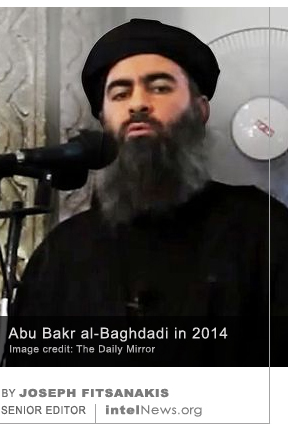
US spy agencies pore over intelligence acquired in raid that killed al-Baghdadi

Abu Bakr al-BaghdadiAmerican intelligence agencies are studying up to seven terabytes of data that were captured by Special Operations Forces during last week’s nighttime raid that killed Abu Bakr al-Baghdadi in Syria. Officials in Washington told The New York Times on Monday that Delta Force commandos confiscated “a large amount of material” from the raid that killed the Islamic State leader. The material allegedly includes several laptops and cellphones, which contain an estimated “four to seven terabytes of data”, according to one United States official who spoke anonymously to the paper.

It is believed that al-Baghdadi changed hideouts across northern Syria every few days, so it is unlikely that he and his entourage carried with them a large printed archive of Islamic State files. However, even a few hard drives or memory sticks could contain extensive information, said The Times. The commandos that carried out the nighttime raid reportedly spent two hours on the ground collecting intelligence from the site. All of it has now been delivered to experts in the Defense Intelligence Agency, the Central Intelligence Agency and other elements of the US Intelligence Community, who are currently “conducting a preliminary review of the confiscated documents and electronic records”, said the paper.

The information may shed light on questions such as if and how al-Baghdadi ran the Islamic State, how he communicated with the group’s military commanders across Iraq and Syria, and how he exchanged information with other senior Islamic State officials in the Middle East and beyond. There are also questions about al-Baghdadi’s links with the leaders of Islamic State affiliates around the world. Essentially, to what extent did the core leadership of the Islamic State under al-Baghdadi direct the operations of the group’s affiliates abroad? There may also be documents among the confiscated information material that discuss the Islamic State’s changing strategy following the collapse of its territorial base in the Middle East.

In addition to the confiscated information, American troops captured two of al-Baghdadi’s lieutenants who were guarding his compound during last weekend’s raid. The two men are currently being questioned by American interrogators and are eventually going to be handed over to the Iraqi government to face justice, according to The Times.

Author: Joseph Fitsanakis | Date: 29 October 2019 | Permalink

Russia detains American diplomats for traveling to top-secret military site

SeverodvinskRussian authorities detained three American diplomats because they allegedly tried to enter a highly secret weapons testing site in northern Russia, according to reports. The site in question is located near the northern Russian city of Severodvinsk. The city is home to a number of military shipyards and is thus restricted for non-Russians. The latter require a special permit to enter it.
In August of this year, Western media reported on a mysterious explosion that took place in a weapons research site located near Severodvinsk. The explosion allegedly happened during testing of a top-secret prototype rocket engine. Russian authorities revealed that five workers died as a result of the explosion, but denied media reports that the explosion had caused a radiation leak that had affected Severodvinsk. The Russian Ministry of Defense also denied allegations that a large-scale nuclear clean-up operation had been conducted in and around Severodvinsk. At the same time, Russian authorities restricted maritime traffic in the White Sea, on the shores of which Severodvinsk is situated.

On Wednesday, the Russian news agency Interfax reported that three American diplomats had been detained by authorities near Severodvinsk, allegedly because they tried to enter the city without the necessary permits. The diplomats were not named but are believed to be military attachés that serve in the United States embassy in Moscow. Interfax said the three were detained on Monday while onboard a passenger train. They were removed from the train, questioned and eventually released. However, they might still face charges of trying to enter a restricted area without permission.

The United States Department of State issued a statement claiming that the three diplomats “were on official travel and had properly notified Russian authorities of their travel”. A State Department spokesman said on Wednesday that the three diplomats’ travel plans had been authorized by the Russian Ministry of Defense. But authorities in Russia said that the three military attachés had been authorized to travel to the city of Arkhangelsk, which is located approximately 30 miles east of Severodvinsk. “We are quite willing to provide the United States embassy with a map of the Russian Federation”, the Russian statement concluded.

Author: Joseph Fitsanakis | Date: 17 October 2019 | Permalink

US Special Forces secrets could fall into hands of Russians as Kurds side with Syria

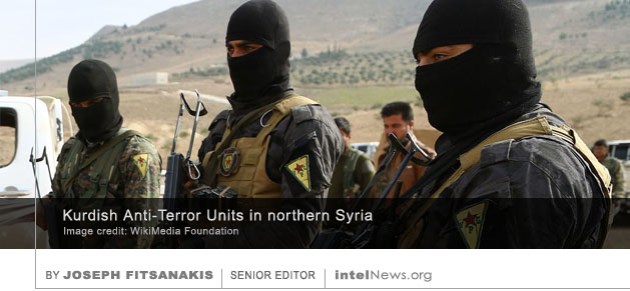
Yekîneyên Antî Teror‎American defense officials with knowledge of Special Operations Forces activities in Syria are concerned that their secrets may fall into the hands of the Russians, as the Kurds switch their allegiance to the Moscow-backed Syrian government. Members of the United States Special Operations Forces and the Central Intelligence Agency (CIA) have had a presence in Kurdish-dominated northern Syria since at least 2012. Following the rise of the Islamic State in 2014, the Americans have worked closely with the Kurds in battling the Islamist group throughout the region.

Throughout that time, US Special Operations Forces have trained members of the Syrian Democratic Forces (SDF), a political and military umbrella of anti-government Syrian groups, which is led by the Kurdish-dominated People’s Protection Unit (YPG) militias. Until recently, the SDF and the YPG were almost exclusively funded, trained and armed by the US through its Special Operations Forces units on the ground in northern Syria. US Special Operations Forces were also behind the creation in 2014 of the SDF’s most feared force, the Anti-Terror Units. Known in Kurdish as Yekîneyên Antî Teror‎, these units have been trained by the US in paramilitary operations and are tasked with targeting Islamic State sleeper cells.

As of this week, however, the SDF and all of its US-trained militias have switched their allegiance to the Russia-backed government of Syrian President Bashar al-Assad. The dramatic move followed the decision of the White House earlier this month to pull its Special Operations Forces troops from norther Syria, effectively allowing the Turkish military to invade the region. According to the American defense news website Military Times, US Pentagon officials are now worried that the SDF may surrender to the Russians a long list of secrets relating to US Special Operations Forces’ “tactics, techniques, procedures, equipment, intelligence gathering and even potentially names of operators”.

One former US defense official told The Military Times that SDF “may be in survival mode and will need to cut deals with bad actors” by surrendering US secrets. Another source described this scenario as “super problematic” and a symptom of the absence of a genuine American strategy in the wider Middle East region. The website also cited US Marines Major Fred Galvin (ret.), who said that Special Operations Forces tend to reveal little about themselves and their capabilities when working with non-US actors. However, this is uncharted territory for them, said Galvin, since “we’ve never had a force completely defect to an opposition like this before”.

Author: Joseph Fitsanakis | Date: 16 October 2019 | Permalink

Trump thought Erdoğan was “bluffing” about invading Syria, sources claim

Turkey SyriaSenior White House officials close to United States President Donald Trump believed that Turkish President Recep Tayyip Erdoğan was bluffing when he threatened to invade northern Syria, according to sources. For over two years, most of northern Syria has been controlled by American-supported Kurdish militias, who were instrumental in helping Washington defeat the Islamic State. But the growing strength of the Kurdish forces alarmed Turkey, which views Kurdish nationalism as a bigger threat than the Islamic State.

Since 2016, Ankara repeatedly threatened to invade northern Syria and disarm the Kurdish groups, which it sees as terrorist. It had refrained from doing so due to the presence of American troops in the area. However, according to news website Axios, key officials in the Trump White House were convinced that Turkish President Erdoğan would not have his troops invade northern Syria even if the American forces pulled out. In making this claim, the website cites six unnamed sources “with direct knowledge of the situation”, some of whom were allegedly “in the room with the two leaders and had access to their phone calls going back several years.

In one of these phone calls, which took place in 2017, President Erdoğan allegedly informed the US leader of his government’s intention to “move in to take care of the Kurdish threat” in northern Syria. But President Trump cautioned him about making such a daring move. He reminded the Turkish leader that, by invading northern Syria, Turkey would become responsible for the tens of thousands of Islamic State supporters and their families who are kept in detention camps. Ankara would also face mass international condemnation and possible sanctions from the United States and Europe. Moreover, the US-trained and -supplied Kurdish forces would arguably create a military quagmire for Turkish troops in the region. At that point Turkey “would own” the problem and would not be able to “come to [the US] for help”, according to Trump.

The Axios report claims that, until last week, the White House thought that “Erdoğan would never actually go through with his long-threatened Syria invasion”, because doing so would be detrimental to Turkish interests in the region. Based on that conviction, President Trump finally decided to call Erdoğan’s bluff by pulling American Special Forces troops out of northern Syria, in the belief that Tukey’s response would amount to nothing further than a few airstrikes and small-scale cross-border incursions. That belief was behind the White House’s surprise decision to suddenly pull its troops from northern Syria, according to Axios’ sources.

The report did not mention whether the US Intelligence Community’s reports to the White House concurred with the US President’s conviction that Turkey would not invade northern Syria even in the absence of US troops. The question is, in other words, did Trump made up his mind about Erdoğan’s intentions to invade northern Syria because, or despite the conclusions of his own Intelligence Community?

Author: Joseph Fitsanakis | Date: 15 October 2019 | Permalink