US spied on 143-member Iran delegation to 2007 UN summit

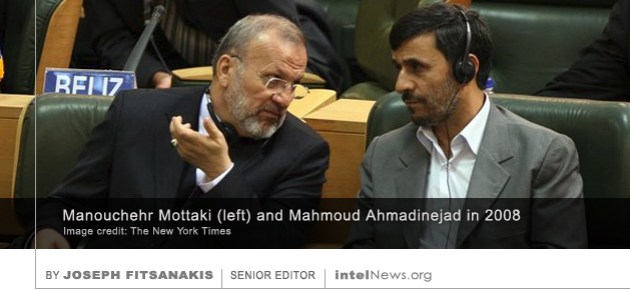
Manouchehr Mottaki and Mahmoud AhmadinejadThe United States National Security Agency spied on the Iranian president, foreign minister, and over 140 Iranian dignitaries who visited New York in 2007 to participate in the United Nations General Assembly. The allegation was aired on Wednesday by American television station NBC, which cited former intelligence officials and a top-secret report on the espionage operation. The original report was included in an October 2007 issue of SID Daily, an internal NSA newsletter published by the spy agency’s Signal Intelligence Division. The report, which is entitled “Tips for a Successful Quick Reaction Capability”, commends the espionage operation against the Iranian UN delegation as an exemplary illustration of a collaborative effort between managers, technical experts, and analysts.

The operation appears to have been directly initiated in early 2007 by the George W. Bush White House, which asked the NSA to spy on Iran’s UN delegation. The blanket permission included espionage conducted against the then Iranian President Mahmoud Ahmadinejad and Minister of Foreign Affairs Manouchehr Mottaki, who were scheduled to be in New York in September of that year to attend the 62nd session of the UN General Assembly. In response to the White House authorization, the NSA deployed a small army of technical experts and analysts to spy on the entire 143-member Iranian delegation for 19 hours a day during the summit.

The NSA teams were allegedly able to record, transcribe and analyze 2,000 conversations of various lengths per day. According to NBC, the NSA was able to intercept the personal conversations of President Ahmadinejad, a number of video conferences involving members of the Iranian delegation, as well as calls made using Skype. The latter were intercepted using a secret technology codenamed BLARNEY by NSA, while the agency also relied on bugs installed in hotel and conference rooms used by the Iranians, said NBC. The intercepted communications were subsequently examined by the NSA’s Social Network Analysis Office in an effort to map the “social networks” of the Iranian government’s senior echelons.

The Iranian government did not respond to NBC’s requests for comment. Iranian President Hassan Rouhani is scheduled to arrive in New York today to attend the 70th UN General Assembly debate.

Author: Joseph Fitsanakis | Date: 24 September 2015 | Permalink

Obama delegation switches hotels allegedly due to espionage fears

Waldorf AstoriaThe president of the United States and his delegation will be housed at a different hotel during a United Nations General Assembly meeting later this month, allegedly due to concerns over Chinese espionage activity. Since the late 1940s, the American president and his diplomatic entourage have resided at the Waldorf Astoria for several days in September, while attending the annual UN General Assembly in New York. The luxury hotel, which is located on Park Avenue on the island of Manhattan, has also served since 1947 as the residence of the US ambassador to the UN. That is also why the American delegation is usually hosted there, courtesy of the ambassador. This year, however, President Barack Obama and his sizeable delegation will be staying at the New York Palace Hotel, located at the corner of Manhattan’s 50th Street and Madison Avenue. The announcement was made last week by the White House and the US Department of State.
According to The Associated Press and The New York Times, the decision to relocate the American high-level delegation is primarily due to security concerns. The reports cited well-placed sources in the US government as stating that the relocation was prompted by the sale last year of the Waldorf Astoria to the Chinese firm Anbang Insurance Group. The McLean, VA-headquartered Hilton Worldwide Holdings, Inc., which sold the hotel to the Chinese firm, pocketed nearly $2 billion from the transaction. Based on the terms of the agreement, the American company will continue to operate the Waldorf Astoria until 2114. But Anbang announced last spring that the hotel would be undergoing a massive renovation program, which, according to media reports, has alarmed American counterintelligence officials. The latter are concerned that Chinese intelligence technicians may use the renovation to install eavesdropping equipment in Waldorf Astoria’s rooms and compromise the hotel’s Internet network.

The US diplomatic exit from the Waldorf Astoria was first reported back in mid-June, but was not confirmed by the White House or the Department of State. Since that time, no American cabinet official, including Secretary of State John Kerry and Vice President Joe Biden, has stayed at the Waldorf. But President Obama’s upcoming trip renewed the media’s interest in the change of hotels, and US government officials finally confirmed that the Chinese-owned hotel had been dropped based “on several considerations, including space, costs and security”. A State Department official told reporters last week that the change took “into account changing circumstances”. The Times also reported that the US government is examining whether its ambassador to the UN will continue to be headquartered at the Waldorf.

Author: Joseph Fitsanakis | Date: 14 September 2015 | Permalink

Dual US-Russian citizen pleads guilty to spying for Russia

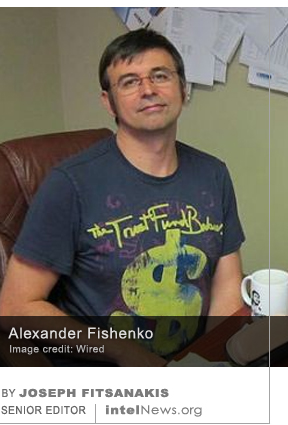
Alexander FishenkoA resident of Texas, who is accused by United States authorities of setting up a front company in order to illegally acquire American technology on behalf of Russia’s intelligence services, has pleaded guilty to espionage charges. Alexander Fishenko, 49, was one of 11 people arrested in October 2012 by the Federal Bureau of Investigation. The arrests came during several raids in locations around Houston, Texas, which included the headquarters of Arc Electronics, Inc. The FBI accused the export firm of having shipped over $50 million-worth of military-grade micro-electronics since 2008. The supplies were received in Moscow, Russia, by a mysterious procurement company called Apex System LLC. Counter-intelligence investigators in the US claim that both firms are part of an elaborate scheme set up by Russian military intelligence, aimed at stealing dual-use electronics hardware created by American firms.
According to the indictment, Arc Electronics told its US suppliers that the microelectronics technologies were intended for use in various types of streetlights. But in reality, said the FBI, the company gave the hi-tech supplies to the Russian Ministry of Defense for use in airborne surveillance systems, as well as in remote weapons guidance systems, among other military applications. Federal prosecutors said that, for over four years, Arc Electronics engaged in a prolonged “surreptitious and systematic” scheme to circumvent US government export controls, thus seriously damaging US national security. Following the early-morning raids, the FBI unsealed indictments against 11 Arc Electronics employees, most of whom were charged with “acting as unregistered agents of the Russian Federation in the United States” —legal jargon for espionage.

Fishenko, who is originally from Kazakhstan, was scheduled to face trial on September 21 in New York. But on Wednesday he chose to plead guilty to the charges leveled against him. He is the fifth member of the 11 Apex System employees arrested back in 2012 to plead guilty to espionage. A government spokesman said the Fishenko’s plea did not result from an agreement to cooperate with the FBI. He now faces up to 15 years in prison. His lawyer, Richard Levitt, declined comment when he was contacted on Wednesday. The Russian government has denied that it had any involvement with Fishenko’s operations.

Author: Joseph Fitsanakis | Date: 08 September 2015 | Permalink

Secret program gave CIA ‘unfiltered access’ to German communications

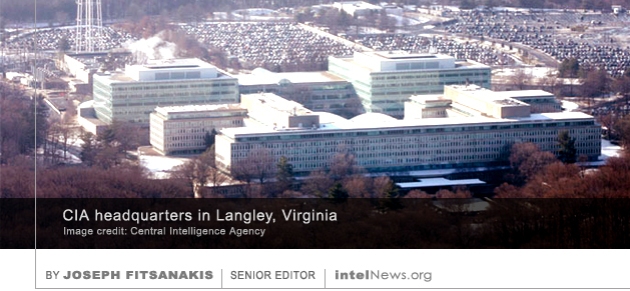
CIAThe United States Central Intelligence Agency had direct and unfiltered access to telecommunications data exchanged between German citizens, according to a new document that has surfaced in the German press. The program, codenamed GLOTAIC, was a collaboration between the CIA and Germany’s Federal Intelligence Service, known as BND. According to German newsmagazine Der Spiegel, which revealed the existence of the program last week, it lasted from 2004 to 2006. During those years, the CIA was given access to telephone and fax data carried by US telecommunications provider MCI Communications, which is owned by Verizon. The US-headquartered company owns a network switching facility in the German city of Hilden, located 10 miles east of Düsseldorf near the country’s border with Holland.

The existence of joint collection programs between the BND and American intelligence agencies has been established in the past, and has prompted the creation of a special investigative committee in the German parliament. The Committee of Inquiry into Intelligence Operations was set up in 2014, after files leaked by American defector Edward Snowden revealed that the US had been spying on the telephone communications of German Chancellor Angela Merkel. But it has also been investigating whether the BND’s collaboration with American intelligence agencies violated the rights of German citizens.

The committee had previously been told that all telecommunications data given to the US by German agencies had previously been vetted by BND officers. But the GLOTAIC documents published by Der Spiegel states that audio recordings of intercepted telephone calls were “directly routed to the US” in the interests of technical efficiency. The parliamentary committee had also been told that the data shared with the CIA concerned non-German citizens using German telecommunications networks. But the documents published last week state that a “technical glitch” in the GLOTAIC system allowed “massive German traffic” to be directly accessed by the CIA without having been first filtered by the BND.

Another document published by Spiegel reveals that the BND warned project CLOTAIC supervisors that the agency faced “serious risks” should the secret operation become public, because it had allegedly violated German federal privacy regulations.

Author: Joseph Fitsanakis | Date: 08 September 2015 | Permalink

Obama authorizes Special Forces, CIA, to conduct assassinations in Syria

Islamic State convoy in SyriaThe United States Central Intelligence Agency is collaborating with the country’s Special Forces in a targeted killing program aimed against senior members of the Islamic State and other militant groups in Syria. The program, which has been directly authorized by US President Barack Obama, is limited in scope and has so far involved fewer than a dozen strikes against suspected militants. But it is believed to reflect increasing frustration in Washington about the lack of progress shown by the military campaign against the Islamic State. Recent reports by American intelligence agencies confirm that the militant group is “fundamentally no weaker” today than it was a year ago, despite an intense US-led bombing campaign involving thousands of airstrikes in Iraq and Syria.
The Washington Post, which revealed the existence of the program on Tuesday, said it brought together the CIA’s Counterterrorism Center (CTC) and the Joint Special Operations Command (JSOC). The CTC is believed to be primarily responsible for identifying and locating senior Islamic State figures in Syria, while the JSOC is in charge of killing them, mostly through the use of unmanned drones, according the paper. The two agencies continue to operate separate drone centers, said The Post, in Virginia and North Carolina respectively; but they have exchanged several of advisors who have constant access to each other’s drone video feeds.

The goal of the targeted killing program is to assassinate what the CIA refers to as “high-value targets”, which includes Islamic State leaders and those members of the organization whose job is to build a membership base outside the territorial boundaries or the Islamic State’s self-described caliphate. The Post said that the list of Islamic State members killed by the CIA-JSOC program includes Junaid Hussain, a British citizen who was instrumental in building and maintaining the Islamic State’s outreach campaign on social media. The paper noted that the CIA-JSOC targeted killing campaign is not part of the wider American military offensive against the Islamic State.

Author: Ian Allen | Date: 01 September 2015 | Permalink

British government releases MI5 file on little-known Cold War spy

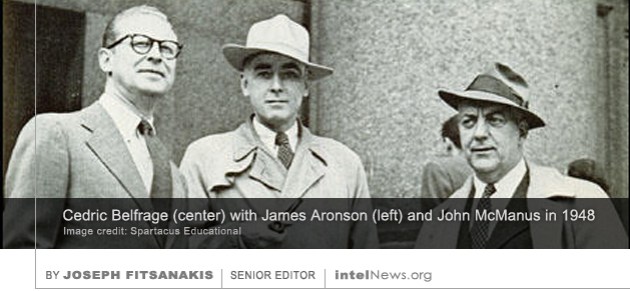
Cedric BelfrageThe British government has released a nine-volume file on an influential film critic who some believe was “one of the most important spies the Soviet Union ever had”. Cedric Belfrage was born in 1904 in London and read English Literature at Cambridge University in the 1920s. While a student at Cambridge he made a name for himself as a reviewer of motion pictures, and by the early 1930s he was known as Britain’s highest-paid film critic. Soon afterwards he moved to the American city of Los Angeles, where he became a film and theater correspondent for British tabloid newspaper The Daily Express. But a multivolume file on him compiled by the British Security Service (MI5) and released last week by the National Archives in London, confirms that Belfrage spied for Soviet intelligence under the codename BENJAMIN.
According to the file, Belfrage turned to communism after witnessing the effects of the Great Depression in the United States. After a 1936 trip to the USSR, he reached out to the Communist Party of the US, which eventually put him in touch with a number of Soviet intelligence operatives in America. In 1940, the Secret Intelligence Service (MI6) set up the British Security Coordination (BSC) in New York. It was a clandestine propaganda project aimed at turning local public opinion in favor of America’s entry into World War II. Belfrage was one of many writers and intellectuals that were recruited by the BSC to help counter the prevalent isolationist sentiment in the country. The film critic worked for MI6 until 1943, and then returned to Britain to join another wartime propaganda outfit, the Political Warfare Executive.

At war’s end, Belfrage returned to the US, only to find that he had attracted the attention of the Federal Bureau of Investigation. The FBI had discovered that the British film critic had dealings with the Communist Party in the 1930s and suspected that he may have worked for Soviet intelligence. Further investigations revealed that Belfrage had indeed conducted espionage under the guidance of Jacob Golos, a Ukrainian-born American who managed a large network of pro-Soviet spies in America in the interwar period. But when he was questioned by the FBI, Belfrage said that he had given Golos a number of British —not American— government documents under direct orders by MI6. The latter allegedly hoped that the Soviets would reciprocate the move within the context of the anti-Nazi alliance between the UK and the USSR.

Eventually, Belfrage was brought up before the House Un-American Activities Committee (HUAC) of the US Congress in 1953. The Committee was conducting public hearings aimed at unmasking suspected communist sympathizers in the American entertainment industry. But the British-born film critic refused to answer questions put to him, prompting HUAC to recommend that he should be deported from the country. The government adopted the Committee’s recommendation and deported Belfrage in 1955 for having been a member of the Communist Party under a fake name. Belfrage traveled throughout the Caribbean and Latin America before settling in Mexico, where he died in 1990, aged 86.

Interestingly, the British files reveal that MI5 decided not to prosecute Belfrage, most likely in order to avoid the embarrassment of admitting that British intelligence had employed a Soviet spy. The decision was probably not unrelated to the public scandal that followed the escape of the so-called Cambridge spies to the Soviet Union. Interestingly, Belfrage studied at Cambridge at the same time that Kim Philby (Soviet cryptonym STANLEY), Donald Duart Maclean (HOMER) and Guy Burgess (HICKS) were students there. But there is no evidence he ever collaborated with them, as he was not interested in politics at that time.

Author: Joseph Fitsanakis | Date: 24 August 2015 | Permalink

US warns China against use of non-official-cover operatives

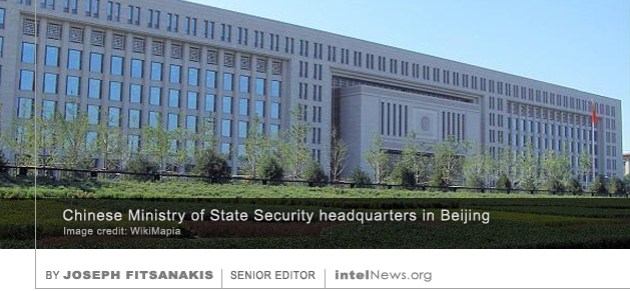
Chinese Ministry of State SecurityThe White House has warned the Chinese government to stop deploying on American soil intelligence operatives masquerading as tourists, business executives or other false covers. Nowadays the standard practice for intelligence personnel deployed abroad is to be posted as diplomatic staff in a foreign embassy or consulate. But there are some intelligence officers who do not follow that practice. These are known as non-official-cover operatives, or NOCs in American intelligence parlance. NOCs are typically high-level principal agents or officers of an intelligence agency, who operate without official connection to the diplomatic authorities of the country that is employing them. They typically pose as business executives, students, academics, journalists, or non-profit agency workers. Unlike official-cover officers, who are protected by diplomatic immunity, NOCs have no such protection. If arrested by authorities of their host country, they can be tried and convicted for operating as unregistered agents of a foreign government.
According to The New York Times, a significant number of Chinese NOCs have recently entered the United States as part of the Chinese government’s Operation FOX HUNT. Supervised by China’s Ministry of State Security (MSS), FOX HUNT is aimed at the thousands of former officials and other fugitives from China, who are alleged to have embezzled funds and are now living abroad, usually in considerable wealth. As part of the MSS operation, teams of intelligence agents are said to have been dispatched around the world in order to hunt down these fugitives, many of whom are believed to have embezzled hundreds of millions of dollars in government funds. Chinese media reports claim that nearly 1000 such fugitives have been “repatriated”, either voluntarily or involuntarily, since the launch of FOX HUNT. The tactics used by the Chinese NOCs are not clear, and some suspect that they include direct or indirect threats against the fugitives’ family members in China. Chinese reports have described FOX HUNT operatives as “mostly young, highly skilled”, and accustomed to “rapid-fire deployment” around the world.

The Times said that Washington views the parts of Operation FOX HUNT that take place on US soil as “a departure from the routine practice of secret government intelligence gathering” that both America and China practice against each other. The US, therefore, does not want Chinese officers without official diplomatic credentials, but posing instead as students, tourists or business representatives, engaging in intelligence operations on US soil, said the paper. It added that Washington’s warning had been delivered to Beijing “in recent weeks”. The Times article did not include specific descriptions of FOX RUN activities on American soil.

Author: Joseph Fitsanakis | Date: 17 August 2015 | Permalink

CIA’s internal watchdog post remains vacant despite mounting calls to fill it

CIAThe administration of United States President Barack Obama has yet to nominate a replacement for the Central Intelligence Agency’s inspector general despite calls by Congress to quickly fill the sensitive post. The position has remained vacant since the end of January of this year, when David Buckley resigned after four years on the job. The position was created in 1989 in the aftermath of the so-called Iran-Contra affair, as part of a broader effort to institute independent oversight of the CIA. The Agency’s inspector general is tasked with, among other things, probing allegations of institutional illegality or personnel misconduct, and evaluating concerns raised by whistleblowers.

According to Michael Isikoff, chief investigative correspondent of Yahoo News, there are “mounting concerns on Capitol Hill” about the failure of the White House to nominate a replacement for Buckley, more than six months following his departure. Isikoff wrote that Senator Diane Feinstein (D-Ca), who chairs the Senate’s Select Committee on Intelligence, wrote to President Obama in June urging him to nominate a new CIA inspector general “as soon as possible”. In her letter, Feinstein expressed alarm over the delay, which could adversely affect a growing list of sensitive internal probes at the Agency. But the White House has yet to respond to Feinstein, let alone nominate a candidate for the position, said Isikoff.

Several government watchdogs and observers told Yahoo News that the situation at the CIA inspector general’s office is “hardly unique” and noted that the process for appointing inspector generals for US government agencies usually “takes too long”. Moreover, the Agency’s office of the inspector general is not headless; it is led by interim inspector general Christopher R. Sharpley, a government lawyer who worked under Buckley. However, many wonder whether the delay stems from the President’s inability to find an individual with a reputation for impartiality and the determination to handle one of the US Intelligence Community’s most challenging posts.

Author: Joseph Fitsanakis | Date: 06 August 2015 | Permalink

Is brother of China’s ex-chief of staff seeking to defect to the US?

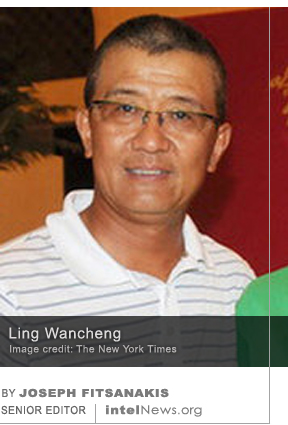
Ling WanchengA well-connected Chinese businessman, described by officials as potentially one of the most damaging defectors in the history of modern China, is reputed to have requested political asylum in the United States. Ling Wancheng, 54, is the multimillionaire brother of Ling Jihua, a close aide of China’s former premier, Hu Jintao, who rose through the ranks of the Communist Party of China to eventually lead its Central Committee’s General Office. With the help of his brother’s connections and political influence, Ling Wancheng transformed himself from a journalist to an entrepreneur in the early 2000s. Soon after receiving his graduate degree in business administration, he founded an investment firm and joined China’s nouveau riche elite. His wealth, which is estimated to be in the hundreds of millions of dollars, coupled with his older brother’s senior position within the Communist Party, made him one of China’s most politically connected entrepreneurs.

However, the Ling family’s fortunes turned dramatically for the worse in March of 2012, when Ling Jihua’s 23-year-old son was killed in a Beijing street while driving a Ferrari after a night of wild partying. Two half-naked women, who were also riding in the car, were seriously injured; one later died of her wounds. The circumstances of the crash, as well as Ling Jihua’s failed efforts to cover it up, were seen as symbolic of a spoiled generation of government officials, whose corrupt practices have isolated the Communist Party from the Chinese populace. Soon afterwards, the new administration of President Xi Jinping initiated a massive anti-corruption campaign as a means of restoring the reputation of the Communist Party. Ling was immediately demoted, cut off from the top echelons of the Chinese government, and in 2014 there were rumors that he would soon be facing a corruption investigation. In July of this year, it was officially announced that Ling had been expelled from the Communist Party and that he would be facing trial on charges of accepting bribes.

The announcement of Ling’s trial stated that he was accused of “accepting certain bribes for himself and on behalf of his family”. But no charges were filed against Ling Wancheng, and there were rumors that he was being pressured by Communist Party officials to testify against his brother. But it appears that the multimillionaire businessman, who owns several properties in the US, was able to flee China and is now in an undisclosed location on US soil. The New York Times, who tried to locate Ling earlier this week, spoke to unnamed American officials, who confirmed that he had indeed fled China and was in the US. The officials refused to confirm that Ling had applied for asylum. But they said that, if he did defect to America, Ling “could become one of the most damaging defectors in the history of the People’s Republic”, due to his political connections.

The Times added that Beijing had contacted the White House requesting that Ling be extradited to China. But the administration of US President Barack Obama appears unwilling to satisfy the Chinese government’s request, given that Chinese hackers are believed to be responsible for the recent theft of up to 24 million American government workers’ personal data.

Author: Joseph Fitsanakis | Date: 04 August 2015 | Permalink

Memos may relate to secret NSA deal with leading cryptography vendor

William FriedmanIn 2007 I wrote in my “National Security Agency: The Historiography of Concealment” that America’s leading signals intelligence agency had made a secret deal with Crypto AG, a Swiss-based manufacturer of cryptographical equipment. The agreement, which lasted for much of the Cold War, allegedly allowed the NSA to read the classified messages of dozens of nations that purchased encoding equipment from Crypto AG. As I expected, the claim drew criticism from individuals connected with Crypto AG, including company scientists, who argued that the Swiss manufacturer would never have agreed to a deal that undermined its professional reputation as a trusted and neutral vendor of cryptological devices. Now, however, the BBC has revealed two recently declassified NSA memos that appear to provide further proof of the deal.

My 2007 claim was based on a string of well documented allegations that surfaced in the early 1980s. While conducting research for his seminal book The Puzzle Palace, historian James Bamford came across references to Project BORIS, which involved a pact between the NSA and the Swiss company. To be precise, the deal appeared to have been struck between the Swiss inventor and Crypto AG founder Boris Hagelin and William F. Friedman, an American cryptologist who led the Armed Forces Security Agency, a forerunner of the NSA. The two men were united by a deep personal friendship, which was forged during World War II by their mutual hatred of Nazism.

Bamford’s claim was echoed in 1996 by Scott Shane and Tom Bowman, reporters for The Baltimore Sun. In a six-part investigative series about the NSA, the two journalists wrote that Friedman visited Hagelin during a trip to Switzerland in 1955 and asked for his help so that American could dominate its Cold War rivals. According to Shane and Bowman, Hagelin agreed and built a type of cryptological backdoor in Crypto AG’s devices, which allowed the NSA to read millions of messages for many decades. The company, of course, reacted furiously, saying that claims of a secret deal were “pure invention”.

On Thursday, however, BBC security correspondent Gordon Corera confirmed that a BBC investigation of 55,000 pages of documents, which were declassified by the NSA in April, claim to have found proof of the secret agreement. The declassified material, said Corera, contains two versions of the same NSA memorandum, as well as an earlier draft, which refer to a “gentleman’s agreement” between Friedman and Hagelin. Under the agreement, Crypto AG would inform the NSA about periodical changes to the technical specifications of its encoding machines. The company would also provide the American spy agency with detailed lists showing the precise models purchased by various national governments around the world. Furthermore, Crypto AG agreed not to sell the more advanced, customizable models of its equipment to countries viewed by Washington as directly adversarial. This, says the BBC, amounted to Crypto AG deceiving some of its customers, by offering them “watered-down versions” of its encoding devices.

Corera notes that there is no evidence in the memos that Crypto AG built any kind of back door in its devices for use by the NSA. Instead, by providing the American agency with detailed operational knowledge of the devices, it enabled American codebreakers to reduce the time and effort needed to break encoded messages intercepted by the NSA.

There are a couple of minor errors in Corera’s article. For instance, the “father of American code-breaking” is not Friedman, as he claims, but Herbert Yardley, who led the so-called Black Chamber (also known as the Cipher Bureau) in 1919, long before Friedman was in the picture. Additionally, he fails to mention Bowman’s contribution to Shane’s Baltimore Sun article, which was published in 1996, not 1995, as he writes. These minor errors aside, however, the BBC discovery is absolutely crucial for our understanding of cryptological history in the Cold War.

Author: Joseph Fitsanakis | Date: 31 July 2015 | Permalink

US Congressional review considers impact of federal database hack

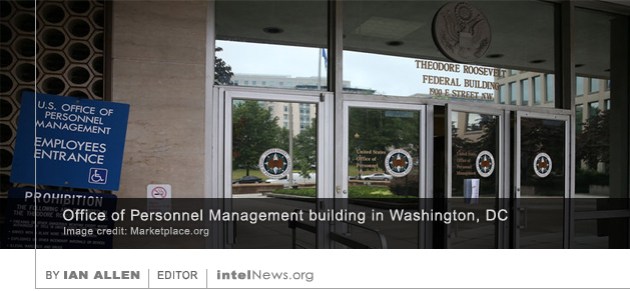
Office of Personnel Management 2A United States Congressional review into last month’s cyber theft of millions of government personnel records has concluded that its impact will go far “beyond mere theft of classified information”. Up to 21 million individual files were stolen in June, when hackers broke into the computer system of the Office of Personnel Management (OPM). Part of OPM’s job is to handle applications for security clearances for all agencies of the US federal government. Consequently, the breach gave the unidentified hackers access to the names and sensitive personal records of millions of Americans —including intelligence officers— who have filed applications for security clearances.

So far, however, there is no concrete proof in the public domain that the hack was perpetrated by agents of a foreign government for the purpose of espionage. Although there are strong suspicions in favor of the espionage theory, there are still some who believe that the cyber theft could have been the financially motivated work of a sophisticated criminal ring. But a new report produced by the Congressional Research Service, which is the research wing of the US Congress, seems to be favoring the view that “the OPM data were taken for espionage rather than for criminal purposes”. The report was completed on July 17 and circulated on a restricted basis. But it was acquired by the Secrecy News blog of the Federation of American Scientists, which published it on Tuesday.

The 10-page document points out that strictly financial reasons, such as identity theft or credit card fraud, cannot be ruled out as possible motivations of the massive data breach. But it points out that the stolen data have yet to appear in so-called “darknet” websites that are used by the criminal underworld to buy and sell such information. This is highly unusual, particularly when one considers the massive size of the data theft, which involves millions of Americans’ credit card and Social Security numbers. Experts doubt, therefore, that the OPM data “will ever appear for sale in the online black market”. This inevitably leads to the conclusion that the breach falls “in the category of intelligence-gathering, rather than commercial espionage”, according to the report.

The above conclusion could have far-reaching consequences, says the report. One such possible consequence is that high-resolution fingerprints that were contained in the OPM database could be used to blow the covers of American case officers posing as diplomats, and even deep-cover intelligence operatives working secretly abroad. Furthermore, the hackers that are in possession of the stolen files could use them to create high-quality forged documents, or even publish them in efforts to cause embarrassment to American intelligence agencies.

Author: Ian Allen | Date: 30 July 2015 | Permalink: https://intelnews.org/2015/07/30/01-1746/

Will Israeli spy Pollard receive secret spy wages after US lets him go?

Jonathan PollardLawyers for Jonathan Pollard, an American with Israeli citizenship who spied on the United States for Israel in the 1980s, confirmed on Tuesday that he will be released in November, by which time he will have served 30 years of a life sentence. The news was welcomed by Pollard’s supporters in Israel, who consider him a hero, as well as by pro-Israel Americans, who have been pressuring the US government to release him. But Newsweek’s veteran intelligence correspondent Jeff Stein responded to the news of Pollard’s release by posing an interesting question: when Pollard is released, will he have access to close to $1 million in spy wages that his Israeli handlers are reputed to have deposited for him in a Swiss bank account?
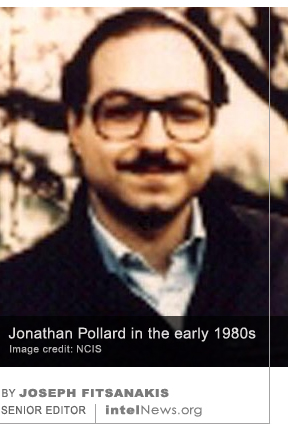
Stein was referring to a practice that is common among intelligence agencies, namely to deposit cash in offshore bank accounts as a way of compensating their assets. The latter can gradually access those funds during trips abroad, usually after their retirement, long after having ceased their espionage activities. If the asset is arrested or perishes, the funds are usually passed on to the asset’s surviving relatives. This method protects the asset from the prying eyes of counterintelligence agencies in the asset’s home country, and sends a message to future recruits that assets and their families will be taken care of by their handlers.

Following Pollard’s arrest in 1985, US government prosecutors repeatedly rejected the view, put forward by Pollard’s legal team, that the former US Navy analyst was a romantic who had spied on the US for Israel because he wanted to assist a small country surrounded by enemies. They told the court that Pollard had also spied for South Africa and had tried to spy for Australia, before finally settling for working for Israel. Far from being a romantic, they said, Pollard was a calculated businessman, who sought financial compensation for his services to the Jewish state. Indeed, according to the Naval Criminal Investigative Service and the Federal Bureau of Investigation, Pollard had pocketed at least $50,000 from his Israeli handers by the time of his arrest, in addition to receiving several expensive items as gifts. The spy had also been promised that Israel would deposit $30,000 every year in a Swiss bank account, which Pollard could access after his retirement.

In his article published Tuesday, Stein wonders whether Israel has continued to deposit $30,000 a year in Pollard’s reputed Swiss bank account, which is a standard practice for intelligence agencies. If the answer is yes, then the amount available today would be in the neighborhood of $1 million. If Pollard moves to Israel come November, as many believe he will, will he then have access to the money he earned by spying on the US government as an unregistered agent of a foreign power? And if so, how should this be expected to affect the already rocky relations between Washington and Tel Aviv?

Stein said he spoke to Pollard’s New York lawyer, Eliot Lauer, who called the rumors of a secret Swiss bank account “poppycock” and added that Pollard had been “secured employment and housing […] in the New York area”. Additionally, there are some who speculate that Pollard may not be allowed to leave the US as part of the conditions of his parole. At this stage, however, nobody knows for sure. Stein contacted the US Parole Commission, NCIS and the Central Intelligence Agency, but all declined comment.

Author: Joseph Fitsanakis | Date: 29 July 2015 | Permalink: https://intelnews.org/2015/07/29/01-1745/

US spy for Israel ‘may be released’ as part of Iran nuclear deal

Jonathan PollardA United States Navy intelligence analyst, who is serving a life sentence for spying on America for Israel, may soon be set free in an effort by Washington to quieten Israeli criticism of a recently struck international agreement on Iran’s nuclear program. Many in US counterintelligence consider Pollard, who acquired Israeli citizenship in 1995, one of the most damaging double spies in American history. But he is widely viewed as a hero in Israel, and many Israelis, as well as pro-Israel Americans, have been pressuring the US administration of President Barack Obama to release him. He has so far served nearly 30 years of his life sentence.
The Wall Street Journal published an article on Friday suggesting that the Obama administration was “preparing to release” Pollard. Citing unnamed US officials, the paper said Washington hoped that the move would “smooth [America’s] relations with Israel in the wake of the Iran nuclear deal”. The latter was signed earlier this month between Tehran and the so-called P5+1 nations, namely the five permanent members of the United Nations Security Council plus Germany. The New York Times added to the speculation on Saturday with a detailed front-page article, which confirmed that “some in Washington appear to be highlighting” Pollard’s upcoming 30-year parole hearing, which is set to take place in November. It added that the White House was contemplating using Pollard’s release to appease, not only Tel Aviv, but also pro-Israel supporters in Congress, many of whom have campaigned for years in favor of Pollard’s release.

But the paper also cautioned that linking a possible release of the jailed American spy with the Iranian nuclear deal was risky and could in fact provoke a serious backlash. It quoted Israeli and American analysts who said that, although Israel was in the past prepared to accept Pollard’s release in exchange for minor concessions in its conflict with the Palestinians, the coalition government of Israeli Prime Minister Benjamin Netanyahu considers the nuclear agreement with Iran to be “too serious a threat” to concede to, no matter what the trade-off is from Washington. Some Israeli commentators used strong words to describe Washington’s alleged plan to release Pollard as a way of appeasing Israel, describing it as “cynical, cheap and misguided”.

The Times said it contacted the US National Security Council on Friday and was told by a spokesman that there was “absolutely zero linkage between Mr. Pollard’s status and foreign policy considerations”.

Author: Joseph Fitsanakis | Date: 27 July 2015 | Permalink: https://intelnews.org/2015/07/27/01-1743/

Did US DEA forces pose as Mexican troops to capture drug kingpin?

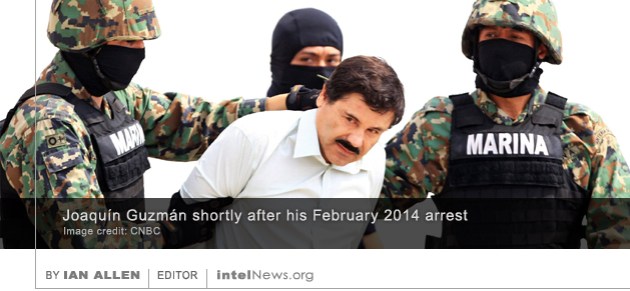
Joaquín ‘El Chapo’ GuzmánThe notorious drug lord Joaquín ‘El Chapo’ Guzmán captured the attention of the world’s media a few weeks ago, when he escaped from a maximum security prison in Mexico through a secret tunnel. But his cinematic prison breakout may have overshadowed the story of his arrest, which, according to recent reports, may be as interesting as that of his latest escape from prison.

Guzmán was arrested in a pre-dawn raid on February 22, 2014. He was reportedly captured in Mazatlán, a resort town in Mexico’s west-coast state of Sinaloa, by an elite squad of Mexican marines. The marines, we were told at the time, were receiving crucial intelligence support from a several United States government agencies. Or at least that is the official story of the drug kingpin’s arrest. On July 18, however, Mexico’s leading investigative newsmagazine, Proceso, published a lead article alleging that Guzmán was not arrested by Mexican marines, but by American operatives disguised as Mexican marines.

The article was written by J. Jesús Esquivel, a longtime reporter on intelligence and security affairs, who has authored two books on the history of operations conducted by the Drug Enforcement Administration (DEA), the Central Intelligence Agency (CIA) and other American security and intelligence agencies in Mexico. In his July 18 article, Esquivel says he was told by two American officials —who he does not name— that Mexican marines had little to do with Guzmán’s capture. The drug lord was tracked down by the US Marshals Service and the DEA through a web of informants and electronic tracking devices. Once they knew they had him, he two agencies, supported by a third American agency, which Esquivel does not identify, raided Guzmán’s hotel suite in Mazatlán, dressed in Mexican marine uniforms and driving vehicles bearing Mexican navy insignia.

The Intercept, which covered Proceso’s story on Thursday, correctly stated that, if the newsmagazine’s allegations are true, they would not mark the first time that American government agents posing as Mexican troops have conducted counternarcotics operations in Mexico. The practice has been revealed before, most recently by The Wall Street Journal. But, if true, Proceso’s allegations would seem to indicate an unprecedented degree of operational activity by US intelligence and security agencies south of the border. Additionally, it is alleged that the American agencies deliberately chose to keep their Mexican counterparts in the dark until after Guzmán had been captured, because they feared that the drug kingpin would be notified by informants inside the Mexican government. If this information is accurate, it would indicate that the line separating the Mexican drug cartels from the country’s government remains markedly blurry.

Author: Ian Allen | Date: 24 July 2015 | Permalink: https://intelnews.org/2015/07/24/01-1742/

CIA using Macau casinos to recruit Chinese officials, says report

Sands casino in Macau ChinaOfficials in China think that United States spy agencies are using casinos in Macau to entrap Chinese government employees, according to a report produced on behalf of an American-owned casino chain in the former Portuguese colony. The report was produced by a private investigator and was commissioned by Sands China, the Macau branch of a casino venture owned by American gambling magnate Sheldon Adelson. Its goal was to investigate why the Chinese-appointed authorities in Macau were hostile to the gambling industry in general and Sands China in particular.

The report is dated June 25, 2010, and includes a warning that it should not be shared with Chinese officials in Macau or in mainland China. It cites several unnamed officials in China’s Liaison Office, which governs Macau and Hong Kong, as well as sources in China’s Ministry of Foreign Affairs, and Chinese businessmen with close ties to the government in Beijing. It suggests that Beijing is weary of the damage caused to its public image by thousands of its employees gambling away an estimated $2 billion each year in Macau. Additionally, says the report, the central government in Beijing is hostile to the foreign-owned gambling industry in Macau because it believes that it collaborates with Western intelligence agencies. Sands China establishments in Macau, in particular, are believed by the Chinese government to be recruiting grounds for the United States Central Intelligence Agency, says the 2010 report.

Citing “well-placed sources” in the Chinese capital, the report suggests that the fear of espionage is “the primary subject” that causes Beijing’s hostility toward Sands China. It notes that “many of the [Chinese] officials we contacted were of the view that US intelligence agencies […] have penetrated and utilized the casinos [in Macau] to support their operations”. It adds that Chinese counterintelligence agencies have “evidence” that CIA operatives “monitor mainland government officials” who visit Macau to gamble, paying particular attention to those losing large amounts of money, or those visiting Macau without the knowledge of their superiors. They then “lure and entrap” them, forcing them “to cooperate with US government interests”.

The report was uncovered by the Investigative Reporting Program of the University of California Berkeley’s Graduate School of Journalism and published on Wednesday in British broadsheet The Guardian. The paper said the report was among a set of documents filed with a court in Las Vegas, where the former head of Sands’ Macau casinos is suing the company for wrongful dismissal. The Guardian contacted the Sands Company, which rejected the contents of the report as “a collection of meaningless speculation”. Its senior vice president for global communications and corporate affairs, Ron Reese, also dismissed the report as “an idea for a movie script”.

Author: Joseph Fitsanakis | Date: 23 July 2015 | Permalink: https://intelnews.org/2015/07/23/01-1741/