News you may have missed #807

Noor Inayat KhanBy IAN ALLEN | intelNews.org |
►►Britain to unveil statue of female SOE spy of Indian origin. Born in Moscow to an Indian father and an American mother, Noor Inayat Khan was in Paris when it fell to Nazi occupation. She immediately returned to London to volunteer for the war effort, joined the Women’s Auxiliary Air Force and was recruited by the Special Operations Executive (SOE). She was sent into France on a secret mission in June 1943, but was betrayed and captured a few months later. She was shot by the Nazis in Dachau in September 1944, aged 30, and was posthumously awarded the George Cross as well as the Croix de Guerre by France. She was one of only three women in the SOE to be awarded the George Cross.
►►US intelligence spending falls or second year in a row. The US government’s total spending on intelligence activities fell in 2012, the second year in a row of declining numbers after years of soaring security spending since the September 11 attacks in 2001. The Office of Director of National Intelligence, the top US intelligence authority, announced on Tuesday that total funding appropriated for the National Intelligence Program, covering activities of the CIA and high-tech spy agencies such as the National Reconnaissance Office, was $53.9 billion in Fiscal Year 2012, which ended on September 30. That was down from the $54.6 billion appropriated during Fiscal Year 2011, according to government officials and figures published by the private Federation of American Scientists.
►►Russia wants to park spy planes on French base. France has been asked by Moscow to allow two Russian spy planes to be deployed at a French base in Djibouti to help track down pirates. Russian Defense Minister Anatoly Serdyukov said last week that the Ilyushin Il-38 naval reconnaissance planes would improve Russia’s ability to spot pirates plaguing waters off the coast of Somalia. Djibouti is at the juncture of the Red Sea and the Gulf of Aden. The French base is home to several thousand French service members and a number of military aircraft.

News you may have missed #806

Mohammed DahabiBy IAN ALLEN | intelNews.org |
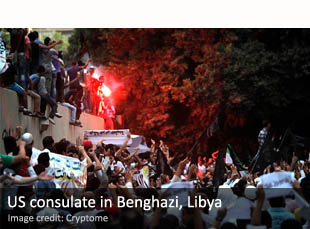
►►Most staff at US consulate in Libya were CIA personnel. Most of the personnel attached to the US diplomatic mission in Benghazi, the Libyan city where a US consulate was attacked ending with the deaths of four Americans, including Ambassador Christopher Stevens, were spies, according to The Wall Street Journal. The paper said 23 of the 30 Americans evacuated from Benghazi in the wake of the September 11, 2012, attack were employees of the CIA. Tyrone Woods and Glen Doherty, two of the men killed that day, and later publicly identified as contract security workers with the State Department, were in fact under contract with the CIA, said the paper.
►►India accuses Pakistan of printing counterfeit banknotes. The Central Economic Intelligence Bureau in India says that the Pakistani spy agency, the Inter-Services Intelligence Directorate (ISI) is printing counterfeit Indian and Bangladeshi currencies from the state-owned security printing presses “under special arrangement” and circulating the same through a well-organized network, which is coordinated by senior ISI officials. This is not the first time that the Indian government has accused Pakistan of counterfeiting Indian currency.
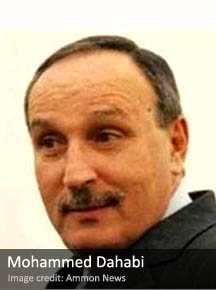
►►Jordan court to announce ex-spy chief’s sentence on November 11. A Jordanian criminal court has postponed a verdict in the case of Mohammed al-Dahabi, who ran the General Intelligence Department between 2005 and 2008 and is on trial for alleged embezzlement of public funds, money laundering and abuse of office. Presiding judge Nashaat Akhras said in court Sunday that the verdict will be pronounced November 11, without giving a reason. Dahabi was arrested in February, when inspectors from the Central Bank of Jordan suspected transactions worth millions of dollars had gone through his bank account.

News you may have missed #805 (analysis edition)

US consulate in Benghazi, LibyaBy IAN ALLEN | intelNews.org |
►►Should the US be wary of Huawei? Regular readers of intelNews know that this blog has been covering the subject of Chinese telecommunications hardware manufacturer Huawei for several years now. During the past few weeks, the United States Congress has flagged the company as being too closely associated with the Chinese intelligence establishment. Other countries have done so as well. But not everyone agrees. New York-based newspaper The Wall Street Journal said recently that “bashing Chinese companies on national security grounds seems like a risk-free strategy” for US politicians and added that, unlike Congress, American governors and mayors are eager to promote investment by Chinese companies. Moreover, Wired‘s Marcus Wohlsenemail suggests that, spies or no spies, US telecommunications companies should fear Huwaei, which is here to stay.
►►Should CIA share some of the blame for Benghazi? For the last month, the US media and Congress have been grilling the State Department for the security failures during the deadly assault on a US compound in Benghazi, Libya. But what if the State Department is the wrong target of scrutiny? According to a counter-theory advanced recently by The Washington Post‘s Dana Milbank, the CIA, not the State Department, bears some responsibility for the security lapse that led to the death of Ambassador Chris Stevens and three other Americans, but is flying under the radar due to the classified nature of its activities in Libya.
►►Could unmanned drones go rogue? Unmanned aerial vehicles, commonly known as drones, have been in the news a lot lately: the US Congress has given the green light for their use by state and local law enforcement, academic researchers, and the private sector. UAVs are rapidly becoming a new tool in patrolling US borders and in NATO military operations in Afghanistan and Pakistan. But non-state actors, including organized criminal gangs and drug cartels, may also be seeing the benefits of UAVs before too long. Read an interesting analysis piece that includes comments by intelNews‘ own Joseph Fitsanakis.

MI5 official’s diaries reveal tensions between UK, US spy agencies

Guy LiddellBy JOSEPH FITSANAKIS | intelNews.org |
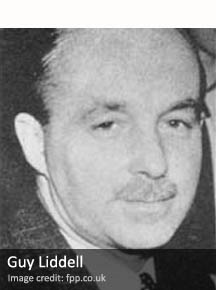
Newly declassified personal diaries belonging to a senior British intelligence official reveal tensions between British and American spy agencies in the years immediately following World War II. The National Archives, an executive agency operating under the United Kingdom’s Secretary of State for Justice, released the diaries on Friday. They belong to Guy Maynard Liddell, a longtime British intelligence operative who rose to the post of Deputy Director General of MI5, Britain’s domestic intelligence agency. Liddell meticulously kept a diary during most of the 1940s and 1950s, in which he detailed both personal information and details of his work at MI5. Two volumes of his diaries (from 1939 to 1945, edited by Nigel West) have already been published. Now a third installment has been declassified by the National Archives, containing Liddell’s diary entries from the late 1940s and 1950s. The diaries project what some intelligence historians describe as “a certain friction” between postwar British and American intelligence services. Even though the two countries were largely viewed as allies in the immediate postwar period, their respective intelligence agencies did not always see eye to eye. In one instance, Liddell describes his American colleagues as “utterly incapable […] of seeing anybody’s point of view except their own” and accuses them of being “quite ready to cut off their noses to spite their faces”. He also comes across as skeptical of the then-newly established Central Intelligence Agency, which, he writes, “someday” may be able to produce information that would be “worth disseminating, evaluating, or coordinating”. In 1947, shortly after the CIA’s founding, Liddell wrote with a degree of uncertainty that “in the course of time, [the Agency] may produce something of value”. Further on he relayed the opinion of CIA Deputy Director Edwin Kennedy Wright, who apparently told British intelligence officials that in American intelligence organizations “500 people were employed to do what 50 people would do” in the UK. Read more of this post

News you may have missed #804

Jeffrey Paul DelisleBy IAN ALLEN | intelNews.org |
►►CIA officer reportedly among dead in Afghanistan bombing. The attack, which was carried out in a remote area of Kandahar Province, occurred when a guard working for the Afghan intelligence service detonated a suicide vest as a delegation of American coalition members and Afghan intelligence officials arrived at the intelligence office in the Maruf District. The blast killed Ghulam Rasool, the deputy intelligence director for Kandahar Province, two of his bodyguards, another Afghan intelligence official, and some Americans, including the CIA officer. A spokeswoman for the CIA declined to comment.
►►Canadian intel officer was ‘on Russian payroll for years’. Former navy intelligence officer Jeffrey Paul Delisle, who pleaded guilty this month to spying, was leaking secrets to Russia, sending classified data about Canada as well as the United States, according to David Jacobson, the US ambassador in Ottawa. So far, the Canadian government has refrained from revealing the identity of “the foreign entity” to whom Delisle passed the classified information. Ambassador Jacobson refused to specify the nature of the information, saying only that “there was a lot of highly classified material”.
►►Panama wants to adopt euro as legal tender. Panama, one of the fastest growing economies in Latin America, wants to adopt the euro as legal tender to run alongside the country’s US dollar economy. Panama’s President Ricardo Martinelli made the request to German Chancellor Angela Merkel during a visit to Europe. The president indicated he had every faith that the crisis in the eurozone would soon be at an end, adding that Panama “would be possibly the only country in the world to have two currencies, the euro and the dollar”.

France pressing for Western military intervention in Mali, claim sources

Mali and the Independent State of AzawadBy JOSEPH FITSANAKIS | intelNews.org |
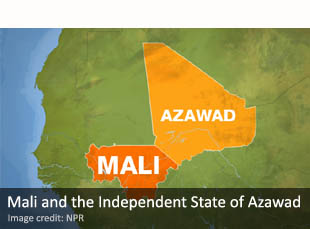
The government of France is holding secret talks with American and other Western officials to explore options for a concerted military intervention in Mali, according to diplomatic sources. A Tuareg rebellion in the northern part of Mali, which began earlier this year, culminated in the unilateral declaration of the Independent State of Azawad. The new state, which borders Algeria, Mauritania, Niger and Burkina Faso, is controlled by the National Movement for the Liberation of Azawad (NMLA). The NMLA is partially staffed by former members of the Libyan Army during the rule of Colonel Muammar al-Gaddafi. But it is also said to incorporate armed members of Ansar Dine, the Movement for Unity and Jihad in West Africa (MUJAO) and Al-Qaeda in the Islamic Maghreb (AQIM), all of which claim to have links with al-Qaeda. Many French observers view the Independent State of Azawad as the African version of mid-1990s Afghanistan, which eventually served as the base for Osama bin Laden’s al-Qaeda. But even though the French government has come out in favor of armed intervention in northern Mali, it has denied persistent rumors that it is contemplating sending French troops in the West African country. Instead, Paris officially favors intervention by the Malian Army backed by African Union troops and using logistical support provided by the Economic Community of West African States (ECOWAS). However, in an article published yesterday, The Associated Press claimed that, behind the scenes, the French government is trying to convince the US and other Western countries to participate in a military intervention in Mali. Read more of this post

News you may have missed #803

Shakil AfridiBy IAN ALLEN | intelNews.org |
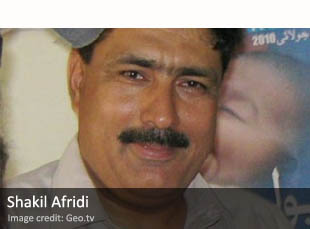
►►Phone seized from Pakistani doctor who helped CIA find bin Laden. Pakistani authorities have seized a Thoraya satellite phone from jailed doctor Shakil Afridi, who helped the CIA trace Osama bin Laden, and also arrested four police commandos guarding his cell. After interrogation, one of the four arrested commandos confessed that he had provided the satellite phone to Afridi. The doctor had reportedly made more than 68 calls from the satellite phone set and most of these calls were long-distance, but the authorities are assessing the satellite phone data to ascertain the country location.
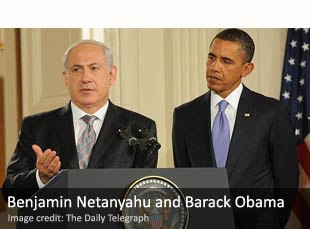
►►US whistleblower protections extended to intelligence community. US President Barack Obama has extended whistleblower protections to national security and intelligence employees. A new Presidential policy directive says employees “who are eligible for access to classified information can effectively report waste, fraud, and abuse while protecting classified national security information. It prohibits retaliation against employees for reporting waste, fraud, and abuse”. The President has also instructed agencies, including the CIA, to establish a review process, within 270 days, that allows employees to appeal actions in conflict with the directive that affect their access to classified information. It is worth noting that the Obama administration has been criticized by open-government advocates for aggressively prosecuting self-described whistleblowers.
►►What do CIA spies do after retirement? What do former spies do when they quit the spy game? Plan covert action campaigns against the nasty old ladies in their homeowners’ association? Overthrow their city council for fun? No, the majority of former CIA case officers work as consultants or contractors within the US intelligence community. However, while returning to work as intelligence consultant is the norm, some few do forge a different path, applying lessons learned from government service to a new life in the private sector.

White House review ‘found no evidence’ of Huawei spying for China

Huawei TechnologiesBy JOSEPH FITSANAKIS | intelNews.org |
A review commissioned by the government of the United States has reportedly found no evidence that Chinese telecommunications hardware manufacturer Huawei Technologies spied for the Chinese government. The 18-month-long review, which was ordered directly by the White House, examined the question of security vulnerabilities posed by telecommunications hardware suppliers, which could theoretically harm US service providers and pose a danger to US national security. The report, which was allegedly aided by several US intelligence agencies and other federal government departments, was based on detailed interviews with nearly 1,000 telecommunications equipment consumers across the United States. It was concluded at the start of 2012, but remains largely classified. However, Reuters news agency cites “two people familiar with the probe”, who claim that the probe contains “no clear evidence” that Huawei spied for the government of China. At the same time, however, the probe concluded that Huawei telecommunications hardware contains numerous structural vulnerabilities which could help hackers exploit telecommunications networks supported by the Chinese company. According to one source quoted by Reuters, the White House report found that the telecommunications hardware sold by Huawei was “riddled with holes”. Read more of this post

Canadian diplomats spied for the CIA in Cuba, claims new book

Embassy of Canada in Havana, CubaBy JOSEPH FITSANAKIS | intelNews.org |
Several accredited Canadian diplomats were recruited by the United States Central Intelligence Agency to spy on Cuba in the aftermath of the 1962 missile crisis, according to a new book. Authored by Canadian retired diplomat John Graham, the book, entitled Whose Man in Havana? Adventures from the Far Side of Diplomacy, is to be published this week by Penumbra Press. In it, Graham claims that he was among a number of Canadian diplomats stationed in Cuba, who were secretly recruited by the CIA. The US agency had been essentially forced out of the island after Washington and Havana terminated diplomatic relations in 1961, soon after the government of Fidel Castro declared itself a proponent of Marxism. The closure of the US embassy meant that the CIA had no base from which to operate in the Caribbean island. Two years later, in May 1963, US President John F. Kennedy personally asked Canadian Prime Minister Lester Pearson for assistance in intelligence-gathering efforts in Cuba. The Canadian leader consented and, according to Graham, Canadian diplomatic officials actively assisted the CIA until at least 1970. The author states in his book that he himself operated in Cuba for two years, from 1962 until 1964, under the official cover of Political Officer at the Canadian embassy in Havana. Prior to that, he says, he was provided with rudimentary training by the CIA, which consisted of spending “just a few days” at the Agency’s headquarters in Langley, VA. He was then tasked with conducting physical surveillance of Soviet military bases on Cuba and, if possible, identifying weapons and electronic security measures, and noting troop movements. Read more of this post

Danish Muslim convert claims he was CIA’s mole inside al-Qaeda

Morten StormBy JOSEPH FITSANAKIS | intelNews.org |
A Danish citizen who converted to Islam in the early 2000s claims he was a spy for the United States Central Intelligence Agency and helped track down an American-born Islamist cleric who was killed by a drone strike in 2010. The man, who goes by the name Morten Storm, told Danish newspaper Jyllands-Posten that he converted to Islam while living in the United Kingdom. But he quickly grew disillusioned, he said, and in 2006 he was recruited by the Danish Police Intelligence Service (PET). In subsequent years, he traveled several times to Yemen on PET missions, and gradually managed to gain the trust of members of the al-Qaeda in the Arabian Peninsula (AQAP). Eventually, he said, he grew close to one of AQAP’s central figures, the American-born Yemeni cleric Anwar al-Awlaki. At that point, claims Storm, the PET turned him over to the CIA, who allegedly used him to gather information on al-Awlaki. The Danish Muslim convert claims that his role as a CIA informant was so important that US President Barack Obama knows his name. He also told the paper that it was his information that eventually helped the CIA track and assassinate the charismatic cleric. According to Storm, the CIA supplied him with a memory stick that contained a stealth Global Positioning System tracking device. He sent the memory stick to al-Awlaki, who used it on his computer, thus allowing the CIA to track him down. In April 2010, President Obama ordered that al-Awlaki’s name be included on a list of individuals that the CIA was officially authorized to kill. Little less than a year later, on September 30, 2011, the cleric and three other suspected members of AQAP were killed when their car was hit by two Hellfire missiles in Yemen’s northern al-Jawf province. Read more of this post

Former CIA senior analyst argues in favor of US deal with Iran

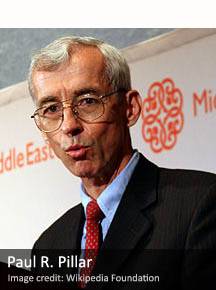
Paul R. PillarBy JOSEPH FITSANAKIS | intelNews.org |
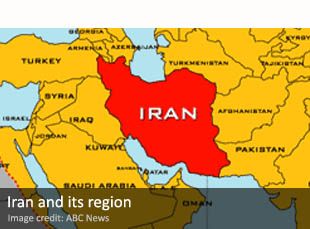
A former senior analyst in the United States Central Intelligence Agency has come out in support of a bilateral compromise between Iran and the West on Tehran’s nuclear program. In an article published last week, Georgetown University professor Paul R. Pillar, who spent nearly three decades with the CIA, dismissed the widespread view that the differences between Iran, Israel, and the West are insurmountable. Commenting on news of a nine-step negotiation plan offered by Tehran in early October, but dismissed by Washington as “unworkable”, Pillar said the offer provided the initial steps of an “eminently achievable agreement” between the interested parties. The CIA veteran, who rose to be one of the Agency’s top analysts prior to his retirement in 2005, argued that a possible outcome of bilateral negotiations would be for Iran to curtail its enrichment of uranium to the 20 percent level in exchange for the lifting of most economic sanctions imposed on Iran by Western countries. “An agreement along these lines makes sense”, he added, “because it would meet the major concerns of each side” in the dispute. He cautioned, however, that, under such an agreement, Tehran would not only be prohibited from continuing its uranium enrichment process, but would also be required to surrender all quantities of uranium previously enriched to a level above 20 percent. Such an agreement, claimed Pillar, would mean that neither Iran nor Israel and the West would receive everything they wanted at once. Instead, the process would depend on a gradual implementation of several bilateral agreements in stages, “each side giving something and getting something at each stage”. Read more of this post

News you may have missed #800

MI6 headquartersBy IAN ALLEN | intelNews.org |
►►British MI6 spy agency feeling shaken not stirred. Analysis on Salon.com about the current state of MI6, Britain’s external intelligence agency, featuring comments by intelNews‘ own Joseph Fitsanakis. The article, written by former CNN and BBC correspondent Barry Neild, argues that MI6 is feeling the heat caused by a series of recent allegations which threaten to disrupt its clandestine operations. The agency, he suggests, is thus undergoing one of the most troubling periods of its hundred-year existence.
►►Germany charges couple with spying for Russia. German government prosecutors say the couple, who called themselves Andreas and Heidrun Anschlag, worked in Germany for Russia’s foreign intelligence service for more than 20 years, gathering information on European Union and NATO strategy. The pair entered Germany in 1988 and 1990, claiming to be Austrian citizens of South American origin. They were arrested in October 2011. German media said it is the first such case in Germany since the end of the Cold War.
►►US allegedly widens covert operations in North Africa. The Associated Press quotes “three US counterterror[ism] officials and a former intelligence official” as saying that the United States is in the process of building “a new military task force” in the North African region. But by the time the US consulate in the east Libyan city of Benghazi was attacked last month, the new task force consisted only of “liaison officers who were assigned to establish relationships with local governments and US officials in the region”.

Moscow denies knowledge of alleged Russian spy ring busted in Texas

Alexander FishenkoBy JOSEPH FITSANAKIS | intelNews.org |
Government officials in Moscow have denied knowledge of an alleged Russian spy ring, which is accused by United States authorities of procuring sensitive microelectronics technology on behalf of the Russian military. Early on Wednesday morning, the Federal Bureau of Investigation conducted pre-dawn raids at several locations in Houston, Texas, and arrested eight members of the alleged spy ring. Four of the arrestees are allegedly Russian citizens, while the remaining five are from Kazakhstan, Azerbaijan and Ukraine. Four are naturalized American citizens. They include Alexander Fishenko, chief executive officer of Apex System LLC, which is accused by the FBI of having exported over $50 million in dual-use microelectronic devices to Russia since 2008. US federal prosecutors allege that three more spy-ring members are currently in Moscow; they include Yuri Savin, Director of Marketing at a company called Artrilor, which is said to have been at the receiving end of Apex System’s export operations. According to the indictment, Arc Electronics told its US suppliers that the microelectronics technologies were intended for use in various types of streetlights. But in reality, said the FBI, the company gave the hi-tech supplies to the Russian Ministry of Defense for use in airborne surveillance systems, as well as in remote weapons guidance systems, among other military applications. The FBI says it has in its possession extensive audio intercepts of the suspects communicating with Russian intelligence, as well as conferring among them about how to hide incriminating documents from US federal authorities. But Sergei Ryabkov, Russia’s Deputy Minister of Foreign Affairs, told Russian reporters on Thursday that the charges against the 11 individuals were “of a criminal nature” and had “nothing to do with intelligence activity”. Read more of this post

FBI raids alleged Russian front-company, indicts 11 on spy charges

Russian Ministry of DefenseBy JOSEPH FITSANAKIS | intelNews.org |
The United States has indicted employees of an alleged Russian front-company in Texas, accused of procuring sensitive microelectronics technology for use by Russian military and intelligence agencies. Public prosecutors in New York said yesterday that the Federal Bureau of Investigation conducted raids in locations around Houston, Texas, which included the headquarters of Arc Electronics, Inc. The export firm is accused of having shipped over $50 million-worth of military-grade microelectronics since 2008. The supplies were received in Moscow, Russia, by a mysterious procurement company called Apex System LLC. Counterintelligence investigators in the US claim both firms are part of an elaborate scheme set up by Russian military intelligence, aimed at stealing dual-use electronics hardware created by American firms. According to the indictment, Arc Electronics told its US suppliers that the microelectronics technologies were intended for use in various types of streetlights. But in reality, said the FBI, the company gave the hi-tech supplies to the Russian Ministry of Defense for use in airborne surveillance systems, as well as in remote weapons guidance systems, among other military applications. Federal prosecutors said that, for over four years, Arc Electronics engaged in a prolonged “surreptitious and systematic” scheme to circumvent US government export controls, thus seriously damaging US national security. Following the early-morning raids, the FBI unsealed indictments against 11 Arc Electronics employees, most of whom were charged with “acting as unregistered agents of the Russian Federation in the United States” —legal jargon for espionage. Read more of this post

News you may have missed #799

Russell TiceBy IAN ALLEN | intelNews.org |
►►Is NSA using UK spy base to guide predator drones? Surrounded by farmland and sheep, hundreds of National Security Agency staff go to work every day at RAF Menwith Hill, where they eavesdrop on communications intercepted by satellite dishes contained in about 30 huge golf ball-like domes. Menwith Hill has been used by the NSA since the 1960s; but lately there is growing disquiet in Britain over whether intelligence gathered at the base is being used to help with the CIA’s controversial clandestine drone strikes. And the British government is keeping mum.
►►Aussie envoy seduced by spy feared her phone was bugged. Former senior Austrade commissioner to Hanoi Elizabeth Masamune, who recently admitted before an Australian court that she had sexual relations with a Vietnamese intelligence officer, told police she feared her Hanoi offices were bugged. In her statement during the trial of eight former Reserve Bank company executives on bribery charges, she said that after receiving a call from a journalist she recalled “being concerned of the level of information which she had. I was also more concerned about whether my phone was being monitored”, she said.
►►NSA whistleblower describes beating polygraph test. Russell Tice, the National Security Agency whistleblower who helped blow the lid open on warrantless wiretapping conducted by the federal government on US citizens post-9/11, says that he took between 12 and 15 polygraph tests during his nearly 20-year-long government career. The tests mellowed over time, Tice says, and they may have also gotten easier to beat. Tice, who is no longer at the NSA, says he, along with those still in contact with at the agency, marvel at how easy it is to beat the lie detector.