Former deep-cover spy leads Kremlin’s efforts to woo Indian high-tech sector

Andrei Bezrukov A FORMER DEEP COVER Russian intelligence officer, whose cover was blown in 2010 when he was arrested in the United States, is spearheading efforts by the Kremlin to secure investments by India’s technology sector. The spy, Andrei Bezrukov, was recruited by the Soviet Committee for State Security (KGB) in the late 1970s or early 1980s—most likely alongside his wife, Elena Vavilova. For several years, the married couple lived in several countries, including Canada and France, before arriving in the United States in 1999 using fraudulently obtained Canadian passports.

Posing as Donald Heathfield and Tracey Foley, Bezrukov and Vavilova were among 10 Russian non-official-cover intelligence officers arrested by the Federal Bureau of Investigation (FBI) in June 2010. They were eventually swapped with Moscow for several Western spies held in Russian prisons. After returning to Russia, Bezrukov and Vavilova received the Order “For Merit to the Fatherland” 4th Class, which is Russia’s second-highest state decoration. They also entered state-sponsored employment, with Bezrukov advising the Rosneft Oil Company—Russia’s second-largest corporation—and teaching at the Moscow State Institute of International Relations.

In June 2025, Bezrukov apparently represented the Russian state at the 28th Saint Petersburg International Economic Forum (SPIEF)—often referred to as “Putin’s Davos”. According to the Washington Post, Bezrukov’s apparent role at SPIEF was to network with Forum representatives from India’s advanced technology sector, allegedly on direct orders by the administration of Russian President Vladimir Putin.

The event, which went under the tagline “Shared Values as a Foundation for Growth in a Multipolar World”, gathered nearly 20,000 delegates from 140 countries. The Kremlin touted it as evidence of the West’s failure to isolate Russia following its invasion of Ukraine. It also served as part of a set of broader efforts by the Kremlin to prevent the Russian economy from sliding into a recession by seeking to develop alternative energy markets and strengthening economic and political ties to the Global South.

India is by far the largest of a group of countries seen as “friendly” by Russia, which could potentially help revitalize the Russian economy, largely through the International North–South Transport Corridor (INSTC). The 14-year-old agreement aims to interconnect a transnational transportation network connecting Russia and India with import-export routes in Central Asia the Middle East, and Europe. Experts claim that the INSTC is the logistical backbone of Russia’s efforts to salvage its economy from the growing pressures of the war in Ukraine.

The Post reported that Bezrukov denied that he is still an employee of Russian intelligence agencies when approached and asked about his past by Western journalists.

Author: Joseph Fitsanakis | Date: 08 December 2025 | Permalink

Israel reportedly trying to recover spy’s remains from Syria

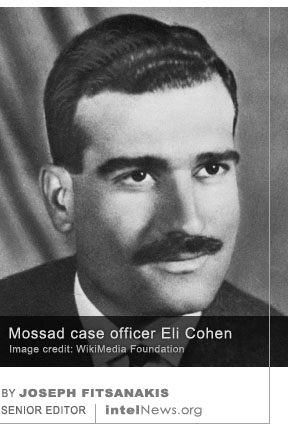
Eli CohenISRAELI OFFICIALS ARE REPORTEDLY trying to recover the remains of Eli Cohen, an Israeli spy who was hanged in Syria in 1965, after his espionage activities were discovered. Born in Alexandria in 1924, Cohen was an Egyptian Jew, whose family immigrated to Israel after 1949. After joining the Mossad, Israel’s primary external intelligence agency, Cohen became a katsa, or case officer.

The spy agency utilized Cohen’s fluency in Arabic and Spanish and sent him to Argentina, where he built his intelligence cover under the name Kamel Amin Thaabet. He pretended to be a Syrian businessman whose family had immigrated to Argentina in the 1920s. While in Argentina, Cohen became an active member of the Arab and Syrian diasporas and joined the Syrian Ba’ath Party.

In 1962, shortly before Ba’athist officers seized power in Syria, the Mossad instructed Cohen to relocate to Damascus. While there, Cohen became a well-known socialite with close connections to the administration of Syrian President Amin al-Hafiz. However, in 1965, Cohen’s espionage was uncovered by Syrian counterintelligence, who utilized technical countermeasures provided by Soviet intelligence. Cohen was convicted of espionage and publicly executed by hanging in Damascus on May 18, 1965.

Since Cohen’s execution, the Syrian state has rejected requests to reveal the location of his tomb and the whereabouts of his remains. On at least two instances, Israel, which views Cohen as a national hero, has offered to exchange Syrian and other Arab prisoners of war in return for the spy’s remains, but Damascus has rebuffed these offers. There are rumors that Syrian authorities regularly relocate Cohen’s remains so as to prevent Israel from covertly retrieving them.

According to reports from Middle Eastern media, since the fall of the administration of former Syrian President Bashar al-Assad, Israeli officials have been in negotiations to gain access to Cohen’s remains. The negotiations are allegedly taking place between Israeli government representatives and former members of the Assad regime, who have knowledge of the whereabouts of the late spy’s remains. In a television interview last week, Eli Cohen’s widow, Nadia, implied that Mossad Director David Barnea is personally involved in the ongoing negotiations.

Author: Joseph Fitsanakis | Date:16 December 2024 | Permalink
Russia using nontraditional means to gather intelligence, Finland warns

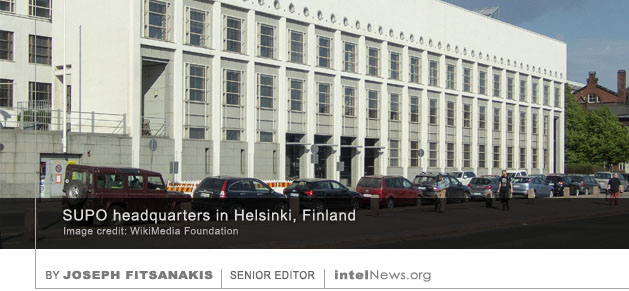
SUPO FinlandRUSSIA’S NEED TO GATHER intelligence from Scandinavian targets has increased considerably since Finland and Sweden joined the North Atlantic Treaty Organization (NATO), prompting Moscow to seek nontraditional means of collecting intelligence, according to Finland’s spy agency. A new report by the Finnish Broadcasting Company (Yle) relays a warning by the Finnish Security and Intelligence Service (SUPO) that Russian spies are increasingly operating in Scandinavia without relying on diplomatic protection.

Human intelligence (HUMINT) operations are typically carried out of diplomatic facilities by intelligence officers who enjoy various degrees of diplomatic immunity. Such protections are seen as crucial for the safety of intelligence personnel, who tend to engage in illegal activities while stationed abroad. However, the number of Russian intelligence officers who are based in diplomatic facilities in Finland and elsewhere in Scandinavia has “significantly decreased” in recent years, according to the Yle report.

The reason for the decline in numbers rests with the numerous expulsions of Russian diplomatic personnel —which include intelligence officers— that took place throughout Europe in the months following Russia’s February 2022 invasion of Ukraine. Since then, Finland is one of dozens of European countries that have repeatedly denied Russia’s requests for the issuance of diplomatic visas. As a result, Russian embassies and consulates in Finland remain understaffed and mostly devoid of intelligence personnel.

In response to this new reality, the Kremlin has been experimenting with using nontraditional HUMINT collectors. The latter are not based in diplomatic facilities and are not protected by diplomatic immunity. Such nontraditional intelligence collectors operate as “journalists or researchers”, according to SUPO. At the same time, Russian intelligence agencies increasingly target for recruitment Finns who life in Russia, or try to recruit them while they are traveling elsewhere in Europe.

Lastly, Russian intelligence agencies are systematically hiring criminals to carry out specific tasks on behalf of the Kremlin, in return for money. Such criminals include computer hackers, who are attracted by the Russian state. Indeed, the Russian government is systematically “providing favorable conditions” for computer hackers to operate out of Russian territory. They receive money and protection in return for letting the Russian state use them as a cover for cyber espionage, sabotage, and influence operations.

Author: Joseph Fitsanakis | Date: 18 November 2024 | Permalink

At least four Russians released in prisoner exchange with West are verified ‘illegals’

SVR hqAT LEAST FOUR OF the eight Russians released by the United States and its allies last week, in exchange for 16 people held in Russian prisons, are verified ‘illegals’ —the term used to describe Russian non-official-cover intelligence personnel. All four operated using third country identity documents, including passports. In every case but one, these identity documents had been illegally acquired.

In intelligence parlance, the term ‘illegals’ emerged during the Cold War to describe Russian intelligence personnel who operated without any formal association with Russian diplomatic facilities. In many cases, these operatives used third country passports. This enabled them to operate with an unusual degree of flexibility and evade the attention of rival intelligence services. At the same time, however, the absence of diplomatic credentials prevented these operatives from claiming diplomatic immunity if caught. It thus exposed them to the possibility of lengthy prison terms upon discovery.

THE TWO GRU ILLEGALS

Among the prisoners exchanged last week was Pavel Alekseyevich Rubtsov. Rubtsov was born in the Soviet Union as the grandson of a Spanish evacuee, who had been taken to Moscow as a child by the leftist Spanish Republic during the Spanish Civil War. At the age of 9, Rubtsov moved with his mother to Spain, where he had his name legally changed to Pablo González Yagüe and grew up in Catalonia and the Basque Country. He was arrested in Poland in 2022 and charged with participating in foreign intelligence activities against Poland on behalf of the Main Directorate of the Russian Armed Forces’ General Staff, which is commonly known as GRU.

IntelNews has previously reported on the case of Mikhail Valeryevich Mikushin, who was also released and returned to Russia on Thursday. Mikushin lived for several years in Canada and Norway using a Brazilian passport under the name of José Assis Giammaria. When he was arrested by Norwegian authorities, Mikushin was working as a researcher on arctic security affairs for the Arctic University of Norway. Among other things, Mikushin was a volunteer researcher for a UiT GreyZone, a scholarly project that studies contemporary hybrid threats and grey zone warfare. Like Yagüe, Mikushin is also believed to have been employed by the GRU.

THE TWO SVR ILLEGALS

Arguably the most unusual case of illegals among those unveiled last week is that of Artem Dultsev and Anna Dultseva. The couple moved from Argentina to Ljubljana, the capital of Slovenia, in 2017. They brought with them their two young children, a boy and a girl, both of whom appear to have been born in Argentina. Artem Dultsev’s Argentinian passport bore the name Ludvig Gisch, born in 1984 in the West African country of Namibia. Dultsev posed as an information technology executive. His wife, Anna Dultseva, who operated an art gallery, used the cover name Maria Rosa Mayer Munos and went by Mayer. Read more of this post

South Korea’s top HUMINT agency probes potentially catastrophic data breach

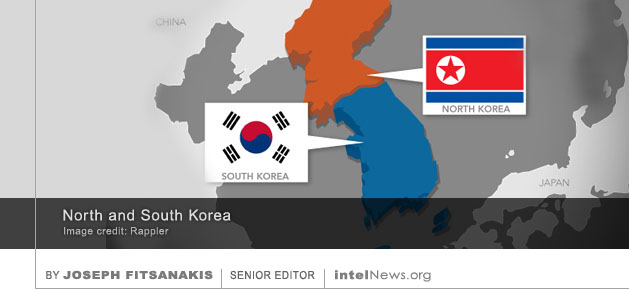
North South KoreaIN A HIGHLY UNUSUAL move, authorities in Seoul have publicly acknowledged a data leak that may have resulted in the outing of a number of South Korean undercover human intelligence (HUMINT) operatives abroad. The South Korean Ministry of National Defense said on Sunday it was investigating an alleged link of highly sensitive data belonging to the Korea Defense Intelligence Command (KDIC).
Formed under American tutelage in 1946, KDIC is today considered South Korea’s most secretive intelligence agency. It operates under the Defense Intelligence Agency (DIA), which makes it part of the Ministry of National Defense’s chain of command. Unlike DIA’s civilian counterpart, the National Intelligence Service, KDIC rarely surfaces in unclassified news reporting, and it almost never issues press releases. Its operations primarily involve HUMINT activities, thus making it South Korea’s most active HUMINT-focused agency.

Predictably, KDIC’s primary intelligence target is North Korea. The agency gathers much of its intelligence on the North through an extensive network of undercover officers operating with diplomatic credentials. KDIC also handles non-official cover (NOC) operatives, who are located mostly in Asia. There have been periodic claims in the unclassified literature that some KDIC NOCs have operated inside North Korea at times –though such claims remain speculative.

On Saturday, the Seoul-headquartered Yonhap News Agency alleged that classified information relating to KDIC had been “leaked”. According to Yonhap, the leak included personally identifiable information about KDIC official and non-official cover personnel stationed abroad. The report claimed that the leak was discovered by South Korean authorities a month ago, and that the discovery had resulted in the recall of several KDIC undercover operatives serving overseas “due to concerns over their identities being exposed”.

The Yonhap report claimed that, according to an ongoing probe, the leak may have originated from a personal laptop computer belonging to a civilian KDIC employee. The employee has since claimed that the laptop had been hacked, but some investigators believe the suspect may have “intentionally left the laptop vulnerable to hacking by North Koreans”.

According to an official statement released on Sunday by the Ministry of National Defense, the case is “currently under investigation by military authorities”.

Author: Joseph Fitsanakis | Date: 29 July 2024 | Permalink

UK charges three Bulgarians with spying for Russia in ‘major national security’ case

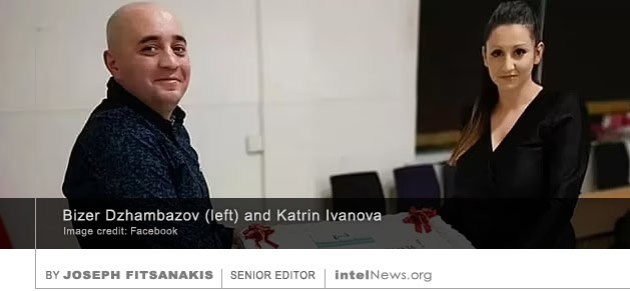
Bizer Dzhambazov and Katrin IvanovaAUTHORITIES IN BRITAIN HAVE charged three Bulgarian nationals with spying for Russia, as part of “a major national security investigation” that led to at least five arrests as early as last February. Two of the Bulgarians appear to be legally married. They have been identified as Bizer Dzhambazov, 41, and Katrin Ivanova, 31, who live in Harrow, a northwestern borrow of Greater London. The third Bulgarian, Orlin Roussev, 45, was arrested in Great Yarmouth, a seaside town in the east coast identity dof England. None of the suspect appears to have a formal diplomatic connection to either Bulgaria or Russia.
The Bulgarians were reportedly arrested in February of this year by the Counter-Terrorism Command of the Metropolitan Police, whose law enforcement mandate includes working on counterespionage cases. Two other individuals who were arrested at the time have not been charged or named. The three suspects have been charged under Section 4 of the United Kingdom’s Identity Documents Act 2010, which prohibits the possession of fake identity documents with “improper intention” and with the owner’s knowledge that they are fake. According to British government prosecutors, the suspects possessed forged passports and identity cards for Spain, France, the United Kingdom, Croatia, Italy, Greece, Bulgaria, the Czech Republic, and Slovenia.

Dzhambazov and Ivanova are believed to have moved to the United Kingdom as a couple in 2013. Both worked in the British healthcare sector —Ivanova as a laboratory assistant for a private company and Dzhambazov as a driver for a hospital. Roussev moved to the United Kingdom in 2009 and worked on the technical side of the financial services industry. He claims to have worked as an adviser for the Ministry of Energy of Bulgaria. He also claims to have previously owned a private company that operated in the area of signals intelligence (SIGINT), which involves the interception of electronic communications.

Bulgaria was one of the Soviet Union’s closest allies during the Cold War. Relations between Bulgaria and Russia plummeted in the 2000s, but pro-Russian sentiments continue to survive among some nationalist segments of the Bulgarian electorate. In June of this year, Kiril Petkov, the leader of Bulgaria’s We Continue the Change party, which today backs Bulgaria’s Prime Minister, Nikolai Denkov, spoke publicly about “Moscow-backed agents” operating inside Bulgaria’s intelligence services. Petkov proposed an ambitious plan to reform the Bulgarian intelligence services in order to “diminish the influence of Russia”. He proposed to do this through the administration of “integrity and ethical tests” to intelligence personnel.

Author: Joseph Fitsanakis | Date: 15 August 2023 | Permalink

Brazil launches investigation into illegal activities of Russian deep-cover spies

José Giammaria Mikhail MikushinAUTHORITIES IN BRAZIL HAVE launched a nationwide probe into the abuse of the country’s citizenship documentation system by Russian spies, who are allegedly using it to build forged identities. According to The Wall Street Journal, Brazil was placed “in an uncomfortable international profile” in the past year, after at least three alleged Russian deep-cover spies were outed by intelligence services in the Netherlands, Norway and Greece.
In June of 2022, authorities in the Netherlands expelled Sergey Cherkasov after he attempted to enter the country using a Brazilian-issued passport under the name of Victor Muller Ferreira. As intelNews explained at the time, Dutch and American counterintelligence outed Cherkasov as an intelligence officer of the Main Directorate of the Russian Armed Forces’ General Staff, which is commonly known as GRU. Cherkasov is alleged to have built his forged identity over several years, while operating in Brazil and the United States. Cherkasov is currently serving a 15-year prison sentence in Brazil for using forged identity documents. He is wanted in the United States for espionage. The alleged spy has reportedly admitted to the use of forged documents, but is denying he worked as a Russian intelligence officer.

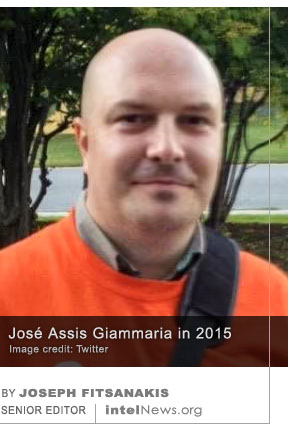
In October of last year, the Norwegian police arrested another Brazilian citizen, José Assis Giammaria (pictured), accusing him of operating under deep cover on behalf o the GRU. According to the Office of the Norwegian state prosecutor, the suspect’s actual name is Mikhail Mikushin. He is believed to have been operating as a deep-cover spy in Brazil, Canada and Norway since 2006. Mikushin is now facing charges of “aggravated intelligence-gathering activity targeting state secrets”, which carry a maximum prison term of 10 years.

In early 2023, Gerhard Daniel Campos Wittich, a resident of Rio de Janeiro, disappeared while traveling abroad. A few months later, he was connected to Irena Shmyrev, a Russian deep-cover spy who was living in Greece under an assumed Greek identity, until she disappeared without trace, reportedly leaving the country in a hurry. According to Greek counterintelligence investigations, Wittich was Irena A.S.’s Russian husband who, like her, worked as a deep-cover intelligence operative out of Brazil.

According to The Wall Street Journal, an official investigation is currently underway in Brazil into how many Russian deep-cover intelligence operatives may be using forged Brazilian citizenship documents to “lurk undetected within the country or around the world”. The paper says that Brazilian investigators have shared “few public details about their probe”. However, it cites “people familiar with the matter” in claiming that the probe centers on “security gaps within Brazil’s documentation system”, which appear to be exploited by undercover spies. Such security gaps allegedly include the ability to obtain a Brazilian identity card and a passport with the use of a single document, namely a birth record.

Author: Joseph Fitsanakis | Date: 03 July 2023 | Permalink

United States charges Russian spy who lived in Maryland using forged identity

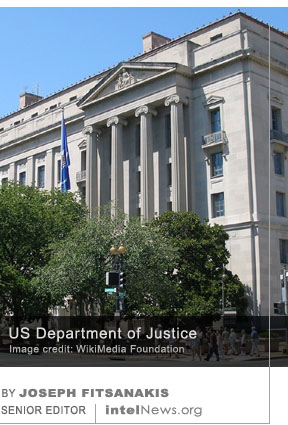
US Department of JusticeA RUSSIAN INTELLIGENCE OPERATIVE, who lived in Maryland using forged Brazilian identity documents, has been charged with espionage and other crimes by the United States Department of Justice. Victor Muller Ferreira, a Brazilian national, was stopped from entering the Netherlands in June of last year, where he had intended to join the International Criminal Court (ICC) as an intern.
Shortly after Muller was stopped at Amsterdam’s Schiphol International Airport, the Netherlands General Intelligence and Security Service (AIVD) revealed that he was in fact Sergey Vladimirovich Cherkasov, a 36-year-old Russian citizen. According to the AIVD, Cherkasov had worked for over a decade as an intelligence officer for the Main Directorate of the Russian Armed Forces’ General Staff, which is commonly known in the intelligence field as GRU.

A few days after Cherkasov returned to Brazil, a federal court in Guarulhos, a suburb of Sao Paolo, found him guilty of having used the identity of a dead Brazilian citizen to forge identity papers, which he then used to enter and leave Brazil 15 times over 10 years. The 10-year period had started in 2010, when Cherkasov had entered Brazil using his real Russian identity. But when he left the country a few months later, he did so using the forged identity that had allegedly been provided to him by Russian intelligence. Having examined the charges against Cherkasov, the court jailed him for 15 years.

Now the United States Department of Justice has charged Cherkasov with a list of new crimes, including acting as an unregistered agent of a foreign power and repeatedly carrying out visa, bank and wire fraud. The charges resulted from an investigation that was conducted by the Federal Bureau of Investigation’s counterintelligence division, in coordination with the Bureau’s Washington Field Office.

The charges stem from the years 2018-2020, when Cherkasov used his forged Brazilian identity to enroll as Master’s student at the Johns Hopkins University’s School of Advanced International Studies. Cherkasov successfully completed his graduate degree in 2020. Two years later, he left for the Netherlands, where he hoped to enter employment in the ICC.

Author: Joseph Fitsanakis | Date: 27 March 2023 | Permalink

Greek authorities uncover identity of Russian spy who posed as Greek citizen

Embassy of Russia in GreeceGREEK INTELLIGENCE OFFICIALS ANNOUNCED late last week that they had uncovered the identity of a female Russian spy who lived in central Athens using a set of forged identity documents. According to the Greek National Intelligence Service (NIS/EYP), the case is under investigation by several Western intelligence agencies. Additionally, there seems to be a connection with Brazil where the Russian spy’s husband lived until recently, using forged identity papers.

In an article published on Friday, the Greek daily Kathimerini, identified the woman as “Irena A.S.”. It said she had arrived in Greece from an unspecified Latin American country in 2018. Soon afterwards, she assumed a new cover identity, using the birth certificate of a Greek child named Maria Tsalla. The child is believed to have died in the northeastern Athens suburb of Marousi in December 1991, a few days after being born. According to the report, NIS/EYP officers discovered that the dead child’s archived death certificate in the Marousi town hall had been removed by persons unknown, giving officials the impression that Maria Tsalla was still alive.

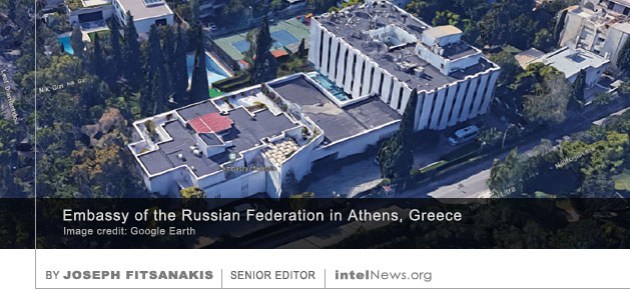
Soon after assuming her cover identity, Irena A.S. registered herself as a resident of Aliveri, a largely rural municipality in the central Greek island of Euboea. Less than a year later, using the name Maria Tsalla, she opened a knitwear store in the central Athens neighborhood of Pagrati, where she also rented an apartment. It is believed that she had hired an employee and had a Greek boyfriend, none of whom were aware that she was not Greek. According to the article in Kathimerini, the NIS/EYP has yet to uncover evidence that Irena A.S. was in contact with officials at the Russian embassy in Athens (pictured).

For reasons that remain unclear, Irena A.S. left Greece in a hurry in January of this year, leaving behind most of her personal belongings. She eventually contacted her store and apartment landlords, informing them that she would not be returning to Greece due to some health issues. In the weeks that followed, she ensured that all of her financial obligations toward her landlords and employee were met. It is believed that Irena A.S.’s husband, also a Russian national, who lived in Brazil using forged cover credentials, and going by the cover name “Daniel Campos”, also disappeared in January of this year. It is highly likely that they have both returned to Russia, possibly under fear of their cover being blown.

Author: Joseph Fitsanakis | Date: 20 March 2023 | Permalink

Australia to deport Kazakh-born Irish woman for allegedly spying for Russia

Irish National Space CentreTHE GOVERNMENT OF AUSTRALIA has ordered the deportation of a Kazakh-born Irish citizen, who is believed to be a spy for the Russian Federation, according to reports from Australia and Ireland. The woman in question has been identified as Marina Sologub, 39, an ethnic Russian who was born in Kazakhstan, but grew up in the Republic of Ireland.
Sologub reportedly spent her teenage years in Glanmire, a suburb of the city of Cork, located on Ireland’s southern coastline. She eventually enrolled at University College Cork, where she graduated with a degree in Politics and Governance. While still at university, Sologub worked for Bernard Allen, a member of parliament for Ireland’s center-right Fine Gael political party. She then worked full-time at the office of Willie Penrose, a parliamentarian for the left-of-center Labour Party, which is far smaller than Fine Gael.

In 2011, when she was in her late 20s, Sologub was hired by Ireland’s National Space Centre in Middleton, Cork, where she remained for 7 years. According to media reports, Sologub has claimed that she was instrumental in “the development of intergovernmental agreement between Republic of Ireland and Russia Federation in use of space for civil purposes” during her time at the National Space Centre.

In 2020, Sologub’s impressive résumé landed her a job with the British-headquartered international consultancy firm Deloitte in Australia. She moved to Australia in September of that year and worked for Deloitte for about a year, at which point she was hired by a private firm specializing in the space industry. She subsequently entered employment with the city council of Marion, a small suburb of Adelaide, the capital of South Australia.

On February 22, the Australian Security Intelligence Organisation (ASIO), which is tasked with counterintelligence, announced that Sologub’s visa was under investigation on suspicion of her role in international espionage. It was reported that Sologub had had “extensive interactions with diplomatic staff from the Russian embassy” in Australia, which began soon after she entered the country in 2020. Now Australia has announced Sologub’s deportation from the country. According to media reports, Sologub’s deportation is part of a wider operation that aims “to identify Russian intelligence workers among high-ranking employees” in Australian government and industry.

Author: Joseph Fitsanakis | Date: 27 February 2023 | Permalink

Mystery surrounds arrest of alleged Russian spy couple in Sweden

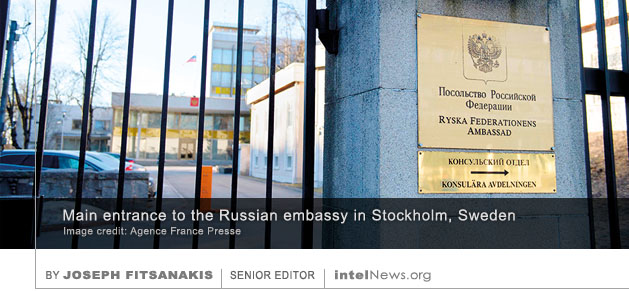
Russian Embassy SwedenNUMEROUS UNANSWERED QUESTIONS SURROUND the arrest of a Russian married couple in Sweden, on charges of espionage. The arrest took place in dramatic fashion in the early hours of Tuesday, November 22. According to the Swedish media, members of the security forces descended via tactical ropes from two Blackhawk helicopters, as startled residents in the typically quiet Stockholm suburb of Nacka looked on.

The raid was apparently conducted based on information received by Sweden’s counterintelligence agency, the Swedish Security Service (SAPO), coupled with tips from the United States Federal Bureau of Investigation (FBI). The targets of the operation were Sergei Nikolaevich Skvortsov and Elena Mikhailovna Kulkova, a Russian-born married couple, who moved to Sweden from Russia in 1999. According to their identity documents, Skvortsov was born in Perm on July 28, 1963, and Kulkova in Moscow on May 22, 1964.

Both Skvortsov and Kulkova are university-educated, with a background in science, mathematics and cybernetics. Upon settling in Sweden, they worked in the import-export technology sector. By 2013 they had become Swedish citizens and had a son. Kulkova also had a daughter from a previous marriage. The Russian investigative source The Insider reports that Kulkova’s daughter’s boyfriend worked for Swedish military intelligence.

Swedish authorities allege that the two suspects migrated to Stockholm on orders of the Main Directorate of the Russian Armed Forces General Staff, known as GRU. The GRU allegedly did not activate them until after they had acquired Swedish citizenship. According to the court indictment, Skvortsov and Kulkova began to actively spy against the United States in 2013 and against Sweden in 2014.

Some sources claim that the case of the Russian couple may be connected to the recent arrests of Payam and Peyman Kia, two Iranian-born Swedish brothers, who were arrested in 2021 and are now facing charges of engaging in espionage on behalf of the GRU. Payam Kia worked for SAPO and had access to classified information from a host of Swedish government agencies. SAPO reportedly launched the probe in 2017, following suspicions that it harbored a spy in its personnel ranks.

Author: Joseph Fitsanakis | Date: 05 December 2022 | Research credit: A.G. | Permalink

Norway arrests alleged Russian illegal who spent years building cover in Canada

José Giammaria Mikhail MikushinAN ALLEGED RUSSIAN DEEP-cover intelligence operative, who was arrested by Norwegian police last week, spent years building his fake cover in Canada, while studying there as a Brazilian citizen, according to reports. Norway’s Police Security Service (PST) announced last week that it had arrested José Assis Giammaria, a 37-year-old Brazilian citizen, on suspicion of entering Norway on false pretenses. According to the PST, Giammaria is in fact a Russian citizen, who has been operating in Norway as a non-official-cover (NOC) intelligence officer.
According to Norwegian authorities, Giammaria worked as a researcher at the Arctic University of Norway. Known as UiT, the university is located in the northern Norwegian city of Tromsø. It has a worldwide reputation for research, and approximately 10 percent of its 17,000 students are international. While there, Giammaria was a volunteer researcher for a UiT GreyZone, a scholarly project that studies contemporary hybrid threats and grey zone warfare. His area of specialization appears to have been Arctic security.

Last Friday, the office of the Norwegian state prosecutor said it believed the suspect’s actual name is Mikhail Mikushin, a Russian citizen born in 1978. In a press statement, a Norwegian government representative said authorities were “not positively sure of his identity”, but it was clear that he was not a Brazilian national. Later on Friday, the Oslo-based Norwegian newspaper Verdens Gang (VG), in association with the investigative website Bellingcat, reported that Mikushin is a military intelligence officer, who holds the rank of colonel in the Main Directorate of the Russian Armed Forces’ General Staff, known as GRU. The newspaper claims that Mikushin left Russia in 2006 with a cover, a term that refers to a fake operational identity used for purposes of espionage. Read more of this post

Hawaii couple alleged to be Russian spies using fake names held without bail

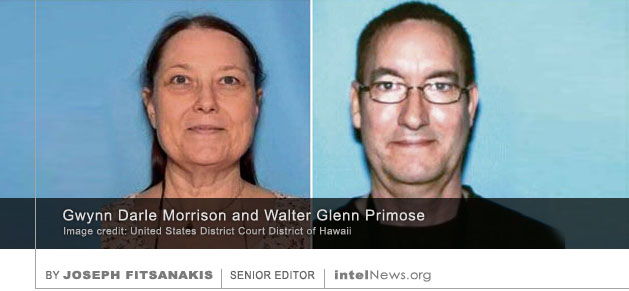
Walter Glenn Primose, Gwynn Darle MorrisonA FEDERAL JUDGE IN HAWAII has denied bail to a married American couple, who are believed to have assumed the identities of dead children in order to lead double lives for over 20 years, according to prosecutors. Local media reports allege that Bobby Edward Fort and Julie Lyn Montague, who were arrested by the Federal Bureau of Investigation on July 22 on the island of Oahu, are Russian spies, and that their names are parts of their assumed identities.

According to the reports, the real names of the couple are Walter Glenn Primose, 66, and Gwynn Darle Morrison, 54. Government prosecutors allege that, in the late 1980s, the couple hurriedly left their home in the state of Texas, telling family members that they were entering the US Federal Witness Protection Program. They are also said to have given some family members permission to take whatever they wanted from their home, before it was foreclosed.

The government claims that the couple then assumed the identities of two infants, Bobby Edward Fort and Julie Lyn Montague, who had died in Texas in 1967 and 1968 respectively. They then used these infants’ birth certificates to obtain social security cards, drivers’ licenses, and even US passports. In 1994, while living in Hawaii under his assumed name, Primrose enlisted in the US Coast Guard, which is the maritime security and law enforcement service branch of the US military. He served there for over 20 years as an avionic electrical technician with a secret level clearance. Following his retirement in 2016, Primrose is said to have worked as a private contractor for the US Department of Defense until his arrest on July 22 of this year. Read more of this post

Alleged Russian spy who used fake Brazilian identity jailed for 15 years

GRUAN ALLEGED RUSSIAN SPY, who used a forged Brazilian identity to travel internationally, has been jailed in Brazil after he was denied entry in Holland, where he had traveled to work as an intern. IntelNews has discussed at length the case of Victor Muller Ferreira, who was outed as a Russian spy by the Netherlands General Intelligence and Security Service (AIVD) in June. According to Dutch officials, Muller’s real name is Sergey Vladimirovich Cherkasov, and he is a Russian intelligence officer.
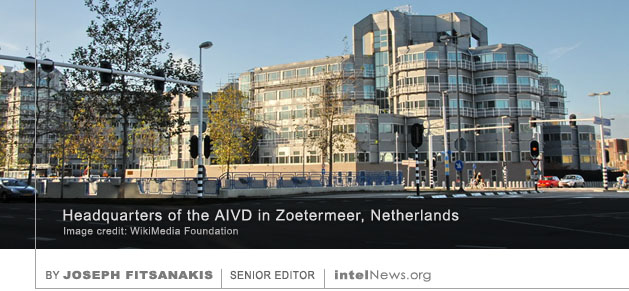
According to Muller’s biographical note, he was born to an Irish father and a Spanish-speaking mother in Niteroi (near Rio de Janeiro) on April 4, 1989. However, according to the AIVD, Cherkasov was actually born on September 11, 1985, and has been working for at least a decade for the Main Directorate of the Russian Armed Forces’ General Staff, which is commonly known as GRU. Cherkasov was apprehended by the Dutch authorities as he tried to enter Holland via air. He was en route to The Hague, where he was about to join the International Criminal Court (ICC) as a paid intern. He planned to eventually transition into full-time employment in the ICC, where he “would be highly valuable to the Russian intelligence services”, according to the AIVD.

The AIVD reportedly notified the Dutch Immigration and Naturalization Service, which detained Cherkasov upon his arrival at Amsterdam’s Airport Schiphol. The Dutch government promptly declared the alleged GRU officer persona non grata and expelled him back to Brazil “on the first flight out”. Last month, a Brazilian federal court in Guarulhos, a suburb of Sao Paolo, found Cherkasov guilty of identity theft that had lasted for at least a decade. The court found that, during that time, Cherkasov used the identity of a dead Brazilian citizen named Victor Muller Ferreira to enter and leave Brazil 15 times. The 10-year period started in 2010, when Cherkasov entered Brazil using his real Russian identity. But when he left the country a few months later, he did so using the forged identity that had allegedly been provided to him by Russian intelligence. Now, according to the British newspaper The Times, Cherkasov has been jailed for 15 years.

Meanwhile, in a separate development, Richard Moore, director of Britain’s Secret Intelligence Service (MI6), claimed last week that half of all Russian spies operating in Europe under diplomatic cover have been expelled since March of this year. Moore was speaking at the annual Aspen Security Forum in the United States. Such expulsions do not relate to alleged intelligence officers like Cherkasov, who do not operate under diplomatic cover. They are therefore far more difficult to detect than their colleagues, who are officially attached to Russian diplomatic missions around the world.

Author: Joseph Fitsanakis | Date: 25 July 2022 | Permalink

Analysis: HUMINT insights from the Muller/Cherkasov case

AIVD HollandAT A TIME WHEN dozens of countries are routinely expelling record numbers of Russian intelligence officers, news of the unmasking of yet another Russian spy is barely newsworthy. However, the case of Sergey Cherkasov/Victor Muller is different. That is because, unlike the vast majority of Russian spies with blown covers, he did not operate under diplomatic protection. This is not necessarily uncommon —in fact, there are probably dozens of Russian case officers operating internationally without diplomatic cover. What is unusual is that one of them has been publicly unmasked. What is more, the case offers some interesting pointers for those interested in contemporary human intelligence (HUMINT).
The Facts

According to the Netherlands General Intelligence and Security Service (AIVD), which publicized the case last week, a man using a Brazilian passport attempted to enter Holland in April of this year. His passport had been issued under the name Victor Muller Ferreira, allegedly born to an Irish father and a Spanish-speaking mother in Niteroi (near Rio de Janeiro) on April 4, 1989. However, according to the AIVD, the man’s real name is Sergey Vladimirovich Cherkasov, a citizen of Russia, who was born on September 11, 1985. Based on the information released by Dutch intelligence, Cherkasov is an intelligence officer of the Main Directorate of the Russian Armed Forces’ General Staff, which is commonly known as the GRU.

The AIVD claims that the reason for Cherkasov’s visit to the Netherlands was to join the International Criminal Court (ICC) in The Hague, as a paid intern. He eventually planned to transition into full-time employment in the ICC, where he “would be highly valuable to the Russian intelligence services”. The AIVD reportedly notified the Dutch Immigration and Naturalization Service, which detained Cherkasov upon his arrival at Amsterdam’s Schiphol International Airport. The Dutch government declared the alleged GRU officer persona non grata and promptly expelled him back to Brazil “on the first flight out”.


Cherkasov’s Cover and Legend

Cherkasov arrived in Holland with a cover, a term that refers to a fake operational identity used for purposes of espionage. It is unlikely that his cover was natural, meaning that he is probably not Brazilian by birth —though it is possible that at least one of his parents was/is not Russian by birth. What is more likely is that Cherkasov’s cover is contractual, meaning that it was crafted especially for him by the GRU after he was hired as an intelligence officer. This likely happened as many as 10 years ago, when Cherkasov was in his early 20s. Read more of this post