US busts Russian spy ring, charges three with espionage
January 27, 2015 1 Comment
 By JOSEPH FITSANAKIS | intelNews.org
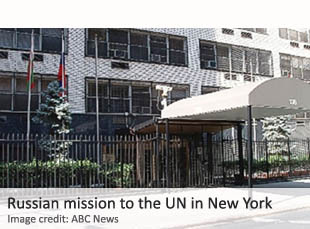
Authorities in the United States have charged three Russian citizens, two of them diplomats, with operating a New York-based spy ring on orders from Moscow. Early on Monday, the Federal Bureau of Investigation named the diplomats as Igor Sporyshev, 40, and Victor Podobnyy, 27. It said the two were employees of the trade office of the Russian permanent mission to the United Nations in New York. But the FBI had apparently been monitoring the two accredited diplomats since March of 2012. Its agents eventually uncovered that Sporyshev and Podobnyy were in fact employees of the SVR, Russia’s Foreign Intelligence Service, one of the direct institutional descendants of the Soviet-era KGB. According to their indictment, the two were employed by the SVR’s ‘ER’ Directorate, which focuses on economics and finance. The two SVR employees, operating under diplomatic guises, regularly met with a third member of the alleged spy ring, Evgeny Buryakov, 39, also an SVR officer. However, unlike Sporyshev and Podobnyy, Buryakov was operating under non-official cover, posing as an employee in the Manhattan office of a major Russian bank. Non-official-cover operatives, or NOCs, as they are known in the US Intelligence Community, are typically high-level principal agents or officers of an intelligence agency, who operate without official connection to the diplomatic authorities of the country that is employing them. They typically pose as business executives, students, academics, journalists, or non-profit agency workers, among other covers. Unlike official-cover officers, who are protected by diplomatic immunity, NOCs have no such protection. If arrested by authorities of their host country, they can be tried and convicted for conducting espionage. US government prosecutors suggested on Monday that the three alleged SVR operatives were also in regular contact with individuals “associated with a leading Russian state-owned news organization”, presumably in the US. They also tried to recruit American citizens to spy for Moscow, including employees of “major companies” and “several young women with ties to a major university in New York”, according to the indictment. It is believed that the three Russians were primarily interested in information relating to potential US government sanctions against Russian financial institutions, as well as Washington’s efforts to promote the development of alternative resources of energy. The FBI said Sporyshev and Podobnyy, who are protected by diplomatic immunity, “no longer reside in the US”. Presumably they were expelled. Buryakov, however, appeared in a Manhattan court on Monday.
 By J. FITSANAKIS and I. ALLEN | intelNews.org












Army colonel who joined ISIS was trained in the United States
June 1, 2015 3 Comments
The government of Tajikistan launched an extensive search campaign in April of this year, following the mysterious disappearance of Colonel Khalimov. But the police commander reappeared on Wednesday in a video published online by the militant group Islamic State, which also known as the Islamic State of Iraq and al-Sham (ISIS). In the video, Khalimov is seen wearing a black ISIS combat uniform and brandishing a sniper rifle. Speaking in Russian, he warns Russian and American citizens that ISIS will “find your towns, we will come to your homes and we will kill you, God willing”. He also states in the video that he participated in a number of counterterrorist training programs on American soil between 2003 and 2007. At least one of these programs, which were presumably funded by Washington, took place in the US state of Louisiana. Khalimov adds —without providing details— that it was the things he experienced during these training programs that led him to join ISIS.
On Saturday, a spokeswoman for the US Department of State told CNN that Khalimov was indeed among an elite group of Tajik counterterrorism operatives who took part in five training courses funded by the US government. The funding was reportedly provided under the Department of State’s Diplomatic Security and Anti-Terrorism Assistance program, which is designed to “train candidates in the latest counterterrorism tactics”. Ironically, these tactics are meant to be employed against groups like ISIS, which Khalimov appears to have joined. A report on CNN notes that counterterrorism experts are now concerned that Khalimov’s defection to ISIS will give the group invaluable insider’s knowledge of counterterrorism techniques, as taught by US instructors.
► Author: Joseph Fitsanakis | Date: 01 June 2015 | Permalink: https://intelnews.org/2015/06/01/01-1706/
Filed under Expert news and commentary on intelligence, espionage, spies and spying Tagged with Gulmurod Khalimov, Islamic State of Iraq and al-Sham, Islamic State of Iraq and Greater Syria, News, OMON (Tajikistan), Special Purpose Mobile Units (Tajikistan), Tajikistan, US Department of State Diplomatic Security and Anti-Terrorism Assistance program