Espionage scandal prompts resignations of top Swiss banking executives
October 2, 2019 Leave a comment
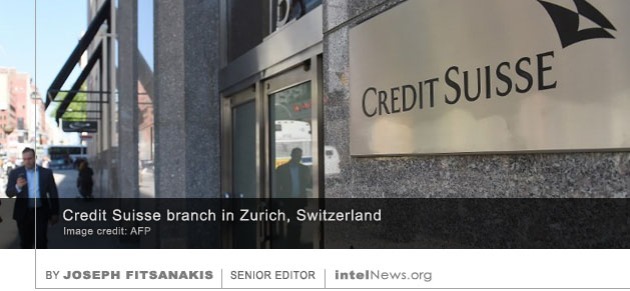 Two senior executives of Credit Suisse, one of the world’s most powerful banking firms, have resigned amidst a high-stakes espionage scandal that may have prompted a suicide and has shocked Switzerland. The alleged target of the espionage is Iqbal Khan, the former Chief Executive Officer (CEO) of Credit Suisse’s wealth-management division. The 43-year-old Khan moved to Switzerland from his native Pakistan at the age of 12. In 2013, after working for more than a decade as an auditor at Ernst & Young, he joined Credit Suisse. He quickly rose to head the institution’s wealth-management division and was credited with having nearly doubled its profits between 2016 and 2018.
Khan’s meteoric success brought him immense financial wealth. He soon bought a piece of property that is adjacent to the home of Tidjane Thiam, the 57-year-old CEO of Credit Suisse. Khan and his wife had the house on their property demolished and began a two-year project to build a new house. But the disruption caused by the large-scale construction project gave rise to a dispute between Thiam and Khan. Their rivalry escalated quickly and prompted the intervention of Credit Suisse board chairman Urs Rohner. However, the dispute between the two men was not resolved, and on July 1 of this year Khan left Credit Suisse. On August 29, Credit Suisse’s rival UBS announced that Khan would co-lead its global wealth management division.
It appears that some Credit Suisse executives were concerned that Khan might try to attract their firm’s customers to his new UBS portfolio. These concerns allegedly prompted Credit Suisse’s Chief Operating Officer (COO), Pierre-Olivier Bouee, to instruct the bank’s security department to keep tabs on Khan. The bank reportedly hired a private investigation firm, Investigo, to monitor Khan’s movements. There was an unexpected turn on September 17, when Khan noticed that he was being followed and promptly confronted an Investigo employee in downtown Zurich. On the same day, the former Credit Suisse star manager filed a complaint with the Zurich office of the Swiss Public Prosecutor.
On September 18, Credit Suisse gave orders to Investigo to stop keeping tabs on Khan. It also launched an internal investigation to evaluate the merits of the decision to spy on Khan. Meanwhile, the Swiss Public Prosecutor’s office announced that it had opened a criminal case on Investigo and had arrested three individuals in connection with the case. On September 24, a private investigator, who is believed to have been involved in Khan’s case, committed suicide. Media reports said the unidentified man was “an external security expert” who mediated between Credit Suisse and Investigo.
On Tuesday, Credit Suisse COO Bouee announced his resignation. Swiss media said the head of the bank’s global security division also resigned. Also on Tuesday, Credit Suisse’s internal investigation found that CEO Thiam had not been involved in the decision to spy on Khan.
► Author: Joseph Fitsanakis | Date: 02 October 2019 | Permalink
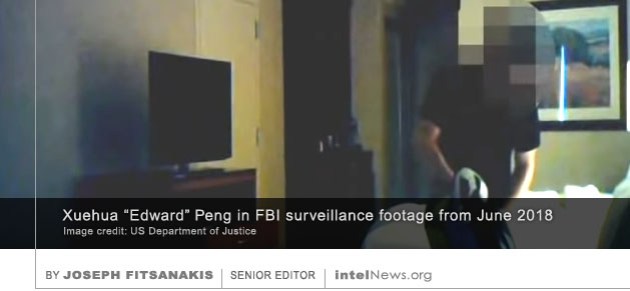 The United States has pressed espionage charges against a naturalized American citizen who operated as a courier for Chinese intelligence while working as a tour operator in California. On Monday federal prosecutors in San Francisco filed espionage charges against Xuehua “Edward” Peng, a 56-year-old Chinese-born American citizen. Peng, a trained mechanical engineer, reportedly entered the United States in June 2001 on a temporary visa. In 2012 he became a naturalized American citizen. By that time he was working for US Tour and Travel, an independent tour operator in California.
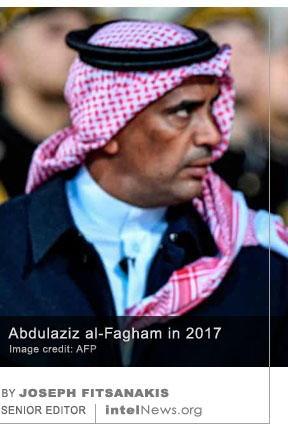 The head of the security detail of Saudi Arabia’s king Salman bin Abdulaziz al-Saud has been shot dead in mysterious circumstances. Abdulaziz al-Fagham was a Major General in Saudi Arabia’s Royal Guard Corps, whose mission is to protect the senior members of the oil kingdom’s royal family. Al-Fagham served two kings, king Salman and his predecessor, king Abdullah bin Abdulaziz Al Saud, and was constantly seen alongside the in official functions. Since much current-affairs coverage in Saudi Arabia’s state-owned media revolves around the activities of the royal family, al-Fagham’s figure was familiar to most Saudis. They were
 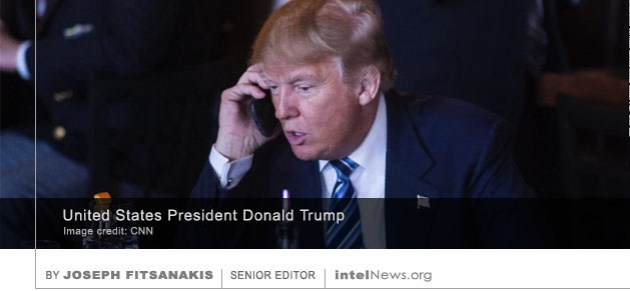 The individual who filed a report claiming that United States President Donald Trump sought help from a foreign country to win the 2020 election is believed to be a male employee of the Central Intelligence Agency. The man, who is legally classified as a whistleblower, filed the report on August 12. It was released for publication on Thursday and is now
 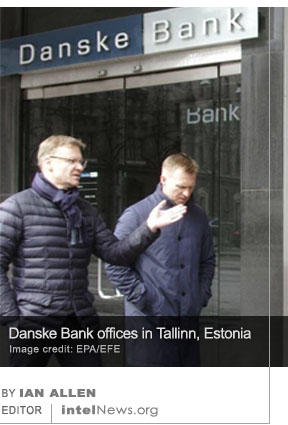 The former chief executive of Danske Bank’s subsidiary in Estonia, which is implicated in a massive money laundering scheme, has been found dead in an apparent suicide in Tallinn. Aivar Rehe, 56, headed the Estonian subsidiary of the Copenhagen-based Danske Bank, one of Northern Europe’s largest retail banks, which was founded in 1871. He belonged to a group of dynamic young entrepreneurs who spearheaded the privatization of the Estonian economy in the post-Soviet era.
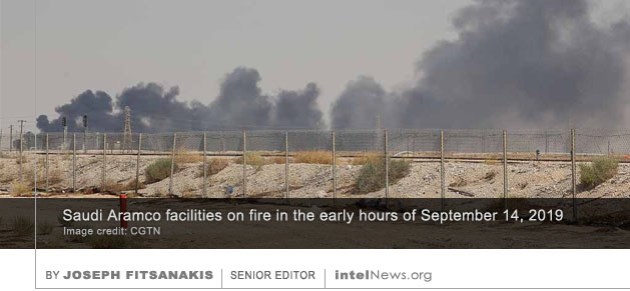 Ever since a barrage of drone and missile attacks struck Saudi Arabia on September 14, many have wondered whether the oil kingdom will go to war with Iran. Riyadh has directly accused the Islamic Republic of being behind the attacks. But the speculation about a possible war is baffling, argues Nesrine Malik in a well-argued
 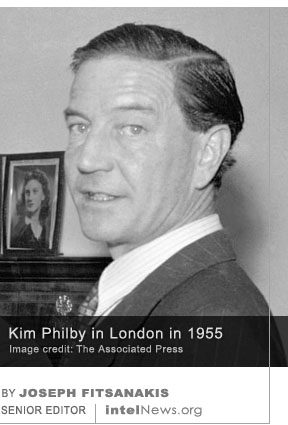 Extensive extracts from the confession of Kim Philby, one of the Cold War’s most prolific double spies, are scheduled to be released today for the first time by Britain’s
 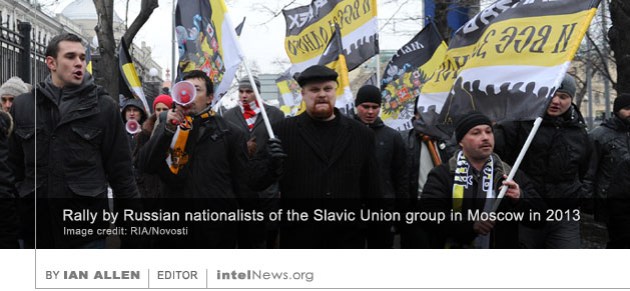 Threats posed by white supremacist and other far-right groups are now global in nature and are increasingly backed by state actors, according to a Congressional testimony by an American former counterterrorism official. The testimony was delivered by Joshua Geltzer, former senior director for counterterrorism at the United States National Security Council. Geltzer, who now directs the Institute for Constitutional Advocacy and Protection at Georgetown University in Washington, DC, testified on Friday before two subcommittees of the US House of Representatives. The Subcommittee on National Security and the Subcommittee on Civil Rights and Civil Liberties held a joint hearing entitled “Confronting Violent White Supremacy”.
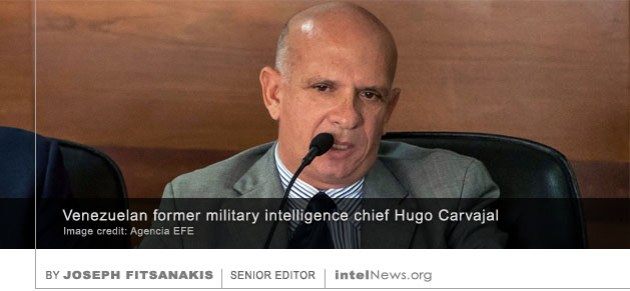 Spain has refused to extradite Venezuela’s former spy chief to the United States, where he is wanted for drug-running. The decision is also an intelligence setback for Washington, as the former spy, Hugo Carvajal, is reputed to possess a “treasure trove” of inside information on the Venezuelan government. Carvajal is a retired general, a former diplomat, and a member of the late Venezuelan President Hugo Chávez’s inner circle. From 2004 to 2011, under Chávez’s tutelage, Carvajal headed the Directorate General of Military Counterintelligence (DGCIM). In 2008 the US named Carvajal as a major facilitator of international drugs trafficking and imposed financial sanctions on his assets around the world. Washington accused Carvajal of assisting the paramilitary group known as the Revolutionary Armed Forces of Colombia (FARC) transport drugs from Latin America to Mexico and from there to the US.
 Russian authorities announced on Tuesday that a gas explosion had damaged a section of a medical facility in Siberia that houses live samples of viruses such as Ebola and smallpox, but added that there was no need to declare a biomedical emergency. The explosion reportedly took place on Monday at the State Research Center of Virology and Biotechnology, known as Vector. The six-floor concrete and steel facility is located in the isolated Siberian town of Kotsovo, near the city of Novosibirsk, 600 miles from the Mongolian border.
 United States officials are considering increasing substantially America’s intelligence-sharing with Saudi Arabia following last weekend’s drone attacks that halved the Kingdom’s oil production and shook global markets. The attacks occurred in the early hours of Saturday, September 14, at two refineries located in eastern Saudi Arabia. The refineries are owned by Aramco, Saudi Arabia’s government-owned oil conglomerate, and are part of the world’s largest crude oil processing facility. The massive fires caused by the attacks were contained within hours and no casualties were reported. But the facilities had to cease operation so that repairs could be completed. This cut Saudi Arabia’s oil production by close to 50 percent, which amounted to a 5 percent reduction in global oil production. The impact on the world’s financial markets was immediate: by Monday morning, oil prices had seen their most significant one-day surge since the 1991 Gulf War.
 The Russian government reportedly fired a number of officials over the defection of a senior Kremlin aide, who alleged worked as an American spy. Meanwhile, Moscow has filed a search request with INTERPOL about the alleged defector’s whereabouts. News of the defection was
 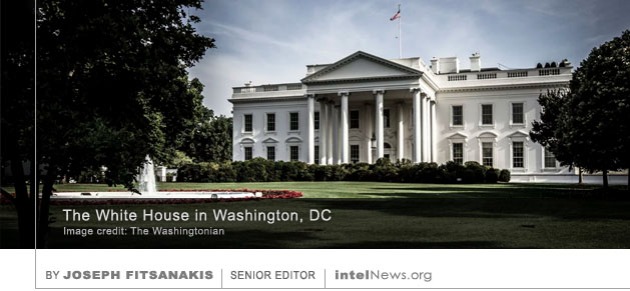 The intelligence services of Israel planted surveillance devices around the White House in an attempt to spy on United States President Donald Trump and his senior advisors, according to a report published on Thursday. The
 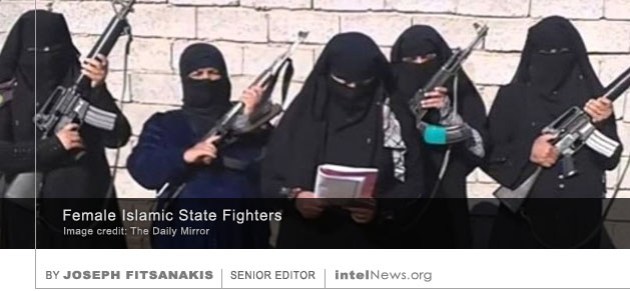 Tens of thousands of supporters of the Islamic State, many of them women and children, are re-radicalizing inside vast Kurdish-run prison camps with inadequate security and almost no infrastructure or provisions. In a







Colombian spy chief resigns over fake dossier that linked militants to Venezuela
October 3, 2019 by intelNews Leave a comment
In recent months, the rise of Venezuela’s Western-supported opposition leader Juan Guaidó has further-fueled tensions between Colombia and Venezuela. Bogotá has come out in support of Guaidó, while many anti-government Venezuelans, some of them armed, have sought refuge in Colombia. Colombia rejects Venezuela’s claims that it is giving shelter to terrorists and argues instead that it is providing humanitarian aid to Venezuelan refugees. In turn, it accuses Caracas of sheltering ELN and FARC guerrillas, a claim that the Venezuelan government strongly denies.
Last week, during the United Nations General Assembly in New York, Colombian President Iván Duque unveiled a dossier of evidence that purportedly proved beyond doubt Venezuela’s collusion with Colombian paramilitaries. Duque told the United Nations gathering that the collusion was supervised by no other than the President of Venezuela, Nicolás Maduro. But within hours of Duque’s speech, reporters who scrutinized the dossier found that much of the photographic evidence in it had been downloaded from the Internet. Moreover, the photographs were not taken in Venezuela, as Duque claimed in his speech, but in Colombia.
The revelations have dominated the news headlines in Colombia and Venezuela in the past week, with the Colombian government engaging in damage control. On Monday, General Oswaldo Peña, Colombia’s military intelligence chief, resigned over the fake dossier. General Peña directed the Comando Conjunto de Inteligencia (Joint Intelligene Command) of the Colombian Armed Forces, which was seen as the primary spy agency behind the information contained in the dossier. In his resignation letter, General Peña wrote that “as a general of the [Colombian] Republic” he was fully aware that he needed to take responsibility for his activities and the activities of his subordinates. President Duque has not commented on the general’s resignation.
► Author: Joseph Fitsanakis | Date: 03 October 2019 | Permalink
Filed under Expert news and commentary on intelligence, espionage, spies and spying Tagged with Colombia, Comando Conjunto de Inteligencia (Colombia), Ivan Duque, Joint Intelligene Command (Colombia), military intelligence, News, Oswaldo Peña, resignations, Venezuela