New book names ex-KGB defector who outed FBI agent Robert Hanssen as Russian spy

Robert HanssenA new book reveals for the first time the name of a former intelligence officer of the Soviet KGB who helped American authorities arrest Robert Hanssen, an American spy for the Soviet Union and Russia. The son of a Chicago police officer, Hanssen joined the Federal Bureau of Investigation in 1976 and was eventually transferred to the Bureau’s Soviet analytical unit, where he held senior counterintelligence posts. It wasn’t until 2000, however, that the FBI realized Hanssen had spied for Moscow since 1979. Following Hanssen’s arrest in 2001, it emerged that he had betrayed the names of 50 FBI and CIA assets or informants, many of whom perished in the hands of the Russian intelligence services.

In 2002, the US Department of Justice opined that Hanssen had caused “possibly the worst intelligence disaster in US history”. He is currently serving 15 consecutive life terms without the possibility of parole. But despite numerous articles, reports and books on the Hanssen spy case, the story of the FBI investigation that led to his arrest remains at best fragmentary. A major question concerns the identity of the mysterious person that helped FBI counterintelligence investigators zero in on Hanssen after years of fruitless efforts to confirm suspicions of the existence of a Russian mole. It is known that the FBI paid the sum of $7 million to a former KGB officer, who delivered the contents of Hanssen’s Russian intelligence file. But the identity of that informant has not been revealed.

That may have changed as of last month, however, thanks to The Seven Million Dollar Spy, a book written by the late David Wise, a journalist and best-selling intelligence author who died on October 8, aged 88. Wise’s book, published posthumously on October 23 in audio book format, received little media attention. But Newsweek intelligence correspondent Jeff Stein said last week that the book might bring us a step closer to uncovering the identity of the individual who led to Hanssen’s capture. Stein explains that the mysterious informant had previously developed a business relationship with Jack Platt, a retired CIA case officer who after the end of the Cold War co-founded an international security consultancy with ex-KGB operative Gennady Vasilenko. The two men staffed their company with several American and Russian former spies. Among them was Anatoly Stepanov, a former case officer in the KGB. Stein reports that, according to Wise’s posthumous book, Stepanov is in fact the pseudonym of former KGB officer Aleksandr Shcherbakov. It was he who delivered Hanssen’s file to the FBI, thus facilitating his eventual capture. It is believed that Shcherbakov defected to the United States in 2010 where he continues to live today under an assumed identity.

Author: Joseph Fitsanakis | Date: 06 November 2018 | Permalink

CIA suffered ‘catastrophic’ compromise of its spy communication system

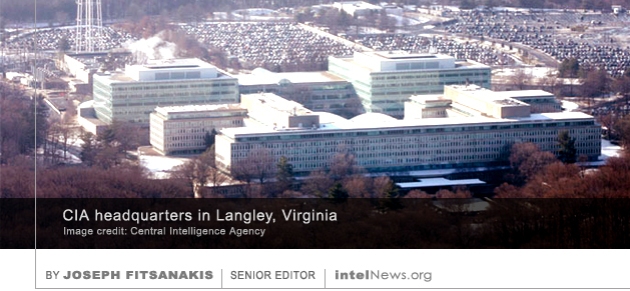
CIAThe United States Central Intelligence Agency suffered a “catastrophic” compromise of the system it uses to communicate with spies, which caused the death of “dozens of people around the world” according to sources. This is alleged in a major report published on Friday by Yahoo News, which cites “conversations with eleven former US intelligence and government officials directly familiar with the matter”. The report by the online news service describes the compromise of an Internet-based covert platform used by the CIA to facilitate the clandestine communication between CIA officers and their sources —known as agents or spies— around the world.

According to Yahoo News, the online communication system had been developed in the years after 9/11 by the US Intelligence Community for use in warzones in the Middle East and Central Asia. It was eventually adopted for extensive use by the CIA, which saw it as a practical method for exchanging sensitive information between CIA case officers and their assets in so-called ‘denied areas’. The term refers to regions of the world where face-to-face communication between CIA case officers and their assets is difficult and dangerous due to the presence of ultra-hostile intelligence services or non-state adversaries like the Taliban or al-Qaeda. However, it appears that the system was flawed: it was too elementary to withstand sustained scrutiny by Internet-savvy counterintelligence experts working for state actors like Iran, China or Russia.

In September of 2009, Washington made a series of impressively detailed revelations about the advanced status of Iran’s nuclear program. These angered Tehran, which redoubled its efforts to stop the US and others from acquiring intelligence information about the status of its nuclear program. Some sources told Yahoo News that one of the CIA assets inside Iran’s nuclear program was convinced by the Iranians to become a double spy. He proceeded to give Tehran crucial information about the CIA’s online communication system. Based on these initial clues, the Iranians allegedly used Google-based techniques “that one official described as rudimentary” to identify an entire network of CIA-maintained websites that were used to communicate with assets in Iran and elsewhere. The Iranians then kept tabs on these websites and located their users in order to gradually unravel an entire network of CIA agents inside their country. Around that time, Iranian media announced that the Islamic Republic’s counterintelligence agencies had broken up an extensive CIA spy ring consisting of more than 30 informants.

The Yahoo News report says that the CIA was able to successfully exfiltrate some of its assets from Iran before the authorities were able to apprehend them. The agency also had to recall a number of undercover officers, after they were identified by the Iranians. The effects of the compromise, however, persisted on a global scale, according to former US intelligence officials. In 2011 and 2012, another network of CIA spies was busted in China, leading to the arrest and execution of as many as three dozen assets working for the US. Many, says Yahoo News, believe that the Iranians coached the Chinese on how to use the CIA’s online communication system to identify clandestine methods and sources used by the agency.

Along with other specialist websites, IntelNews monitored these developments as they took place separately in Iran and China. However, the Yahoo News report is the first to piece together these seemingly disparate developments and suggest that they were likely triggered by the same root cause. What is more, the report suggests that the CIA had been warned about the potential shortcomings of its online communication system before 2009, when the first penetrations began to occur. In response to the compromise, the CIA has reportedly modified, and at times completely abandoned, its online communication system. However, the implications of the system’s compromise continue to “unwind worldwide” and the CIA is “still dealing with the fallout”, according to sources. The effects on the agency’s operational work are likely to persist for years, said Yahoo News.

Author: Joseph Fitsanakis | Date: 05 November 2018 | Permalink
South Africa to probe mysterious death of former Rwandan spy chief

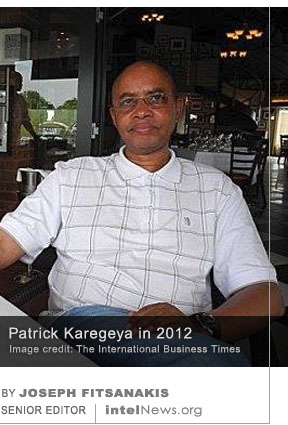
Patrick KaregeyaSouth Africa is preparing to launch an official inquest into the mysterious death of the former director of Rwanda’s external intelligence agency, who was found dead in a luxury South African hotel four years ago. The body of Patrick Karegeya, 53, was discovered on December 31, 2014, in a room at the Michelangelo Towers Hotel in Sandton, an affluent suburb of Johannesburg. Karegeya was a leading member of the Rwandan Patriotic Army (RPA), the armed wing of the Rwandan Patriotic Front (RPF), which was founded in 1987 in Uganda by Rwandan Tutsi refugees. In 1994, the RPA, led by Paul Kagame, took control of Rwanda, thus putting an end to the genocide of up to a million Tutsis and moderate Hutus. Soon afterwards Karegeya was named Director General of External Intelligence in the RPA, which was renamed to Rwandan Defense Forces.
In 2004 however, after falling out with Kagame, who had become President of Rwanda in 2000, Karegeya was arrested, stripped of his rank of colonel, and served 18 months in prison for “insubordination and desertion”. He fled the country in 2007 and received political asylum in South Africa. The Rwandan government later claimed that Karegeya had been a double spy for South Africa. In 2010, Karegeya teamed up with General Faustin Kayumba Nyamwasa, who used to head the Rwandan Army, and had also escaped to South Africa after falling out with President Kagame. The two formed a new Rwandan opposition party in exile, called the Rwanda National Congress. The response from the government in Kigali was to try Karegeya and Nyamwasa in absentia in a military court. They were both sentenced to lengthy prison terms for “promoting ethnic divisions” in the country. In 2011, the Rwandan government issued international arrest warrants for the two former military men, but South Africa refused to extradite them.

When Karegeya was found dead in his hotel room, his neck was abnormally swollen and showed signs of strangulation; a rope and a bloodied towel were found tucked inside the hotel room’s safe, according to media reports. Nobody has ever been tried for Karegeya’s murder. On Wednesday, however, French news agency Agence France Presse (AFP) said that the government of South Africa will be launching a formal investigation into Karegeya’s killing in a matter of months. The news agency said it had spoken to “a South African court official […] who did not have permission to speak to the media”. The official told AFP that the probe is “not a trial, it’s a formal inquest”, which may eventually lead to a court case. The inquest will be officially launched on January 16, 2019, said the anonymous official.

Author: Joseph Fitsanakis | Date: 02 November 2018 | Permalink

Suicide bomber who attacked Russian spy agency identified as ‘anarchist-communist’

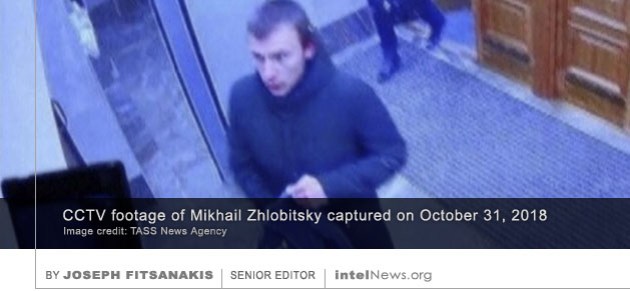
Mikhail ZhlobitskyA teenager who killed himself with an improvised explosive device in the lobby of a regional office of Russia’s domestic intelligence agency appears to have identified himself as an “anarchist-communist” on social media. At 8:52 am local time on Wednesday, the 17-year-old entered the regional office of Russia’s Federal Security Service (FSB) in the city of Archangelsk, located 800 miles north of Moscow. On CCTV footage released by the Russian security services, he is seen reaching into his backpack and taking out an object, which soon exploded, killing him and wounding three others.
The bomber was later identified in the Russian media as Mikhail Zhlobitsky, a student at a local technical college. Within hours, reports pointed to posts made on social media platforms by Zhlobitsky, who used several online aliases, including that of “Sergey Nechayev”, one of Russia’s leading 19th-century anarchists, who died in prison for advocating terrorism as a means of revolution. Shortly before the attack, someone using the alias “Valeryan Panov” commented on the social messaging application Telegram that he was about to bomb the FSB in Archangelsk. In the comment, which was posted on an anarchist forum, the user said that he had decided to act “because the FSB falsifies cases and tortures people”. The user added that he would probably die in the attack because he had to manually detonate the improvised explosive device he was carrying with him. He concluded his message with the words: “I wish you a glorious future of anarchist communism!”.

The activities of militant Russian anarchists and anarcho-communists date back to the mid-19th century; anarchist militants are responsible for numerous assassinations of senior Russian officials, including Emperor Alexander II, who was killed by a Russian anarchist in 1881. But the movement was ruthlessly suppressed by the Soviet state and today the FSB and other Russian security services are actively monitoring the remnants of the Russian anarchist movement. These include the Confederation of Revolutionary Anarcho-Syndicalists, the group Autonomous Action, and the Siberian Confederation of Labor. Large sections of these groups have now moved underground, as the government of Russian President Vladimir Putin has named anarchists as primary enemies of order and security in the Russian Federation. Earlier this month, another Russian teenager, Vladislav Roslyakov, killed himself after shooting 19 students and teachers at a technical college in Kerch, a Black Sea port city in Russian-annexed Crimea. No political motive for the attack has been reported.

Author: Joseph Fitsanakis | Date: 01 November 2018 | Research credit: S.F. | Permalink

Denmark recalls its envoy from Tehran, accuses Iran of assassination plot

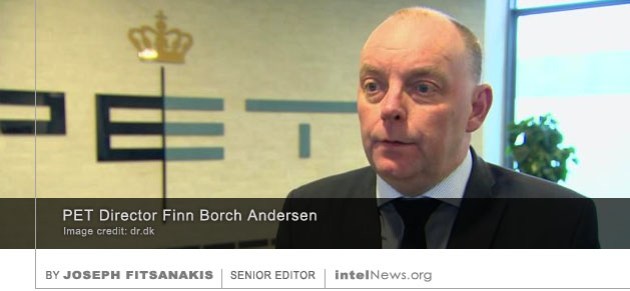
Finn Borch AndersenThe Danish government has recalled its ambassador from Iran and has accused the intelligence services of the Islamic Republic of plotting an assassination operation on Danish soil. Danish government officials also said that Copenhagen would seek to impose further economic and diplomatic sanctions on Tehran, in coordination with the European Union. The accusations against Iran were leveled during an emergency news conference in the Danish capital on Tuesday, led by Anders Samuelsen, Denmark’s Minister of Foreign Affairs, and Finn Borch Andersen (pictured), Director of the Danish Security and Intelligence Service, known as PET.
The two men said that “an Iranian intelligence agency” had planned “an attack on Danish soil”, which  Defense Minister Samuelsen condemned as “completely unacceptable”. PET Director Andersen said that a Norwegian national of Iranian background had been arrested in Sweden on October 21, and was now in custody awaiting extradition to Denmark. The arrestee is an employee of Iranian intelligence, said Andersen, and had been observed conducting surveillance against a Danish-based leading member of an Iranian separatist group. The alleged target is a member of the Arab Struggle Movement for the Liberation of Ahvaz (ASMLA), a hardline separatist group campaigning for a separate homeland for Iran’s Arab minority. Approximately 2 percent of Iranians (around 1.5 million people) belong to the country’s ethnic Arab population. Most of them are concentrated in Khuzestan, a region in Iran’s oil-rich southwest, which borders neighboring Iraq. Some of these ethnic Arabs seek autonomy from Tehran, which they see as an alien regime. ASMLA represents the militant wing of Iran’s separatist Arab community and has a history of staging terrorist attacks inside Iran. Last September, the group claimed it was behind an armed attack on a military parade in the city of Ahvaz —a major urban center in Iran’s Arab-speaking region— which killed 24 people, including some women and children. Later, however, a representative of the group retracted the claim.

On Tuesday, several Iranian officials issued strong denials of the Danish government’s allegations. Speaking in Tehran, Iranian Foreign Ministry Spokesman Bahram Qassemi dismissed Denmark’s claims as “spiteful”. He added that the timing of reports linking Iran to assassination operations on European soil were suspect and described them as “a plot by [Iran’s] enemies to damage Tehran’s growing relations with European countries”. Earlier this month, France seized the financial assets of individuals whom it described as Iranian spies, after blaming Tehran for a foiled bomb attack in Paris. The move followed the arrest of six people in France, Germany and Belgium, who allegedly planned to bomb the annual conference of the National Council of Resistance of Iran (NCRI) last June. The NCRI is led by Mujahedin-e Khalq (MEK), a militant group with roots in radical Islam and Marxism, which Iran sees as a terrorist organization.

Author: Joseph Fitsanakis | Date: 31 October 2018 | Permalink

Britain knew of Saudi plan to target journalist, warned Saudis against it

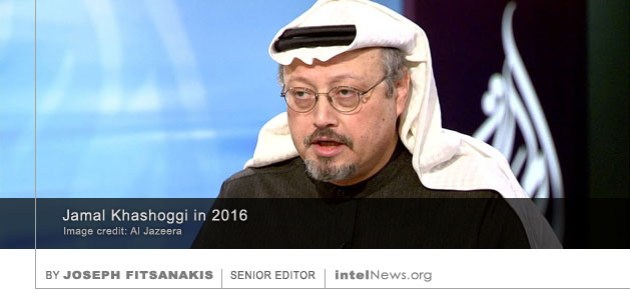
Jamal KhashoggiBritish intelligence had prior knowledge of a plot by the Saudi government to target Jamal Khashoggi, the dissident journalist who was killed in the hands of Saudi intelligence officers in Istanbul on October 2, and allegedly warned Riyadh not to proceed with the plan, according to a report. Khashoggi was a former Saudi government adviser who became critical of the kingdom’s style of governance. He is believed to have been killed by a 15-member Saudi hit squad while visiting the Saudi consulate in Istanbul. He went there for a scheduled appointment in order to be issued a document certifying his divorce from his former wife in Saudi Arabia. After vehemently denying any role in Khashoggi’s killing, the Saudi government admitted last week that the journalist was killed while inside the Saudi consulate in Istanbul. It has pledged to punish those responsible and reform the Kingdom’s intelligence services. But critics accuse Riyadh of ordering the dissident’s murder.

Now a new report claims that Britain’s external intelligence agency, the Secret Intelligence Service (MI6), was aware of a plot by the Saudi government to kidnap Khashoggi in order to silence him. British newspaper The Sunday Express says it has evidence from “high ranking intelligence sources” that MI6 was in possession of communications intercepts containing conversations about Khashoggi. The conversations were between Saudi government officials and officers of the General Intelligence Directorate (GID), the Kingdom’s primary spy agency. In the intercepts, a member of the Saudi royal family is allegedly heard giving orders for the GID to kidnap Khashoggi from Turkey sometime in early September. He also instructs the GID to secretly transport the dissident journalist to Saudi soil where he could be interrogated. During the conversation, a discussion took place about the possibility that Khashoggi would physically resist his abductors. At that point in the conversation, the high ranking intelligence source told The Express, the royal family member “left the door open for alternative remedies […] should Khashoggi be troublesome”.

The paper reports that MI6 “became aware” of the arrival of a 15-member Saudi hit squad in Istanbul on October 1, a day before Khashoggi went missing. According to the paper’s source “it was pretty clear what their aim was”, so MI6 contacted the GID directly and warned the Saudi spy agency to “cancel the mission”, said the source. However, the source added, “this request was ignored”.  On October 10, The Washington Post, the newspaper that employed Khashoggi, said that American intelligence agencies had evidence that the Saudi royal family tried to lure The Washington Post journalist Jamal Khashoggi back to Saudi Arabia, in order to capture him.

Author: Joseph Fitsanakis | Date: 29 October 2018 | Permalink

Islamic State’s online footprint declines drastically, experts say

Islamic State - IAThe online arm of the Islamic State, which was once one of the organization’s most noticeable trademarks, has declined markedly in 2018, according to expert observers in the United States and elsewhere. This is especially applicable to the militant group’s online propaganda and recruitment campaign, which appears to have effectively ceased, say experts.
According to The Washington Times newspaper, most information warfare experts at the United States Department of Defense believe that very little is left of the Islamic State’s once sizeable Web and social-media presence. The paper said that, according to the US Pentagon, the total media footprint of the group —which is also known as the Islamic State of Iraq and Syria (ISIS)— has diminished by as much as 83 percent since its peak in 2015. Online activity measured by the US Pentagon includes posts on social media by Islamic State members and commanders, as well as professionally produced pro-ISIS images and videos aired on YouTube and other image- and video-based online platforms. It also includes material from the Islamic State’s press bureau, the Amaq News Agency, which in previous years produced hundreds of pro-ISIS videos.

Experts told The Washington Times that the Islamic State’s online footprint has shrunk as a result of the group’s loss of its territory. The loss of ISIS’ physical bases in the Middle East has resulted in the death of many of the group’s online propagandists. Those who survived are currently hiding or fleeing from the authorities, fearing arrest or death. This has “crushed [the militant Sunni group’s] ability to mount a coordinated Web-based strategy”, said The Washington Times. The military attacks against ISIS continue to take place alongside an “aggressive counterstrategy in cyberspace”, said the paper, which is being led by the US Pentagon and its allies. This has included the successful targeting of thousands of social media accounts belonging to ISIS members and supporters, as well as complex hacking operations. The US Pentagon also coordinates the delivery of online content that counters the Islamic State’s narrative and messages.

But some experts warned the paper that the Islamic State continues to recruit members online and that the group’s online recruitment efforts are not completely a thing of the past. In fact, new ISIS-sponsored content continues to appear online regularly, they said. In September of this year alone, the Islamic State released 12 different videos, mostly aimed at recruiting new members. Additionally, the militant group continues to use Facebook, YouTube, and other popular online social media platforms, experts warned.

Author: Ian Allen | Date: 26 October 2018 | Permalink

Trump’s use of unsecured iPhone worries White House officials

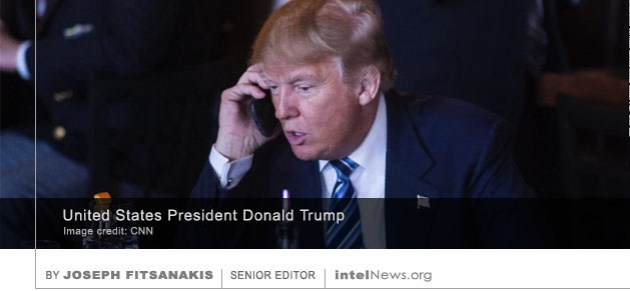
Donald TrumpOfficials in the White House are concerned about President Donald Trump’s insistence on using an unsecured iPhone to communicate with friends and associates, despite warnings that foreign spies may be listening in. Prior to being elected president, Trump used an Android phone, made by Google, which the NSA advised him to abandon due to security concerns. That is when he switched to using iPhones. Since his election to the presidency, Trump has routinely used three iPhone cell phones. He uses one of them to access a limited list of authorized applications, including Twitter. He uses the second iPhone for phone calls, but cannot use it to send texts, take pictures, or download and install applications. Both of these iPhones have been vetted and secured by the National Security Agency (NSA).

But The New York Times said on Wednesday that, despite the advice of the NSA, the US president continues to use a third iPhone, which is his personal device. The newspaper cited “current and former American officials” who said that the president’s third iPhone has not been secured by the NSA, and is thus “no different from hundreds of millions of iPhones in use around the world”. Trump uses that third iPhone to call many of his old friends and associates. The president has been repeatedly warned, sources said, to abandon the use of his unsecured third iPhone. Moreover, US intelligence agencies have confirmed that Chinese, Russian, and possibly other spy agencies have been “routinely eavesdropping” on the US president’s calls made on his personal iPhone.

To some extent, Trump has heeded the advice of his intelligence agencies in recent months and has begun to rely on his secure White House landline to make important calls, thus avoiding cell phones altogether. But he refuses to give up use of his iPhones, despite repeated warnings by the NSA, sources told The Times. They added that “they can only hope [Trump] refrains from discussing classified information when he is on them”. The president’s use of unsecured phone devices adds to what sources described as “frustration” with his “casual approach” to communications security. In July of this year, Nada Bakos, a 20-year veteran of the Central Intelligence Agency, said in an editorial that President Trump’s “Twitter feed is a gold mine for every foreign intelligence agency”. The CIA veteran described Trump’s use of social media is too impulsive and potentially dangerous from a national-security perspective.

Author: Joseph Fitsanakis | Date: 25 October 2018 | Permalink

French government report says thousands approached by Chinese spies on LinkedIn

LinkedInA French government report warns of an “unprecedented threat” to security after nearly 4,000 leading French civil servants, scientists and senior executives were found to have been accosted by Chinese spies using the popular social media network LinkedIn. The report was authored by France’s main intelligence agencies, the General Directorate for Internal Security (DGSI) and the General Directorate for External Security (DGSE). According to the Paris-based Le Figaro newspaper, which published a summary of the classified report, the two intelligence agencies presented it to the French government on October 19.

The report describes Chinese efforts to approach senior French scientists, business executives, academics and others, as “widespread and elaborate”, and warns that it poses an “unprecedented threat against the national interests” of the French state. It goes on to state that nearly 4,000 carefully selected French citizens have been approached by Chinese intelligence operatives via the LinkedIn social media platform. Of those nearly half, or 1,700, have leading posts in French industry, while the remaining 2,300 work in the public sector. In their totality, those targeted are involved nearly every area of industry and government administration, including those of nuclear energy, telecommunications, computing and transportation, said the report. According to Le Figaro, those targeted were approached online by Chinese spies who employed fake identities and identified themselves as headhunters for Chinese corporations, think-tank researchers or consultants for major companies. They then invited targeted individuals to all-expenses-paid trips to China for conferences or research symposia, or offered to pay them as consultants.

The DGSI-DGSE report concludes that most of those targeted displayed shocking levels of “culpable naivety” and a “completely insufficient” awareness of online espionage methods. To address this, French intelligence agencies have produced guidelines on detecting and evading attempts at recruitment or luring from intelligence operatives using social media, said Le Figaro. French civil servants are now being informed of these guidelines through a concerted campaign by the French intelligence community, said the paper. The report, however, did not say whether similar efforts were taking place in the French private sector.

Author: Joseph Fitsanakis | Date: 24 October 2018 | Permalink

Russian espionage reaching ‘intolerable levels’ say Swiss officials

Jean-Philippe GaudinRussian espionage activities in Switzerland are increasing and are crossing long-established “red lines”, according to senior Swiss defense and intelligence officials who spoke at a news conference last week. The claims were made by Guy Parmelin, head of Switzerland’s Federal Department of Defense, and Jean-Philippe Gaudin, director of the Swiss Federal Intelligence Service (NDB). The two men spoke on Friday before reporters in Bern. Following the news conference, Gaudin spoke with reporters from the Reuters news agency.
Gaudin, who assumed the post of NDB director three months ago, told Reuters that Russian espionage activities in Switzerland have been increasing steadily in recent years. He refused to provide details, but said that “it is clear we have more activities than before”. Additionally, Moscow had more active spies in Switzerland than in previous years, said Gaudin. He refused to provide numbers, saying that he would “share that with [his] colleagues elsewhere and not with the media”. The NDB chief noted that Switzerland had always been a target of Soviet and Russian espionage because it hosts the headquarters of a large number of international and non-governmental organizations. However, what is different today, he said, is that Moscow is targeting Switzerland’s “sensitive infrastructure”, which is “a red line”. He did not provide further information. Speaking alongside Gaudin, Defense Minister Parmelin said that Russian espionage activities against Swiss national infrastructure “has reached intolerable levels”.

These allegations by senior Swiss government officials come a little more than a month after reports that Swiss and other Western intelligence agencies thwarted a plot by two Russians who tried to hack the computer systems of a Swiss government laboratory that investigates nuclear, biological and chemical weapons. The laboratory, located in the western Swiss city of Spiez, had been commissioned by the Organization for the Prohibition of Chemical Weapons to carry out investigations related to the poisoning of Russian double agent //Sergei Skripal// and his daughter Yulia in March of this year. It has also carried out probes on the alleged use of chemical weapons by the Russian-backed government of President Bashar al-Assad in Syria.

The Russian embassy in Bern rejected the accusations of espionage and called the allegations made by Gaudin, and Parmelin “absurd”.

Author: Joseph Fitsanakis | Date: 23 October 2018 | Permalink

Iran has clandestine missile factories in Lebanon, claims Israel’s ex-spy chief

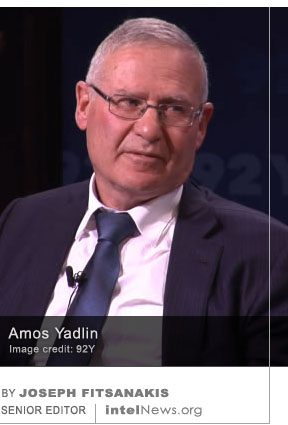
Amos YadlinThe government of Iran is smuggling parts for ballistic missiles to Lebanon, where they are secretly assembled in clandestine factories operated by the Shiite militant group Hezbollah, according to Israel’s former spy chief. For several months now, the international news agency Reuters has been claiming that Tehran has transported short-range ballistic missiles to secret bases controlled by pro-Iranian militias in Iraq. Iran’s move was aimed at “deterring attacks on [Iran’s] interests in the Middle East and to give it the means to it reginal foes”, said Reuters, citing “Iranian, Iraqi and Western sources”. Both Iran and Iraq denied the Reuters report.
In September, another report, citing “Western intelligence sources”, said that Iran had begun smuggling parts of short-range ballistic missiles to Hezbollah-controlled areas of Lebanon, using commercial flights. The report pointed to at least two flights that are suspected by Western intelligence agencies of having illegally transported precision weapon parts to Lebanon. Both flights were operated by Qeshm Fars Air, a company believed to be used by Iran’s Islamic Revolutionary Guard Corps (IRGC). Members of the IRGC, arguably the most loyal branch of the Iranian military, are selected on the basis of their ideological commitment to the defense of the 1979 Islamic Revolution. The two flights identified in the report departed from commercial and military airports in Tehran and landed in Lebanon after taking “uncharacteristic flight paths” through Syria, said Western intelligence sources.

On Sunday, Israel’s highest-circulation newspaper, Yedioth Ahronoth, carried an interview with the former director of the Jewish state’s Military Intelligence Directorate, Major General (ret.) Amos Yadlin. Yadlin, who also served as Israel’s military attaché in Washington, said that Iran used to hide ballistic missile parts in Syria, hoping to establish de facto missile bases there. However, Tehran’s plan suffered a major setback last May, said Yadlin, when Israel’s air force destroyed approximately 50 targets inside Syria, including —according to Yadlin— Iranian missile factories. Since then, he said, Tehran has been relocating its missile factories to Lebanon, believing that Israel will not attack its neighbor to the north. But Yadlin, who is a known supporter of left-of-center parties in Israel, and a proponent of the two-state solution to the Palestinian problem, argued that Israel should consider attacking Iran’s military factories in Lebanon. The Jewish state faces two choices, said Yadlin: “to strike [Lebanon], not necessarily by air”, or to allow Hezbollah to acquire precision missiles. “Israel will not accept this change”, he added.

Author: Joseph Fitsanakis | Date: 22 October 2018 | Permalink

Hardline military official to take command of Pakistan’s powerful spy agency

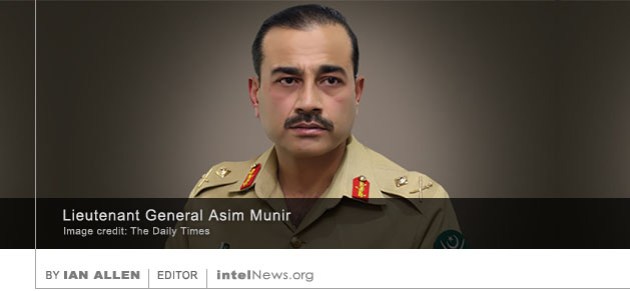
Lieutenant General Asim MunirThe hardline former director of Pakistan’s military intelligence agency is preparing to take the helm of the country’s powerful spy agency, the Inter-Services Intelligence directorate (ISI). Lieutenant General Asim Munir, who has spent more than two decades as a career military officer, has been officially appointed as director-general of ISI. In one of his first notable assignments, Munir served as a military attaché in Pakistan’s embassy in Saudi Arabia. After being promoted to a two-star general, he was appointed commander of Force Command Northern Areas in Gilgit-Baltistan, Pakistan’s northernmost region. The area borders Jammu and Kashmir, an autonomous Indian-administered region, which the Pakistanis claim belongs to them. Gilgit-Baltistan is also a strategic geopolitical corridor that connects Pakistan with one of its major regional allies, China.
In late 2016, after concluding his service in Gilgit-Baltistan, Munir was appointed by Chief of the Pakistan Army Staff General Qamar Javed Bajwa to serve as director-general of Military Intelligence, the spy wing of the Pakistan Army. In September of this year, Munir was promoted to lieutenant general, a move that prompted rumors that he would soon become head of ISI. According to The Asia Times, which published a summary analysis of Munir’s career, his recent promotion confirmed that he was “the army chief [General Bajwa]’s guy” and that he was favored to lead the ISI. Technically it is Pakistan’s prime minister who appoints the head of ISI. But in reality the chief of the Army is the one who selects the spy agency’s director. The past four directors of the ISI have all been handpicked by Pakistan’s military leadership.

Munir’s appointment as head of Pakistan’s most powerful spy agency was due to his experience in working closely with Pakistan’s most important strategic partners, China and Saudi Arabia, said The Asia Times. The career military officer is known within army ranks as a nationalist hardliner who views the army as a central guarantor of political stability in Pakistan. He is also a practicing Muslim and has sought to strengthen the ties between Islam and the Pakistani armed forces. According to The Asia Times, Munir is expected to deepen the ISI’s involvement in Pakistan’s domestic political affairs. This is something that concerns pro-democracy and other opposition activists in the country, who have been alarmed by the recent rise to power of /Imran Khan, a former cricket player and Pakistan’s newly elected prime minister. Munir will be formally sworn in his new position on October 25, when the current director-general of ISI, Lieutenant General Naveed Mukhtar, is expected to announce his retirement.

Author: Ian Allen | Date: 19 October 2018 | Permalink

Czech spy agency says it neutralized Hezbollah cyberespionage network

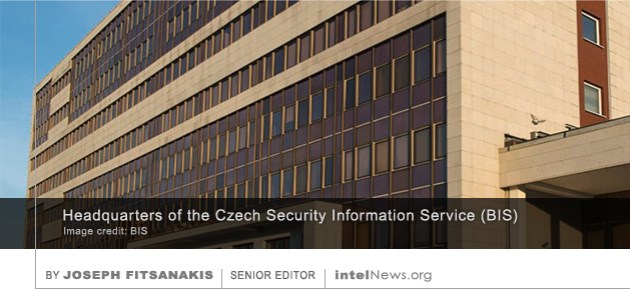
Czech Security Information ServiceOfficials in the Czech Republic have announced that the country’s spy agency headed an operation in several countries, aimed at neutralizing a cyberespionage network operated by the Lebanese militant group Hezbollah. Early last week, the Security Information Service (BIS), the primary domestic national intelligence agency of the Czech Republic, issued a short statement saying that it “played a big part in helping to identify and disconnect Hezbollah servers in the Czech Republic, other EU member states and the US”. But it did not elaborate. On Tuesday, however, ZDNet’s Zero Day security blog published more information from the Czechs about the BIS operation.
According to the BIS, its cyber security force discovered a number of servers located on Czech soil, which were “almost certainly” used by Hezbollah, the Shiite militant group that controls large swathes of territory in Lebanon. The servers were allegedly used in a wide-range cyberespionage operation that began in 2017 by a group of Hezbollah hackers based in Lebanon. It was there, said the BIS, where the command-and-control facilities of the operation were located. The servers located on Czech soil were used to download phone apps that contained malicious software. The hackers targeted individual phone users located mainly in the Middle East, according to the BIS, but other targets were in eastern and central Europe. It is believed that the majority of targets were Israeli citizens. Invariably, targeted individuals were approached online, mostly through fake Facebook profiles. Most of the targets were men, and the fake Facebook profiles featured pictures of attractive young women. After initial messages were exchanged via Facebook, the targets were convinced to download phone applications that would allow them to continue communicating with the ‘women’. These applications would install spyware on their phones, thus allowing Hezbollah hackers to capture the content of messages and calls made on the phones. The latter could also be used as eavesdropping devices.

According to BIS Director Michal Koudelka, the spy agency “played a significant role in identifying and uncovering the hackers’ system. We identified the victims and traced the attack to its source facilities. Hacker servers have been shut down”, he said. Koudelka added that some of the servers used by Hezbollah were located in other European Union countries and in the United States. These were shut down following a joint cyber operation by BIS and “partners”, said Koudelka, though he did not identify them.

Author: Joseph Fitsanakis | Date: 17 October 2018 | Permalink

Suicide bomb threat reportedly leads to evacuation of Iranian envoy to Turkey

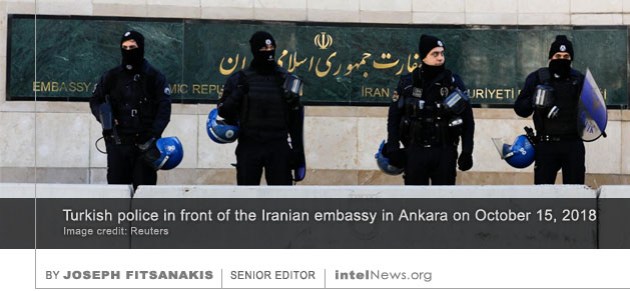
Iran embassy in AnkaraThere were conflicting reports yesterday in Ankara of an alleged evacuation of Iran’s ambassador to Turkey, following credible reports of a suicide bomb attack, possibly by the Islamic State. Several Turkish media outlets reported on Monday afternoon that authorities in Ankara had communicated an urgent intelligence warning to the Iranian embassy there of a possible suicide bomb attack. According to the reports, members of the Sunni militant group Islamic State of Iraq and Syria (ISIS) were behind the planned attack.
At 2 pm local time, reports stated that Iran’s ambassador to Turkey, Mohammad Ebrahim Taherian Fard, had been hurriedly evacuated from the Iranian embassy by Turkish security forces. By that time, all roads leading to the Iranian embassy, located next to the Ankara Hilton in one of the Turkish capital’s leafiest areas, had been cordoned off. Reporters from the Reuters news agency and Agence France Presse said that Turkish police and special forces had shut down Tahran Road, where the Iranian embassy is located, and were searching cars. Armed security forces had also surrounded the Iranian embassy, according to Reuters.

Strangely, however, reports of a possible bomb attack and of the ambassador’s evacuation were strongly refuted by the Iranian government, which denounced them as “sheer lies” and “complete fabrications”. In a statement published online on Monday afternoon, Iran’s Ministry of Foreign Affairs said that its diplomats in Ankara had noticed “an increased Turkish security presence” around the Iranian embassy. However, they continued working normally, as they were unaware of the reasons for the heightened security. They assumed that Turkish President Recep Tayyip Erdoğan was appearing nearby, said the statement. A statement by the Iranian embassy in Ankara said that consular employees were present at the embassy and that all scheduled services were being offered without interruption.

In the past month, the embassies of Iran in Paris and Athens have come under attack by Kurdish separatists and leftwing groups protesting against Tehran’s alleged oppression of ethnic minorities in the country. In the past, the Islamic Republic has been rarely targeted by ISIS, whose members dismiss Shiite Islam as a heresy. In June 2017, two attacks were carried out simultaneously in Tehran, targeting the Iranian parliament and the Mausoleum of Ruhollah Khomeini, founder of post-1979 Iran. In September of this year, ISIS claimed responsibility for an attack in Iran’s southwestern city of Ahvaz, which killed 25 soldiers and civilians during a military parade.

Author: Joseph Fitsanakis | Date: 16 October 2018 | Permalink

Pakistan removes judge who accused spy agency of trying to rig general election

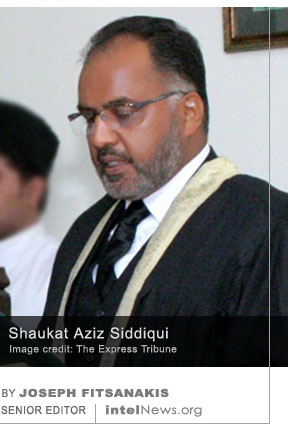
Shaukat Aziz SiddiquiThe government of Pakistan has dismissed a High Court judge who accused the country’s powerful intelligence agency of interfering with the judicial process in order to rig the outcome of last July’s general election. On July 25, the governing center-right Pakistan Muslim League – Nawaz (PML-N) was unseated by the conservative-centrist Pakistan Tehreek-e-Insaf, headed by former cricket star Imran Khan. The elections took place amidst a corruption scandal that saw Nawaz Sharif, former prime minister of Pakistan and leading member of PML-N, arrested on charges of fraud. Sharif was charged following the release of the so-called Panama papers, the massive data leak of documents belonging to Panamanian offshore firm Mossack Fonseca. The leak disclosed that Sharif and his family were owners of a large number of high-end properties in the United Kingdom and elsewhere around the world.

Shortly after the revelations, Sharif moved to Britain, where he and his children cared for his ailing wife. During his absence, he was sentenced in absentia to ten years in prison. Sharif chose to return to Pakistan on July 13, less than two weeks prior to the general election, and was arrested upon arriving in Islamabad. His supporters claim that the media spectacle surrounding his imprisonment severely hurt PML-N’s electoral performance. Last month, the High Court in Islamabad suspended Sharif’s prison sentence and ordered his release on bail, saying that the prosecution had failed to prove conclusively that the high-end properties in the UK belonged to him. Sharif’s release prompted renewed accusations of electoral rigging by PML-N supporters, who claim that Sharif could have been released from prison before the elections, and that the High Court deliberately withheld its decision until this month in order to hurt PML-N.

In July, Shaukat Aziz Siddiqui, a High Court judge, publicly added his voice to those claiming that Sharif’s arrest had been politically motivated. In a speech given before the Rawalpindi Bar Association, the High Court judge accused Pakistan’s powerful Inter-Services Intelligence Directorate (ISI) of exercising pressure on High Court judges in order to delay the decision to release Sharif on bail until after the general election. Justice Siddiqui’s charges made national headlines and prompted strong denials from the Pakistani military, which governs the ISI, and the Pakistan High Court. The latter launched an investigation of Justice Siddiqui, following a complaint issued by the country’s military leadership.

On Friday, the panel of judges that carried out the investigation on Justice Siddiqui, accused him of “conduct unbecoming of a judge of a high court” and recommended his removal from the High Court. On the same day, the Ministry of Justice of Pakistan announced that the country’s President, Arif Alvi, was “pleased to remove Mr. Justice Shaukat Aziz Siddiqui […] from his office with immediate effect”. The announcement did not elaborate on the precise reasons that led to Justice Siddiqui’s removal from the country’s High Court. Siddiqui’s firing marks the first time that a judge has been dismissed under an elected government in Pakistan. In the past, such incidents have occurred only under military dictatorships, which have ruled Pakistan for prolonged periods since the country’s independence in 1947.

Author: Joseph Fitsanakis | Date: 15 October 2018 | Permalink