Authorities in Eastern Europe warn about rise of heavily armed paramilitary groups

Night Wolves SlovakiaSecurity agencies in Eastern Europe have voiced concern about the rise of far-right paramilitary groups whose members have access to heavy weaponry, including in some cases armored vehicles and tanks. The most recent warning came on Sunday, when the Czech daily newspaper Mlada Fronta Dnes published excerpts of a leaked security report on the subject. The report was authored by analysts in the Security Information Service (BIS), the country’s primary domestic intelligence agency. It detailed the recent activities of a group calling itself the National Home Guard, a far-right, anti-immigrant militia that some experts say consists of around 2,000 members throughout the Czech Republic. Although this is officially denied, the group is believed to be the armed wing of National Democracy, a far-right nationalist political party that received 36,000 votes in the 2017 legislative election.

The BIS report states that the National Home Guard has 90 branches across the nation and is now in possession of significant quantities of weapons, some of which have been smuggled into the Czech Republic from Libya. Many of the organization’s largest branches, in the cities of Prague, Ostrava, and elsewhere, organize regular weapons training sessions in secret locations. In some smaller cities around the country, where police presence is limited, National Home Guard is now holding regular armed patrols, in which immigrants —especially those from predominantly Muslim countries— are targeted. Additionally, the group has recently started to recruit heavily from the ranks of the police and the Czech Armed Forces, according to the BIS report.

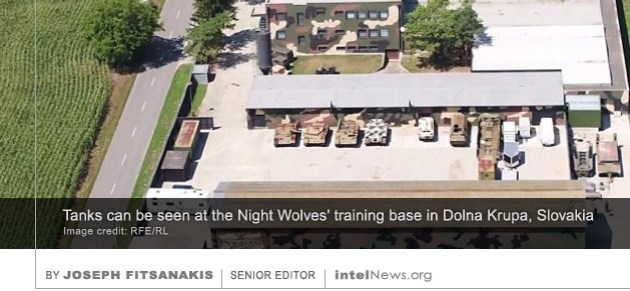
The Mlada Fronta Dnes revelation comes only a month after a report by the BBC said that two far-right militias in Slovakia had begun training at a paramilitary base that contains armored personnel carriers and tanks. The base belongs to the Night Wolves, a biker gang that is known for its anti-immigrant and anti-European Union stance. Recently, however, the Night Wolves have been training in paramilitary tactics in coordination with two other groups, the Slovak Levies and NV Europe, said the BBC. Located in the village of Dolna Krupa, 45 miles north of the Slovakian capital Bratislava, the base contains several tanks and other armored vehicles. The Night Wolves claim that the facility hosts a World War II museum, which explains the presence of the military vehicles. But the BBC said that the group is suspected of using the base to train pro-Russia Ukrainian separatists and other Eastern European paramilitary groups. The BIS report states that far-right paramilitary groups in Czech and Slovakia —which until 1993 were regions of unified Czechoslovakia— maintain regular contact with each other.

Author: Joseph Fitsanakis | Date: 06 September 2018 | Permalink | Research credit: J.R.
IntelNews thanks J.J. for helping to ensure the factual accuracy of this report


Police investigate mysterious disappearance of close WikiLeaks associate

Arjen KamphuisPolice in Norway and Holland have opened formal investigations into the whereabouts of a Dutch cybersecurity expert and senior associate of WikiLeaks, who disappeared without trace on August 20. Arjen Kamphuis, a 47-year-old online privacy specialist, is known for his book Information Security for Journalists, which offers advice on investigative reporters working on national security and intelligence matters. Additionally, Kamphuis, who has Dutch citizenship, is a close associate of Julian Assange, founder of the international whistleblower website WikiLeaks.

According to reports, Kamphuis was last seen in Bodo, a town of 50,000 people located in Norway’s arctic region. Witnesses say that on August 20, Kamphuis checked out of his hotel in the center of Bodo and headed on foot to the town’s main railway station, where he planned to catch a train to Trondheim, Norway’s third largest city. From there he was scheduled to fly to the Dutch capital Amsterdam on August 22. However, it is not known whether Kamphuis ever boarded the 10-hour, 500-mile train ride to Trondheim. He certainly did not board his flight to Amsterdam and has not been heard from since he left his Bodo hotel on August 20. The French news agency Agence France Presse cited Norwegian police spokesman Tommy Bech, who said that Norwegian authorities were unaware of Kamphuis’s current whereabouts. He refused to speculate about what may have happened to Kamphuis after he left his hotel in Bodo, but said that the Norwegian police had opened a formal investigation into his disappearance, in association with police in Holland.

The Dutch cybersecurity expert’s disappearance comes as the fate of his close associate and WikiLeaks founder Julian Assange appears increasingly uncertain. The Australian-born Assange has been living in self-confinement inside the Ecuadorian embassy in London for six years. During that time, the Ecuadorian government has offered Assange protection against charges of rape and sexual assault that have been filed against him in Sweden, which the WikiLeaks founder dismisses as a political conspiracy against him. This past summer, however, Ecuador’s new President, Lenin Moreno, said that Assange would need to leave his embassy quarters soon. Assange is also wanted in the United States for leaking classified government documents through the WikiLeaks platform.

Author: Joseph Fitsanakis | Date: 05 September 2018 | Permalink

Germany drops espionage case against senior Swiss intelligence official

Paul ZinnikerGermany has dropped a criminal case against the second-in-command of Switzerland’s intelligence agency, who was accused by Berlin of authorizing an espionage operation against the German tax collection service. A year ago, Germany launched an unprecedented investigation into three senior officials of Switzerland’s intelligence agency, the Federal Intelligence Service (NDB). The probe was launched on suspicion that the Swiss officials masterminded a spy operation against German tax investigators who were probing the activities of Swiss banks. The German probe was launched three months after authorities in Germany arrested a Swiss intelligence officer, identified only as “Daniel M.”, for engaging in espionage on German soil.

The German government believes that billions of euros have been deposited by its citizens in banking institutions in European tax-havens like Liechtenstein, Switzerland or Monaco. For the past decade, German authorities have resorted to bribing whistleblowers in offshore banks in order to acquire internal documents that reveal the identities of German citizens who are hiding their money in foreign bank accounts. It is estimated that over a hundred million dollars have been paid to whistleblowers by German authorities since 2006. The latter argue that the proceeds collected from unpaid taxes and fines more than justify the payments made out to whistleblowers. But the Swiss government has strongly criticized Berlin for encouraging Swiss banking sector employees to steal internal corporate information that often breaks Switzerland’s stringent privacy laws. It is believed that the NDB has been instructed by the Swiss government to monitor efforts by German tax-fraud investigators to approach potential whistleblowers working in the Swiss banking sector.

The man identified as “Daniel M.” appears to be one of several Swiss spies who have been collecting information on the activities of German tax investigators. For a while it appeared that German counterintelligence officials were intent on targeting Paul Zinniker (pictured), Deputy Director of the NDB. They claimed that Zinniker was the main support officer of the operation that “Daniel M.” was participating in when he was arrested in Germany in 2017. According to the Germans, it was Zinniker’s who conceived the operation in 2011. But on Monday a spokesman for Germany’s federal prosecutor told the Swiss News Agency that Berlin dropped the case against Zinniker back in June. The revelation came less than 48 hours after a report in the Sunday edition of the Swiss newspaper Neue Zürcher Zeitung claimed that the charges against Zinniker would be dropped. According to the German federal prosecutor’s office, the case against the Swiss spy official was dropped because of the lack of cooperation by Swiss authorities, which made it impossible to prove that Zinniker was indeed the mastermind of the espionage operation against Berlin.

Author: Joseph Fitsanakis | Date: 04 September 2018 | Permalink

Microwave weapons were behind US diplomats’ ailments, says leading scientist

US embassy in CubaAdvanced weapons that emit microwave radiation were most likely responsible for the ailments of American diplomats in Cuba and China, according to the scientist leading the investigations into the matter. In September of 2017, Washington recalled the majority of its personnel from its embassy in Havana and issued a travel warning advising its citizens to stay away from the island. These actions were taken in response to allegations by the US Department of State that at least 21 of its diplomatic and support staff stationed in Cuba suffered from sudden and unexplained loss of hearing, causing them to be diagnosed with brain injuries. In April, the Canadian embassy evacuated all family members of its personnel stationed in Havana over similar health concerns.
Less than a year later, in June 2018, the US reportedly evacuated at least two more diplomatic personnel from its consulate in the Chinese city of Guangzhou, after they experienced “unusual acute auditory or sensory phenomena” and “unusual sounds or piercing noises”. The evacuations took place two weeks after the US Department of State disclosed that a consulate worker in Guangzhou had been flown home for medical testing, in response to having experienced “subtle and vague, but abnormal, sensations of sound and pressure”. The evacuations from China prompted comparisons to the very similar phenomena that had been reported by US diplomatic personnel in Cuba the previous year. In 2017, media reports stated that Washington had concluded that the American diplomats were exposed to “an advanced device that was deployed either inside or outside their residences”. But the Cuban government denied that it had anything to do with the American diplomats’ symptoms, and some believe that the alleged “covert sonic device” may have been deployed by an intelligence service of a third country —possibly Russia— without the knowledge of Cuban authorities. However, the US government has remained largely silent about the cases.

Now, however, Douglas H. Smith, the head of the team of scientists that were tasked by the US government to examine the matter, says that microwave radiation was almost certainly responsible for the diplomats’ ailments. Dr. Smith, who is also the lead author of a written account of the investigation that was published in the Journal of the American Medical Association, spoke to The New York Times. He said that microwaves were now considered “a main suspect” and that his team of scientists was now “increasingly sure” that the diplomats had suffered brain injuries caused by microwave radiation. The Times sought comments on Dr. Smith’s statement from the US Department of State and the Federal Bureau of Investigation. However, the Department of State said that its own investigation had yet to conclusively identify the cause of the ailments, while the FBI declined to discuss the matter.

Author: Joseph Fitsanakis | Date: 03 September 2018 | Permalink

Malaysia charges senior intelligence officials with stealing government funds

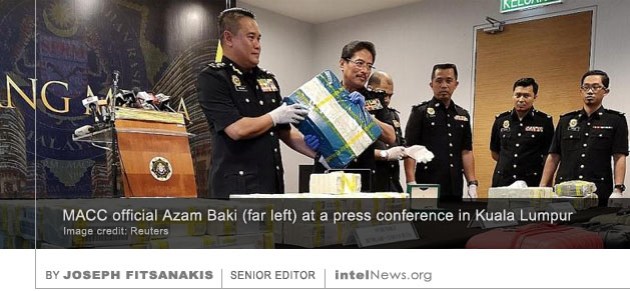
Azam Baki MalaysiaEight senior officials of Malaysia’s external intelligence agency, including its former director, have been arrested, allegedly for stealing over $16 million from government coffers. The arrests represent a dramatic widening of the anti-corruption campaign that has gripped the Asian nation of 31 million since it was launched in May of this year. The campaign is led by a special task force within the Malaysian Anti-Corruption Commission (MACC). The task force was set up by Malaysia’s Prime Minister Mahathir Mohamad, with the aim of probing the so-called 1MDB scandal. The acronym refers to the 1Malaysia Development Berhad, a government-owned strategic development company spearheaded by Malaysia’s then Prime Minister, Dato Sri Najib Razak, with the aim of raising funds to match foreign direct investment in the country.
However, in 2015 opposition politicians began to allege that hundreds of millions of dollars had gone missing from the fund. In May 2018, when Malaysia’s current prime minister took office, the MACC launched a nationwide investigation into the allegations. Meanwhile, Western governments, including the United States, alleged that several billions in 1MDB funds invested from abroad were stolen and used to purchase a superyacht, private airplanes and other luxury items, such as jewelry, clothing and fine art. By August, the 1MDB probe had turned into the largest corruption investigation in Malaysia’s history. On August 6, former Prime Minister Najib Razak was charged with several counts of money laundering and was barred from leaving the country.

On Thursday, MACC’s Operations Commissioner, Azam Baki said at a press conference in Kuala Lumpur that police had arrested eight current and former member of the Malaysian External Intelligence Organization (MEIO). The eight included officials, case officers, and the agency’s former Director, Hasanah Abdul Hamid, said Baki. He added that during the arrests police seized over $6 million in cash and luxury items from several locations, including from MEIO’s headquarters in Putrajaya, Malaysia’s administrative center located 25 miles south of Kuala Lumpur. A ninth person, an unnamed Malaysian businessman who lives in London, had also been arrested, said the MACC official. According to a government press release, the eight current and former members of MEIO are connected to a transfer of $16 million from the 1MDB fund to private bank accounts in Malaysia and abroad. All eight have denied the charges through their lawyers.

Author: Joseph Fitsanakis | Date: 31 August 2018 | Permalink

Afghan government in crisis as senior security and spy chiefs tender mass resignations

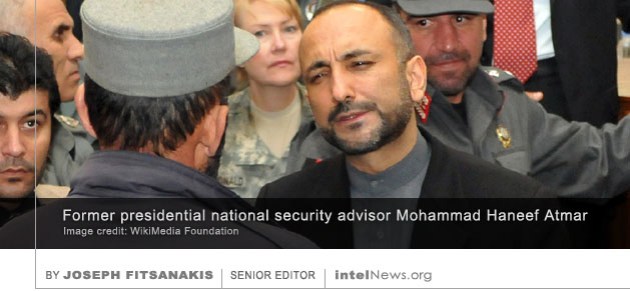
Mohammad Haneef AtmarThe government of Afghanistan is facing one of its most serious crises since the end of the Taliban reign in 2001, as the country’s most senior security and intelligence officials tendered their resignations this week. The unprecedented move followed a dramatic escalation in attacks against Afghan government installations by Taliban and Islamic State forces, which have resulted in dozens of casualties throughout the Central Asian country. On Saturday, Mohammad Haneef Atmar, long time national security adviser to President Ashraf Ghani and one of the Afghanistan’s most recognizable and powerful political figures, tendered his resignation. Many seasoned observers were surprised when President Ghani, who is a close political ally of Atmar, accepted his resignation and replaced him with Hamdullah Mohib, who until recently was Afghanistan’s ambassador to the United States.

But the political crisis deepened on Sunday, when three more senior officials tendered letters of resignation. Tariq Shah Bahrami, Minister of Defense, Wais Ahmad Barmak, Minister of the Interior, and Masoom Stanekzai, head of Afghanistan’s National Security Directorate, all resigned their posts. All three have been subjected to intense criticism by Afghanistan’s political opposition and national media, for having failed to stop the anti-government insurgency, which is intensifying in nearly every one of the country’s provinces. Criticism of the three men became even sharper last week, after the Taliban launched a spectacular rocket attack on the Presidential Palace in the Afghan capital Kabul, which was heard in the background during President Ghani’s speech to commemorate the Muslim festival of Eid.

Late on Sunday, however, a presidential spokesman told media representatives that President Ghani had rejected the three officials’ resignations. Instead, he demanded that they stay in their posts and redouble their efforts to enhance the security of Afghanistan. Later that same evening, the Presidential Palace issued a written statement to the media, which said that President Ghani “did not approve the [officials’] resignations”. Instead, he “gave them the necessary instructions to improve the security situation” in the country. Meanwhile on Tuesday US Defense Secretary James Mattis insisted during a press conference in Washington that the current US strategy in Afghanistan is working and that the Talian would eventually be forced to negotiate, thus ending the country’s ongoing civil war.

Author: Joseph Fitsanakis | Date: 30 August 2018 | Permalink

US delegation met secretly with Syrian intelligence chiefs, newspaper claims

Ali MamloukA delegation of senior American government officials met secretly with Syria’s spy chiefs in an effort to lay out the terms of a possible deal between Washington and Damascus, according to a Lebanese newspaper. Relations between the United States and Syria have been strained since the late 1950s, when Damascus blamed Washington for a failed coup and expelled America’s ambassador there. In 2012, the US shut down its embassy in the Syrian capital in response to the government’s violent suppression of protests. Since then, Washington has carried out missile strikes on Syrian soil at least twice, while openly supporting armed groups that are opposed to the government of President Bashar al-Assad.

But according to the Lebanese newspaper Al-Akhbar, a group of senior American officials held a secret meeting in Damascus with Syrian spy chiefs. If true, the move could signify a major shift in US-Syrian relations. The paper, which supports the pro-Assad Shiite paramilitary group Hezbollah, and is close to the Syrian government, published news of the alleged meeting on Tuesday. It said that the meeting took place in complete secrecy during the last week of June and that it was facilitated by intermediaries from Russia and the United Arab Emirates. The latter used a UAE government airplane to fly the US delegation —whose names Al-Akhbar did not reveal— to the Syrian capital. The visiting delegation, which according to the paper “included [senior] officers from many US intelligence and security agencies”, was transported to a secret Syrian government facility in the dead of night by “a huge procession of black SUVs”, said the paper. The Syrian delegation at the meeting was reportedly headed by Ali Mamlouk, special security adviser to President al-Assad and head of the National Security Bureau of the governing Ba’ath Party. Other participants from the Syrian side included Mohammed Dib Zeitoun, director of the General Security Directorate, and Muwaffaq Asaad, the deputy chief of staff of the Syrian Armed Forces, said Al-Akhbar.

During the meeting, the two sides allegedly attempted to lay out the foundations of a possible post-civil war deal between Washington and Damascus. According to the Lebanese paper, the US delegation offered to withdraw American Special Forces from Kurdish-controlled northern Syria. In return, they allegedly asked for the removal of Iranian troops from Syrian regions that are adjacent to the Israeli border. The two sides also discussed the resumption of intelligence sharing on matters relating to Sunni radicals operating in Syria. No decisions were taken during the meeting, said Al-Akhbar, but the two sides decided to continue to share proposals and ideas about a possible bilateral agreement.

The French news agency Agence France Presse said on Tuesday that it could not independently confirm Al-Akhbar’s claims, as its attempts to contact the US departments of State and Defense were not fruitful. It noted, however, that both Mamlk and Zeitoun feature on the US government’s list of sanctions against Syrian government officials that are believed to have directly participated in human-rights abuses against political opponents since the outbreak of the civil war in 2011.

Author: Joseph Fitsanakis | Date: 29 August 2018 | Permalink

Russia, US, deny conducting mystery airstrikes in Tajikistan

Afghanistan TajikistanRussia, the United States and Tajikistan have all denied that they were behind a series of mystery airstrikes that took place along the Tajik-Afghan border on Sunday, while the identity of the targets also remains unknown. The 800-mile border between Afghanistan and Tajikistan consists of mountainous terrain. Unlike the Afghan-Pakistani border, which is rife with skirmishes and firefights, the Afghan-Tajik border is usually peaceful and sparsely guarded. But on Sunday, August 26, local officials from both sides of the Afghan-Tajik border reported that fighter jets conducted a series of airstrikes. News media in Tajikistan’s capital Dushanbe said that Tajik border guards exchanged fire with Taliban fighters, killing as many as eight, but losing two officers in the process. However, on Monday a Tajik border police official denied media reports and said that the border incident involved Tajik lumberjacks who were attacked by unknown assailants from Afghanistan.

Adding to the mystery, Afghan officials said on Sunday that fighter jets bombed Afghan territory adjacent to the Tajik border. They added that they did not know if the fighter jets were Russian or Tajik. However, Tajikistan has a nominal air force consisting of no more than four Czech-made light-attack aircraft, which have not been used in over a decade. That leaves Russia, which maintains an air base in the suburbs of Dushanbe, 100 miles from the Afghan border. But on Monday, Moscow denied any involvement in the incident, as did Tajikistan. Russian officials placed the blame on the US, saying that the American-led North Atlantic Treaty Organization (NATO) force in Afghanistan is known to regularly launch airstrikes throughout Afghanistan. But US Pentagon officials said that they were not involved. When asked by reporters in Kabul, Afghan government representatives said that Afghanistan lacked the ability to monitor its airspace due to a lack of radar equipment. They called on the US-led NATO force to investigate Sunday’s incident.

Meanwhile, the identity of the persons targeted in the alleged airstrikes is also in doubt. On Monday, the Taliban denied that they had engaged with either Afghan or Tajik government forces along Afghanistan’s northern borderlands, saying that they had not authorized their fighters to operate in the area. Additionally, the Taliban have not been known to engage Tajik government troops in the past. Some observers have opined that the border skirmish may have been caused by drug smugglers who regularly transport drugs from Afghanistan to Russia or the Caspian Sea region through Tajikistan and Uzbekistan. However, there are no prior reported incidents of Russian, American or Tajik fighter jets having been deployed along the Afghan-Tajik border to combat drug traffickers.

Author: Joseph Fitsanakis | Date: 28 August 2018 | Permalink

CIA informants inside Russia are going silent, say US sources

Kremlin, RussiaSecret informants inside the Russian government, which the United States has relied on in recent years for tips about Moscow’s strategy and tactics, have gone silent in recent months, according to sources. Over many years, US intelligence agencies have built networks of Russian informants. These consist of officials placed in senior positions inside the Kremlin and other Russian government institutions, who can help shed light on Russia’s political maneuvers. These informants were crucial in enabling the US Intelligence Community to issue warnings of possible Russian meddling in the American presidential elections of November 2016. Since then, US spy agencies have largely relied on these informants to produce detailed assessments of Russian intelligence activities targeting the US, and propose measures against those involved.

But on Friday, The New York Times said in an article that these vital sources of information in Moscow have been going silent in recent months. Citing “current and former officials”, the paper said that US officials did not believe that the informants have been captured or killed. Instead, they have voluntarily “gone underground” because of “more aggressive counterintelligence” practiced by Russian security agencies. Moscow has stepped up attempts to detect spies operating inside Russia since the Sergei Skripal incident, when relations between it and most Western countries sank to their lowest point since the Cold War. In turn, Western informants operating in Russia have “decided it is too dangerous to pass information” and have gone “silent for their own protection”, said The Times.

This situation, however, has left the Central Intelligence Agency and other US spy agencies “in the dark” about the intentions of Russian President Vladimir Putin, just as America is nearing its mid-term elections. The lack of information has been exacerbated by the expulsion of dozens of American diplomats from Russia in March of this year. Moscow announced the expulsions in response to Washington’s decision to expel 60 Russian diplomats in protest against the attempt —allegedly by Russia— to kill Sergei Skripal in England. Many of the diplomats who were expelled from Russia were in fact intelligence officers operating under diplomatic cover. Few of those are now left on Russian soil and, according to The Times, “are under incredible surveillance” by Russian counterintelligence agencies. Washington is still collecting information from Russia through other channels, including communication intercepts, which, according to The Times, “remain strong”. But the paper cited anonymous American officials who “acknowledged the degradation in the [overall flow of] information collected from Russia.

Author: Joseph Fitsanakis | Date: 27 August 2018 | Permalink

Russia is looking for nuclear missile that went missing, US sources claim

Russian nuclear-powered missileRussia is preparing to carry out an extensive search for a nuclear-powered missile that went missing during a test several months ago, according to American intelligence sources. The missing missile appears to be part of a new Russian-made weapon system that President Vladimir Putin boasted about earlier this year. During his annual state-of-the-union speech in Moscow on March 1, Putin said that Russia had developed a new type of nuclear-powered missile with a virtually unlimited range. This new type of weapon, said the Russian president, could fly indefinitely and thus deliver nuclear warheads to any target around the world. Additionally, the new system was designed in such a way that it could evade every known missile defense system and was thus “invulnerable to interception”, he claimed.

According to observers, the recently announced Russian weapon has been in development for more than 15 years. It is based on gasoline-powered engines that are used during the missile’s takeoff. But soon afterwards, they give way to a nuclear-powered engine that guides the missile to its eventual destination. However, despite Putin’s claims, the weapon has never been successfully tested according to American intelligence sources. The Americans claim that the Russian military tested these missiles at least four times between November of 2017 and February of this year, and that all four missiles crashed long before they reached their intended destination. The idea of indefinite flight, therefore, which Putin boasted about earlier this year, remains unrealized, according to American sources. Moscow, however, denies that the missiles crashed during the testing stage.

Now the American news network CNBC has said that Russia is preparing to launch a large-scale search operation for one of the nuclear-powered missiles that went missing in the Arctic Ocean in November of 2017. It is believed that the missile crashed in the Barents Sea, a vast expanse of water located off the northern coasts of Russia and Norway. Citing anonymous individuals “with direct knowledge of a US intelligence report” on the subject, CNBC said on Tuesday that the Russian search mission will consist of three vessels, at least one of which will be specially equipped to handle radioactive material from the missing missile’s nuclear core. The American news network said that the Russian search mission has no definite timeline. The Russian government has not commented on CNBC’s allegations.

Author: Joseph Fitsanakis | Date: 24 August 2018 | Research credit: A.G.B. | Permalink

German ex-spy chief tells West to stop sharing intelligence with Austria

Peter GridlingA former director of Germany’s foreign intelligence service has warned Western officials to stop sharing intelligence with the government of Austria, because of its alleged proximity to the Kremlin. August Hanning served as chief of Germany’s Federal Intelligence Service, known as BND, from 1998 to 2005. He went on to serve as the most senior civil servant in the Ministry of the Interior until his retirement in 2009. In an interview published on Wednesday in Germany’s Bild newspaper, Hanning argued that “caution is necessary with [an intelligence] service [like that of Austria,] which cannot protect its own secrets or the sources and sensitive information of its partners”. He went on to add that “there is […] now extreme caution when sharing information] with the Austrian intelligence services.

Hanning’s statement came less than a week after The Washington Post claimed in a major article that most Western intelligence services had stopped sharing sensitive information with the Austrian government. The newspaper alleged that the disruption in intelligence cooperation between Austria and other Western countries was sparked by an unprecedented police raid on the headquarters of Austria’s spy agency in February of this year. On February 28, Austrian police raided the central offices of the Office for the Protection of the Constitution and Counterterrorism (BVT), which operates as Austria’s domestic intelligence agency. By that evening, thousands of classified documents had been removed from the BVT’s headquarters and stored in police facilities in Vienna. Austrian officials claimed that the raid was sparked by allegations made by South Korean intelligence that blank Austrian passports had been acquired by the North Korean government.

However, according to The Post, the raid was politically motivated by Austria’s far-right Freedom Party, which is part of the country’s ruling coalition. The purpose of the raid, said the article, was to neutralize the BVT, whose mission includes defending the Austrian constitution from domestic threats from the far left and the far right. Many Western services were alarmed by the February 28 raid on the BVT and immediately stopped sending sensitive information to the agency’s Vienna headquarters, according to The Post. It also said that Western European powers are concerned by the seemingly close relations between some members of Austria’s government and the Kremlin. Last week, Russian Premier Vladimir Putin traveled to Austria to attend the wedding of Karin Kneissl, Austria’s Minster of Foreign Affairs, who is politically close to the Freedom Party. The Russian leader said that he attended Kneissl’s wedding on a “purely private” capacity. But that did little to appease European Union leaders.

On Monday, the BVT rejected the claims made by The Post. In a statement issued to the media, BVT director Peter Gridling (pictured) said that “cooperation [between the BVT and] partner intelligence services continues to work well in key areas such as the fight against terrorism”.

Author: Joseph Fitsanakis | Date: 23 August 2018 | Permalink

Radioactive device goes missing in Malaysia, prompting security fears

Malaysia’s Atomic Energy Licensing BoardA highly radioactive device used by an energy company has gone missing in Malaysia, sparking a nationwide emergency for fear that it might have been stolen by a militant group. According to Malaysia’s Straits Times newspaper, a radioactive dispersal device (RDD), which is used for the industrial radiography of oil and gas supplies, disappeared during transit on August 10. The device, which weighs approximately 50 pounds, or 23 kilograms, disappeared from the back of a company truck in the early hours of the morning while it was being transported by two technicians. They were reportedly transporting the RDD from Kuala Lumpur to Seremban, an industrial town with a population of approximately 600,000, located 40 miles south of the Malaysian capital.

The technicians told the police that they placed the RDD onto the back of a company truck for the routine transport, at approximately 2:00 a.m. Upon arriving in Seremban at 3:00 a.m. that night, they realized that the device had “simply disappeared” from the truck. The Straits Times said that both men were immediately arrested, but were released last Friday, August 17, after the authorities determined that they were not implicated in sabotaging or stealing the radioactive device. On Monday, August 20, the Reuters news agency contacted Mazlan Mansor, police chief of Selangor, the federal province that includes both Kuala Lumpur and Seremban. He told the news agency that “yes, there is a report and we are investigating”. However, he refused to elaborate on the missing RDD, according to Reuters.

A major question regarding the missing device concerns the amount of iridium that is inside it. Iridium is a radioactive substance that is used for the non-destructive testing (known as industrial radiography) of oil and gas supplies. Some experts have expressed concerns that the radioactive substance inside the missing RDD could be combined with conventional explosives and be used as a ‘dirty bomb’ in order to contaminate a highly populated area with radiation. The New Straits Times quoted an unnamed official at Malaysia’s Atomic Energy Licensing Board as saying that the RDD “cannot fall into the wrong hands, as the consequences can be deadly”.

Author: Joseph Fitsanakis | Date: 22 July 2018 | Research credit: A.G.B. | Permalink

US announces arrest of two men charged with spying for Iran

Mujahedin-e KhalqAuthorities in the United States have announced the arrests of two men who have been charged with spying on American soil on behalf of the Islamic Republic of Iran. The men were reportedly arrested on August 9, but information about them was only released on Monday by the US Department of Justice. In a press statement published online, John Demers, US Assistant Attorney General for National Security, said the men were arrested because of concerns that they “acted on behalf of Iran”. They were identified as Ahmadreza Mohammadi Doostdar, 38, and Majid Ghorbani, 59. Doostdar is reportedly a dual citizen of the US and Iran, while Ghorbani is an Iranian citizen who lives in the US state of California. The two men are not believed to be diplomats.

According to the US government, the men were observed “conducting surveillance of political opponents and engaging in other activities that could put Americans at risk”. The press statement alleges that Doostdar carried out surveillance of a Jewish center in Chicago, while Ghorbani attended meetings and rallies organized by Iranian opposition groups operating in the US. The press release identifies one such group as the Mujahideen-e Khalq (MEK), a militant faction that has roots in radical Islam and Marxism. Between 1970 and 1976, the group assassinated six American officials in Iran and in 1970 tried to kill the United States ambassador to the country. It initially supported the Islamic Revolution of 1979, but later withdrew its support, accusing the government of Ayatollah Khomeini of “fascism”. It continued its operations in exile, mainly from Iraq, where its armed members were trained by the Palestine Liberation Organization and other Arab leftist groups. Until 2009, the European Union and the US officially considered the MEK a terrorist organization. But the group’s sworn hatred against the government in Iran brought it close to Washington after the 2003 US invasion of Iraq. By 2006, the US military was openly collaborating with MEK forces in Iraq, and in 2012 the group was dropped from the US Department of State’s list of foreign terrorist organizations. Today the group enjoys open protection from the EU and the US.

On June 30 of this year, authorities in Belgium arrested a married Belgian couple of Iranian descent, who were found to be carrying explosives and a detonator. On the following day, July 1, German police arrested an Iranian diplomat stationed in Iran’s embassy in Vienna, Austria, while a fourth person was arrested by authorities in France, reportedly in connection with the three other arrests. All four individuals were charged with having planned a foiled plot to bomb the annual conference of the MEK-affiliated National Council of Resistance of Iran (NCRI) that took place on June 30 in Paris, France. It is not known whether the arrests in Europe are in any way connected with the cases of the two men held in the US.

Japan releases files on 1942 Tokyo spy ring that helped USSR win World War II

Richard SorgeJapan has released secret documents from 1942 relating to the Tokyo spy ring led by Richard Sorge, a German who spied for the USSR and is often credited with helping Moscow win World War II. The documents detail efforts by the wartime Japanese government to trivialize the discovery of the Sorge spy ring, which was at the heart of modern Japan’s biggest spy scandal. Thirty-five people, many of them highly placed Japanese officials, were arrested in Tokyo in October of 1941 for spying for the Soviet Union. Sorge, the German head of the spy ring, had fought for the Central Powers in World War I, but had subsequently become a communist and trained in espionage by Soviet military intelligence. He was then sent to Tokyo where he struck a close friendship with the German Ambassador and joined the German embassy. He eventually informed Moscow that German ally Japan was not planning to invade Russia from the east. That tip allowed Stalin to move hundreds of thousands of troops from the Far East to the German front, which in turn helped the USSR beat back the Nazi advance and win the war.

Japanese newspaper Mainichi Shimbun, which has seen the declassified documents, said they were among the personal files of Taizo Ota, a Japanese counterintelligence official who led Division VI of Japan’s Ministry of Justice. The unit was in charge of political policing and counterespionage during World War II. The documents date from May 1942, which was when the Japanese government finally publicized the arrest of Sorge and his comrades, more than six months after they were caught spying for Moscow. The documents were issued by Japan’s Ministry of Justice but —according to experts— were most likely authored by officials in Japan’s Ministry of Foreign Affairs, who were in charge of investigating the Sorge spy ring case. According to Mainichi Shimbun, the documents were part of a broader effort by the Japanese government to cover up the espionage case by instructing the country’s media to give it marginal attention.

One document instructs newspaper editors to cover the incident on an inside page and to use a headline smaller than the length of four columns. Another document states that newspaper editors should not use pictures in reporting on the spy ring, and adds that no information other than what is included in government press releases should be printed. A third document specifically instructs newspaper editors to avoid all mention of Kinkazu Saionji, a core participant in the Sorge spy ring. Saionji was a member of Japan’s governing aristocracy and a grandson of former Prime Minister Kinmochi Saionji, the country’s most esteemed interwar politician. Indeed, much of the information in the newly unearthed documents details efforts by the Japanese state to conceal the magnitude of communist penetration in the country’s leading families and governing circles.

Coverage of the Sorge incident in Japan’s two leading newspapers of the time, the Nichi Shimbun and the Asahi Shimbun indicate that the government pressure was successful, according to Mainichi Shimbun. Both papers covered the incident but neither paper published information about it on its front page, nor was there mention of Saionji or of other senior Japanese officials who were members of the Sorge spy ring. According to Japanese researchers, the documents provide rare detailed examples of attempts by the country’s wartime government to guide reporting on national-security affairs. The files are currently archived in the Modern Japanese Political History Materials Room of the National Diet Library in downtown Tokyo.

Author: Joseph Fitsanakis | Date: 20 August 2018 | Permalink

Brussels will ‘not comment’ on reports Britain is spying on EU Brexit committee

Sabine WeyandRelations between the European Union and the United Kingdom hit a new low on Thursday, as the European Council refused to comment on claims that British spy agencies have spied on Brexit negotiators in Brussels. Consultations between the two sides have progressed at an alarmingly slow pace ever since June 23, 2016, when voters in the island nation elected to leave the EU during a nationwide referendum. In March of 2017, London officially invoked Article 50 of the EU Treaty, which requires that Britain’s withdrawal from the multinational body be completed within two calendar years. But there are many who think that a mutual agreement will not be reached between the two sides.

On Wednesday, British newspaper The Daily Telegraph alleged that a number of EU Brexit negotiators believe that their closed-door meetings are being spied upon by the British Secret Intelligence Service, known as MI6. According to The Telegraph, fears of espionage were raised by Sabine Weyand, a German EU official who is currently serving as Deputy Chief of the European Council’s Article 50 Working Party. On July 13, during a meeting of the European Council, Weyand reportedly said “it could not be excluded” that British intelligence agencies had found ways to listen in to the closed-door meetings of EU Brexit negotiators. According to The Telegraph, Weyand and other EU officials became suspicious after London appeared to be privy to information discussed on July 5 at a closed-door meeting of the Article 50 Working Party. Weyand told the European Council that the information had reached London “within hours” of it having been presented in Brussels. Just hours following the secret presentation, senior British government officials were reportedly lobbying in public against the information contained in it.

On Thursday, a spokesman for the European Commission, which operates as the EU’s cabinet, did not deny that concerns about espionage were raised by EU Brexit negotiators. When asked by reporters in Brussels about The Telegraph’s allegations, the spokesperson responded: “The Commission’s position today is that we cannot comment on these press reports”. As the press conference was taking place, British negotiators were arriving in Brussels in order to resume the latest round of Brexit talks with the EU’s Article 50 Working Party.

Author: Joseph Fitsanakis | Date: 17 August 2018 | Permalink