Probe uncovers massive $3 billion secret bribe fund in Azerbaijan
September 6, 2017 Leave a comment
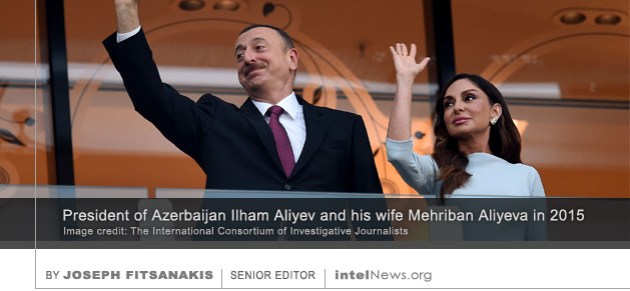 An investigation by a consortium of European newspapers has uncovered details of a massive slush fund worth nearly $3 billion, which was allegedly used by Azerbaijan’s governing elite to bribe officials, business leaders and journalists at home and abroad. The fund was operated out of Baku, the capital of the former Soviet state, which is routinely accused of human-rights abuses. Western countries, including the United States, censure the government of the oil-rich state for its role in systematic abuses. These involve high levels of public- and private-sector corruption, vote-rigging, politically motivated disappearances, and wide curtailment of basic civil liberties. This new information is bound to add to Azerbaijan’s image as a secretive oil-rich state ruled by corrupt elite connected to the country’s President, Ilham Aliyev, and his family.
The existence of the slush fund was revealed by the Organized Crime and Corruption Reporting Project (OCCRP), an international investigative consortium. The OCCRP’s report was published in Tuesday, following a lengthy investigation by members of 17 European news media, including publications in the United States, Britain, Germany, France, Denmark and Belgium. The report states that the fund, which it nicknames “the Azerbaijani Laundromat”, was operational for over two years, from 2012 to 2014. During that time, it participated in “over 13,000 transactions”, many of which were carried out through companies based in the United Kingdom but registered in the British Virgin Islands, Belize and the Seychelles. Payments were processed by the Estonian branch of Danske Bank, a major European banking institution.
According to the OCCRP report, most of the fund’s recipients were politicians, business executives, reporters and other influential people in Western Europe, as well as Turkey and Central Asia. Other recipients included wealthy families in Azerbaijan, who used the funds to finance a luxurious lifestyle, according to the report. Some foreign recipients of the funds were politicians, journalists or lobbyists who have been vocal in supporting Azerbaijan’s government and its policies. Most of the funds are believed to have originated from Azerbaijani-based companies, primarily Baktelecom MMC. But Russian-based companies, including Rosoboronexport, Russia’s state-operated exporter and importer of defense-related technologies, also contributed over $30 million to the slush fund.
Perhaps most controversially, the OCCRP report alleges that some of the secret slash funds originated from senior cabinet members in Azerbaijan, as well as some intelligence officials. It also states that investigators uncovered “ample evidence of [the fund’s] connection to the family of [Azerbaijan’s longtime] President Ilham Aliyev”. Late on Tuesday, a statement issued by President Aliyev’s office rejected the report as “baseless, malicious and […] provocative in nature”. More reactions to the OCCRP report are expected in the coming days.
► Author: Joseph Fitsanakis | Date: 06 September 2017 | Permalink
 By JOSEPH FITSANAKIS | intelNews.org |










 intelNews.org
ISIS threatens stability of former Soviet Republics, says Russian spy chief
May 22, 2019 by Joseph Fitsanakis 1 Comment
Thousands of Islamic State fighters are operating in Afghanistan’s northern border regions and are attempting to destabilize former Soviet Republics with substantial Muslim populations, according to Russia’s domestic spy chief. This warning was issued by Alexander Bortnikov, director of Russia’s Federal Security Service (FSB), which functions as Russia’s primary counter-terrorism agency. Bortnikov made these remarks during a visit to the capital of Tajikistan, Dushanbe, for a meeting of the heads of intelligence agencies of the Commonwealth of Independent States (CIS), an intergovernmental organization comprised of former Soviet Republics in the Eurasian region. The meeting was reportedly held behind closed doors, but Russia’s government-owned news agency TASS carried a summary of Bortnikov’s remarks.
The Russian intelligence chief said that, with the aid of the intelligence services of CIS states like Uzbekistan, Azerbaijan, Tajikistan, Kyrgyzstan, and others, the FSB was able to uncover and suppress eight Islamic State cells in the past year, which operated in the Central Asian region. However, the reach of the CIS countries does not extend to Afghanistan, said Bortnikov, where as many as 5,000 Islamic State fighters are congregating along the country’s border with three CIS states, namely Turkmenistan, Uzbekistan and Tajikistan. Many of these fighters are Turkmens, Uzbeks, Tajiks, Russians, and other citizens of CIS states, who previously fought with the Islamic State in Syria and elsewhere, and now form integral components of the Islamic State’s fighting force in Afghanistan and Pakistan. It appears that the Islamic State is now attempting to exploit the mountainous and porous borders of northern Afghanistan in order to destabilize neighboring countries, he said. These fighters intend to exploit “migrant and refugee flows [in Central Asia] in order to operate covertly from the Afghan battle zones to neighboring countries” and from there possibly to Russia, according to Bortnikov.
These covert activities of Islamic State fighters have already caused an escalation of tensions in the region and can be expected to continue to do so, as these groups radicalize and co-opt Muslim communities in CIS countries, noted Bortnikov. He added that popular responses to Islamist radicalization are prompting increasing incidents of “anti-Islamic terrorism”, which further-fuel religious and ethnic tensions in the region. As a reminder, last week the Islamic State announced that its so-called Khorasan Province fighters would be amalgamated into a new armed group calling itself Islamic State – Pakistan Province. Earlier this month, the group also proclaimed the establishment of a new overseas province in India’s Jammu and Kashmir state, called “wilayah al-Hind” (province of Hind). In addition to these two forces, there are currently an estimated 3,000 to 4,000 Islamic State fighters in Afghanistan’s Pashtun regions.
► Author: Joseph Fitsanakis | Date: 22 May 2019 | Permalink
Filed under Expert news and commentary on intelligence, espionage, spies and spying Tagged with Afghanistan, Alexander Bortnikov, Azerbaijan, FSB, Islamic State, Kyrgyzstan, News, Russia, Tajikistan, Uzbekistan