News you may have missed #663

X-37B spaceplaneBy IAN ALLEN | intelNews.org |
►►Indian spy agency seeks more wiretap powers. As intelNews reported in December, India’s primary intelligence agency, the Research and Analysis Wing (RAW) was granted unfettered access to intercept electronic communications inside India. According to reports from India, the country’s Department of Telecommunications has now asked Interpol to help it gain access to encrypted electronic communications exchanged over Skype, BlackBerry telephones, etc. But doesn’t the Indian government already have access to BlackBerry communications?
►►US spaceplane spying on China. America’s classified X-37B spaceplane is probably spying on China, according to a report in Spaceflight magazine. The unpiloted vehicle was launched into orbit by the US Air Force in March last year and has yet to return to Earth. The Pentagon has steadfastly refused to discuss its mission but amateur space trackers have noted how its path around the globe is nearly identical to China’s spacelab, Tiangong-1.
►►Mossad seeks Chinese speakers. Do you speak Chinese? If so, Israel’s Mossad needs you. Recently, the spy agency put up a job posting on its website for a strategic researcher. The ad notes that preference will be given to Chinese, Arabic and Persian speakers. Experience in intelligence work is also a plus. Notably, China maintains close relations with Iran and with Arab states, possibly prompting the Mossad to seek Chinese speakers for its current and future intelligence work.

Did cell phone companies help India spy on the United States?

Page from the Lords of Dharamraja document leakBy JOSEPH FITSANAKIS | intelNews.org |
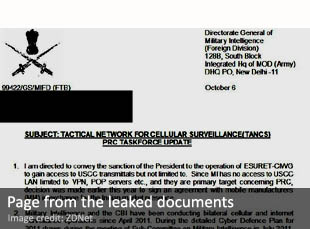
Leaked documents acquired by a computer hacker collective appear to show that international cell phone manufacturers helped Indian intelligence agencies spy on the United States, in return for access to the Indian cellular phone market. The documents, which are written in English, were posted online on Saturday by a group of Indian hackers calling themselves Lords of Dharamraja. In a statement, the group said they obtained the documents by breaking into the computer servers of Indian Military Intelligence, after managing to acquire the source code of Symantec Corporation, makers of Norton antivirus software. According to the documents, the companies arm-twisted to assist Indian intelligence agencies to spy on the US included Apple, Nokia, and Research in Motion, the company that builds BlackBerry devices. The documents also appear to show that Indian intelligence agencies were particularly eager to spy on the United States-China Economic and Security Review Commission. Established by the US Congress in 2000, the Commission is tasked with researching and reporting on the national security implications of bilateral trade between the US and China. Allegedly, the cellular telephone makers provided Indian intelligence agencies with backdoor access to personal phones used by Commission members. These back doors allegedly allowed the Indian Military Intelligence Directorate and India’s Central Bureau of Investigation to spy on Commission members beginning in April of 2011. Read more of this post


News you may have missed #659

China and PakistanBy IAN ALLEN | intelNews.org |
►►China wants military bases in Pakistan. An Indian intelligence report leaked in the country’s press appears to reveal that China and Pakistan are in secret negotiations to allow Beijing to build military bases on Pakistani soil. The report states that “China’s desire for a military presence in Pakistan has been discussed by the political and military leadership of that country in the recent months. China’s deepening strategic penetration of Pakistan and joint plans to set up […] oil pipelines/rail/roads as well as naval and military bases are a matter of concern”.
►►Turkey ‘almost shot down’ Israeli spy drone. An Israeli drone flying over Turkey was nearly intercepted by Turkish aerial defense forces, an Istanbul-based media outlet reported on Tuesday. According to the report, “by the time the order [to shoot down the Israeli drone] was given, [it] had already left the area”. A spokesperson for the Israel Defense Forces refused to comment on the Turkish report.
►►Analysis: Global apparatus for drone killing emerges under Obama. “The Obama administration’s counterterrorism accomplishments are most apparent in what it has been able to dismantle, including CIA prisons and entire tiers of al-Qaeda’s leadership. But what the administration has assembled, hidden from public view, may be equally consequential”. Excellent analysis by Greg Miller, who argues that “the rapid expansion of the drone program has blurred long-standing boundaries between the CIA and the military”.

CIA installed nuclear surveillance device atop Himalayas mountains

Nanda DeviBy JOSEPH FITSANAKIS | intelNews.org |
The United States Central Intelligence Agency tried at least twice to install a nuclear-powered surveillance device atop the Indian Himalayas, in an effort to spy on China. The decision to plant the device was taken in 1964, soon after communist China detonated its first nuclear bomb. In 1965, a team of CIA operatives attempted to climb Nanda Devi in the Garhwal Himalayas, which, at 25,645 feet (7,816 meters), is the highest mountain peak located entirely within Indian territory. But the top-secret mission failed miserably after adverse weather forced the CIA team to give up its effort approximately 2,000 feet below the summit. Battling against a heavy snowstorm, the CIA officers abandoned the 125-pound device, which was eventually swept away (.pdf document) by an avalanche. Incredibly, the team members deserted the surveillance device even though they knew it contained plutonium 238, which can emit radioactivity for over 500 years. In 1966, the same CIA team returned to Nanda Devi, in an effort to recover the complex surveillance instrument, but failed to locate it. In response to the second failed mission, the Agency decided to close the book on Nanda Devi, and instead constructed an identical surveillance device, which was transported and installed on Nanda Kot, a mountain peak located about nine miles (15 km) southeast of Nanda Devi. At 6,861 meters, Nanda Kot is about 3,000 feet shorter and far less steep than Nanda Devi. In 1967, a successful CIA attempt was made to reach the peak of Nakda Kot, where the radioactive surveillance device was installed. It is believed that it served its purpose before being abandoned there in 1968. Ten years later, in 1978, both operations were revealed in an article published in US-based Outside magazine. The revelation caused a major political uproar in India, as many Indians consider the Himalayas ‘sacred’ ground. Now the National Archives of India has released a batch of previously classified internal documents from India’s Ministry of External Affairs. Read more of this post

Did Outside Spy Agencies Know About Kim Jong Il’s Death?

Kim Jong Il lies in state in PyongyangBy JOSEPH FITSANAKIS* | intelNews.org |
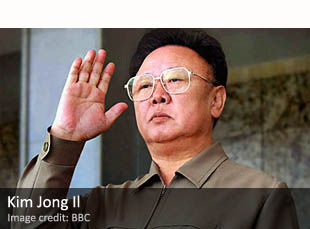
According to KCNA, North Korea’s state news agency, Premier Kim Jong Il died at 8:30 am on Saturday, December 17. However, government media did not announce the startling news until early Monday morning, that is, nearly 50 hours after the “Dear Leader’s” sudden passing. Assuming that North Korean reports of the time and location of Kim’s death are truthful, the inevitable question for intelligence observers is: did anyone outside North Korea receive news of Kim Jong Il’s death during the 50 hours that preceded its public announcement? In times like this, most Westerners tend to look at the Central Intelligence Agency, National Security Agency, MI6, DGSE, or any of the other recognizable acronyms that dominate American and European news reports. The reality is, however, that despite their often-mythical status, Western intelligence agencies tend to be limited in their global reach, which is usually heavily concentrated on selected adversaries, like Russia, or China. These agencies therefore tend to rely on their regional allies to get timely and accurate information on smaller nations that are often difficult to penetrate. In the case of North Korea, Western spy agencies depend heavily on actionable intelligence collected by South Korean and Japanese spies. Read more of this post

Spy agencies scramble for clues after North Korean leader’s death

Kim Jong IlBy JOSEPH FITSANAKIS* | intelNews.org |
Even though rumors had been rife for quite some time about North Korean leader Kim Jong Il’s worsening health, his death startled intelligence agencies the world over. In typical fashion, North Korean state media announced yesterday that “the dear leader” had died on Saturday onboard a train during one of his usual field trips, “due to immense mental and physical strain caused by his […] building of a thriving nation”. A period of national mourning has been declared in the country until December 29. In the hours following the startling announcement, which Time magazine dubbed “a nightmare before Christmas”, no unusual activity was observed in the North, while early Monday reports from North Korean capital Pyongyang stated that traffic was “moving as usual”. Moreover, despite longstanding rumors about Kim Jong Il’s ill health, few intelligence analysts in South Korea, Japan, or the United States have been observing overt signs of political instability, or a leadership crisis. However, despite the apparent calm in the North, intelligence agencies around the world have gone on high alert, led by those in South Korea, which has remained technically at war with the North since 1950.  South Korean President Lee Myung-bak reportedly placed the country’s military on emergency alert on Sunday, and has ordered government officials to remain in capital Seoul and “maintain emergency contact” with their office staff. French sources said that one of the first outcomes of an emergency National Security Council meeting that took place in Seoul on Sunday was to request that the American Pentagon, which maintains nearly 30,000 troops in South Korea, steps up aerial surveillance over the North. Japan has also stepped up its intelligence-gathering operations in North Korea, and its Prime Minister, Yoshihiko Noda, instructed his government to “closely share information” on North Korea with the United States, South Korea, and —notably— China. Read more of this post

Comment: Is China the New Spy Superpower?

US and China

US and China

By JOSEPH FITSANAKIS* | intelNews.org |

In fifteen years of monitoring intelligence-related developments, I have rarely seen so many news items about China appear simultaneously in the Western press, as I did during the past fortnight. On December 5, financial news network Bloomberg reported that the United States government invoked “Cold War-era national security powers” to compel telecommunications companies operating on American soil to disclose confidential data about their networks. The plan, spearheaded by the US Department of Commerce, but undoubtedly prompted and monitored by the National Security Agency, features a detailed survey distributed to dozens of telecommunications service providers, as well as hardware and software developers. The latter are reportedly required to supply “a detailed accounting” of every piece of “foreign-made hardware and software” installed on their networks, in a move that Bloomberg interprets as “a hunt for Chinese cyber-spying”. A few days later, intelligence researcher and author David Wise opined in The New York Times that the West had better recognize that China “has developed a world-class espionage service —one that rivals the CIA”. He qualified his statement by providing several examples of major espionage triumphs achieved by the Chinese intelligence services in the last decade, such as the acquisition of design blueprints for the US-built B-1 bomber and Northrop Grumman’s B-2 stealth bomber. Other examples given by Wise include China’s attainment of the design specifications for the US Navy’s Quiet Electric Drive system, aimed at enhancing the stealth abilities of submarines, as well as the remains of the modified Black Hawk helicopter that crashed in Abbottabad, Pakistan, during the CIA-led operation to assassinate al-Qaeda founder Osama bin Laden last May. Most of all, Wise laments the acquisition by the Chinese of the design specifications for the W-88 warhead, the symbol of America’s next-generation of mini-nuke weapons. Read more of this post

News you may have missed #645

Turki al-Faisal

Turki al-Faisal

►►Polish authorities arrest retired spy. The former head of Poland’s State Protection Bureau (1993-96) has been detained by officers of the country’s Central Anticorruption Bureau. Identified as Gromoslaw Cz., the arrestee is a retired general and intelligence officer, who participated in the extraction of CIA officers in Iraq in 1990. According to TVN 24 news, Gromoslaw Cz.’s detention is connected with events surrounding the privatization of the G-8 group of energy companies in the years 1994-2004, which eventually set up Energa concern in 2005.
►►Are China’s hotel rooms bugged? What could have been a dull security conference in Canada last week turned into a pretty interesting one, when former diplomat Brian McAdam claimed that “virtually all” hotels in China are rigged with hidden microphones and video cameras. The latter, he said, are used by the Chinese government to recruit many of its informants, by catching them in the act in carefully planned liaisons.
►►Ex-spy chief says Saudi Arabia may join nuke arms race. Saudi Arabia may consider acquiring nuclear weapons to match regional rivals Israel and Iran, its former intelligence chief Prince Turki al-Faisal said on Monday. “Our efforts and those of the world have failed to convince Israel to abandon its weapons of mass destruction, as well as Iran […]. Therefore it is our duty towards our nation and people to consider all possible options, including the possession of these weapons” Faisal told a security forum in Riyadh.

News you may have missed #642

Predator drone

Predator drone

►►Australia concerned China using civilian satellites to spy. Concerns that China may use civilian satellite tracking stations to monitor Australian military operations have been dismissed by the Swedish Space Corporation. The company owns and operates two satellite tracking stations 400 km north of the West Australian capital, Perth. One was used by the China Satellite Launch Company last month in China’s first space docking operation.
►►Did Iran capture US stealth drone intact? For the second time this year, the Iranian government is claiming it forced down a stealthy US Air Force spy drone. Only this time, it says it bagged the RQ-170 “with little damage” by jamming its control signal —a potentially worrying development for American forces heavily reliant on remote-controlled aircraft. A US official, who asked not to be named, told Reuters that “there is absolutely no indication up to this point that Iranians shot down this drone”.
►►Canadian Mounties spied on native protest groups. Canada’s federal government created a vast surveillance network in early 2007 to monitor protests by First Nations, including those that would attract national attention or target “critical infrastructure” like highways, railways and pipelines, according to RCMP documents. The RCMP intelligence unit reported weekly to approximately 450 recipients in law enforcement, government, and unnamed “industry partners” in the energy and private sector. The news follows revelations last month of the RCMP’s largest-ever domestic intelligence operation, aimed against G8 and G20 protesters.

News you may have missed #640

Amos Yadlin

Amos Yadlin

►►Chinese defector says Canada right to worry about spying. Li Fengzhi, a former intelligence officer for China’s Ministry of State Security, who defected to Canada in 2003, has told a conference that Canada should be concerned about relationships between senior politicians and journalists from China, saying Beijing is targeting lawmakers everywhere. He was referring to the case of senior Conservative MP Bob Dechert, who was enveloped by controversy in September over amorous e-mails he sent to Shi Rong, a Chinese government journalist based in Toronto. After the Dechert controversy broke, the journalist recalled to Beijing to meet with her superiors and has not returned to her Canadian posting.
►►More intel officials warn against airstrikes on Iran. Meir Dagan, the former head of Israeli spy agency Mossad, is not alone in warning against the possibility of Israeli attacks against Iran’s nuclear program. He has now been joined by Major General Amos Yadlin, who until recently headed Israel’s Military Intelligence directorate. Speaking at Israel’s Institute for National Security Studies, Yadlin doubted that airstrikes could threaten Iran’s numerous, distant and well-defended nuclear facilities. Another intelligence official, Saudi Arabia’s Prince Turki al-Faisal, also cautioned last week against any attacks on Iran, saying that “there are other non- military policy alternatives, as yet unexplored, that could have the desired result without the unwanted consequences”.
►►GCHQ challenges code breakers via social networks. Britain’s signals intelligence agency, the General Communications Headquarters, has launched a code cracking competition to help attract new talent. The organization has invited potential applicants to solve a visual code posted at an unbranded standalone website. The challenge will also be ‘seeded’ to social media sites, blogs and forums. A spokesman said the campaign aimed to raise the profile of GCHQ to an audience that would otherwise be difficult to reach.

News you may have missed #634

Husain Haqqani

Husain Haqqani

►►Korean ex-soldier investigated for spying. Police suspect that a former South Korean Army soldier, Kim, 34, whose full name was undisclosed to the media, crossed through Shenyang, northeastern China, into the North and handed over information gathered during and after his military service. This is the second case involving alleged North Korean spying on the South in as many days.
►►Pakistan ambassador to US resigns over spy memo row. Islamabad’s ambassador to Washington, Husain Haqqani, has resigned after a confrontation between Pakistan’s military and the civilian government of President Asif Ali Zardari. His resignation follows reports of an offer by the Pakistani government to the United States to rein in the army and its spy agency, Inter-Services Intelligence. Zardari’s government was accused of treachery over the proposal, which was made in a memo delivered to the US military chief, Admiral Mike Mullen.
►►US says ‘no proof’ of Libyan ex-spy chief’s capture. It emerged earlier this week that former Libyan intelligence chief Abdullah al-Senussi had been captured. But the United States now says there is no proof he is in custody. According to Susan Rice, the US envoy to the United Nations, Libyan authorities “were not able to confirm that Senussi was in anybody’s custody”.

Analysis: China an ‘easy scapegoat’, says leading cybersecurity expert

Mikko Hypponen

Mikko Hypponen

By JOSEPH FITSANAKIS | intelNews.org |
It is fashionable nowadays to single out China as the primary source of global cyberespionage. During the past few days alone, the Japanese government said Chinese hackers had attacked computers systems in its Lower Parliament, while Britain’s General Communications Headquarters (GCHQ) pointed to Beijing as the main culprit behind an unprecedented rise in organized cyberattacks. A few days ago, the United States intelligence community publicly named for the first time China and Russia as “the most aggressive collectors” of US economic information and technology online. But is the image of China as the ultimate cyber-villain accurate? Not necessarily, according to leading cybersecurity expert Mikko Hypponen. Speaking earlier this week at the PacSec 2011 conference in Tokyo, Japan, Hypponen, who leads computer security firm F-Secure, disputed the predominant view that a single country could be the source of the majority of organized cyberattacks directed against governmental and corporate targets. It is true, said Hypponen, that cyberespionage attacks “are commonly attributed to the Chinese government”. Moreover, it does appear like “a lot” of these attacks are indeed coming from Chinese sources, he said. But the problem of attribution —accurately and conclusively determining the responsible agency behind a cyberattack— remains unresolved in our time. Even if Chinese servers are conclusively identified as sources of such attacks, it would be dangerous to assume that Chinese government operatives —and not rogue agents, or nationalist hacker gangs— are necessarily behind them. Additionally, it is entirely possible that other countries —perhaps even Western countries— could be behind such attacks, but that they consciously try to mask them in such a way as to make China appear responsible. The reason is that Beijing is “such an easy scapegoat”, said Hypponen. Read more of this post

News you may have missed #625

Ahmed Al Hawan

Ahmed Al Hawan

►►Egypt’s most famous spy dies at 74. Egypt’s most famed spy on Israel, Ahmed Al Hawan, 74, has died after a long fight with illness, local media reported on Wednesday. Al Hawan worked for the Egyptian intelligence service during the years that followed Egypt’s military defeat by Israel in 1967. He supplied the Israelis with mistaken and misleading information that was crucial in Egypt’s war with Israel in 1973.
►►Analysis: Dark days for Taiwan’s spies. When Taiwan’s government last month announced budget cuts in military intelligence, the Ministry of National Defense (MND) insisted operations against mainland China would not be affected. However, media paint a vastly different picture, suggesting Taiwan’s future leaders will be completely deaf and blind to secretive developments across the Taiwan Strait.
►►US cyberespionage report names adversaries. A US intelligence report released last week concluded China and Russia are “the most aggressive collectors” of US economic information and technology online. But the report also states that America’s “allies and partners“, including the “French and the Israelis” are also stealing the s vital industrial and commercial secrets by infiltrating computer networks.

News you may have missed #624

Viktor Bout

Viktor Bout

►►Russia angry at Viktor Bout’s US guilty verdict. Moscow has reacted angrily to the guilty verdict handed down to Russian arms dealer Viktor Bout by a court in the United States. Bout, a former Soviet military intelligence (GRU) officer, was arrested in a sting operation in Bangkok, Thailand, in March of 2008. At the time of his arrest, he and his two collaborators were negotiating a complex weapons deal with two informants posing as representatives of the Revolutionary Armed Forces of Colombia (FARC), Latin America’s largest leftist paramilitary group.
►►Symposium examined Reagan’s use of intelligence. The CIA released more than 200 declassified documents it prepared for US President Ronald Reagan during a symposium last week at the Ronald Reagan Presidential Library in Simi Valley, California. The CIA conference, entitled “Ronald Reagan, Intelligence, and the End of the Cold War“, included a discussion by American and Soviet former spies.
►►Suspected Chinese spy loses bid to rejoin Canada civil service. Haiyan Zhang, worked as a senior communications analyst with the Privy Council Office in Ottawa. She was fired when Canada’s spy agency questioned her “loyalty to Canada” over suspicion she was spying for China. Now she has lost her fight to return to the civil service.

US report links telecoms company to Chinese spy services

Sun Yafang

Sun Yafang

By JOSEPH FITSANAKIS | intelNews.org |
For the first time a United States government agency has openly linked one of China’s main telecommunications companies with the country’s intelligence services. The alleged link is provided in a new report by the US Open Source Center, which acts as the open-source intelligence (OSINT) arm of the Office of the Director of National Intelligence. The report concludes that the company, Huawei Technologies, relies on a series of formal and informal contacts with the Chinese People’s Liberation Army and the Ministry of State Security (MSS), which oversee and administer China’s military and civilian intelligence apparatus. Founded in 1987 to import Western office telephone systems to China, the company has become one of the country’s leading exporters of all kinds of communications hardware equipment, ranging from routers to cell towers and undersea cables. But Huawei’s export growth has been hampered in recent years by widely circulated suspicions that the company maintains close ties to the Chinese military and intelligence establishments. The Open Source Center report adds to these suspicions, by pointing out that Huawei’s current chairperson, Sun Yafang (pictured), was an employee of the MSS Communications Department prior to joining Huawei in 1989. It also says that, prior to joining the company, Sun utilized her personal contacts at MSS to “help Huawei through financial difficulties at critical moments when the company was founded in 1987”. The close contacts between the —ostensibly private— company and the Chinese government have persisted ever since, says the report, and points out that the Chinese state has funded Huawei with nearly a quarter-billion dollars for “research and development” projects in the past three years alone. This is not the first time that Huawei has been accused of maintaining close contacts with Chinese intelligence agencies. In 2009, the Australian Security Intelligence Organisation (ASIO) investigated one of Huawei’s Australian-based subsidiaries for links to Chinese intelligence operations. In the following year, the Indian government barred the company from operating in India, citing its allegedly “strong links with the Chinese military”. Read more of this post