Chinese hackers used Facebook to target Uighur activists with malware
March 25, 2021 4 Comments

CHINESE HACKERS USED FAKE Facebook accounts to target individual activists in the expatriate Uighur community and infect their personal communications devices with malware, according to Facebook. The social media company said on Wednesday that the coordinated operation targeted approximately 500 Uighur activists living in the United States, Canada, Australia, Syria, Turkey and Kazakhstan.
At least 12 million Uighurs, most of them Muslims, live in China’s Xinjiang region, which is among the most impoverished in the country. The Chinese state is currently engaged in a campaign to quell separatist tendencies among some Uighurs, while forcibly integrating the region’s population into mainstream culture through a state-run program of forcible assimilation. It is believed that at least a million Uighurs are currently living in detention camps run by the Communist Party of China, ostensibly for “re-education”. Meanwhile, thousands of Uighur expatriates, most of whom live in Kazakhstan and Turkey, are engaged in a concerted campaign aimed at airing human-rights violations occurring in the Chinese detention camps throughout Xinjiang.
According to Facebook, Chinese hackers set up around 100 accounts of fake personas claiming to be journalists with an interest in reporting on human rights, or pro-Uighur activists. They then befriended actual Uighur activists on Facebook and directed them to fake websites that were designed to resemble popular Uighur news agencies and pro-activist websites. However, these websites were carriers of malware, which infected the personal communications devices of those who visited them. Some Facebook users were also directed to fake smartphone application stores, from where they downloaded Uighur-themed applications that contained malware.
Facebook said it was able to detect and disrupt the fake account network, which has now been neutralized. It also said it was able to block all fake domains associated with the hacker group, and notified users who were targeted by the hackers. It added that its security experts were not able to discern direct connections between the hackers an the Chinese state.
► Author: Joseph Fitsanakis | Date: 25 March 2021 | Permalink

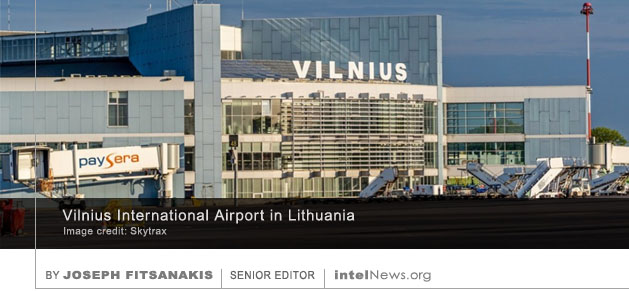 CITING NATIONAL SECURITY GROUNDS, the government of Lithuania has canceled an agreement with a Chinese-owned company to supply baggage-scanning equipment at airports across the Baltic country. The Beijing-based company, Nuctech, is owned by Tsinghua Tongfang, which is in turn controlled by the China National Nuclear Corporation (CNNC). Tasked with managing China’s nuclear fuel supply and development program, CNCC is owned by the Chinese government.
 THREE CHINESE NON-OFFICIAL cover intelligence officers, who were working in London under journalistic cover, were expelled from Britain in the past year, according to a new report. The claim was made on Thursday by The Telegraph newspaper, which
 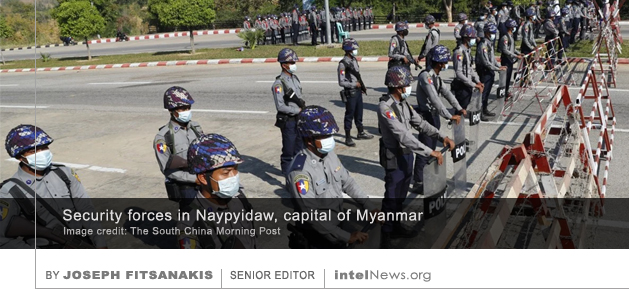 CHINESE GOVERNMENT OFFICIALS HAVE denied claims that Beijing consented to, and even supported, the coup that took place in Myanmar on Monday. The Southeast Asian country’s armed forces seized control of key government installations in the early hours of Monday, before announcing that parliament had been dissolved. Hundreds of politicians, including Myanmar’s State Counsellor Aung San Suu Kyi, have been arrested, and the fate of many of them remains unknown. The military claims that the general elections of November 8, 2020, which gave Aung San Suu Kyi’s National League for Democracy party 61 percent of the vote, were fraudulent.
 The Afghan government reportedly expelled from the country 10 Chinese intelligence officers on Saturday, after they were found to have contacts with pro-Taliban groups. Meanwhile the White House was recently briefed about claims that Beijing offered Afghan militants bounties for killing American soldiers.


 A former employee of British intelligence has strongly denied accusations, which surfaced last week in the European press, that he gave secrets to two Chinese operatives in exchange for money. Some news outlets have suggested that he is currently under investigation by at least one European government.
 A court in Paris has sentenced to prison two former employees of France’s external intelligence agency, who were accused of spying for the government of China. A third person, the wife of one of the accused, was also handed a jail sentence.
 • In-fighting erupts between Syrian intelligence and army in Damascus. Violent clashes broke out between Syrian regime intelligence forces and local militias affiliated with the army’s 4th Division and national defense in Damascus’ countryside, local media sources reported. Sporadic fighting
  The trial of two French former intelligence officers begins today in Paris, with the two men accused by French authorities of having spied for China in the 1990s and 2000s. French officials have remained largely silent on the two cases, but media reports have suggested that the two former intelligence officers were found to have carried out espionage tasks for the Chinese government.
 A
A 






 intelNews.org
Taiwan files charges against couple identified by Chinese defector as alleged spies
April 9, 2021 by Joseph Fitsanakis 1 Comment
AUTHORITIES IN TAIWAN HAVE filed money-laundering charges against a Chinese couple, who were identified as spies by a man who defected to Australia in 2019, claiming to be a Chinese intelligence operative. Wang “William” Liqiang, 28, from China’s eastern Fujian province, defected to Australia in October of 2019, while visiting his wife and newborn son in Sydney. He and his family are currently believed to be living under the protection of the Australian Security Intelligence Organization (ASIO).
In a 17-page sworn statement filed shortly after his defection, Wang reportedly gave details of his work as an undercover intelligence officer for Chinese military intelligence. He is also said to have shared the identities of senior Chinese intelligence officers in Taiwan and Hong Kong, and to have explained how they carry out espionage operations on behalf of Beijing. Some media reports claimed that Mr. Wang had shared details about deep-cover Chinese intelligence networks in Australia. Wang also claimed that he worked for a Hong Kong-based company called China Innovation Investment Limited (CIIL), which was in reality a front company set up to provide proprietary cover for Chinese spies like himself.
The Chinese government responded to Wang’s allegations by publicly calling him a “fraud” and claiming that his Chinese passport and Hong Kong identity papers were forgeries. Meanwhile, CIIL filed legal action against Wang for libel and spreading malicious falsehoods. But that did not stop Taiwanese authorities from arresting CIIL’s directors, Xiang Xin and Gong Qing, on November 24, 2019. The directors, a married couple, were about to board an international flight at Taiwan’s Taoyuan Airport, when they were detained by members of the country’s Investigation Bureau. Following their detention, they were barred from leaving the country until further notice.
Under Taiwanese law, authorities in the island country had until April 14 of this year to file charges against the couple, or allow them to leave the country. On Thursday, the Office of the Taipei District Prosecutor announced that money laundering charges had been filed against the two CIIL directors. According to the indictment, the couple used nearly $26 million that they allegedly acquired illicitly from China, in order to purchase three luxury apartments in Taipei’s affluent Xinyi district. Additionally, the Prosecutor’s office said the two Chinese citizens continue to be under investigation for potentially violating Taiwan’s National Security Act.
► Author: Joseph Fitsanakis | Date: 09 April 2021 | Permalink
Filed under Expert news and commentary on intelligence, espionage, spies and spying Tagged with Australia, China, defectors, Gong Qing, Hong Kong, Investigation Bureau (Taiwan), money laundering, News, Taiwan, Wang Liqiang, Xiang Xin