News you may have missed #0181

Bookmark and Share

Details emerge on Israeli bombing of Syrian nuke reactor

Ibrahim Othman

Ibrahim Othman

By JOSEPH FITSANAKIS | intelNews.org |
German newsmagazine Der Spiegel has published a most detailed examination of the background to Operation ORCHARD, the 2007 Israeli air attack on what is thought to have been a Syrian nuclear reactor. The attack was carried out by Israeli fighter jets in the night of September 6, 2007, at Al-Kibar, a site deep in the Syro-Arabian Desert, twenty miles from Deir al-Zour. Neither Syria nor Israel have commented on the attack, which is widely thought to have targeted Syria’s so-called Al-Kibar nuclear reactor. Der Spiegel’s article is based on interviews with nuclear and security experts, as well as “with individuals involved in the operation, [and] have only now agreed to [speak], under conditions of anonymity”, according to the authors. The article claims that the initial tip about Al-Kibar was given to the Israelis in 2004 by the US National Security Agency, which “detected a suspiciously high number of telephone calls between Syria and North Korea”. Read more of this post
FBI still lacks translators, eight years after 9/11, says report

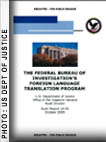
Report cover

Report cover

By IAN ALLEN | intelNews.org |
An internal audit by the US Justice Department’s inspector general has found that the FBI faces a critical shortage of foreign-language specialists, eight years after 9/11. The audit report (redacted version available in .pdf here) issued last Monday by inspector general Glenn Fine, reveals that the lack of translators prevented the FBI from accessing 31 per cent of the foreign-language material it collected in counter-terrorism operations from 2006 to 2008. This means the Bureau, which serves as America’s primary counterintelligence and counterterrorism force, has been unable to read tens of thousands of pages and listen to or review 1.2 million hours of audio intercepts in the last two years alone. Remarkably, despite the well-understood need for foreign-language specialists in the post-9/11 security environment, the audit found that the total number of FBI translators dropped from 1,338 in March 2005 to 1,298 in September last year. Read more of this post

Israel mum on mysterious devices found in Lebanon

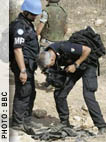
One of the devices

One of the devices

By JOSEPH FITSANAKIS | intelNews.org |
Israel has refused to either confirm or deny it planted a number of communications interception devices that were uncovered last week by security forces in southern Lebanon. Responding to a “request for clarifications” issued by the United Nations, the Israeli government said simply that “collecting intelligence in southern Lebanon will continue as long as the government in Beirut is not in full control of its territory”, an obvious reference to Hezbollah, the Shia Islamic political and paramilitary organization that controls large parts of Lebanon. Three the devices were found last week, attached to a telecommunications cable on the outskirts of the southern Lebanese village of Houla. Interestingly, two of the devices self-destructed by exploding as Lebanese security personnel were approaching. Read more of this post

News you may have missed #0155

  • NSA confirms rumors of new Utah data center. IntelNews readers have known about this since last July. Despite the new center, NSA still cannot process all the information it intercepts. But officials told a press conference on Friday that the Agency “has no choice but to continue enhancing its data processing efforts”.
  • UK intel agents to train West Bank security forces. Britain is sending intelligence officers from MI5 and MI6 to the West Bank, to train the Palestinian Authority’s Mukhabarat intelligence agency. According to The Daily Mail, the move is aimed to “stop a wave of brutal torture by Palestinian security forces”. How ironic is it, then, that both MI5 and MI6 are currently under investigation by British police for complicity to torture?

Bookmark and Share

Mysterious self-destructing devices found at Lebanon-Israel border

One of the devices

One of the devices

By JOSEPH FITSANAKIS | intelNews.org |
Lebanese authorities have revealed the discovery last week of three communications interception devices near the Israel-Lebanon border. Interestingly, two of the devices self-destructed by exploding as Lebanese security personnel were approaching. Members of the Lebanese Armed Forces decided to detonate a third device, fearing that it too might explode at any moment. The three devices were attached to a telecommunications cable on the outskirts of the southern Lebanese village of Houla. Israeli officials have so far refused to address the accusation of the Lebanese government that the devices were planted by Israeli spies. Read more of this post

Indian government tells telecoms to avoid buying Chinese hardware

Huawei logo

Huawei logo

By IAN ALLEN | intelNews.org |
The Indian government has asked the country’s telecommunications companies to “refrain from buying Chinese telecommunications equipment”, because they may be used by Beijing to spy on India. The request was reportedly delivered to Indian telecommunications industry representatives by officials from India’s Department of Telecommunications, in a closed-door meeting earlier this week. Indian media report that the Department’s request has no legal backing, but is simply a call for Indian telecommunications providers to “self-regulate”. But the government is said to be working on official guidelines to restrict the domestic use of telecommunications hardware and software originating from countries considered “unfriendly” to India, including Pakistan, China and Egypt. Some industry observers have expressed fears that the pending restrictions will severely hinder the growth of India’s rapidly rising telecommunications sector. Read more of this post

News you may have missed #0133

  • Book examines Central Asian espionage in WWI. On Secret Service East of Constantinople, by Peter Hopkirk (John Murray Publishers), examines the role of German intelligence services in Kaiser Wilhelm’s attempt to gain influence in the Ottoman Empire, the Caucasus, Persia, Afghanistan and India. A very interesting, under-researched aspect of World War I.
  • CIA intercepted communication between Zazi and al-Qaeda. A local TV station in Denver, Colorado, quotes “intelligence officials familiar with the investigation” of Najibullah Zazi, as saying that the CIA alerted US federal agencies after intercepting a conversation between Zazi and a senior al-Qaida operative. No word yet about this from the FBI, which is supposed to handle domestic terrorism cases.
  • US defense secretary hints at more secret nuke sites in Iran. Speaking alongside Secretary of State Hillary Clinton last night at a CNN/George Washington University forum, Robert Gates dropped what seemed to be a big hint that the United States knows much more about the Iranian nuclear program than the Iranians might think.

Bookmark and Share

News you may have missed #0128

  • US government appeals judge’s order in Cuban Five spy case. US government officials are contending a judge’s order because they say it would be detrimental to US national security. The order requires the US government to turn over any national security damage assessments in the Cuban Five case. Washington accuses the Five of spying on the US for Cuba. Three of the five are to be given new sentences on October 13 after an appeals court ruled that the initial sentences they received (ranging from 19 years to life) were too long.
  • Indian spies want access to missed calls. Indian security agencies have told the country’s Department of Telecommunications that they need access to missed calls because “anti-social elements” may be using the system to communicate without actually making a call. Last month, India’s Intelligence Bureau asked for all VOIP (internet-based) calls in the country to be blocked until it figures out a mechanism to track them. It also said it wants access to the content of all mobile phone calls in the country.
  • New book investigates Stasi’s scientific espionage. Documents from the vaults of HVA (Hauptverwaltung Aufklärung), the foreign department of the Stasi, the East German Ministry for State Security, which were purchased by the CIA from a German informant in 1992, were made available in 2005 to Kristie Macrakis professor of history at the Georgia Institute of Technology in Atlanta. Her book, Seduced by Secrets: Inside the Stasi’s Spy-Tech World, offers a rare look into the Stasi’s secret technical methods and sources. Macrakis’s analysis of the CIA material reportedly reveals that about 40% of all HVA sources planted in West German companies, research institutions and universities were stealing scientific and technical secrets.

Bookmark and Share

News you may have missed #0126

  • Cyber spying increasing in the US, says new report. The Office of the US National Counterintelligence Executive’s annual report says that cyber attacks against US government and business targets “proliferated in fiscal year 2008”. The report also states that Blackberries and iPhones belonging to government and business personnel are becoming major targets by foreign cyber spies.
  • Analysis: The case for a US National Declassification Center. There is no argument about the fact that the US government’s declassification system simply doesn’t work. The way around the problem is to establish a centralized National Declassification Center, according to a National Archives and Records Administration white paper.
  • New Colombian spy agency forbidden from conducting wiretaps. Technically, the scandal-prone Administrative Department of Security (DAS) is no more in Colombia. The new agency, which is expected to replace DAS, will not be allowed to tap telephones, a function that will be solely entrusted to the police force. We’ll have to wait and see about that.

Bookmark and Share

News you may have missed #0122

  • Canada authorities push for Internet spy bill. The push for new Internet surveillance capabilities in Canada –dubbed the “lawful access” initiative– dates back to 1999, when government officials began crafting proposals to institute new surveillance technologies in Canadian fifth-generation networks. Internet Service Providers are skeptical of the initiative, while law enforcement and security agencies argue that the changes are long overdue.
  • Peru’s former leader guilty of spying, bribery. Peru’s former strongman Alberto Fujimori pleaded guilty today to charges of wiretapping opponents and paying bribes to lawmakers and publishers during his rule from 1990 to 2000. Unfortunately, the CIA supported Fujimori and his right-hand man, Vladimiro Montesinos and even suppressed a CIA officer who tried to argue that supporting such lowlifes was politically wrong and ethically immoral.
  • CIA honors two spies. CIA director Leon Panetta awarded the Trailblazer Medal (the supreme decoration in the US intelligence community) to two agents, one of whom is the late John Guilsher, who recruited Soviet scientist Adolf Tolkachev at the height of the Cold War. Are we to presume that Panetta has not read the recent paper by Benjamin Fischer, former CIA clandestine operative and retired CIA historian, who claims that Tolkachev was actually a KGB double agent tasked by Soviet intelligence with providing US military strategists with false information?

Bookmark and Share

News you may have missed #0114

Bookmark and Share

Colombia to dismantle scandal-prone spy agency

Semana cover

Semana cover

By JOSEPH FITSANAKIS | intelNews.org |
Colombia’s Administrative Department of Security (DAS) is to be dismantled and most of its 6,000 employees are to be transferred to the country’s other law enforcement agencies, according to Colombian officials. The decision was announced last Friday by DAS director Felipe Muñoz, who said that a new organization would be established to replace the corrupt and scandal-prone agency. A day earlier, Colombian President Álvaro Uribe said that a flood of recent scandals involving DAS had forced him to consider eliminating the agency. Earlier this year, the Colombian government was forced to fire 33 DAS agents for illegally wiretapping the phones of several public figures Read more of this post

News you may have missed #0108

  • Fatah dismisses spy chief in West Bank. Palestinian President Mahmoud Abbas has dismissed Palestinian General Intelligence Chief Mohammad Abu Assam. The dismissal appears to be part of a broader plan to unify the Palestinian Preventive Security Service and the General Intelligence Service, who have been fighting a notorious turf war for several years.
  • Indian Intelligence Bureau wants to block all VOIP Services. India’s Intelligence Bureau has instructed the country’s communications ministry to block all VOIP (internet-based) calls in the country until it figures out a mechanism to track them. It has also said it wants access to the content of all mobile phone calls in the country. Indian security agencies have been struggling with this issue since the 2008 Mumbai attacks, after it emerged that the attackers used VOIP software to communicate with the their handlers.
  • Is Afghan President’s brother a US informant? There is speculation that Ahmed Wali Karzai, notorious drug lord and younger brother of Afghan President Hamid Karzai, is in fact an informant for US intelligence agencies. It true, this would explain why he has been allowed by US agencies to operate freely in the country.

Bookmark and Share

Lawsuit halted in 15-year-old CIA wiretap case

Judge Lamberth

Judge Lamberth

By JOSEPH FITSANAKIS | intelNews.org |
A lawsuit against an alleged illegal wiretap operation by the CIA, which was initially filed 15 years ago, was put on hold late last week by a US federal appeals court. The court imposed the temporary hold in an apparent disagreement with US District Judge Royce Lamberth, who last July said CIA attorneys committed fraud in alleging that US national security would be threatened if details of the lawsuit were openly discussed. Judge Lamberth ruled that the CIA had kept the case secret for years in order to avoid embarrassment. But the appeals court appears to have accepted the CIA’s claim that discussing the case openly will reveal operational secrets and harm US national security. A simultaneous decision by the appeals court to order the government to grant security clearances to lawyers on both sides of the argument probably means that the case, which briefly surfaced last July after Judge Lamberth’s decision to reveal it to the public, will disappear once again under the “state secrets” clause. Read more of this post