Greece expels Russian diplomats who ‘tried to bribe Greek officials’
July 12, 2018 Leave a comment
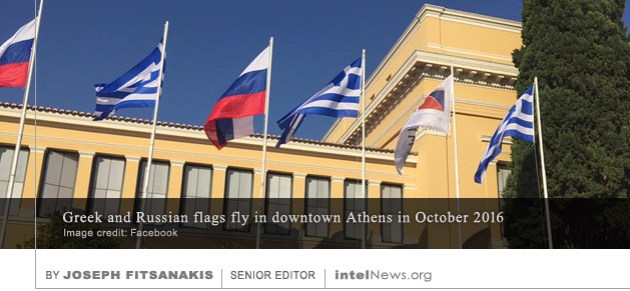 In a rare moment of downturn in relations between Athens and Moscow, Greece has expelled two Russian diplomats and refused to accredit two more, reportedly for “undermining Greek national security”. Greece was not among nearly 30 countries that expelled or refused to accredit over 150 Russian diplomats in March, in an act of solidarity with the United Kingdom. The expulsions came in response to the attempted assassination of Sergei Skripal, a Russian former intelligence officer who had been living in England since 2010. Britain accused the Kremlin of having sponsored the attack on Skripal. But the Greek government, which has enjoyed warm relations with Moscow for decades, warned against unduly aggressive measures against the Kremlin.
Things changed swiftly on Wednesday, however, when Athens announced the surprise expulsion of two Russian diplomats from the Greek capital. One of the two diplomats has been named as Victor Yakovlev, third secretary of the Russian embassy in Athens, who some say is in fact an intelligence officer. Two more Russian diplomats, who have not been publicly named, were barred from entering Greece —a move that effectively amounts to a refusal by the Greek government to accredit them. According to an official statement from the Greek Ministry of Foreign Affairs, the expulsions were meant to prevent the “undermining of [Greek] national security”. However, a report in the Greek daily Kathimerini said that the move was taken in response to attempts by Russian spies to bribe Greek state officials. Other reports claim that the Russians were caught trying to blackmail Greek lawmakers over the possible expansion of the North Atlantic Treaty Organization (NATO), of which Greece is a member.
Some of the allegations in the Greek press refer to the country’s three-decade long dispute with the Former Yugoslav Republic of Macedonia, which Athens accuses of harboring territorial ambitions against its neighbors. Greece —the wealthiest and most powerful state in the Balkans— has barred the entry of its northern neighbor into the European Union and NATO until it complies with a list of Greek demands. Chief among those is the drawing of a clear distinction between Greek Macedonia —once an ancient Greek kingdom ruled by Alexander the Great— and the Former Yugoslav Republic of Macedonia, which encompasses a small portion of Alexander’s former empire. Last month, the decades-long dispute between the two neighboring countries appeared to draw to a close with the proposed adoption of “Northern Macedonia” as the official name of the former Yugoslav republic. The agreement would open the way for the tiny landlocked country to enter into negotiations for eventual entry into NATO. However, nationalists in both countries have staged public rallies to protest against the proposed agreement.
It appears that Russian diplomats may have tried to convince Greek lawmakers —through extortion, bribing or both— to vote against the proposed agreement. There are also reports that Russian diplomats assisted in the organization of nationwide rallies against the proposed agreement in Greece, possibly by funding them or by spreading information about them on social media. The Russian government said on Wednesday that it would protest the expulsion of its diplomats from Athens. It also said that it reserved the right to respond to Greece’s move in kind, possibly by expelling an equal number of Greek diplomats from Moscow.
► Author: Joseph Fitsanakis | Date: 12 July 2018 | Research credit: SF | Permalink
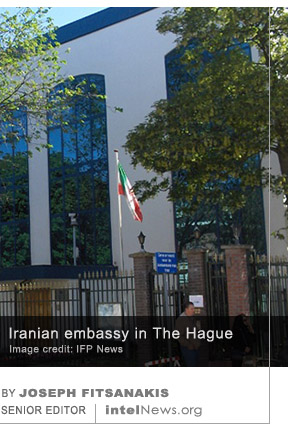 Holland has expelled two Iranian diplomats without saying why, leading to speculation that the expulsions may be related to the arrests of members of an alleged Iranian sleeper cell in Belgium, Germany and France last week. On Friday, a spokesperson from Holland’s General Intelligence and Security Service (AIVD)
 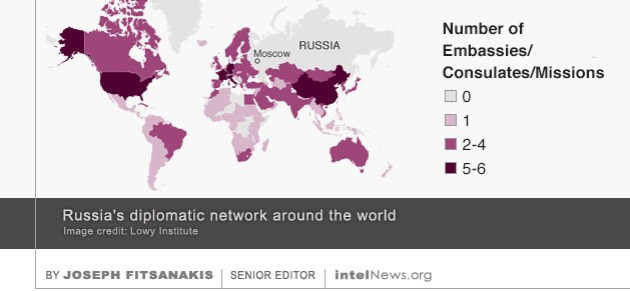 Though unprecedented in size, the recent expulsions of over 150 diplomats by nearly 30 countries and organizations around the world have hardly made a dent on Russia’s huge diplomatic footprint. The
  Britain secured the largest expulsion of Russian diplomats in history by sharing “unprecedented degrees of intelligence” with dozens of foreign countries about the attempted killing of former spy Sergei Skripal. Nearly 30 countries and international organizations, including the European Union and the North Atlantic Treaty Organization, have expelled or refused to accredit over
 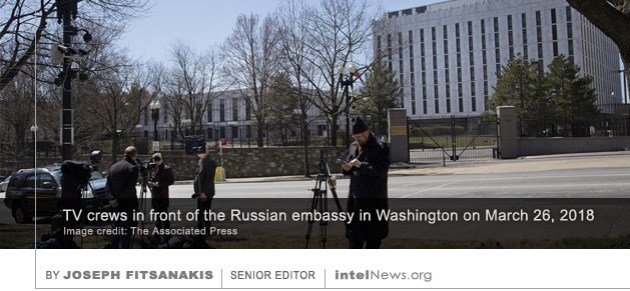 Relations between Russia and much of the West reached a new low on Monday, with the expulsion of over 100 Russian diplomats from two dozen countries around the world. The unprecedented expulsions were publicized on Monday with a series of coordinated announcements issued from nearly every European capital, as well as from Washington, Ottawa and Canberra. By the early hours of Tuesday, the number of Russian diplomatic expulsions had reached 118 —not counting the 23 Russian so-called “undeclared intelligence officers” that were expelled from Britain last week. Further expulsions of Russian diplomats are expected in the coming days.
 predecessor, Barack Obama, and his Secretary of State Hillary Clinton, who is known for her hardline anti-Russian stance. In Europe, the move to expel dozens of Russian envoys from 23 different countries —most of them European Union members— was a rare act of unity that surprised European observers as much as it did the Russians.
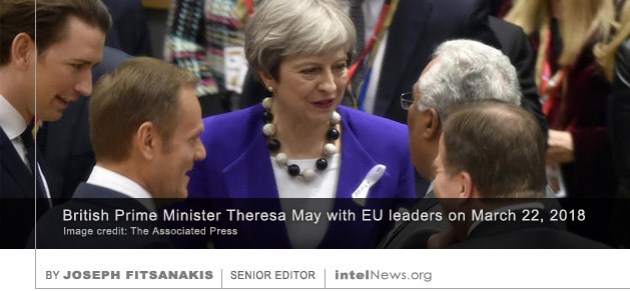 The European Union has recalled its ambassador to Moscow in an apparent response to the poisoning of Sergei Skripal, a Russian double agent, who was attacked with a nerve agent in England earlier this month. Skripal, 66, and his daughter Yulia, 33, remain in critical condition in hospital, nearly three weeks after being poisoned with a nerve agent that British scientists say belongs to Russia’s Cold-War-era chemical stockpiles. Moscow has angrily rejected claims that Skripal, who spied for Britain in the early 2000s, was on a Kremlin-approved hit-list of defectors. But British Prime Minister Theresa May traveled to Brussels on Thursday to brief European Union heads of state about the attack on Skripal.
 As expected, Moscow snubbed the British government’s demand for information into how a Russian-produced military-grade nerve agent ended up being used in the streets of Salisbury, England. As British Prime Minister Theresa May addressed the House of Commons on Wednesday afternoon, Sergei Skripal continued to fight for his life in a hospital in southern England. His daughter, Yulia, was also comatose, having been poisoned with the same Cold-War-era nerve agent as her father. This blog has
  the latest expulsions are dwarfed by the dramatic expulsion in 1971 of no fewer than 105 Soviet diplomats from Britain, following yet another defection of a Soviet intelligence officer, who remained anonymous.
 Ukraine fired its deputy-head of foreign intelligence and expelled a Belarussian diplomat a day after the government of Belarus claimed that it busted a Ukrainian spy ring that recruited local agents. The chain of events began on October 25, when the Belarussian Committee for State Security (KGB) arrested a Ukrainian journalist. The journalist, Pavlo Sharoyko, is based in the Belarussian capital Minsk and works as the Belarus correspondent for the National Radio Company of Ukraine —the country’s public broadcaster. Even though Sharoyko was arrested in October, his imprisonment was not publicly announced by Belarus until last Saturday. On Tuesday, November 21, at a press conference held at the KGB headquarters in Minsk, KGB spokesman Dmitry Pobyarzhin
 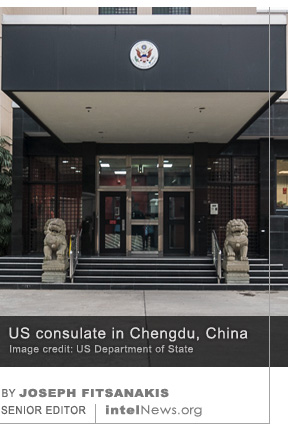 An American diplomat stationed in China was abducted and interrogated for several hours by Chinese authorities, who believed him to be an officer of the Central Intelligence Agency working under official cover. The alleged abduction took place in early 2016 but was revealed this week by the online news outlet Politico. The website said that the diplomat, who has not been named, was stationed at the United States consulate general in Chengdu, a city of 14 million that is the administrative capital of western China’s Sichuan province. Founded in 1985, the US consulate in Chengdu is one of Washington’s seven diplomatic and consular posts in China. It is staffed by 130 people, approximately 30 of whom are Americans and 100 are locally hired Chinese citizens. The facility’s consular district includes several Chinese provinces, including the politically sensitive Tibet Autonomous Region.
 American officials have revealed more information about a mysterious sonic device that is believed to have caused numerous diplomats to suffer hearing loss and other serious ailments. Last month, the Associated Press
 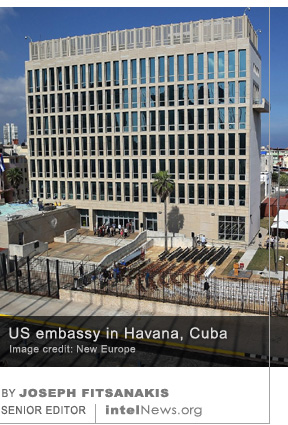 Authorities in Cuba, the United States and Canada are investigating reports that several foreign diplomats stationed in Havana have been experiencing severe hearing loss in recent months.
  Russia is planning to expel approximately 30 American diplomats from its territory, and seize buildings and property belonging to the United States Department of State, according to Russian media reports. The expulsions will be in response to the expulsion last December of 35 Russian diplomats stationed in the US by the administration of President Barack Obama. In addition to expelling the diplomats, Washington also reclaimed two “recreational facilities” (in reality intelligence outposts) that were used by the Russians in New York and Maryland. The White House said that the expulsions were ordered in response to alleged efforts by Russia to interfere in the 2016 US presidential election.
 There had been rumors for some time about a possible expulsion of Russian diplomats from the United States, in response to alleged Russian interference in the 2016 US Presidential election. The White House confirmed the rumors on Thursday morning, by
 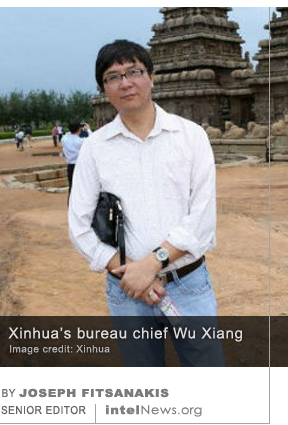 For the first time in history, India has refused to extend temporary residency visas for three senior Chinese media correspondents, effectively expelling them from the country, allegedly for espionage activities. All three reporters are employees of China’s state-run Xinhua news agency. They include Xinhua’s bureau chief in the Indian capital, New Delhi, Wu Xiang, and the agency’s Mumbai bureau chief, Lu Tang. A third journalist, She Yonggang, also based in Mumbai, has been asked to leave India by no later than July 31.






 intelNews.org
Western spy agencies thwarted alleged Russian plot to hack Swiss chemical lab
September 17, 2018 by intelNews Leave a comment
The laboratory, located in the western Swiss city of Spiez, has been commissioned by the Netherlands-based Organization for the Prohibition of Chemical Weapons (OPCW) to carry out investigations related to the poisoning of Russian double agent Sergei Skripal and his daughter Yulia in March of this year. It has also carried out probes on the alleged use of chemical weapons by the Russian-backed government of President Bashar al-Assad in Syria. In the case of the Skripals, the laboratory said it was able to duplicate findings made earlier by a British laboratory.
Switzerland’s Federal Intelligence Service (NDB) reportedly confirmed the arrest and subsequent expulsion of the two Russians. The Swiss agency said it “cooperated actively with Dutch and British partners” and thus “contributed to preventing illegal actions against a sensitive Swiss infrastructure”. The office of the Public Prosecutor in the Swiss capital Bern said that the two Russians had been the subject of a criminal investigation that began as early as March 2017. They were allegedly suspected of hacking the computer network of the regional office of the World Anti-Doping Agency in Lausanne. The Spiez laboratory was a target of hacking attempts earlier this year, according to a laboratory spokesperson. “We defended ourselves against that. No data was lost”, the spokesperson stated.
On April 14, Russian Minister of Foreign Affairs Sergei Lavrov stated that he had obtained the confidential Spiez lab report about the Skripal case “from a confidential source”. That report confirmed earlier findings made by a British laboratory. But the OPCW, of which Russia is a member, states that its protocols do not involve dissemination of scientific reports to OPCW member states. Hence, the question is how Foreign Minister Lavrov got hold of the document.
As intelNews reported in March, in the aftermath of the Skripals’ poisoning the Dutch government expelled two employees of the Russian embassy in The Hague. In a letter [.pdf] sent to the Dutch parliament on March 26 —the day when a large number of countries announced punitive measures against Russia— Holland’s foreign and internal affairs ministers stated that they had decided to expel the two Russian diplomats “in close consultation with allies and partners”. The Russians were ordered to leave the Netherlands within two weeks. It is unknown whether the two expelled Russian diplomats are the same two who were apprehended in The Hague, since none have been publicly named.
A November 2017 parliamentary letter from Dutch minister of internal affairs Kajsa Ollongren, states[4] that Russian intelligence officers are “structurally present” in the Netherlands in various sectors of society to covertly collect intelligence. The letter added that, in addition to traditional human intelligence (HUMINT) methods, Russia deploys digital means to influence decision-making processes and public opinion in Holland.
► Author: Matthijs Koot | Date: 17 September 2018 | Permalink
Filed under Expert news and commentary on intelligence, espionage, spies and spying Tagged with computer hacking, diplomatic expulsions, GRU, MIVD (Netherlands), NDB (Switzerland), Netherlands, News, Switzerland