January 3, 2018
by intelNews
 Since 2008, when we launched intelNews, it has been our end-of-year tradition to take a look back and highlight what we see as the most important intelligence-related stories of the past 12 months. In anticipation of what 2018 may bring in this highly volatile field, we give you our selection of the top spy stories of 2017. They are listed below in reverse order of significance. This is the last part in a three-part series. Part one is available here. Part two is available here.
 04. Unprecedented security changes are taking place in Saudi Arabia. Analysts agree that the Kingdom of Saudi Arabia is undergoing its most important political changes in generations. On November 4, 2017, nearly 50 senior Saudi officials, including at least 11 princes, some of them among the world’s wealthiest people, were suddenly fired or arrested. A royal decree issued on that same evening said that the arrests were carried out by a new “anti-corruption committee” led by Crown Prince Mohammed bin Salman, the king’s 32-year-old son, who is first in line to the throne. The king and his son appear to be in the process of removing their last remaining critics from the ranks of the Kingdom’s security services, which they now control almost completely. Earlier in the year, the BBC alleged that Saudi security services were secretly abducting Saudi dissidents from abroad and jailing them in Saudi Arabia. Also in November, Saudi Arabia was seen to be behind a failed attempt by Lebanon’s Prime Minister Saad al-Hariri —a dual Lebanese-Saudi citizen— to resign while on a trip to Saudi Arabia. There were allegations that Hariri was under arrest by the Saudis, who objected to the presence of Hezbollah members in his cabinet. But Hariri later returned to Lebanon and rescinded his resignation.
03. Extraordinary transformation of the intelligence landscape in South Korea. Developments in North Korea have been at the forefront of security reporting in recent months. But reports from the Korean Peninsula have largely ignored the dramatic changes 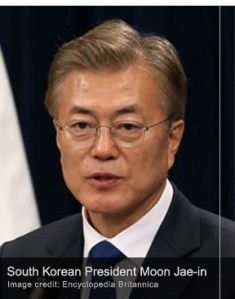 taking place in the intelligence infrastructure of South Korea, which are arguably as important as developments north of the 38th parallel. In June, the new center-left government of President Moon Jae-in banned the powerful National Intelligence Service (NIS) from engaging in domestic intelligence gathering. The move came after a lengthy investigation concluded that the NIS interfered in the 2012 presidential elections and tried to alter the outcome in favor of the conservative candidate, Park Geun-hye, using 30 dedicated teams of officers for that purpose. In November, three former NIS directors were charged with secretly diverting funds from the agency’s clandestine budget to aid Park, who has since been impeached and is now facing a lengthy prison sentence.
02. Turkey’s fallout with the West is affecting spy relations. Turkey has been a NATO member since 1952. However, rising tensions in the country’s domestic political scene are negatively affecting Ankara’s relations with its Western allies, particularly with Germany and the United States. Last month, Turkey issued an arrest warrant for Graham Fuller, an 80-year-old former analyst in the CIA, who Ankara says helped orchestrate the failed July 2016 military coup against the government of President Recep Tayyip Erdoğan. Washington flatly denies these allegations. In May, the Turkish Minister of Foreign Affairs Mevlüt Çavuşoğlu accused “the secret services of [Western] countries” of “using journalists and also bloggers [as spies] in Turkey”. Earlier in the year, a German report claimed that the Turkish state had asked its diplomats stationed all over Europe to spy on Turkish expatriate communities there, in order t to identify those opposed to the government of President Erdoğan. In some cases, Turkish spies have asked their Western European counterparts to help them monitor the activities Turkish expatriates, but such requests have been turned down. Nevertheless, there is increasing unease in Western Europe as Turkey intensifies its unilateral intelligence activities aimed at monitoring political dissent among Turkish communities abroad.
01. With America divided, Russian spies make dramatic post-Cold War comeback. The collapse of the Soviet Union was a traumatic experience for the once all-powerful Russian spy agencies. But, if CIA and FBI assessments are correct, the bitterly divisive state of American politics gave Russian spooks a chance for a dramatic comeback. Using a mixture of human and online intelligence operations, Russian spies helped drive a wedge between the White House and the US Intelligence Community. American intelligence agencies are tasked with providing information to  assist policy-makers, including the president. So when the CIA and the FBI conclude that the Russian government launched an extensive and sophisticated campaign to undermine the 2016 US presidential election, one expects the president to take that advisement under serious consideration. However, the US leader has openly dismissed the conclusions of his own Intelligence Community and has publicly stated that he believes President Vladimir Putin’s assurances that his country did not meddle in the US election.
What we have here, therefore, is a US president who sees the Kremlin as more trustworthy than his own Intelligence Community. This is a remarkable, unprecedented state of affairs in Washington, so much so that some CIA officials have reportedly questioned whether it is safe for them to share information about Russia to President Trump. Throughout that time, the FBI has been conducting an extensive counterintelligence investigation into alleged ties between the president’s campaign team and the Kremlin. As intelNews has noted before, the FBI probe adds yet another layer of complexity in an already intricate affair, from which the country’s institutions will find it difficult to recover for years to come, regardless of the outcome of the investigation. The state of Russian politics may be uncertain, and the country’s economy in bad shape. But Russian spooks can look back to 2017 as the year in which they made an unexpected comeback, scoring a dramatic victory against their decades-old rival.
This is the last part in a three-part series. Part one is available here. Part two is available here.
► Authors: Joseph Fitsanakis and Ian Allen | Date: 03 January 2018 | Permalink
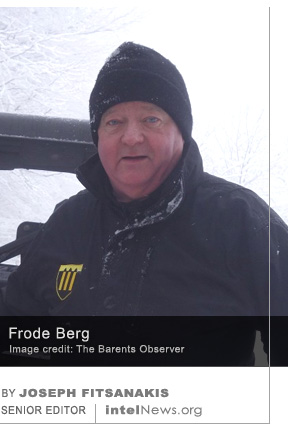 A Norwegian retiree, who was arrested in northern Russia late last year on charges of spying, acted as a courier for the Norwegian Intelligence Service (NIS), according to his lawyer. Last December, intelNews reported on the arrest of Frode Berg, 62, from Kirkenes, a small town in Norway’s far north, located near the Russian border. Berg retired in 2014 after nearly 25 years of service in the Office of the Norwegian Border Commissioner, a government agency that operates under Norway’s Ministry of Justice and Public Security. Following his retirement, Berg traveled regularly to Russia and helped organize a number of joint Norwegian-Russian community events, including athletic competitions and art festivals. But he is currently in a Russian jail and faces a long prison sentence if convicted on espionage charges.
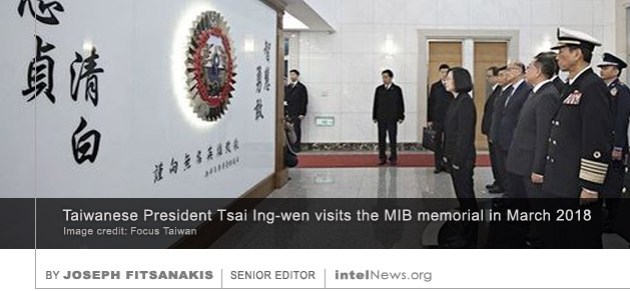 The government of Taiwan has acknowledged publicly for the first time that a Chinese major general, who was executed by Beijing in 1999 for espionage, was indeed one of its spies. The military officer was Liu Liankun, a logistician for the Chinese People’s Liberation Army, who headed its Department of General Logistics. However, China arrested Liu for espionage in 1999, and accused him of having spied for Taiwan for five years, in exchange for money. At the time, Taiwan denied that Liu spied on its behalf and refused to acknowledge that it had any role in the major general’s alleged espionage activities.
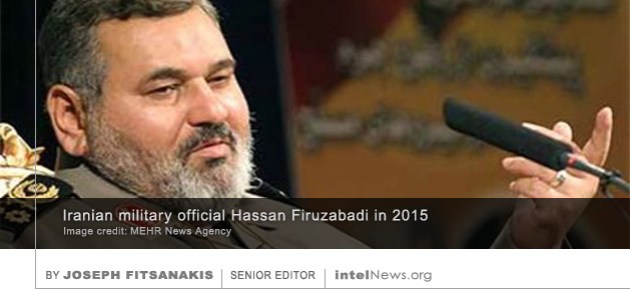 The former chief of staff of Iran’s Armed Forces has said that foreign governments used different species of lizards, including chameleons, to spy on the Iranian nuclear program. The claim was made by Hassan Firuzabadi, a veteran Iranian military official, who from 1989 to 2016 served as the chief of staff of the Iranian Armed Forces —the most senior military post in the Islamic Republic. Since his retirement in 2016, Firuzabadi has served in a number of key consultancy roles and is currently a senior military advisor to Ayatollah Ali Khamenei, Iran’s reform-minded supreme leader.
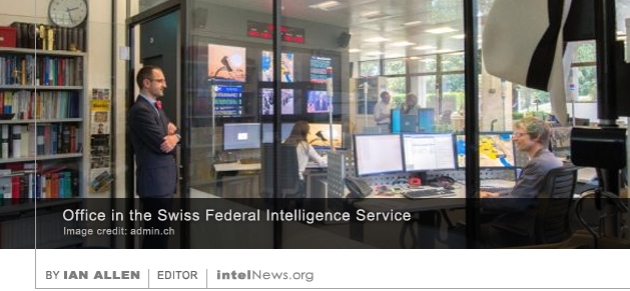 Officials in Switzerland say new laws enacted in recent months will help them change their country’s image as one of Europe’s most active spy venues. For decades, the small alpine country has been a destination of choice for intelligence officers from all over the world, who use it as a place to meet assets from third countries. For example, a case officer from Britain’s Secret Intelligence Service (MI6) will travel to Switzerland to meet her Algerian agent. She will exchange money and documents with him before she returns to Britain and he to Algeria, presumably after depositing his earnings into a Swiss bank account.
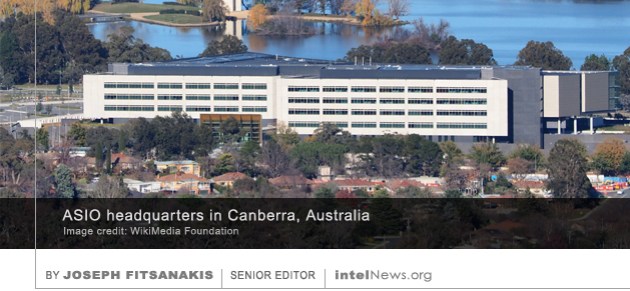 Foreign intelligence collection and espionage threats against Australia are greater today than at any time during the Cold War, according to a senior Australian intelligence official. The claim was made on Wednesday by Peter Vickery, deputy director general of the Australian Security Intelligence Organisation (ASIO), the country’s primary counterintelligence agency. He was speaking before a parliamentary committee that is considering aspects of a proposed bill, which aims to combat foreign influence on Australian political and economic life. If enacted, the bill would require anyone who is professionally advocating or campaigning in favor of “foreign entities” to register with the government. Several opposition parties and groups, including the Catholic Church, have
 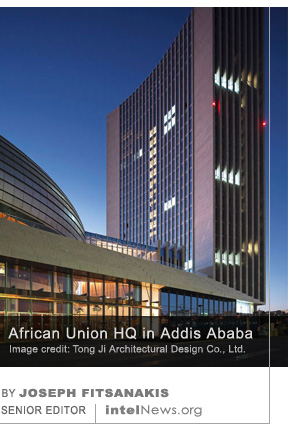 Chinese spies hacked the computer servers of the African Union headquarters in the Ethiopian capital Addis Ababa, which the Chinese government funded and built as a gift to the organization, a French newspaper has claimed. Beijing donated $200 million toward the project and hired the state-owned China State Construction Engineering Corporation to build the tower, which was
  Since 2008, when we launched intelNews, it has been our
  as a result of “acute poisoning from an undefined substance”, according to his doctors. Also in February, Kim Jong-nam, half-brother of North Korean Supreme Leader Kim Jong-un, was killed in an
  support for the rebels could backfire by causing the suddenly unemployed fighters to join jihadist organizations. In August, there were reports that US troops
  Since 2008, when we launched intelNews, it has been our
  10.
10. 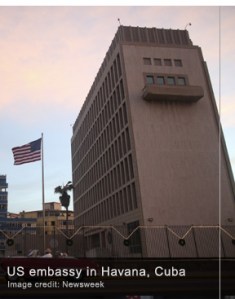 the alleged device may have been deployed by an intelligence service of a third country —possibly Russia— without the knowledge of the Cuban authorities. In October, the White House expelled 15 Cuban diplomats from the US in response to the incident. But the question of what harmed the health of at least 20 employees at the US embassy in Havana remains largely unanswered.
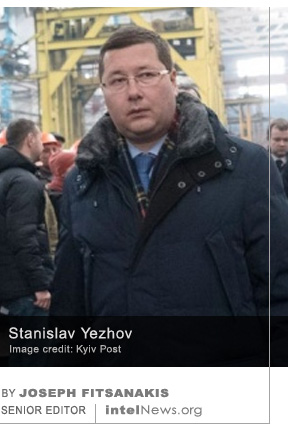 Ukraine’s counterintelligence agency has arrested the principal translator of the country’s prime minister, accusing him of spying for Russia. The translator has been identified as Stanislav Yezhov, who has served as a translator for two consecutive Ukrainian prime ministers. As part of his job, Yezhov has been present at nearly all high-level meetings between Ukraine’s Prime Minister, Volodymyr Groysman, and foreign leaders since 2016, when Groysman assumed his executive post. In the last year alone, Yezhov accompanied the Ukrainian prime minister during official trips to Washington, London and Berlin. Before translating for Groysman, Yezhov is thought to have served as an interpreter for Viktor Yanukovych, Ukraine’s former President. Yanukovych, a pro-Russian politician, occupied that office from 2010 until his ousting from power in 2014, as a result of the 2014 Ukrainian revolution.
 A Russian court has sentenced an Estonian aircraft business executive to 12 years at a maximum security prison, allegedly for having spied on Russia a decade ago. Little is known about the case of Raivo Susi, who co-owns two companies that are involved in the sale and maintenance of non-commercial aircraft. The Estonian businessman’s activities include the partial ownership of Aerohooldus OU, which provides training jet aircraft for use by the Air Force of Estonia –a member state of the North Atlantic Treaty Organization (NATO).
 Ukraine fired its deputy-head of foreign intelligence and expelled a Belarussian diplomat a day after the government of Belarus claimed that it busted a Ukrainian spy ring that recruited local agents. The chain of events began on October 25, when the Belarussian Committee for State Security (KGB) arrested a Ukrainian journalist. The journalist, Pavlo Sharoyko, is based in the Belarussian capital Minsk and works as the Belarus correspondent for the National Radio Company of Ukraine —the country’s public broadcaster. Even though Sharoyko was arrested in October, his imprisonment was not publicly announced by Belarus until last Saturday. On Tuesday, November 21, at a press conference held at the KGB headquarters in Minsk, KGB spokesman Dmitry Pobyarzhin
 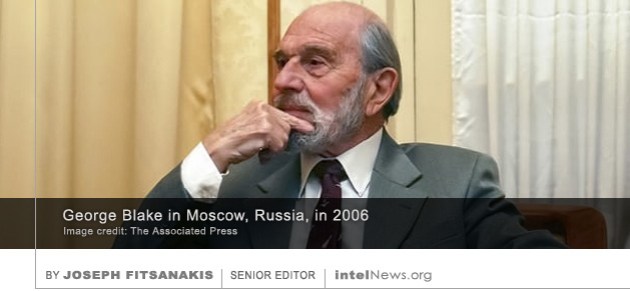 One of the Cold War’s most recognizable spy figures, George Blake, who escaped to the Soviet Union after betraying British intelligence, issued a rare statement last week, praising the successor agency to Soviet-era KGB. Blake was born George Behar in Rotterdam, Holland, to a Dutch mother and a British father. Having fought with the Dutch resistance against the Nazis, he escaped to Britain, where he joined the Secret Intelligence Service, known as MI6, in 1944. He was serving in a British diplomatic post in Korea in 1950, when he was captured by advancing North Korean troops and spent time in a prisoner of war camp. He was eventually freed, but, unbeknownst to MI6, had become a communist and come in contact with the Soviet KGB while in captivity. Blake remained in the service of the KGB as a defector-in-place until 1961, when he was arrested and tried for espionage.






 intelNews.org
High-level MI6 spy inside al-Qaeda writes book detailing his work
May 25, 2018 by Ian Allen 1 Comment
Aimen Dean, a.k.a. Ramzi
A Saudi-born man, who some refer to as the most valuable British-run spy inside al-Qaeda, has authored a soon-to-be-published book about his experiences. Aimen Dean, known in al-Qaeda circles simply as ‘Ramzi’, became radicalized in the first half of the 1990s in response to the Bosnian War. At that time, he traveled from his home country of Saudi Arabia to Bosnia, where he joined large numbers of foreign Muslim fighters who fought in support of Bosnian-Muslim forces. In subsequent interviews, Dean has said that he continues to view his participation in the Bosnian War as an “ethical and moral” act in defense of a “defenseless population”. Following the end of the Bosnian War, Dean joined many foreign-born fighters who followed al-Qaeda co-founder Osama bin Laden to Afghanistan. While there, he pledged allegiance to bin Laden and gained his trust.
Dean’s task in Afghanistan was to train new al-Qaeda recruits in Islamic theology and history. But he was also tasked with combat duties, which included bomb-making. He witnessed the drastic shift in al-Qaeda’s raison d’être from a group ostensibly fighting to defend Muslims under attack, to a center of a violent campaign against the West. Dean has stated that during his first period in Afghanistan, he sincerely believed that the West was involved in a systematic campaign to destroy Islam and Muslims. Gradually, however, Dean’s views began to conflict with those of al-Qaeda’s leaders. He especially objected to the use of suicide bombers and the deliberate targeting of civilians by al-Qaeda fighters. His disillusionment with al-Qaeda peaked in August of 1998, when the organization targeted the United States embassies in Kenya and Tanzania in coordinated strikes.
During a leave of absence from al-Qaeda’s Afghanistan stronghold, Dean was approached by the United Kingdom’s Secret Intelligence Service, more commonly known as MI6. He says that he quickly agreed to work as a spy for the British agency and did so from 1998 until 2007, when he claims that his cover was blown. Dean has now written a book, co-authored with two CNN reporters, Paul Cruickshank and Tim Lister. Entitled Nine Lives: My Time As MI6’s Top Spy Inside al-Qaeda, the book is due to appear in stores on June 7.
► Author: Ian Allen | Date: 25 May 2018 | Permalink
Filed under Expert news and commentary on intelligence, espionage, spies and spying Tagged with Aimen Dean, al-Qaeda, book news and reviews, espionage, MI6, News, UK, War on Terrorism