Tension mounts as South Korea launches largest anti-spying operation in 30 years

NIS South KoreaTENSION IS MOUNTING BETWEEN the government and opposition forces in South Korea, as the conservative administration of President Yoon Suk Yeol appears to be behind an effort to probe alleged links between senior liberal political figures and North Korean intelligence. The effort, which some commentators suggest could be the largest counter-espionage operation in the country’s history since 1992, is being led by the National Intelligence Service (NIS).

The operation came to light on January 18, when hundreds of police officers, led by NIS officers, conducted search raids at a number of regional offices of the Korean Confederation of Trade Unions (KCTU). Founded in the mid-1990s, the KCTU is South Korea’s second-largest labor coalition, representing over 1.1 million members. It is politically aligned with the Democratic Party of Korea (DPK), a left-of-center liberal coalition which was in government until last year. Since its establishment in 2014, the DPK has been engaged in a bitter political rivalry with the People Power Party (PPP), a conservative coalition that currently governs South Korea.

According to reports, the NIS is investigating charges that members of the KCTU formed “a clandestine organization” that engaged in protests against the United States and organized “various subversive campaigns under instructions from North Korea”. According to the NIS, the clandestine organization was led by a senior KCTU official, who was handled by clandestine operatives of North Korea’s ruling political party, the Workers’ Party of Korea (WPK). The NIS claims that the official met repeatedly with WPK operatives during trips to countries like Vietnam and Cambodia, between 2016 and last year.

On January 18, a large police force appeared to be trying to enter the KCTU headquarters in Seoul, in an attempt to arrest the trade union official, who has not been named. Video footage appeared on South Korean social media, which appeared to show a standoff between law enforcement and KCTU officials. The latter attempted to be trying to prevent the police and NIS representatives from entering the building. Eventually, the authorities were able to enter the building, while also attempting to prevent some individuals barricaded inside from leaving. Read more of this post

Espionage allegations prompt sharp exchanges between ex-CIA officials

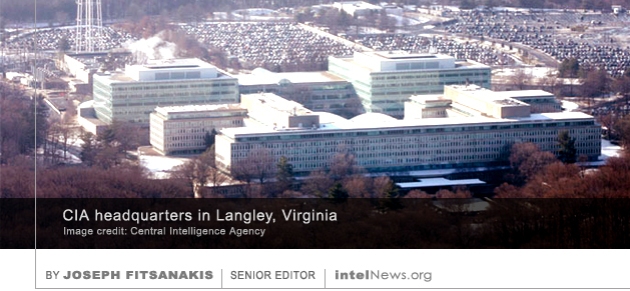
CIAA BOOK BY A former Central Intelligence Agency (CIA) case officer, which alleges that a senior Agency official sabotaged American counterintelligence efforts on orders from Moscow, has prompted a series of fiery exchanges by retired CIA personnel. The primary figures in the dispute are the book’s author, Robert Baer, and Paul J. Redmond, who served as the CIA’s Associate Deputy Director of Operations for Counterintelligence.

Baer’s book, The Fourth Man: The Hunt for a KGB Spy at the Top of the CIA and the Rise of Putin’s Russia (Hachette Books, May 2022), focuses on the period following the arrests of three American intelligence insiders, who were found to have spied for the Kremlin: Federal Bureau of Investigation (FBI) agent Robert Hanssen, and CIA officers Aldrich Ames and Edward Lee Howard. By 2002, Hanssen and Ames were serving life sentences for espionage, while Howard had died in Russia where he had fled while under investigation by the FBI. Collectively, these three had been responsible for some of the CIA’s gravest operational setbacks against the Soviet KGB and its Russian successor agencies.

Some in the CIA, however, remained convinced that not all of the CIA’s failures in the 1980s and 1990s could be explained away in this fashion. They held on to the suspicion that Moscow had been able to recruit a senior CIA executive, who —among other things— had sabotaged numerous probes by some of the Agency’s most committed spy-hunters. Baer’s book discusses how, in the mid-1990s, the CIA’s Directorate of Operations actively pursued those suspicions, by setting up a Special Investigations Unit (SIU). This new unit was led by one of the CIA’s most talented counterintelligence officers, Paul Redmond.

CONTROVERSY

This is precisely the point at which Baer’s book turns wildly controversial: it alleges that the missing spy, whom Baer refers to as “the fourth man”, is none other than Redmond himself. The retired CIA case officer further alleges that even the SIU eventually concluded that Redmond —i.e. its leading member— was a spy for Moscow. The author claims that the SIU presented those findings at a briefing with Redmond among the audience. The presentation prompted Redmond to storm out of the meeting, Baer alleges.

Importantly, Baer describes his case as “inconclusive”, and claims that he relies on information from some of his former CIA colleagues. He also admits that the very idea of a “fourth man” may be nothing more than a chimera. Nevertheless, the SIU probe did occur. It also appears that the FBI opened an investigation into the matter in 2006. Baer claims to have received a visit by two FBI agents in 2021, in which he was asked about what he knew about Raymond. This, he says, left him with the impression that some sort of counterintelligence effort to find the “fourth man” was “ongoing then and is continuing” now. Moreover, according to Baer, this counterintelligence investigation is no longer confined in-house at CIA; the FBI has now taken the lead.

REDMOND’S SIDE RESPONDS

Remarkably, Baer appears to have spoken to Redmond at least twice while preparing his book. On each occasion, the retired CIA senior executive fiercely rejected Baer’s claims that he was a spy for Moscow. In recent months, Redmond voiced his dismay at Baer’s claims publicly. As SpyTalk reports, the first time Redmond spoke publicly about Baer’s book was in November of last year, during an event held by the Association of Former Intelligence Officers. Read more of this post
Austria expels four more Russian diplomats for espionage, sources say

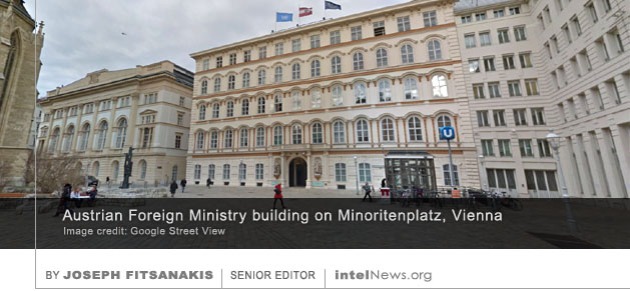
Austria Foreign Affairs MinistryTHE MINISTRY OF FOREIGN Affairs of Austria announced Thursday that it has ordered the expulsions of four Russian diplomats from its territory. It is highly unusual for Austria, which is traditionally reluctant to take sides in international political disputes, to expel Russian diplomats.
According to the ministry, two of the diplomats are stationed at the Embassy of Russia in the Austrian capital, Vienna. The other two diplomats are members of the Permanent Mission of Russia to the United Nations office in the same city. All four have been declared personae non gratae (unwelcome persons) in accordance with Article 9 of the Vienna Convention on Diplomatic Relations. They are being expelled for allegedly “committing actions incompatible with their diplomatic status”.

Although Austrian authorities have refused to provide details about the expulsions, the phrase “actions incompatible with [one’s] diplomatic status” is often used in diplomatic lingo to refer to activities relating to espionage or other clandestine operations. The Reuters news agency cited “officials speaking on condition of anonymity” in claiming the four Russian diplomats were indeed involved in espionage. However, the Russian embassy in Vienna declined media requests for comment.

The Russian diplomats have been ordered to leave Austria by the end of Wednesday, February 8. The last time Austria expelled Russian diplomats was 2020, prompting Russia to expel an Austrian diplomat in response. Since that time, and including this week’s expulsions, Austria has expelled a total of nine Russian spies from its territory. According to media reports, over 140 diplomats are currently based at the Embassy of Russia in Vienna.

Author: Joseph Fitsanakis | Date: 03 February 2023 | Permalink

Germany arrests alleged collaborator of intelligence officer who spied for Russia

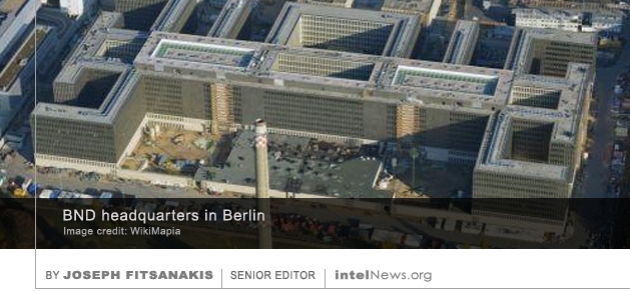
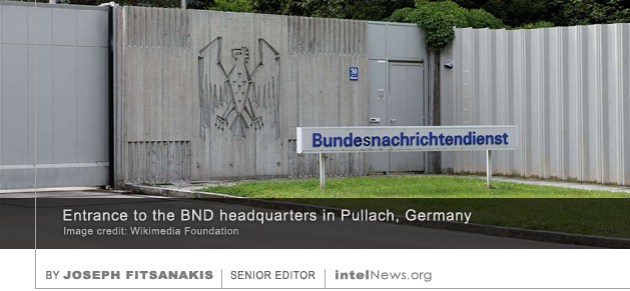
BND GermanyTHE GERMAN GOVERNMENT ANNOUNCED last week the arrest of a man believed to have acted as a courier between Russian intelligence and another German spy, who was arrested in December and is awaiting trial. The new arrest is bound to attract even more international attention to this unfolding case of espionage, whose urgency has reportedly alarmed Western intelligence services.

On December 22, German authorities arrested a senior German intelligence official, who has been charged with treason and remains in custody. The official, named only as “Carsten L.”, in compliance with Germany’s strict privacy laws, worked in the signals intelligence (SIGINT) wing of the Federal Intelligence Service (BND). As Germany’s foreign intelligence agency, the BND is tasked with collecting intelligence on foreign targets, a mission that makes it broadly equivalent to the United States Central Intelligence Agency (CIA).

As intelNews reported earlier this month, Carsten L.’s seniority within the BND allowed him to access several compartmentalized areas of information, including secrets shared with the BND by other Western intelligence agencies. For this reason, it was reported that some Western intelligence officials were “most incensed” with this case. One source reported that British intelligence leaders were “considering whether they will continue to provide the BND with their most sensitive information”.

Now a second arrest has come to arguably add to the gravity of this case. On January 22, the German Federal Criminal Police Office announced the arrest of “Arthur E.”, who was captured at the Munich International Airport. Apparently, Arthur E. is a German citizen who has German-Russian background. According to the press release issued by the German government, Arthur E. was arrested through a collaborative effort between the BND and the United States Federal Bureau of Investigation (FBI). Apparently, the FBI became suspicious when Arthur E. attempted to frantically leave the United States after Carsten L.’s arrest. Read more of this post

Iran executes former deputy defense minister, accusing him of being an MI6 spy

Ali ShamkhaniIRAN ANNOUNCED ON SATURDAY one of the most high-profile executions in its recent history, involving Alireza Akbari, who served as the Islamic Republic’s deputy minister of defense in the 2000s. Akbari, 61, a dual Iranian-British citizen, was reportedly executed by hanging on or before January 14.
As a government official, Akbari was associated with the Iranian Reformists, who were particularly prominent in the early 2000s during the presidency of Mohammad Khatami. Akbari served as deputy defense minister under Defense Minister Ali Shamkhani (1997-2005), a two-star general. General Shamkhani (pictured), an Iranian Arab, currently chairs Iran’s Supreme National Security Council. He is among the few Reformists who today remain in positions of power in Iran.

Akbari’s tenure was cut short in 2005, when Khatami was succeeded in the presidency by Mahmoud Ahmadinejad, a hardliner, who made sweeping changes in government administration. After he was briefly detained by pro-Ahmadinejad hardliners, Akbari moved to the United Kingdom in 2008, and established a small but reputable think-tank. By 2019, he had acquired British citizenship and was active in Iranian politics, but from afar. But in 2019, Akbari was invited to visit Iran by an unnamed “senior Iranian diplomat”, ostensibly to assist in negotiations with Western powers over Iran’s nuclear program. Having previously helped in international negotiations at the conclusion of the Iran-Iraq War in the late 1980s, Akbari agreed to travel to Tehran.

However, the invitation was part of what the Iranians later described as a “deception operation”, which marked the culmination of a “long and multi-layered process involving counterintelligence”. Akbari’s arrest in Tehran’s Imam Khomeini International Airport was the last time Akbari was seen in public. Iranian prosecutors later described Akbari as a “key spy” for Britain’s Secret Intelligence Service (MI6) and accused him of working for an MI6 front company. In that role, they claimed, Akbari gave MI6 information about nearly 200 Iranian officials, for which he was paid over $2 million in a variety of currencies. Read more of this post

Western intelligence agencies alarmed by arrest of Russian spy in Germany

BND GermanyWESTERN INTELLIGENCE AGENCIES HAVE been alarmed by the arrest of a senior German intelligence official, who has been charged with spying for Russia, according to an expert in German intelligence. On December 22, the German government announced the arrest of a senior officer in the signals intelligence (SIGINT) wing of the Federal Intelligence Service (BND). As Germany’s foreign intelligence agency, the BND is tasked with collecting intelligence on foreign targets, a mission that makes it broadly equivalent to the United States Central Intelligence Agency.
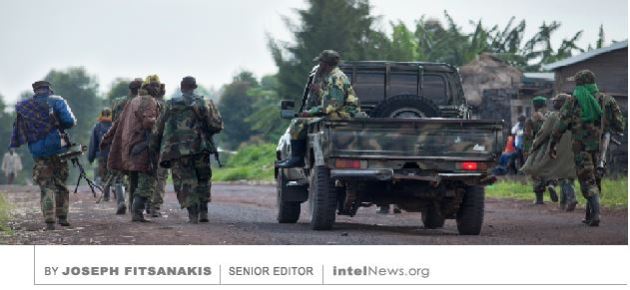
The official, named only as “Carsten L.”, in compliance with Germany’s strict privacy laws, has been charged with “high treason” and is currently awaiting trial. When announcing his arrest, German officials said they were tipped by a foreign intelligence agency that detected a document from the BND’s internal files in the possession of a Russian spy agency. The identity of the intelligence agency that provided the tip is among several important details about the case that remain unknown for the time being. Among them are the duration of Carsten L.’s alleged espionage for Moscow, as well as his motives.

Some reports suggest that Carsten L. may have been blackmailed by the Russians as a result of a kompromat. It has also been reported that the alleged spy was found to be in possession of material relating to the Alternative for Germany (AfD), a far-right party known for its friendly stance toward the Kremlin. But such reports are largely speculative. No information about Carsten L.’s motives has been released by the office of the German prosecutor. It is clear, however, that at least some of the information that Carsten L. gave the Russian government relates to the ongoing war in Ukraine.

Additionally, the suspect’s seniority within the BND allowed him to access several compartmentalized areas of information, including secrets shared with the BND by other Western intelligence agencies. These almost certainly include the United States Central Intelligence Agency and National Security Agency, as well as a host of British intelligence agencies. On Monday, British newspaper The Telegraph quoted German intelligence expert, Erich Schmidt-Eenboom, who said that British intelligence officials were “most incensed” with the case. He added that British intelligence leaders were “considering whether they will continue to provide the BND with their most sensitive information”. The German expert concluded that the Carsten L. case may have “deep implications for future cooperation between the BND and other Western spy agencies”.

Author: Joseph Fitsanakis | Date: 10 January 2023 | Permalink

Congo accuses Rwandan spy cell of plot to shoot down president’s plane

M23 Congo RwandaTHE GOVERNMENT OF THE Democratic Republic of the Congo (DRC) has dismantled an alleged Rwandan spy network and has charged its members with plotting to assassinate the country’s president. This development, which was announced late last week by authorities in Kinshasa, has plunged relations between the two neighboring countries into a new low.
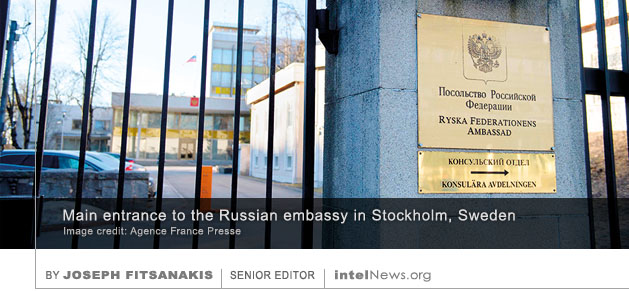
The DRC has long accused Rwanda of training and equipping members of the so-called March 23 Movement (M23), who have been engaged in a decade-long conflict with the Congolese state in the North Kivu province. Since March of last year, DRC government forces have been engaged in a major offensive against the M23, but the rebel group continues to control several strategic towns and villages in North Kivu. Meanwhile, Rwanda has accused the DRC of using the offensive as a pretext to invade Rwanda. Late last year, the Rwandan Defense Forces (RDF) captured Congolese territory, in what authorities in Kigali described as an attempt to create a buffer zone between Rwanda and the DRC military offensive. In response, the DRC suspended a host of bilateral agreements with Rwanda and expelled the Rwandan ambassador from Kinshasa.

Last Thursday, the DRC’s Deputy Minister of the Interior, Jean-Claude Mandongo, posted a video on social media, announcing the arrest of several members of an alleged Rwandan spy ring. According to Mandongo, the spy ring consisted of two alleged Rwandan spies and two Congolese accomplices. The two Rwandans have been identified in DRC media reports as Dr. Juvenal Nshimiyimana and Moses Mushabe, who is allegedly a serving intelligence officer in the RDF. According to Mandongo, the two Rwandans were stationed in the DRC in a non-official-cover capacity, as employees of a humanitarian non-governmental organization called African Health Development Organization (AHDO).

Authorities in the DRC seem to believe that the AHDO serves as a proprietary cover for Rwandan intelligence, although they have provided no evidence for this claim. Officials in Kinshasa also claim that Rwandan spies are operating in other AHDO branches across the DRC. Statements from the Ministry of the Interior suggest that more arrests of alleged Rwandan spies are imminent. According to DRC officials, AHDO facilities were strategically located adjacent to the N’djili International Airport in Kinshasa, in order to monitor the movements of the presidential air fleet. In a report published on Tuesday, DRC authorities claimed that the alleged Rwandan spy cell planned to assassinate DRC President Félix Tshiskedi, by shooting down his presidential jet. The Rwandan government has rejected these claims.

Author: Joseph Fitsanakis | Date: 04 January 2023 | Permalink

Mystery surrounds arrest of alleged Russian spy couple in Sweden

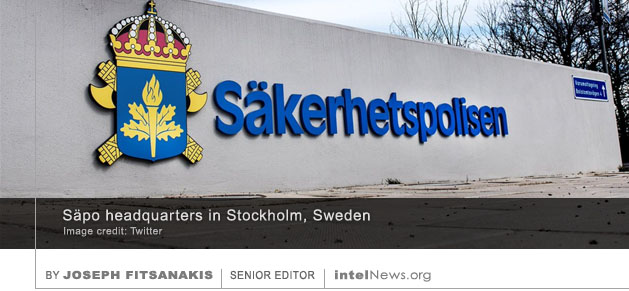
Russian Embassy SwedenNUMEROUS UNANSWERED QUESTIONS SURROUND the arrest of a Russian married couple in Sweden, on charges of espionage. The arrest took place in dramatic fashion in the early hours of Tuesday, November 22. According to the Swedish media, members of the security forces descended via tactical ropes from two Blackhawk helicopters, as startled residents in the typically quiet Stockholm suburb of Nacka looked on.
The raid was apparently conducted based on information received by Sweden’s counterintelligence agency, the Swedish Security Service (SAPO), coupled with tips from the United States Federal Bureau of Investigation (FBI). The targets of the operation were Sergei Nikolaevich Skvortsov and Elena Mikhailovna Kulkova, a Russian-born married couple, who moved to Sweden from Russia in 1999. According to their identity documents, Skvortsov was born in Perm on July 28, 1963, and Kulkova in Moscow on May 22, 1964.

Both Skvortsov and Kulkova are university-educated, with a background in science, mathematics and cybernetics. Upon settling in Sweden, they worked in the import-export technology sector. By 2013 they had become Swedish citizens and had a son. Kulkova also had a daughter from a previous marriage. The Russian investigative source The Insider reports that Kulkova’s daughter’s boyfriend worked for Swedish military intelligence.

Swedish authorities allege that the two suspects migrated to Stockholm on orders of the Main Directorate of the Russian Armed Forces General Staff, known as GRU. The GRU allegedly did not activate them until after they had acquired Swedish citizenship. According to the court indictment, Skvortsov and Kulkova began to actively spy against the United States in 2013 and against Sweden in 2014.

Some sources claim that the case of the Russian couple may be connected to the recent arrests of Payam and Peyman Kia, two Iranian-born Swedish brothers, who were arrested in 2021 and are now facing charges of engaging in espionage on behalf of the GRU. Payam Kia worked for SAPO and had access to classified information from a host of Swedish government agencies. SAPO reportedly launched the probe in 2017, following suspicions that it harbored a spy in its personnel ranks.

Author: Joseph Fitsanakis | Date: 05 December 2022 | Research credit: A.G. | Permalink

Sweden charges two brothers with spying for Russian military intelligence

Säpo swedenAUTHORITIES IN SWEDEN HAVE charged two brothers, one of whom worked in a highly secretive Swedish intelligence unit, with spying for Russian military intelligence for a decade, according to news reports. The charges resulted from a six-year investigation led by the Swedish Security Service (SAPO), which is the country’s counterintelligence agency. SAPO reportedly launched the probe in 2017, based on suspicions that it harbored a spy in its personnel ranks.

The two brothers have been named by Swedish media as Payam Kia, 35, and Peyman Kia, 42. They were reportedly born in Iran and became Swedish citizens in 1994. It is also reported that Payam Kia worked for SAPO and had access to classified information from a host of Swedish government agencies. SAPO accuses the two men of having worked “jointly” to pass information to the Main Directorate of the Russian Armed Forces’ General Staff, known broadly as GRU.

According to Swedish authorities, the two men began spying for Russia in September of 2011 and continued until the fall of 2021. Peyman Kia allegedly acted as a courier, passing information and payments between his brother and his Russian handlers. Per Lindqvist, chief prosecutor for Sweden’s National Security Unit, told the Associated Press news agency that the Kia brothers case involved “extremely sensitive topics”, but did not elaborate. Some reports claim that Payam Kia had access to the files of Swedish spies operating abroad.

The younger of the two brothers was reportedly arrested in September of 2021. His older brother was arrested in November of the same year. They face up to life imprisonment. They both deny the charges against them.

Author: Joseph Fitsanakis | Date: 14 November 2022 | Permalink

Norway arrests alleged Russian illegal who spent years building cover in Canada

José Giammaria Mikhail MikushinAN ALLEGED RUSSIAN DEEP-cover intelligence operative, who was arrested by Norwegian police last week, spent years building his fake cover in Canada, while studying there as a Brazilian citizen, according to reports. Norway’s Police Security Service (PST) announced last week that it had arrested José Assis Giammaria, a 37-year-old Brazilian citizen, on suspicion of entering Norway on false pretenses. According to the PST, Giammaria is in fact a Russian citizen, who has been operating in Norway as a non-official-cover (NOC) intelligence officer.
According to Norwegian authorities, Giammaria worked as a researcher at the Arctic University of Norway. Known as UiT, the university is located in the northern Norwegian city of Tromsø. It has a worldwide reputation for research, and approximately 10 percent of its 17,000 students are international. While there, Giammaria was a volunteer researcher for a UiT GreyZone, a scholarly project that studies contemporary hybrid threats and grey zone warfare. His area of specialization appears to have been Arctic security.

Last Friday, the office of the Norwegian state prosecutor said it believed the suspect’s actual name is Mikhail Mikushin, a Russian citizen born in 1978. In a press statement, a Norwegian government representative said authorities were “not positively sure of his identity”, but it was clear that he was not a Brazilian national. Later on Friday, the Oslo-based Norwegian newspaper Verdens Gang (VG), in association with the investigative website Bellingcat, reported that Mikushin is a military intelligence officer, who holds the rank of colonel in the Main Directorate of the Russian Armed Forces’ General Staff, known as GRU. The newspaper claims that Mikushin left Russia in 2006 with a cover, a term that refers to a fake operational identity used for purposes of espionage. Read more of this post

Germany ‘erroneously’ granted entry visa to known Russian intelligence officer

BfV GermanyLAST SUMMER, GERMAN EMBASSY staff in Russia issued an entry visa to a Russian national, despite warnings by at least two European security agencies that he was a known intelligence officer, according to a report. The incident has fueled persistent allegations that Berlin’s counterintelligence posture against Russia is ineffective.
According to the German newsmagazine Der Spiegel, it was in July of this year when the German Embassy in Moscow received an application for an entry visa to Germany by a Russian national. The application included an official invitation issued to the visa applicant by the Russian Consulate General in the eastern German city of Leipzig. However, the application prompted a strong counterintelligence warning by the Federal Office for the Protection of the Constitution (BfV), Germany’s domestic security agency. According to Spiegel, at least one more European intelligence agency warned against allowing the Russian national to travel to Western Europe. The reason for the warnings was that the visa applicant was known to operate internationally under diplomatic cover, on behalf of a Russian intelligence agency.

The counterintelligence warnings were examined and caused the visa application to be rejected. However, a month later the applicant submitted a second application for an entry visa to Germany. Remarkably, the German embassy approved the second application, after “no longer recogni[zing] any suspicion of espionage” in association with this case. One possible reason, according to Spiegel, was that Russian officials had applied pressure on the German government, asking for a review of the application. When the issue was raised in Berlin, an internal review was launched. It reportedly found that the espionage warnings had been “overlooked due to an [administrative] error”. The visa was thus promptly canceled. Der Spiegel claims it is “possible that the accidental visa issue was related to [Berlin] wanting to show good will to the Russian side”.

What does that mean? Back in April, Germany expelled 40 suspected Russian intelligence officers, in response to Russian war crimes in Ukraine. As expected, Russia promptly expelled an equal number of German diplomats in a tit-for-tat move. The Russian Foreign Ministry made sure to point out that it would respond in a similar fashion, should Berlin choose to expel more Russian diplomats in the future. Such an eventuality, according to Spiegel, would run the risk of decimating Germany’s diplomatic presence in Russia, given that its size is considerably smaller than that of Russia’s in Germany. Germany, in other words, is not prepared to risk a complete breakdown in its diplomatic relations with Russia.

Some claim, however, that the current arrangement between the two countries is being exploited by the Kremlin. Der Spiegel notes that, according to intelligence experts, no European country hosts more Russian intelligence officers under diplomatic cover than Germany. It is estimated that at least 100 bogus diplomats are currently stationed in Russia’s diplomatic facilities throughout Germany.

Author: Joseph Fitsanakis | Date: 10 October 2022 | Permalink

Reuters investigation focuses on alleged loss of CIA spy networks in Iran

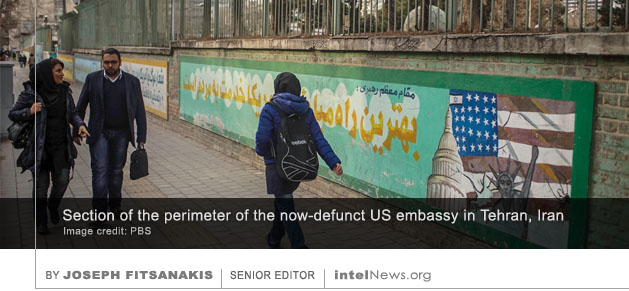
US embassy IranA YEAR-LONG INVESTIGATION by the Reuters news agency attempts to shed light on the alleged arrests of more than a dozen Iranian spies, who claim to have worked for the United States Central Intelligence Agency. Periodically Iran claims to have captured members of alleged CIA spy rings operating across its territory. For instance, in 2019 Iran’s Ministry of Intelligence announced the arrest of a “CIA network” consisting of 17 individuals who worked in the private sector and a number of government agencies.
The news agency said two of its reporters, Joel Schectman and Bozorgmehr Sharafedin, spent dozens of hours interviewing six Iranian former CIA assets, as well as 10 former employees of the United States Intelligence Community, who have “knowledge of Iran operations”. All six of the Iranians interviewed spent between five and 10 years in prison for their CIA connections. Two of them left Iran after serving their prison sentences, and are now refugees in central and northern Europe. At least one of them claims he was never contacted by the CIA after his release in 2019.

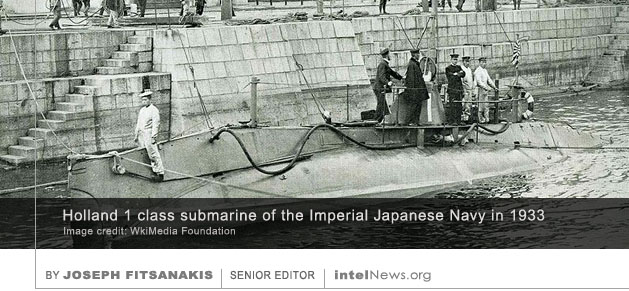
According to the Reuters investigation, CIA assets in Iran operate in a high risk environment, given that the United States has not had diplomatic facilities in the Middle Eastern country since 1979. Diplomatic facilities are regularly used to shelter CIA personnel, who recruit, train and handle foreign assets. Despite the absence of such facilities, the CIA is willing to take great risks in running agents inside Iran, because of the country’s geopolitical significance. The agency’s intensity in operating in Iran is matched by the Islamic Republic’s aggressive counterintelligence posture, which, according to the Reuters investigation, has “netted dozens of CIA informants” in recent years.

It is claimed that Iran’s counterintelligence efforts were inadvertently aided by a mass-produced CIA covert communications system, which the spy agency operated until 2013 in at least 20 countries around the world, including Iran. The Internet-based system was intended for use by CIA sources who were not fully vetted, but were still considered useful due to their access to secret information, according to Reuters. This appears to be a major update on a story that was first reported by Yahoo News in 2018. It claimed that that the CIA had suffered a “catastrophic” compromise of the system it used to communicate with spies, which caused the death of “dozens of people around the world” according to sources.

Reuters said it contacted CIA spokeswoman Tammy Kupperman Thorp, who declined to comment on specific allegations. The CIA spokeswoman dismissed the “notion that CIA would not work as hard as possible to safeguard” its assets around the world as “false”. The news agency said it also contacted Iran’s Ministry of Foreign Affairs and its Mission to the United Nations in New York, but received no responses.

Author: Joseph Fitsanakis | Date: 03 October 2022 | Permalink

Research sheds light on Japan’s wartime espionage network inside the United States

Imperial Japanese NavyMUCH HAS BEEN WRITTEN about the wartime intelligence exploits of the Allies against Japan. Such exploits range from the United States’ success in breaking the Japanese JN-25 naval code, to the extensive operations of the Soviet Union’s military intelligence networks in Tokyo. In contrast, very little is known about Japan’s intelligence performance against the Allies in the interwar years, as well as after 1941. Now a new paper by an international team or researchers sheds light on this little-studied aspect of intelligence history.
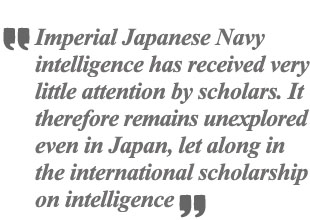
The researchers, Ron Drabkin, visiting scholar at the University of Notre Dame, K. Kusunoki, of the Japan Maritime Self-Defence Force, and Bradley W. Hart, associate professor at California State University, Fresno, published their work on September 22 in the peer-reviewed journal Intelligence and National Security. Their well-written article is entitled “Agents, Attachés, and Intelligence Failures: The Imperial Japanese Navy’s Efforts to Establish Espionage Networks in the United States Before Pearl Harbor”.
The authors acknowledge that the history of the intelligence efforts of the Imperial Japanese Navy (IJN) has received very little attention by scholars. Consequently, it remains unexplored even in Japan, let alone in the international scholarship on intelligence. There are two main reasons for that. To begin with, the IJN systematically destroyed its intelligence files in the months leading to Japan’s official surrender in 1945. Then, following the war, fearing being implicated in war crimes trials, few of its undercover operatives voluntarily revealed their prior involvement in intelligence work.

Luckily, however, the past decade has seen the declassification of a number of Federal Bureau of Investigation (FBI) counterintelligence files relating to Japanese intelligence operations targeting the United States. Most of these files date from the 1930s and early 1940s. Additionally, a number of related documents have been declassified by the government of Mexico, which is important, given that Mexico was a major base for Japanese intelligence operations targeting the United States. Read more of this post

Hawaii couple alleged to be Russian spies using fake names held without bail

Walter Glenn Primose, Gwynn Darle MorrisonA FEDERAL JUDGE IN HAWAII has denied bail to a married American couple, who are believed to have assumed the identities of dead children in order to lead double lives for over 20 years, according to prosecutors. Local media reports allege that Bobby Edward Fort and Julie Lyn Montague, who were arrested by the Federal Bureau of Investigation on July 22 on the island of Oahu, are Russian spies, and that their names are parts of their assumed identities.
According to the reports, the real names of the couple are Walter Glenn Primose, 66, and Gwynn Darle Morrison, 54. Government prosecutors allege that, in the late 1980s, the couple hurriedly left their home in the state of Texas, telling family members that they were entering the US Federal Witness Protection Program. They are also said to have given some family members permission to take whatever they wanted from their home, before it was foreclosed.

The government claims that the couple then assumed the identities of two infants, Bobby Edward Fort and Julie Lyn Montague, who had died in Texas in 1967 and 1968 respectively. They then used these infants’ birth certificates to obtain social security cards, drivers’ licenses, and even US passports. In 1994, while living in Hawaii under his assumed name, Primrose enlisted in the US Coast Guard, which is the maritime security and law enforcement service branch of the US military. He served there for over 20 years as an avionic electrical technician with a secret level clearance. Following his retirement in 2016, Primrose is said to have worked as a private contractor for the US Department of Defense until his arrest on July 22 of this year. Read more of this post

An assessment of Russia’s espionage network in Switzerland

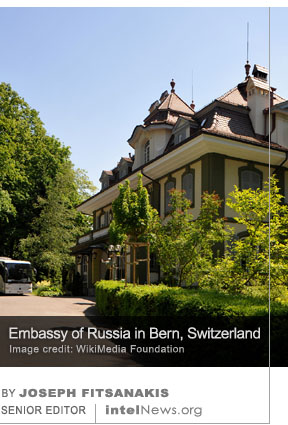
Russian embassy SwitzerlandSINCE LATE FEBRUARY, WHEN Russian troops invaded Ukraine, over 500 Russian diplomats have been expelled from Western countries. Even former Russian allies have contributed to the growing list of expulsions —most recently Bulgaria, which ousted a near-unprecedented 70 Russian diplomats last week, citing espionage concerns. Amidst that sea of expulsions, Switzerland remains an island. It is among the few European countries that have yet to officially expel Russian diplomats. Abiding by its centuries-old policy of neutrality, it has resisted calls to take sides in the intelligence war between the West and Russia.

“No-Questions-Asked” Approach to Espionage

Russia has been able to take advantage of Switzerland’s neutrality policy since February. Instead of returning to Moscow, at least some of the expelled Russian diplomats have been reposted to Switzerland. They continue to operate there under a “no-questions-asked” policy, which has prevailed since the days of the Cold War. For this and other reasons (i.e. proximity to prime intelligence targets, safety, advanced telecommunications systems), Switzerland has been a major intelligence hub for decades. According to the Nachrichtendienst des Bundes (NDB), Switzerland’s Federal Intelligence Service, the past few years have witnessed higher levels of activity by foreign intelligence services than any other period since the Cold War.

Russia’s Intelligence Presence in Switzerland

During that time, Russia has been able to build a pan-European espionage hub in the small alpine state. That is the conclusion of a report by Jonas Roth, which was published last week in the Neue Zürcher Zeitung (NZZ), Switzerland’s newspaper of record. The report, entitled “So Spioniert Russland in der Schweiz” (“How Russian spies operate in Switzerland”), features commentary by several experts and government officials. One source tells Roth that, despite the intense diplomatic pressure Russia has faced globally since February, its espionage structures in Swiss cities like Geneva and Bern “are still intact”.

How many Russian intelligence officers are currently operating in Switzerland? According to the report, at least a third of Russia’s 220-strong diplomatic presence in the country consists of intelligence officers. These 70 or so intelligence officers represent all three of Russia’s primary intelligence agencies, namely the Foreign Intelligence Service (SVR), the Main Directorate of the Armed Forces’ General Staff (GRU), and the Federal Security Service (FSB). Officers from these agencies handle an unknown number of informants and agents; these are Swiss or third-country nationals, who provide the Russians with intelligence on a regular basis. Special activities are carried out by Russian intelligence personnel who travel to Switzerland on an ad hoc basis. Read more of this post