Sophisticated spy malware found on Russian government computers
August 1, 2016 1 Comment
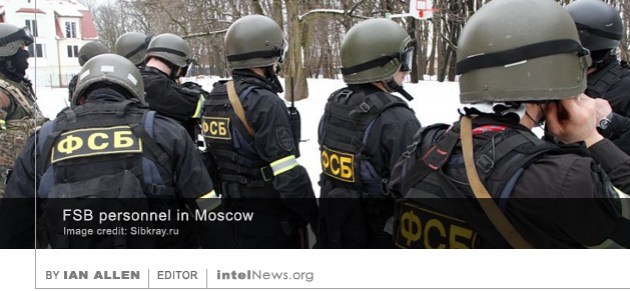 According to the predominant media narrative, the United States is constantly defending itself against cyber-attacks from countries like China and Russia. But, as intelNews has argued for years, this narrative is misleading. Recent intelligence disclosures clearly show that the US cyber-security posture is as offensive as that of its major adversaries. Additionally, China and Russia have to defend their computer networks as much as America does. Last weekend’s report from Moscow helps restore some of the balance that is missing from media reporting on cyber-security. According to the Russian Federal Security Service (FSB), a meticulously coded and sophisticated virus has been found on the computer networks of at least 20 major Russian agencies and organizations. The targets appear to have been carefully selected by the malware’s authors. They include government bodies, weapons laboratories and defense contractors located throughout Russia.
The FSB said that once installed, the virus gave its handler control of the infected computer system. It permitted an outside hacker to turn on a computer’s microphone or camera, and capture screenshots. It also stealthily installed keylogging software, thus allowing an outside party to monitor keyboard strokes on an infected system. Based on its functions, the malicious software seems to be designed to conduct deep surveillance on infected computers and their physical surroundings. The FSB would not attribute the malware to a specific hacking group or nation. But it said it believed that the malware attack was “coordinated”, “planned and planned professionally”. It also said that the coding of the virus “required considerable expertise”. In a brief statement released Saturday, the FSB said that aspects of the coding of the virus, as well as other identifying information, resembled those detected in preceding hacking attacks on computer servers in Russia and other countries. The statement did not elaborate, however.
The news about hacked Russian computers comes less than two weeks after it was claimed that Russian government-backed hackers stole electronic data belonging to the Democratic National Convention (DNC) in the United States. The Democratic Party’s presidential candidate, Hillary Clinton, publicly accused the Russian government of orchestrating the hacking of the DNC computer systems in an attempt to damage her campaign.
► Author: Ian Allen | Date: 01 August 2016 | Permalink
 A Russian television station has aired footage allegedly showing a Russian guard stationed outside the United States embassy in Moscow trying to stop an American diplomat from entering the embassy. The Kremlin claims that the alleged US diplomat was in fact a Central Intelligence Agency officer who was returning to the embassy in disguise following a spy operation. As intelNews
  The Russian government says it has arrested a senior Ukrainian intelligence officer, who was allegedly trained by the United States Central Intelligence Agency and tasked with infiltrating the Russian secret services. In a
  Russian intelligence officials have warned authorities in Thailand that the Islamic State is planning to strike at Russian targets in the Southeast Asian country. Thai authorities received the warning in a memorandum dated November 27, 2015, which came from the Russian Federal Security Service (FSB). The document, marked ‘urgent’, warned of a series of coordinated attacks against Russian-related businesses and facilities in several cities across Thailand. Several Thai news sites, as well as CNN in the United States,
 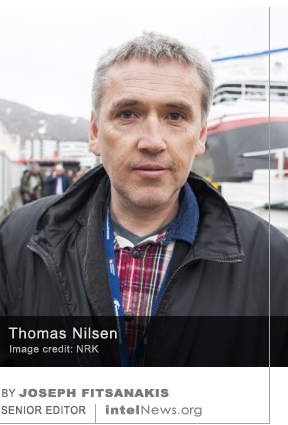 Norway’s state broadcaster has alleged that the Russian intelligence service pressured a Norwegian newspaper to fire one of its journalists who covered fossil fuel exploration in the Arctic Ocean. Last week, journalist Thomas Nilsen was fired by
  The Russian and Estonian intelligence services have exchanged two men accused by each country of spying for the other, in a rare public example of what is commonly referred to as a ‘spy-swap’. The exchange took place on Saturday on a bridge over the Piusa River, which forms part of the Russian-Estonian border, separating Estonia’s Polva County from Russia’s Pskov Oblast.
 A resident of Texas, who is accused by United States authorities of setting up a front company in order to illegally acquire American technology on behalf of Russia’s intelligence services, has pleaded guilty to espionage charges. Alexander Fishenko, 49, was one of 11 people











Analysis: Is Putin planning to restore the Soviet-era KGB?
October 4, 2016 by intelNews Leave a comment
If the Kommersant article is accurate, Russia’s two main intelligence agencies will merge after an institutional separation that has lasted a quarter of a century. They were separated shortly after the official end of the Soviet Union, in 1991, when it was recognized that the KGB was not under the complete control of the state. That became plainly obvious in August of that year, when the spy agency’s Director, Vladimir Kryuchkov, helped lead a military coup aimed at deposing Soviet Premier Mikhail Gorbachev. The two new agencies were given separate mandates: the SVR inherited the mission of the KGB’s foreign intelligence directorates and focused on collecting intelligence abroad; the FSB, on the other hand, assumed the KGB’s counterintelligence and counterterrorist missions. A host of smaller agencies, including the Federal Agency of Government Communications and Information (FAPSI), the Federal Protective Service (FSO) and others, took on tasks such as communications interception, border control, political protection, etc.
Could these agencies merge again after 25 years of separation? Possibly, but it will take time. An entire generation of Russian intelligence officers has matured under separate institutional roofs in the post-Soviet era. Distinct bureaucratic systems and structures have developed and much duplication has ensued during that time. If a merger was to occur, entire directorates and units would have to be restructured or even eliminated. Leadership roles would have to be purged or redefined with considerable delicacy, so as to avoid inflaming bureaucratic turf battles. Russian bureaucracies are not known for their organizational skills, and it would be interesting to see how they deal with the inevitable confusion of a possible merger. It could be argued that, if Putin’s goal is to augment the power of the intelligence services —which is doubtful, given their long history of challenging the power of the Kremlin— he would be better off leaving them as they are today.
► Author: Joseph Fitsanakis | Date: 04 October 2016 | Permalink
Filed under Expert news and commentary on intelligence, espionage, spies and spying Tagged with Analysis, FSB, intelligence reform, Joseph Fitsanakis, KGB, Russia, SVR (Russia), USSR