Malaysia releases second female assassin of Kim Jong-un’s half-brother from prison
May 3, 2019 Leave a comment
 The second of two female assassins who killed the half-brother of North Korean leader Kim Jong-un in 2017 in Kuala Lumpur has been released from prison by the Malaysian state, after a mostly secret trial. The two women, Doan Thi Huong of Vietnam and Siti Aisyah of Indonesia (pictured), approached Kim Jong-nam as he was waiting to board a plane at the Kuala Lumpur International Airport on February 13. The estranged half-brother of the North Korean leader was about to travel to Macau, where he had been living in self-exile since 2007. Soon after his encounter with the two women, Kim collapsed and eventually died from symptoms associated with VX nerve agent inhalation. Huong was arrested on February 15, when she returned to the same airport to catch an outbound flight to Vietnam. Siti’s arrest was announced a day later.
Both women told Malaysian police that they worked as escorts and that they were under the impression that they had been hired by a Japanese YouTube show to carry out a televised prank on an unsuspecting traveler. They claimed that they did not realize that the men who had hired them several months prior to the assassination operation were agents of the North Korean government —which international authorities blamed for Kim’s murder. In March of this year, Malaysian authorities announced that all charges against the Indonesian woman, Siti, had been dropped, and that she would be released from detention. No reasoning behind the decision was provided to the media. On Thursday, it was revealed that Huong would be freed, after she agreed to plead guilty to a much lesser charge of “causing bodily injury”, as requested by government prosecutors.
What is behind the decision of the Malaysian court? British newspaper The Guardian said last month that the government of Indonesia engaged in intense “behind-the-scenes diplomacy” in order to have its citizen released. These efforts “significantly influenced how events […] unfolded in the courtroom”, said the paper. Additionally, the Malaysian government had been uncomfortable with the international attention of this incident from the very beginning, and had expressed the desire “to be done with the trial because it was diplomatically inconvenient”, according to The Guardian. The paper added that, as the international status of Kim Jong-un rose unexpectedly through his meetings with United States President Donald Trump, Malaysia sought to be “part of this conversation”. Kuala Lumpur thus decided that “the recovery of [its] relationship with Pyongyang [was] more important than justice for the assassination of Kim Jong-nam”, former South Korean intelligence officer Dr. Nam Sung-wook told The Guardian.
► Author: Joseph Fitsanakis | Date: 03 May 2019 | Permalink
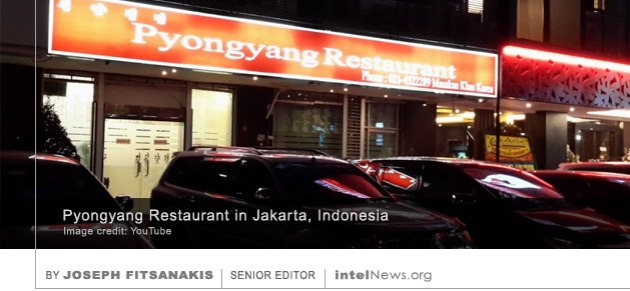 Indonesian authorities said on Sunday that they will investigate a North Korean restaurant in the country, after a Singaporean news agency claimed it was being used as a center for espionage. The announcement comes amidst heightened tensions between North Korean and its neighbors, following the
 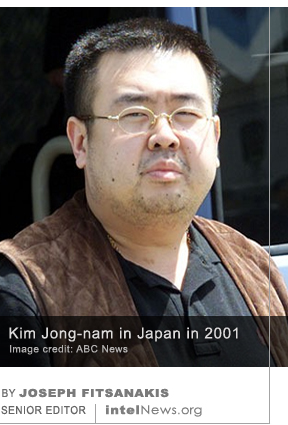 Two women have been arrested in the past 48 hours in connection with the assassination of Kim Jong-nam, half-brother of North Korea’s supreme leader, who died in Malaysia on Monday. Kim, the grandson of North Korea’s founder Kim Il-Sung, died after two women approached him at the Kuala Lumpur International Airport and splashed his face with liquid poison. Some reports suggest that he was injected with a poisoned needle.
 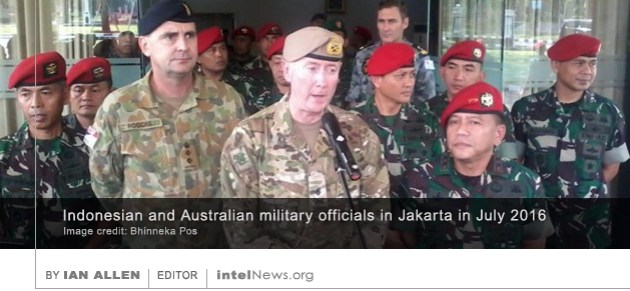 The Indonesian military has halted all forms of cooperation with the armed forces of Australia, with some media reports suggesting that the decision was prompted by fears of espionage. Indonesia and Australia have held joined military training sessions for many decades. In recent weeks, members of the Kopassus, the elite special forces of the Indonesian military, were training on a base in Perth, Australia, with their counterparts in the Australian Special Air Service. On Wednesday, however, the Indonesian government
 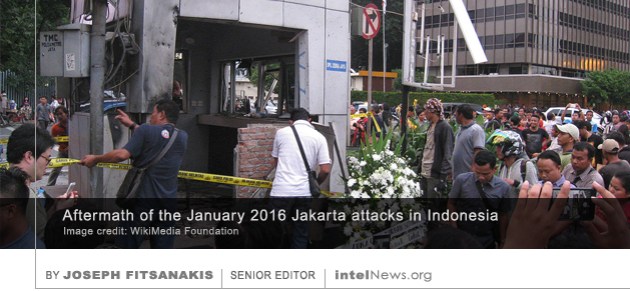 An ambitious new personnel exchange program between intelligence agencies in Australia and Indonesia aims to combat the unprecedented rise of militant Islamism in Southeast Asia, which is fueled by the Islamic State. The program, which is already underway, aims to strengthen intelligence cooperation between two traditionally adversarial regional powers.
  Australian law enforcement and intelligence agencies routinely use paid informants in Indonesia and Pakistan as part of a decade-old covert war against human traffickers in the Indian Ocean. This information has been revealed by The Australian newspaper in response to


 By JOSEPH FITSANAKIS | intelNews.org









 intelNews.org
Chinese-linked hacker group breached Indonesian spy agency’s networks
September 14, 2021 by Ian Allen Leave a comment
A GROUP OF COMPUTER hackers with links to the Chinese state is likely behind a major breach of networks belonging to at least ten Indonesian government ministries and agencies, including the country’s primary intelligence service. The breach was first reported on September 10 by cybersecurity firm Insikt Group, whose researchers say they have been monitoring the hacks since April of this year.
Insikt Group said experts in its threat research division noticed that a number of PlugX malware command and control servers were regularly communicating with hosts inside the networks of the Indonesian government. After forensically examining the communication patterns, the researchers concluded that the initial contact between the command and control servers and the Indonesian government networks was made in March of this year, if not earlier. The technical details of the intrusion are still being determined, according to Insikt Group.
The firm said that the breach was perpetrated by Mustang Panda, a mysterious advanced persistent threat actor, which is also known as BRONZE PRESIDENT, HoneyMyte, and Red Lich. In the past, Mustang Panda has been particularly active in Southeast Asia, targeting servers in Mongolia, Malaysia and Vietnam. The targets of this latest breach included the Indonesian State Intelligence Agency, known as BIN. According to Insikt Group, BIN was “the most sensitive target compromised in the campaign”.
The company said it notified the Indonesian government twice about these intrusions, in June and July. Although no response was forthcoming from the Indonesian government, changes in its computer networks since that time may be taken as evidence that the authorities took steps to “identify and clean the infected systems”, according to Insikt Group’s report.
► Author: Ian Allen | Date: 14 September 2021 | Permalink
Filed under Expert news and commentary on intelligence, espionage, spies and spying Tagged with BIN (Indonesia), China, computer hacking, cyber security, Indonesia, Insikt Group, Mustang Panda, News