US is helping Israel detect intelligence blind spots and locate Hamas leaders: report

UNITED STATES INTELLIGENCE AGENCIES are actively assisting Israel identify the intelligence blind spots that led to the security failure of October 7, and locate senior Hamas leaders, according to the chair of the House Permanent Select Committee on Intelligence. Representative Mike Turner (R-OH) said during an interview on Sunday with CBS’s Face the Nation that American intelligence agencies are “working closely” with the Israeli intelligence community.

The purpose of the collaboration is to find intelligence “gaps” and identify the “institutional bias that resulted in” Israeli intelligence officials dismissing warnings about a potential attack by Hamas in the months leading to October 7. The United States is also providing Israel with “selective […] information” about Hamas targets, including senior Hamas officials. Turner noted that “we are not just providing direct access to our intelligence” and that “caution” is being used in determining the types of intelligence that United States agencies are sharing with Israel.

Turner’s comments come less than a week after The New York Times reported that Israeli intelligence had managed to obtain Hamas’ detailed battle plan for the October 7 attack in 2022. It was a 40-page document, written in Arabic, which allegedly contained the precise details of Hamas’ attack plan, but did not specify a date. Senior intelligence officials dubbed the battle plan “Jericho Wall”, but dismissed it as purely aspirational and thought it too elaborate to be carried out in practice.

On November 27, Israel’s Channel 12 television revealed a series of leaked emails from officers in Israel’s 8200 Intelligence Corps unit of the Israel Defense Forces. The emails reportedly raised concerns about an impending attack by Hamas in southern Israel. According to Channel 12, the Unit 8200 emails provided a “highly detailed warning” about Hamas’ plans to take over Israeli villages near the Gaza Strip and kill hundreds of Israelis. However, senior military officials dismissed the plans as “an imaginary scenario”.

Author: Joseph Fitsanakis | Date: 04 December 2023 | Permalink

Analysis: Israel’s misjudgment of Hamas caused the October 7 intelligence failure

Gaza StripSINCE OCTOBER 7, WHEN Hamas launched its surprise attack on Israel, many more details about the intelligence failure have emerged. It appears that Israeli intelligence officials have warned for years about military exercises held by Hamas in the Gaza Strip, which have included practice raids on cities deep inside Israel. However, the Israel Military Intelligence (IMI) did not heed to the warnings, because it considered Hamas operationally incapable of carrying out such raids. Instead, the IMI estimated that the Hamas leadership aimed to arrive at a settlement with Israel. That seems like the result of a highly successful disinformation operation, which added significantly to the effectiveness of the sudden attack on Israel on October 7.

It now appears that several months after the Israel Defense Forces (IDF) Operation Guardian of the Walls, which targeted Hamas in the Gaza Strip in May of 2021, Hamas began to train for a large-scale operation against Israel. However, the IMI estimated that Hamas was not capable of attacking aQ Quote large number of settlements simultaneously. It also believed that such an operation would go against the spirit of Hamas leadership’s spirit intention to settle with Israel.

As early as 2022, the IMI had analyzed videos of Hamas’ military exercises, which Hamas itself had made available on social media networks. Meanwhile, the intelligence information that emerged from the Gaza Strip showed that the professionalization of Hamas’ military arm, the Izz ad-Din al-Qassam Brigades, was improving. However, IMI officials rejected the need to build an operative response to the mass-attack scenario that these exercises pointed to, because they saw them simply as exercises.

Israeli intelligence also analyzed the communications discourse between the commanders of Hamas, which it had acquired through intercepts. It purportedly indicated that Hamas intended to carry out raids on Israeli communities located near the fence between Israel and Gaza, but also on targets located deeper inside Israel. The communications discourse also indicated that such attacks could occur, not only using tunnels, but with incursions above ground and even through aerial methods.

One of the methods that Hamas trained on, and one that was known to Israeli intelligence, focused on disabling the highly sophisticated observation posts, sensors and remote-controlled machine guns, which Israel has installed along the border fence with the Gaza Strip. The purpose of these exercises was to enable an attack on the fence and overtake it these sophisticated tools with Hamas operatives, thus effectively blinding the Israeli forces. However, Israeli authorities made no effort to prepare for such a scenario by protecting these installations.

The broad picture that is emerging raises serious questions about why the IDF did not take a reasonable course of action against Hamas’ operational plan —and why it failed to do so despite being aware of the intensity of the Hamas exercises, and despite being aware of the group’s stated intentions. Q QuoteIndeed, a preventive course of action should have been in place even in the absence of specific intelligence warnings —if only to enable the IDF to repel a surprise attack by Hamas. There was no need to estimate what Hamas would do in order to prepare for a surprise attack.
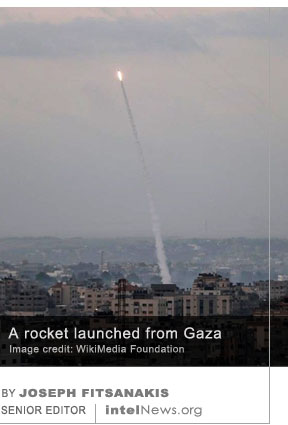
Yet it is now patently obvious that there was ample intelligence about Hamas’ intentions. The latter were both apparent and known. Even without the wisdom of hindsight, it is clear there was enough intelligence to enable Israel to act in a timely manner against Hamas’ plan. Yet Israel severely misjudged Hamas’ intentions. In retrospect, it appears that ample intelligence about Hamas’ intentions had been gathered, that the IMI and Shin Bet were severely underprepared for a surprise attack, that the precise details of Hamas’ attack were missed, and that Hamas’ intentions were misjudged. These are the reasons why Israel was caught unprepared and suffered a catastrophic surprise on October 7.

Author: Dr. Avner Barnea | Date: 10 November 2023 | Permalink

Dr. Avner Barnea is research fellow at the National Security Studies Center of the University of Haifa in Israel. He served as a senior officer in the Israel Security Agency (ISA). He is the author of We Never Expected That: A Comparative Study of Failures in National and Business Intelligence (Lexington Books, 2021).

Analysis : Attack on Israel Points to Systemic Failure at All Levels

Hamas Israel - BarneaTHE COMPARISON BETWEEN THE October 2023 attack on Israel and the Yom Kippur War is reasonable. We still have an obscured perspective on what happened on October 7. But even this partial picture makes it possible to draw a preliminary comparison. Undoubtedly, there is no precedent for such a monumental failure in the history of Israeli intelligence.

The most striking difference between the two case studies is that in 1973 the system as a whole did not fail. The failure was personal, on the part of several key people, who did not perform according to expectations. The events of 2023 point to a systemic failure at all levels, not personal mistakes. The failure is at the level of intelligence warning, the military response to the attack, and even the actions of Israel’s political leadership.

An Intelligence and Military Failure

In 1973, the intelligence-gathering system was working well, and Egypt’s war intentions were known. Thousands of reports from observations along the Suez Canal spoke of the Egyptian preparations. The wireless transmissions that were issued testified to preparation for war in the Egyptian army. All this did not translate into a warning of war, due to the failed performance of some senior officers in the Israeli Military Intelligence (IMI), who stuck to their preconceived notions until the last moment.

In 2023, the failure is systemic. It involves both the level of collection and at the level of assessment. It relates both to the IMI and the Israel Security Agency (ISA). It has already become clear that the intelligence collection mechanisms failed to detect large-scale preparations for an all-out attack from the Gaza Strip. A massive intelligence system failed to detect the preparatory actions of the assailing forces.

When the perceived enemy is Palestinian civilians and when Israel Defense Forces (IDF) soldiers spend their time guarding settlements and worshipers, instead of engaging in hard training, the result is catastrophic. On October 7, we witnessed the operations of an army whose main mission is occupation. Given what we saw on that day, namely more than 1,000 civilian and military casualties and approximately 150 kidnapped Israelis, it is not clear how this army will be able to face the upcoming challenges in this war. The need for the professionalism and resilience of the IDF, which was there in 1973, continues to exist.
A Political Failure

The comparison between the political leadership of 1973 and 2023 is also discouraging. Back then, the root of the failure was that the intelligence information the leadership received from Eli Zeira, the director of IMI, who was the nation’s most senior intelligence officer, was distorted and false. It is now understood that the IMI’s assessments were based on the concept of reassuring the political leadership. Yet, Prime Minister Golda Meir and Minister of Defense Moshe Dayan were challenged after the war, and were eventually removed from their positions. However, they acted responsibly.

In contrast, there is not much to say about Israel’s current political leadership. It suffices to look at the composition of the Security Cabinet and the first leaks that have already begun to emanate from it, or at the surge of slander that members of the governing coalition have begun to heap on the finest of the IDF’s officers. It is nothing short of a disgrace and a disaster.

This war has just begun. It is still too early to draw conclusions. But we can examine the conclusions from the Yom Kippur War and assess their relevance to today. When Israeli Prime Minister Benjamin Netanyahu talks about revenge, it is advisable to remember those lessons. The conflict with the Palestinians is long and bitter. They will not give up their ambition for their state. It is now time to comprehend the full cost of the continuation of the conflict.

► Author: Avner Barnea | Date: 11 October 2023 | Permalink

Dr. Avner Barnea is research fellow at the National Security Studies Center of the University of Haifa in Israel. He served as a senior officer in the Israel Security Agency (ISA). He is the author of We Never Expected That: A Comparative Study of Failures in National and Business Intelligence (Lexington Books, 2021).

How Did Israel Miss This Attack? Some Likely Explanations

Gaza HamasTHE HAMAS-LED OPERATION al-Aqsa Flood, which began on October 7, marked the first large-scale conflict within the borders of Israel since the 1948 Arab-Israeli War. However, unlike the coalition of Arab armies it faced in 1948, Israel now confronts an alliance of sub-state groups. Led by Hamas’ military wing, the al-Qassam Brigades, this alliance includes the Syrian- and Iranian-backed Palestinian Islamic Jihad and a number of secular groups, such as the Fatah-aligned al-Aqsa Martyrs’ Brigades, the Popular Front for the Liberation of Palestine (PFLP) and the Democratic Front for the Liberation of Palestine (DFLP).

Such groups are lesser-known than Hamas; however, they often bring with them expertise in niche areas, such as handling networks of informants inside Israel, building sophisticated explosives, employing unmanned combat drones, or procuring specialized weaponry. They are therefore likely to have contributed greatly to the outcome of Operation al-Aqsa Flood. Their participation also enabled Hamas to launch what essentially amounted to a combined arms assault on Israel. The latter included coordinated land, sea and air elements, which were purposefully low-tech. That may explain why the assailants were able to short-circuit and overwhelm the purportedly impregnable security perimeter that Israel maintains around the Gaza Strip.

Iranian and Lebanese Coaching

Putting aside the individual low-tech elements of the operation, its overall level of tactical organization almost certainly points to considerable support from actors beyond the Gaza Strip. Such actors likely include networks of informants within Israel, as well as possibly Iran and its Lebanese proxy, Hezbollah. Both are well-versed in hybrid warfare and have studied Israeli defense systems more extensively than any other regional actor. Additionally, Iran’s Islamic Revolutionary Guard Corps (IRGC) and Hezbollah’s Lebanese Resistance Brigades are seasoned practitioners of deception operations. They likely coached Hamas, not only on how to carry out Operation al-Aqsa Flood, but more importantly on how to prevent Israel and its allies from gathering intelligence about it.

There is no question that an operation of such a magnitude must have taken months —possibly even years— to conceive, develop and organize. Such a complex process would have taken place under the watchful eyes and ears of Israeli and Egyptian intelligence agencies, who have historically faced little resistance in penetrating Palestinian militant groups, including Hamas. Yet none seem to have collected enough intelligence to anticipate the attack. It is equally stunning that the meticulous planning of Operation al-Aqsa Flood appears to have escaped the attention of American intelligence agencies, whose presence in the Middle East is significant. How was that even possible? Read more of this post

FBI, NYPD forewarned Capitol Police of serious violence by Trump supporters

US CapitolTHE FEDERAL BUREAU OF Investigation and the New York Police Department gave Capitol Police officials specific warnings that supporters of United States President Donald Trump were determined to engage in serious violence on January 6, according to federal officials. The FBI even made contact with known far-right radicals across the United States in early January, and warned them not to travel to Washington for the pro-Trump rally that resulted in the bloody attack on the US Capitol, according to NBC News.
Citing “senior law enforcement officials”, including “a senior FBI official”, NBC reported on Sunday that the FBI had “credible and actionable information” about specific far-right radicals who intended to join the protest on January 6. This information was allegedly communicated to Capitol Police officials, according to the report. The senior FBI official, who is not named in report, told NBC that the Bureau made contact with those radicals and warned them not to travel to Washington for the protest. Citing “multiple law enforcement officials”, the news network also said that the Capitol Police was given extensive intelligence by NYPD about planned acts of violence on January 6. The intelligence was “specific”, “detailing the threats and extremist rhetoric on social media”, according to the news network.

Despite these warnings, however, Capitol Police reportedly turned down an offer of assistance by the US National Guard three days before the fateful siege of the Capitol Building Complex by thousands of pro-Trump insurgents, many of whom were armed. According to the Associated Press, despite the advanced and detailed warnings given to it, “the Capitol Police planned only for a free speech demonstration”.

Meanwhile, the experts warning of a significant risk of widespread violence on January 20, when President-Elect Joe Biden is scheduled to be sworn into office, are growing in number. On Sunday, Cindy Otis, a former Central Intelligence Agency analyst and vice-president of the Alethea Group, which tracks online threats, warned that “we are in a tinderbox situation right now”. She pointed to numerous threats made online, which claim that last Wednesday’s attack on the Capitol was “just a taste of things to come”. There are reports that far-right insurgents are preparing for a violent showdown in DC, aimed at preventing Biden from entering the White House on January 20. Other reports suggest that groups of insurgents seek to organize synchronous potentially violent rallies in every state of the union that day.

Author: Joseph Fitsanakis | Date: 11 January 2021 | Permalink

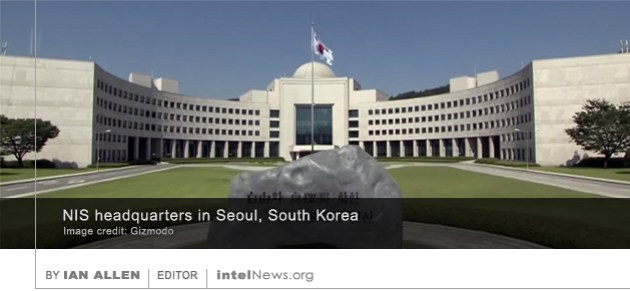
S. Korean spy agency admits error, says ‘executed’ N. Korean general is alive

NIS South KoreaThe intelligence agency of South Korea has admitted it made an error when it claimed earlier this year that North Korean authorities had executed one of the regime’s most prominent military figures. On February 10, South Korean newspapers printed a series of articles suggesting that Pyongyang had executed General Ri Yong-gil, who led the Korean People’s Army (KPA), holding post that was equivalent to the United States’ chairman of the Joint Chiefs of Staff. The articles said at the time that the information about General Ri’s execution came directly from the National Intelligence Service (NIS), South Korea’s primary external spy agency. The general had allegedly been executed after being found guilty of “factionalism, abuse of power and corruption”. The reports added that General Ri had turned into an alcoholic and was in poor health as a result. Speculation as to the reason for General Ri’s alleged execution brought up the possibility that he had led an opposition faction within the KPA. This, in turn, led some analysts to speculate that the administration of Kim Jong-un was close to collapse.

However, after the seventh congress of the Workers’ Party of Korea (WPK), which concluded on Monday, not only has the view of Kim’s rule as weak been overturned, but General Ri appears to have come back from the dead. On May 10, the Rodong Sinmun, the official newspaper of the Central Committee of the WPK, announced that General Ri had been appointed member of the WPK’s Central Military Commission. The announcement also said that the General would also be a candidate member of the Political Bureau of the WPK Central Committee, in accordance with the Committee’s wishes. It appears, therefore, that, not only is General Ri alive and well, but that he also features prominently the inner sanctum of the WPK’s political leadership.

Soon after Rodong Sinmun’s announcement, Hong Yong-pyo, South Korea’s Minister of Unification, told reporters in Seoul that the government would have to “check the details” of General Ri’s fate. An anonymous South Korean government official told newspapers that the NIS had assumed General Ri had been purged because he “hadn’t been seen for some time”. But critics of the government in Seoul accused the conservative administration of President Park Geun-hye of using “skewed perceptions” of the regime in Pyongyang in order to block negotiations with North Korea, and urged “some serious soul-searching” regarding the dependability of the NIS. IntelNews regulars will recall that Won Sei-hoon, who headed the NIS from 2008 to 2013, was jailed last year for interfering with national elections in order to further Park’s electoral power.

Author: Ian Allen | Date: 13 May 2016 | Permalink

News you may have missed #792 (US diplomatic attacks edition)

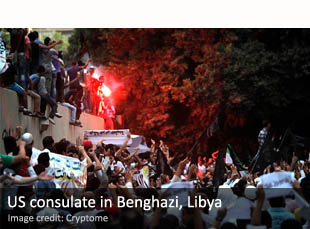
US consulate in Benghazi, LibyaBy IAN ALLEN | intelNews.org |
►►Attack on US diplomats ‘was intelligence failure’. James Corum, an American military historian and the author of several books on military history and counter-insurgency, argues that the mob attacks on US diplomatic facilities in Cairo, Benghazi and Sana’a marked “one of the worst intelligence failures in American history”. Either, he says, US intelligence agencies had no warnings of mass action against the embassies, or senior intelligence officers disregarded or downplayed the information received from field agents. Finally, he suggests that “the real explanation is probably the latter”.
►►Attack on consulate in Libya ‘may have been planned’. Senior US officials and Middle East analysts raised questions Wednesday about the motivation for the Benghazi attack, noting that it involved the use of a rocket-propelled grenade and followed an al-Qaeda call to avenge the death of a senior Libyan member of the terrorist network. Libyan officials and a witness said the attackers took advantage of a protest over the film to launch their assault. Libyan Deputy Interior Minister Wanis al-Sharif said the security force was outgunned by the attackers, who joined a demonstration of “hundreds” of people outside the consulate
►►What happened in Benghazi was a battle. “It was not a simple mob that attacked the US consulate in Benghazi on Tuesday, killing four Americans. Benghazi was the scene of a pitched battle, one in which unknown Libyan assailants besieged American diplomats with small-arms fire for over four hours, repelling several attempts by US personnel to regain control of it. Nor was what happened in Benghazi a simple story of Americans assaulted by the Libyans they helped to liberate from Muammar Gaddafi last year. Libyan security forces and a sympathetic local militia helped the Americans to suppress the attack and get the diplomats inside to safety”.

CIA declassifies internal review on Iraq ‘intelligence failure’

Report cover pageBy JOSEPH FITSANAKIS | intelNews.org |
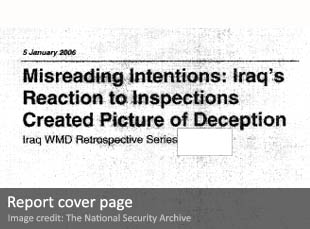
An internal report on the alleged failure of the Central Intelligence Agency to accurately read the intentions of the Iraqi regime in the run-up to the 2003 invasion by the United States, has been declassified. The report, entitled Misreading Intentions: Iraq’s Reaction to Inspections Created Picture of Deception, was authored in 2006, classified ‘secret’. It was prepared by the CIA’s Directorate of Intelligence (DI), the part of the Agency that is responsible for collating and assessing gathered intelligence in order to assist the decisions of US policy-makers on key foreign issues. The report describes what it sees as the DI’s intelligence failure to assess the true state of Iraq’s purported weapons of mass destruction program in the run-up to the US invasion. It says that invalid predispositions and “analytic liabilities” among CIA analysts prevented the Agency from seeing the issue of weapons of mass destruction from the viewpoint of the Iraqi government. Although heavily redacted, the report seems to state that CIA analysts spent little time examining the view, held by many at the time, that the Iraqi regime had in fact terminated its WMD program by 1995. Furthermore, Agency analysts failed to realize in time that, although it had terminated its WMD program, the Iraqi regime maintained a deliberate policy of ambivalence about the purported existence of the program, in order to save face, deter potential adversaries and appear more dangerous than it actually was. Such a policy of deception was well within the character of the Iraqi regime and should have been detected by American intelligence experts, says the report. Read more of this post

News you may have missed #772

Israeli team at the 1972 Munich OlympicsBy TIMOTHY W. COLEMAN | intelNews.org |
►►India restricts agency-to-agency contacts with CIA. According to The Deccan Herald, Indian intelligence officials are growing increasingly wary of the frequent interactions between their own intelligence personnel and the CIA. Cooperation between the US intelligence organizations and Indian government agencies has been increasing under the guise of counter-terrorism efforts. Calcutta News reports that a book published by author Prem Mahadevan, called The Politics of Counterterrorism in India, identifies at least two CIA penetrations of Indian intelligence officials since 2001.
►►Canadian spy revealed classified information in “massive leak”. As was previously reported on this blog, former Sub-Lieutenant Jeffrey Paul Delisle, a navy intelligence officer, is accused of spying for Russia. According to The New Zealand Herald, the accused Canadian spy provided the Russian government with classified information on the US, Britain, Canada, New Zealand and Australia in what is being termed a “massive leak”.
►►Germany had advance warning of 1972 Olympics massacre. Israel-based English-language newspaper The Jerusalem Post is reporting that an article in the German newsmagazine Der Spiegel, stated Germany had advance warning about a potential terrorist attack on Israeli athletes at the 1972 Olympic games. Previously classified documents accessed by Der Spiegel show that not only were there indications of a terror plot, but that there were explicit warnings and details. Perhaps more damaging are the lengths and extremes that German intelligence officials went to in order to cover up blatant mistakes in the case.

News you may have missed #729 (intel blunder edition)

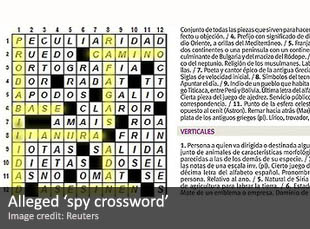
Alleged Venezuelan 'spy crossword'By IAN ALLEN | intelNews.org |
►►US drones ‘incidentally’ spy on Americans. A leaked US Air Force document stipulates that a drone that happens to capture surveillance images of Americans may store them for a period of 90 days. The paper appears to justify spying on citizens, as long as it is “incidental”. The document accepts that the Air Force may not record information non-consensually; however it does state: “collected imagery may incidentally include US persons or private property without consent”. The report, dated April 23 was discovered by Steven Aftergood of the Federation of American Scientists and has been put online.
►►Indian intel blunder sparks anger in Pakistan. India’s Research and Analysis Wing (RAW) intelligence agency sparked outrage in Pakistan and self-deprecatory jokes in India itself last week, after it listed ordinary Pakistani shopkeepers as terrorists on a mission to attack some of India’s landmark institutions. RAW, which is considered India’s premier intelligence agency, issued an advisory to state governments in which it said that five trained militants from Pakistan’s banned Lashkar-e-Taiba group had sneaked into India with fake identities to attack a nuclear facility, oil refinery, seaport and defense academy. Within hours after photographs of the five men were released, a Pakistani television channel reported that two of the three men on the list were shopkeepers and one was a guard, all living in Lahore, and that none of them had ever left Pakistan.
►►Venezuelan spies face criticism over ‘crossword puzzle’ plot. Venezuelan government critics, and even some supporters, are ridiculing a Venezuelan state TV host’s allegation that a newspaper crossword puzzle may have had a hidden call for a plot to kill President Hugo Chavez’s elder brother. Intelligence agents questioned Neptali Segovia, the author of the puzzle, after state TV presenter Miguel Perez Pirela pointed out that Wednesday’s crossword contained the word “ASESINEN”, or kill, intersecting with the name of Chavez’s brother, “ADAN”. He noted they were below the word “RAFAGAS”, meaning either gusts of wind or bursts of gunfire.

News you may have missed #716 (analysis edition)

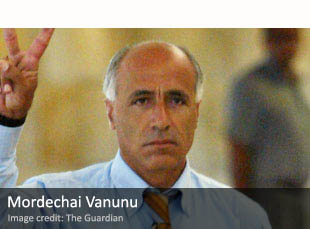
Mordechai VanunuBy IAN ALLEN | intelNews.org |
►►Kabul attacks show intel failures in Afghanistan. Dozens, possibly hundreds of people would have been involved in training, equipping and then infiltrating into the heart of Kabul the large number of insurgents who were prepared to fight to a certain death in the Afghan capital last Sunday. Yet neither Afghan nor foreign intelligence operatives appeared to have any idea that an unprecedented wave of attacks was about to engulf both Kabul and several other key locations around the country. So it seems that Afghan President Hamid Karzai may have a point when he says that the “infiltration in Kabul and other provinces is an intelligence failure for us and especially for NATO and should be seriously investigated”.
►►Report claims China spies on US space technology. China is stealing US military and civilian space technology in an effort to disrupt US access to intelligence, navigation and communications satellites, according to a report authored by the State and Defense Departments. The report (.pdf) argues China should be excluded from recommendations made to the US government to ease restrictions on exports of communications and remote-sensing satellites and equipment. Chinese officials have denied the report’s allegations, calling it a “Cold War ghost”.
►►The long and sordid history of sex and espionage. Using seduction to extract valuable information is as old as the Old Testament —literally— Whether from conviction or for profit, women —and men— have traded sex for secrets for centuries. The Cold War provided plenty of opportunities for so-called “honey-pot” scandals. Perhaps the most dramatic case of seduction in recent times involved Israeli nuclear technician Mordechai Vanunu. In 1986 he visited London and provided The Sunday Times with dozens of photographs of Israel’s alleged nuclear weapons program. But Mossad was on his trail and a female agent —Cheryl Ben Tov— befriended him (reportedly bumping into him at a cigarette kiosk in London’s Leicester Square). She lured him to Rome for a weekend, where he was drugged and spirited to Israel.

News you may have missed #475 (Arab revolution edition)

  • Obama ‘disappointed’ with US intelligence on Tunisia. US President Barack Obama sent word to National Intelligence Director James Clapper that he was “disappointed with the intelligence community” over its failure to predict that the outbreak of demonstrations would lead to the ouster of President Zine el-Abidine Ben Ali in Tunis.
  • An Intelligence Failure in Egypt? The US intelligence community is like the offensive line of the government. They protect the quarterback all day long, and no one notices until they give up a sack. Which raises the question: was US President Barack Obama blindsided by the uprisings in Tunisia and Egypt?
  • Did US intelligence fail in North Africa? “One former official said US president Barack Obama recently urged the CIA to put as much effort into analysis of the situation in North Africa as into covert operations, including those targeting al-Qaida”.

News you may have missed #0251 (analysis edition)

Bookmark and Share

Former MI6 head testifies in UK Iraq War commission

Sir John Scarlett

Sir John Scarlett

By JOSEPH FITSANAKIS | intelNews.org |
Sir John Scarlett, who until recently headed MI6, Britain’s foremost external spy agency, chaired the country’s Joint Intelligence Committee (JIC) in the run-up to the Iraq War. He was therefore in charge of an influential government report, produced in September 2002, which argued that Iraq’s supposed weapons of mass destruction constituted an immediate threat to Britain. As part of the official inquiry into Britain’s entry in the Iraq War, Sir John testified yesterday about the controversial report, known as ‘the dodgy dossier’, which has been criticized as a monumental intelligence failure that helped drag the country into an unpopular war. The former JIC chairman admitted that British intelligence services were aware before the War that Iraq had dismantled its long-range missiles and thus had no way of shooting its chemical munitions at distant targets, including Britain. Read more of this post

News you may have missed #0100

  • Iran says US is forging nuclear intelligence. Ali Asghar Soltanieh, Iran’s envoy to the International Atomic Energy Agency, says the US government is using forged intelligence to make the case to the UN’s nuclear watchdog group that Iran is pursuing an atomic weapons program. What is arguably missing in the Iranian nuclear debacle is conclusive IAEA confirmation of the existence of Iran’s nuclear arms program, as in the case of Syria.
  • Pakistanis call for intelligence dialogue with India. Mahmud Ali Durrani, Pakistan’s former national security adviser, has called for a “frank dialogue” between Pakistani and Indian security services. As intelNews reported earlier this year, Durrani was fired for his dovish stance vis-à-vis India and for being “too pro-American”.
  • US official was investigated for espionage. Alberto Coll, a Cuban-American who lost a senior job at the Navy War College after he was convicted of lying about a 2004 trip to Havana, was also investigated for espionage, according to an FBI document.

Bookmark and Share