ISIS remains strong with 30,000 members in Iraq and Syria, experts warn

ISIS forces in RamadiThe Islamic State has recovered from some of its recent defeats in the battlefield and has as many as 30,000 committed members in Iraq and Syria, according to two reports by American and United Nations experts. Last month, the Iraqi government announced that the war against the group, which is also known as the Islamic State of Iraq and Syria (ISIS) had been won. The statement was echoed by the United States President Donald Trump, who said that the war against the militant Sunni group was “98 percent” over. But now two new reports, one produced by the United States Department of Defense and the other by an expert UN panel, warn that both ISIS and al-Qaeda remain powerful, popular and dangerous in Iraq, Syria, and many other regions of the world.

The UN report was published on Monday by the organization’s Analytical Support and Sanctions Monitoring Team, which is tasked with monitoring the impact of UN-imposed international sanctions. The report recognizes that ISIS has suffered unprecedented military defeats in Iraq and Syria in the past year, and that many of its most hardened fighters are dead or have abandoned the conflict zones in the region. But it warns that the militant organization is now morphing into a “covert version” of its former self and that its organizational core remains mostly intact in both Iraq and Syria. What is more, ISIS’ center is backed by as many as 30,000 unreconstructed members, who are split roughly equally between the two countries. The US Pentagon report, which was delivered this week to Congress states that ISIS has as many as 17,100 fighters in Iraq and another 14,000 in Syria. Many of those surviving fighters are citizens of dozens of different countries around the world, according to the report. Some of them are still engaged in armed fighting, while others are “hiding out in sympathetic communities and urban areas”, mostly in Iraq, the UN report states.

There are also tens of thousands of ISIS fighters and supporters in Libya, Afghanistan, Egypt, and in several West African and Southeast Asian countries, according to the reports’ authors. These fighters are led by commanders who remain in contact with senior ISIS leaders and continue to revere Abu Bakr al-Baghdadi as the group’s central figure. In addition to ISIS, al-Qaeda also remains strong and dangerous, according to the UN report. Its regional structure “continues to show resilience” and in some regions of the world it is far stronger than ISIS. These include several regions of Africa, including areas of Somalia and the Sahel, as well as in Yemen, where al-Qaeda is believed to command as many as 7,000 armed fighters at the moment.

Author: Joseph Fitsanakis | Date: 15 August 2018 | Permalink

Germany arrests Jordanian intelligence operative who spied on mosque

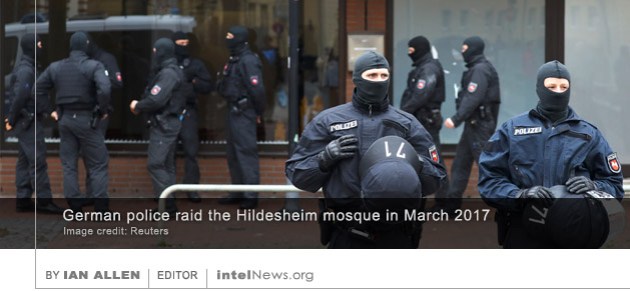
Hildesheim mosqueAuthorities in Germany announced yesterday the arrest of a German national who is accused of spying on a central German mosque on behalf of Jordan, according to media reports. The man was reportedly arrested on Tuesday at an unknown location by officers of Germany’s domestic intelligence agency, the Federal Office for the Protection of the Constitution (BfV). In a press statement, the agency said the man is a 33-year-old German national named “Alexander B.”. German privacy rules forbid the public identification of crime suspects prior to their conviction in a court of law.

According to the public statement issued by the BfV, the 33-year-old man is believed to have worked for “a Jordanian intelligence agency” —most likely the Jordanian General Intelligence Department, or GID, which is a branch of the Jordanian Armed Forces— since at least 2016. He is accused of having infiltrated a Sunni mosque in the central German city of Hildesheim, located 20 miles southeast of Hanover in Germany’s Lower Saxony region. His mission, according to the BfV, was to keep tabs on mosque goers who expressed support for the ideology of the Islamic State, and might even consider traveling to the Middle East to join the radical group. The alleged Jordanian intelligence operative was also tasked with reporting on news reaching the mosque from those of its members who had already gone to the Middle East and joined the Islamic State.

Last year, German authorities closed down the Hildesheim mosque, known in German as Deutschsprachiger Islamkreis Hildesheim e. V. (DIK), and arrested its imam, Ahmad Abdulaziz Abdullah A., known as Abu Walaa. The Iraqi-born imam was charged with supporting a foreign terrorist organization by actively recruiting young Muslims on behalf of the Islamic State. The mosque has since remained closed, because authorities believe that it had become a beehive of fundamentalist activity. Jordan is one of the Middle East’s most liberal states and has been targeted repeatedly by the Islamic State, which views its leadership as pro-Western. However, it appears that Alexander B. was spying on the Hildesheim mosque —therefore on German soil— without having informed the host country of his activities. The government of Jordan has not commented on his arrest.

Author: Ian Allen | Date: 09 August 2018 | Permalink

Indian intelligence infiltrated Islamic State in ‘unprecedented operation’

New Dehli IndiaA joint Indian-American counterintelligence operation, described as “unprecedented in its scale and scope”, reportedly foiled a major suicide attack by the Islamic State in New Delhi and helped achieve “a string of victories” against the group in Afghanistan and Pakistan. Citing “top diplomatic and intelligence sources”, the New Delhi-based daily The Indian Express said that the “audacious” operation took place a year ago, but details about it were only made available to its reporters in recent days.
The paper said that the operation lasted 18 months and involved the systematic surveillance of numerous suspects in Dubai, New Delhi and several cities in Afghanistan. It also involved substantial intelligence-sharing between Indian and American security agencies, as well as constant intelligence-gathering by as many as 80 Indian physical-surveillance experts. Intelligence gathered from physical surveillance was reportedly combined with information collected through telephone intercepts. Eventually it became clear that the Islamic State had recruited and trained 12 suicide bombers across several secret camps in Pakistan. The recruits were tasked with carrying out suicide bomb attacks throughout Pakistan, Afghanistan and India.

One such recruit, the 25-year-old “son of a wealthy [Afghan] businessman”, had been sent by the Islamic State to New Delhi to carry out his deadly mission. In order to escape the attention of the authorities, he had enrolled in a private engineering college in New Delhi. But he was arrested by Indian intelligence and quickly transported to Afghanistan, where he was interrogated by American officers. According to The Indian Express, intelligence gathered from these interrogations helped the United States-led coalition in Afghanistan achieve “a string of successes” against former Taliban forces aligned with the Islamic State. The Afghan would-be suicide bomber remains in Afghanistan under US custody, according to the paper.

Author: Joseph Fitsanakis | Date: 17 July 2018 | Permalink

Spy chiefs from Russia, China, Iran and Pakistan hold high-level meeting

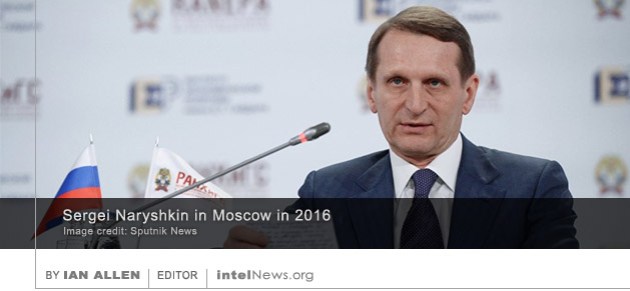
Sergei NaryshkinIntelligence directors from Russia, China, Iran and Pakistan met on Tuesday to discuss regional cooperation with particular reference to combating the Islamic State in Afghanistan. Information about the high-level meeting was revealed yesterday by Sergei Ivanov, media spokesman for the Russian Foreign Intelligence Service (SVR). Ivanov told Russia’s state-owned TASS news agency that the meeting was held in Pakistan and included the participation of SVR director Sergei Naryshkin. TASS reported that the meeting was held under the auspices of Pakistan’s powerful Inter-Services Intelligence (ISI) Directorate and was attended by “senior intelligence officials” from Pakistan, Russia, Iran and China.
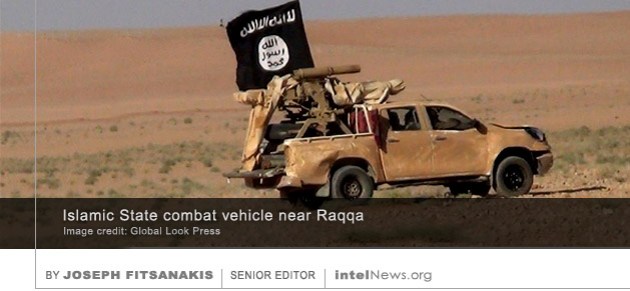
Ivanov said that discussions during the meeting “focused on the dangers arising from a buildup of the Islamic State on the Afghan territory”. The Islamic State announced the formation of its Afghan province (wilayah in Arabic) in January 2015, using the term “Khorasan Province”. By July 2016, two of its most prominent leaders had been killed in coordinated drone strikes by the United States, but the group continues to launch operations to this day. Its core is thought to be made up of nearly 100 fighters from the Islamic State’s former strongholds in Syria and Iraq. According to Russian reports, security officials in China, Russia, Pakistan and Iran are concerned that the Islamic State’s Afghan command is becoming stronger as fighters from the group are leaving the Middle East and moving to Afghanistan.

Tuesday’s high-level meeting in Islamabad follows an announcement last month by the Beijing-led Shanghai Cooperation Organization (SCO) that it would adopt a more active stance on security issues in Afghanistan. Early in June, Afghan President Mohammad Ashraf Ghani described the SCO as “an important platform for anti-terrorist cooperation and enhancing regional connectivity” in Central and South Asia. President Ghani made these comments shortly before traveling to China to attend the annual summit of the SCO, of which Afghanistan is an observer country.

Author: Ian Allen | Date: 11 July 2018 | Permalink

Analysis: The Islamic State is far from dead; it is regrouping and rebranding itself

Islamic State ISISIn a recent series of interviews to promote his new book, Anatomy of Terror, former FBI special agent and current counterterrorism expert Ali Soufan insists that the Islamic State remains potent and dangerous. Speaking last week to the British newspaper The Guardian, Soufan warned that, even though the Islamic State was unable to hang on to its self-described caliphate in the Middle East, the group has ample opportunities to regroup. In the days of al-Qaeda, “we only had one vacuum, in Afghanistan”, from where Osama bin Laden’s organization operated from and spread its message, said Soufan. “Now we have so many vacuums —Syria, Yemen, Libya, northern Nigeria, Tunisia, the Philippines— and it’s expanding. That’s very dangerous”, he warned.
Soufan, a well-read analyst and complex thinker, who today presides over The Soufan Group and oversees the Soufan Foundation, is right to warn against the notion that the Islamic State is on its way out. The group’s meteoric rise marked a watershed moment in the modern history of militant Sunni Islam. Even if it is militarily annihilated —a prospect that is far from certain— its physical absence will in no way erase its impact and influence among its millions of supporters and sympathizers. In fact, experts warn that the group is —like al-Qaeda before it— proving to be resilient and able to withstand intense military pressure from its enemies. Currently, all signs show that the Islamic State is actively reorganizing under the command of its leader, Abu Bakr al-Baghdadi. The prolonged absence of the Iraqi-born al-Baghdadi has prompted wild speculation about this supposed demise or severe incapacitation. There are even some who claim that he was killed by an Islamic State faction in an internal coup.
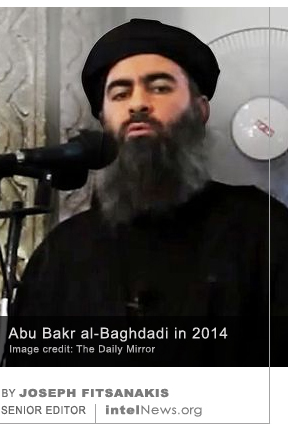
But most intelligence agencies agree that al-Baghdadi —and his core lieutenants— remain very much alive and well. Three weeks ago, The Washington Post cited anonymously a “senior United States counterterrorism official” who confirmed that, by all indications, al-Baghdadi was alive and was coordinating the group’s activities in its last strongholds in eastern Syria. This is supported by communications intercepts, detainee interrogations and statements by informants, said The Post. It is important to note that Al-Baghdadi continues to have alongside him some of the militant group’s most hardened commanders, most of whom were trained in intelligence and military tactics during the reign of Saddam Hussein. Under their guidance, retreating Islamic State forces are leaving behind cell-based formations of underground fighters in areas that are liberated by the fragile US-led coalition. Read more of this post

Joint US-Iraqi intelligence operation used cell phone app to trap senior ISIS figures

Abu Bakr al-BaghdadiAn joint operation conducted by American and Iraqi intelligence officers employed a popular messaging app on the phone of a captured Islamic State commander to apprehend four very senior figures in the organization, according to reports. The Reuters news agency said on Thursday that the ambitious intelligence operation began in February, when Turkish authorities captured a close aide to Abu Bakr al-Baghdadi, the Iraqi-born leader of the group known as Islamic State of Iraq and Syria (ISIS). According to Hisham al-Hashimi, security advisor to the government of Iraq, the ISIS aide was Ismail al-Eithawi, also known by his alias, Abu Zaid al-Iraqi. Iraqi officials claim that al-Eithawi was appointed by al-Baghdadi to handle the secret transfer of ISIS funds to bank accounts around the world.
It appears that al-Eithawi had managed to escape to Turkey when the United States-led coalition shattered ISIS’ self-proclaimed caliphate. But he was captured by Turkish counterterrorism forces and handed over to Iraqi authorities. Baghdad then shared the contents of al-Eithawi’s cell phone with US intelligence officers. The latter were able to help their Iraqi counterparts utilize the popular messaging app WhatsApp, a version of which was installed on al-Eithawi’s cell phone. According to al-Hashimi, the Iraqis and Americans made it seem like al-Eithawi was calling an emergency face-to-face meeting between senior ISIS commanders in the area. But when these Syria-based commanders crossed into Iraq to meet in secret, they were captured by Iraqi and American forces.

According to al-Hashimi, those captured include a Syrian and two Iraqi ISIS field commanders. More importantly, they include Saddam Jamal, a notorious ISIS fighter who rose through the ranks to become the organization’s governor of the Euphrates’ region, located on Syria’s east. Al-Hashimi told reporters on Thursday that Jamal and al-Eithawi were the most senior ISIS figures to have ever been captured alive by US-led coalition forces. The Iraqi government advisor also said that al-Eithawi’s captors were able to uncover a treasure trove of covert bank accounts belonging to ISIS, as well as several pages of secret communication codes used by the militant group.

Author: Joseph Fitsanakis | Date: 11 May 2018 | Permalink

Britain launched first-ever military-style cyber campaign against ISIS, says spy chief

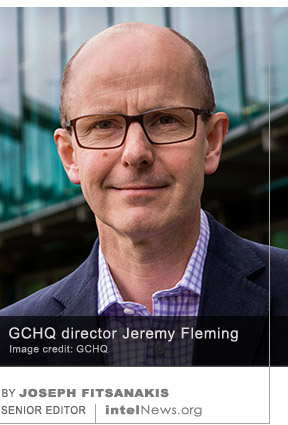
Jeremy FlemingFor the first time in its history, the United Kingdom has launched its first-ever military-style cyber campaign against an adversary, according to the director of the country’s primary cyber security agency. The target of the campaign was the Islamic State, the militant Sunni Muslim group that is also known as the Islamic State of Iraq and Syria (ISIS). The existence of the all-out cyber war was announced last week by Jeremy Fleming, the newly appointed director of the Government Communications Headquarters (GCHQ), Britain’s signals intelligence organization. Fleming, a former Security Service (MI5) officer, was speaking at the CYBERUK2018 conference, held in the northern English city of Manchester. It was his first public speech as director of GCHQ.
Fleming told his Manchester audience that the cyber operation that targeted ISIS was a “major offensive campaign” that seriously hampered the group’s ability to launch and coordinate both physical and online attacks against its enemies. The campaign also prevented ISIS from using its “normal channels” online to spread its message, effectively suppressing the group’s propaganda efforts, said Fleming. The new GCHQ director noted that large parts of the cyber operation against ISIS were “too sensitive to talk about”. But he added that the methods used to combat the Sunni Muslim group’s online operations were so aggressive that they “even destroyed equipment and networks” used by ISIS members. He did not specify what he meant by “destroyed equipment”, but his comment brought to mind the so-called Stuxnet virus, which was discovered by researchers in 2010. The virus appeared to have been designed by what experts described as “a well-resourced nation-state”, with the aim of sabotage sensitive hardware components found in centrifuges used by the Iranian government in its nuclear program.

During his Manchester speech, Fleming claimed that the British cyber war against ISIS was conducted in compliance with existing international legal frameworks. He added, however, that the “international doctrine governing the use [of cyber weapons] is still evolving”. The GCHQ director admitted that Britain’s cyber capabilities “are very powerful”, but argued that “we only use them in line with domestic and international law, when our tests of necessity and proportionality have been satisfied, and with all the usual oversight in place”.

Author: Joseph Fitsanakis | Date: 20 April 2018 | Permalink | Research credit: K.B.

Dozens of successor groups forming in wake of ISIS defeat, experts warn

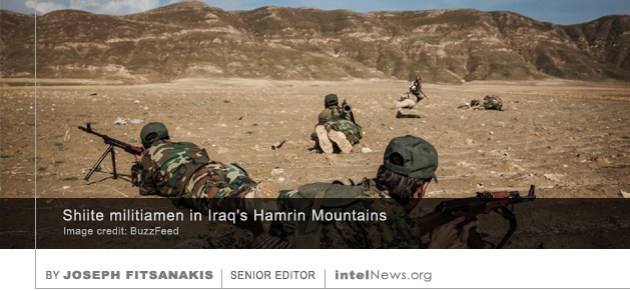
Hamrin Mountains IraqThe collapse of the Islamic State of Iraq and Syria is giving rise to a host of successor groups, which are quickly regrouping, recruiting members and launching increasingly sophisticated attacks against government forces, according to experts. A military victory in the war against ISIS was officially declared by the Iraqi government in December of last year. In recent weeks, United States President Donald Trump has repeated his government’s claim that American forces are “knocking the hell out of ISIS”. The Sunni militant group, which rose to prominence in 2014 after conquering much of Syria and northwestern Iraq, is clearly on the retreat, having lost every major urban center that it used to control. However, the collapse of the organization has led to the emergence of numerous insurgent groups that are quickly forming in Iraq and Syria.
Many of these highly agile groups are operating in the sparsely inhabited and remote southern district of Iraq’s Kurdish region, which includes the Hamrin Mountains. Others are found in Iraq’s arid regions west of the Euphrates. All are engaged in recruitment, propaganda and —increasingly— attacks against government forces and rival Shiite militias. Writing on Sunday, BuzzFeed’s Turkey-based Middle East correspondent Borzou Daragahi profiled one such group, the so-called White Flags. The group was formed in late 2017 through the union of two ISIS commanders, Khaled al-Moradi, an Iraqi Turkman, and Hiwa Chor, a former member of Ansar al-Islam, a predominantly Kurdish jihadist group that was active in northern Iraq after 2003. Daragahi notes that the White Flags have managed to carry out strikes in Baghdad and Kirkuk, and have repeatedly ambushed Iraqi government forces and members of Shiite militias. Senior White Flag members have been involved with ISIS for years and have “a wide range of experience [and] a high level of training”, says Daragahi. They are one of several post-ISIS armed groups that are recruiting members from Iraq’s disaffected Sunni Arab minority, while promising to protect them from the ire of the almost exclusively Shiite Iraqi government.

In a separate but related development, two analysts with Britain’s Government Communications Headquarters —the country’s primary communications interception agency— have warned that ISIS remains a “significant threat” to the West. The two analysts spoke on Britain’s Sky News television, using only their first names, Ben and Sunny. They recognized that ISIS has lost much of its territory in recent months, but cautioned that it continues to be “a very advanced adversary”, primarily due to its technological dexterity. Operational planners of ISIS have “pushed the bar and raised the bar” in terms of the “technology they have used and the ways in which they have used it”, said one of the analysts, adding that British intelligence agencies have to keep adapting their techniques to remain “one step ahead” of ISIS operatives. IntelNews regulars will recall that last year this blog advised Western counter-terrorism officials to “actively and immediately prepare” for attacks by ISIS militants using chemical weapons.

Author: Joseph Fitsanakis | Date: 3 April 2018 | Permalink

Analysis: Egyptian Islamist group is emerging as ISIS’ most powerful branch

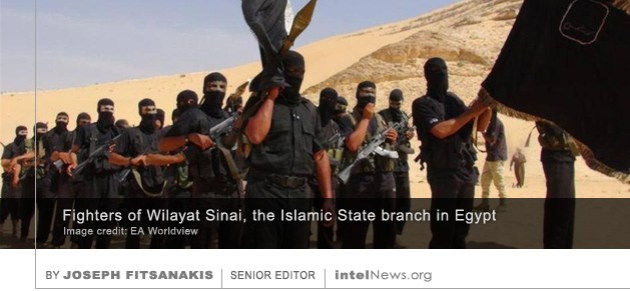
Wilayat SinaiThrough a series of meticulously planned terrorist strikes and assassinations, Wilayat Sinai has emerged as the strongest international arm of the Islamic State of Iraq and Syria (ISIS), according to some experts. Known officially as ISIS – Sinai Province, Wilayat Sinai claimed responsibility for the October 2015 downing of Metrojet Flight 9268. All 224 passengers and crew, most of them Russians, died when the plane blew up in midair over Egypt’s Sinai Peninsula. The incident marked the worst aviation disaster in Russian history. The same group, Wilayat Sinai, was behind last month’s attack on the Al Rawda Sufi mosque in bir al-Abed, Egypt. The massacre resulted in the deaths of 311 people, making it the worst terrorist attack in the history of modern Egypt.
According to leading Israeli defense and security expert Amos Harel, Wilayat Sinai’s most recent strike demonstrates that, aside from operational expertise, the group also possesses formidable intelligence collection capabilities. In an article published on Tuesday in the Israeli daily Ha’aretz, Harel focuses on the group’s assassination attempt against Egyptian Defense Minister Sedki Sobhy and Interior Minister Magdy Abdel-Ghaffar. The attack took place on December 19 at the Al-Arish military airport in north Sinai. Wilayat Sinai guerrillas fired an antitank missile at a parked Egyptian Air Force helicopter, which had just transported the two ministers to the area. Footage of the attack, released last week by ISIS, shows the helicopter exploding after being hit by the missile. Three people died in the attack, a security guard, a helicopter pilot, and a senior aide to Defense Minister Sobhy. Although neither minister was harmed in the attack, that is not the point, says Harel, and points to the fact that the officials’ trip to northern Sinai was part of a surprise visit, which had not been announced in advance. It seems, therefore, says Harel, “that Wilayat Sinai obtained intelligence information that exposed the minister[s] to attack”.

Interestingly, the group’s membership is not large. American and other Western intelligence sources estimate that its armed nucleus consists of no more than a thousand fighters. However, Wilayat Sinai members have access to advanced weaponry, which is routinely smuggled into Egypt from Libya and the Sudan. It is thus the weaponry, coupled with advanced organization and intelligence capabilities, that makes Wilayat Sinai so dangerous, says Harel. In the past three years, the militant group has killed in excess of 1,500 people in Egypt. But as its attacks become increasingly surgical and sophisticated, Egypt may be forced to respond with increasing firepower, which could further-destabilize the volatile Sinai region. Meanwhile, Israeli security forces are preparing for the possibility of cross-border raids by Wilayat Sinai, warns Harel. The Egyptian-Israeli border region could become the next front in the war against ISIS.

Author: Joseph Fitsanakis | Date: 27 December 2017 | Permalink

Defector claims US agreed to let thousands of Islamic State fighters leave Raqqa

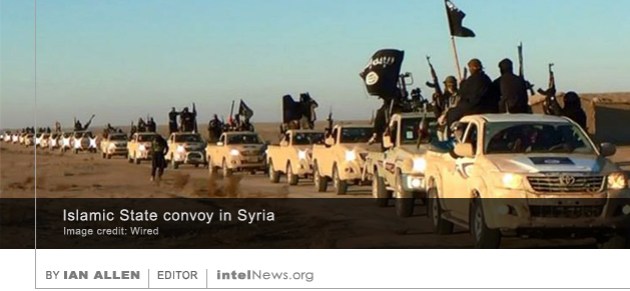
Islamic State convoy in SyriaA senior former commander of one of Syria’s largest Kurdish rebel groups, who recently defected to Turkey, has accused the United States of agreeing to let thousands of heavily armed Islamic State fighters escape from Raqqa in exchange for conquering the city without a fight. The Syrian city served as the de facto capital of the Islamic State from early 2014 until October of this year, when it was captured by a coalition of forces supported by the United States and other Western powers. The Syrian Democratic Forces (SDF), a predominantly Kurdish militia, was among the groups that captured Raqqa. One of its spokesmen, Talal Silo, told Western media correspondents back in October that the Western-backed coalition had allowed fewer than 300 hardline fighters of the Islamic State to leave the war-ravaged city during the final stages of the battle.

But several news agencies reported at the time that a large convoy of vehicles was seen leaving Raqqa, composed of dozens of trucks, buses and over a hundred cars. The BBC reported on November 13 that the convoy was 4 miles long and was seen heading toward Deir ez-Sor, an Islamic State stronghold located two hours’ drive southeast of Raqqa. Coalition partners, including the United States, Germany, the United Kingdom and France, denied that such a convoy existed. But the BBC’s claims have now been corroborated by Silo, the same SDF spokesman who last October rejected them as fictional. In October, Silo, who is a Syrian Turkoman, defected to Turkey and is now living in Ankara under heavy security protection. He told the Reuters news agency in a recent  interview that the BBC’s claims were correct, and that the number of Islamic State militants who were allowed to leave Raqqa with their weapons were in their thousands, not 300 as the SDF had originally claimed.

According to Silo, a secret agreement was reached between the Western-backed coalition and the Islamic State for the evacuation of “about 4,000 people” from Raqqa. Of those fewer than 500 were unarmed civilians, said Silo. He added that the convoy went to Deir ez-Sor, which at the time was still under the control of Islamic State. The SDF defector also told Reuters that the deal struck with the Islamic State was kept secret from media correspondents. The latter were told that they were not allowed to approach Raqqa due to heavy fighting, when the real goal was to prevent them from witnessing the peaceful departure of the Islamic State convoys. According to Silo, the deal was approved by all members of the Western-backed coalition, including the United States.

On Thursday, the SDF denied that Silo’s allegations were true and claimed that he was being pressured to make them by Turkey. The Turkish government accuses the SDF of being a Syrian branch of the Kurdish Workers Party (PKK), with which it is at war. American military officials also denied Silo’s claims, calling them “false and contrived”. The officials said that the US “does not make deals with terrorists”.

Author: Ian Allen | Date: 08 December 2017 | Permalink

Israeli armed raid in Syria reportedly led to US banning laptops on some flights

Ibrahim al-AsiriA temporary ban issued by United States authorities on laptop computers onboard some commercial flights earlier this year came from a tip by Israeli intelligence, according to a new report. The report was published last week in the American magazine Vanity Fair. It claimed that Israeli commandos carried out a dangerous night-time operation deep inside Syria, in order to acquire physical proof that the Islamic State had  built bombs that were not detectable by X-ray screening systems at airports. But some Israeli intelligence officials became infuriated with Donald Trump after the US President allegedly gave Russia background information about the commando operation, according to the article.

The order to temporarily ban electronic devices larger than cellphones was issued by the US government on March 20, 2017. It applied to direct flights to the US departing from a dozen international airports in the Middle East. In June, the New York Times alleged that the ban was aimed at stopping Islamic State operatives from bringing onboard airplanes bombs disguised as laptop batteries. The paper also said that the information about these bombs had been acquired by Israeli government hackers who had penetrated Islamic State computer systems. But now a new report by Vanity Fair claims that Tel Aviv tipped off the Americans following a commando raid deep inside Syrian territory, which acquired physical evidence of the bombs. The magazine alleges that the raid was carried out by the Sayeret Matkal, an elite unit of the Israel Defense Forces, under the supervision of the Mossad, Israel’s external spy agency. Its target was a highly secretive cell of explosives experts, who were led Ibrahim al-Asiri, a Saudi militant who built bombs for the Yemen-based Al-Qaeda in the Arabian Peninsula. The Mossad shared some of the intelligence from that raid with the Central Intelligence Agency, which in turn told President Trump. That led to the decision to ban laptops from selected flights, until X-ray machines at airports were modified to detect the new type of bomb.

The Vanity Fair article repeats earlier claims that President Trump shared intelligence given to him by the Israelis with Russian Foreign Minister Sergei Lavrov and Russian Ambassador to the United States Sergei Kislyak, when he met them in May of this year. According to Israeli sources, Mr. Trump did not tell the Russian officials that Israel was behind the operation. But he allegedly identified the city in Syria where the raid took place, and in doing so placed the life of an Israeli human asset at risk, according to some. The Israeli government will not comment on these allegations. Additionally, Vanity Fair said that one “former Mossad officer with knowledge of the operation and its aftermath” would not say whether the asset in question had been safely exfiltrated from Syria or even whether he or she was still alive.

Author: Joseph Fitsanakis | Date: 27 November 2017 | Permalink

Despite retreat, ISIS still earns $50 million a year from oil, says expert

Oil field in SyriaDespite its ongoing territorial retreat, the Islamic State of Iraq and Syria is earning over $4 million a month from its involvement in the oil trade, according to a leading expert in the finances of the group. In the past, a sizeable portion of the Islamic State’s income came from oil revenues, as the group controlled several major oilfields in northern Iraq and eastern Syria. But the loss of its territory in the past year has delivered a sharp blow to the Islamic State’s finances. The group has lost virtually every oilfield that it used to control in northern Iraq, while two weeks ago it conceded Syria’s most lucrative oilfield, the Omar oilfield, which it controlled since July of 2013. In early October, the United States-led coalition estimated that the Islamic State’s oil revenues had fallen to approximately $4 million a month, down 90 percent from the group’s financial peak of $40 million a month in 2015.
But a leading expert in the Islamic State’s finances has warned that the group’s oil revenues remain formidable and should not be dismissed as insignificant. Dr. Patrick Johnston, a senior political scientist at the RAND Corporation, told The Cipher Brief last week that the Sunni militant group will continue to profit from the oil trade in the foreseeable future. Johnston said that Islamic State coffers will most likely receive nearly $50 million this year from oil profits alone, an amount that remains formidable for any militant group. Much of that will come from extortion, said the RAND Corporation scientist, as groups of Islamic State fighters force commercial enterprises —including oil installations— in eastern Syria to pay them for “protection”. Additionally, the group continues to tax energy consumption in the areas that it controls, while also taxing fuel trucks that transit through areas under its control. As the militant group’s expenses shrink due to its loss of territory, and as its financial obligations decrease, its oil-derived revenue will be more than sufficient to sustain its operations, according to Johnston.

Essentially, as the Islamic State continues to transform from a state-like structure into an insurgency, its financial model is morphing accordingly, says Johnston. It follows that the US-led coalition must alter its approach into disrupting the group’s financial operations. So far, says the RAND scientist, the Counter-ISIS Finance Group (CIFG), which coordinates efforts to counter the militant group’s finances between coalition partners, has been relatively successful. A parallel effort by the US military, known as Operation TIDAL WAVE II, has managed to limit the Islamic State’s oil-related activities. But the coalition should be careful while restoring the oil industry in areas previously held by the Islamic State. Otherwise, “without rigorous monitoring and evaluation, reconstruction assistance could end up inadvertently resuscitating [the Islamic State] rather than contributing to its demise in Iraq and Syria”, warns Johnston.

Author: Joseph Fitsanakis | Date: 08 November 2017 | Permalink

Analysis: West should prepare for chemical attacks by the Islamic State

Biochemical terrorismA German newspaper reported last week that at least one European intelligence agency has already warned that the Islamic State is exploring the use of chemicals for attacks in Europe. Such an eventuality would be a radical departure from prior attacks by the Islamic State in the West. In the past, the militant group has shown a strong preference for low-tech means of dispensing violence, such as firearms, vehicles and knives. But it has utilized chemical substances in Iraq and Syria, and its technical experts have amassed significant knowledge about weaponized chemicals.
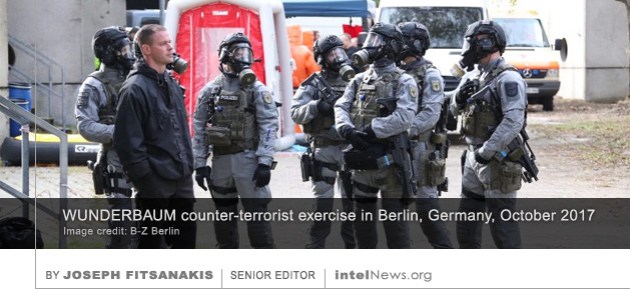
Last week, several European and American counter-terrorism experts participated in a bioterrorism preparedness exercise in Berlin. Codenamed WUNDERBAUM, the exercise was one of several anti-terrorism drills that have taken place in the German capital this year alone. But last week’s drill was the first with an exclusive focus on preparing for a bioterrorist attack. German authorities insisted that the drill was not sparked by concrete intelligence of a pending biological or chemical attack. But the Berlin-based national newspaper Die Welt claimed on Friday that it had information about at least one such warning by a European intelligence agency. The paper did not name the agency, but said that “a foreign intelligence agency” had warned European security authorities of a possible terrorist attack by the Islamic State using chemical weapons. According to Die Welt, the warning was “explicit” and cautioned that the Sunni militant group may be preparing to use improvised bombs utilizing chemicals, including toxic gasses. The warning was communicated to European intelligence agencies, including Germany’s said Die Welt.

How likely is such a scenario? Terrorist groups tend to be conservative in their use of lethal technologies. They typically opt for time-tested methods using explosives or firearms, because these have a higher of success in comparison to more sophisticated, hi-tech weapons. The latter are also more expensive to build and require scientific and technical capabilities that are not typically available to terrorist organizations. Militants are usually strapped for cash, and are not science-savvy, so exceptions to this general trend are rare. But the Islamic State is different. Read more of this post

French-Swiss firm allegedly bribed Islamic State to keep its factory working in Syria

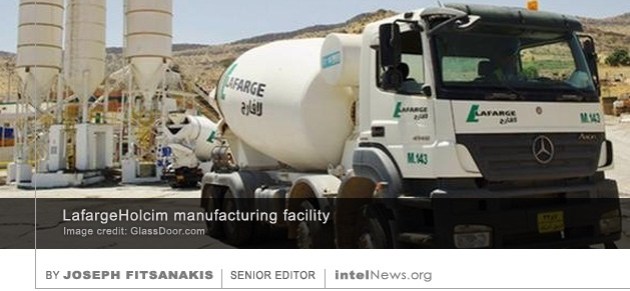
LafargeHolcimThe world’s largest building materials manufacturer, LafargeHolcim, which is headquartered in France and Switzerland, allegedly bribed the Islamic State to keep its factory working in Syria, according to court witnesses. The company specializes in the manufacture of building materials such as cement, concrete and various byproducts. It was formed in 2015 by a merger of France-based Lafarge and Swiss-based Holcim, and currently employs an estimated 120,000 employees in nearly 100 countries around the world.
In 2011, soon after the Syrian Civil War broke out, various militant groups began operating in the area around one of LafargeHolcim’s plants, located in in north-central Syria, 10 miles south of the Syrian-Turkish border. In June of 2016, French newspaper Le Monde published allegations that LafargeHolcim’s subsidiary, Lafarge Cement Syria (LCS), which owns the plant, bribed various militias to stay away from its factory. According to the paper, at least €20,000 (approximately $24,000) went to the Islamic State, which eventually conquered the area around the LafargeHolcim plant. The article further claimed that LCS managers in Syria sent detailed emails to LafargeHolcim executives in Europe about their dealings with various militias, including the Islamic State. LafargeHolcim approved the use of funds to bribe the militias, said Le Monde, in order to allow the factory to remain operational and to avoid having their employees taken hostage.

The newspaper’s allegations prompted the Office of the Public Prosecutor in Paris to launch a preliminary investigation in October of the same year. Eventually, an official complaint was filed by the French Ministry of Finance, which argued that the activities of LCS may have constituted illicit financial relations between a French-owned company and a terrorist group. An official investigation was opened in June of 2017 into whether LafargeHolcim illegally financed terrorist groups through its subsidiaries, Lafarge and LCS. Investigators are also examining claims that the company presented the French government with forged accounting documents in order to hide the bribes it gave to various Syrian armed groups.

Last week, investigators heard from the first time from witnesses, three of whom were LCS employees in 2014, when the company first made contact with Islamic State militants. They allegedly told prosecutors that the French-Swiss company paid approximately $20,000 a month to various armed groups, including al-Qaeda, al-Nusra Front, and the Islamic State. Prosecutors did not discuss details about the witnesses’ testimonies, but Le Monde said it spoke to individuals with direct knowledge of the investigation, who said that the witnesses’ testimonies were particularly damning for LafargeHolcim. The probe continues.

Author: Joseph Fitsanakis | Date: 25 September 2017 | Permalink

Saudis say they busted spy ring, foiled suicide attack on defense ministry

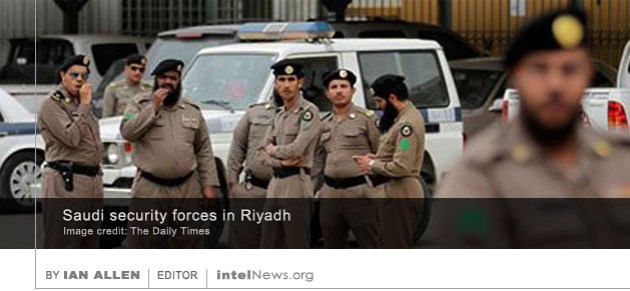
Saudi security forcesOfficials in Saudi Arabia said on Tuesday that they foiled an elaborate suicide attack on the country’s defense ministry headquarters and infiltrated a foreign spy ring in the Kingdom, arresting its members. The near-simultaneous announcements were made by a member of the Presidency of State Security, an intelligence body founded only in July of this year, which is directly accountable to the county’s prime minister.


The government-controlled Saudi Press Agency reported that two Yemeni and two Saudi nationals were arrested in early-morning raids in the capital Riyadh. The four men, said the news agency, were preparing to launch a sophisticated attack against the headquarters of the Ministry of Defense, which is centrally located in the nation’s capital. According to the report, the four would-be attackers had trained in explosives and in the use of suicide belts. Upon searching their safe house in Riyadh, Saudi security officers reportedly found firearms and hand grenades, as well as knives and at least two ready-to-use suicide belts, each weighing in excess of 15 pounds, or 7 kilos. The four men are believed to be members of the Islamic State of Iraq and Syria.

In a near-simultaneous announcement, the Presidency of State Security said that its officers had managed to infiltrate an alleged foreign spy cell. The Reuters news agency quoted an anonymous Saudi government source who said that “a group of people” were arrested in Riyadh for carrying out “intelligence activities for the benefit of foreign parties”. The members of the alleged spy ring had regular “contacts with external entities, including the Muslim Brotherhood”, said the anonymous source, referring to the Egyptian-based group that has branches in many Arab countries. The source added that the leaders of the alleged spy ring had received intelligence training and financial support from two foreign countries, which have not been publicly named.

It was not clear on Wednesday morning whether the two developments —the arrest of the alleged terrorists and the spy ring infiltration— were related.

Author: Ian Allen | Date: 14 September 2017 | Permalink