Obama’s National Security Nominations: Nothing to See Here
January 8, 2013 2 Comments
 By I. ALLEN and J. FITSANAKIS | intelNews.org |
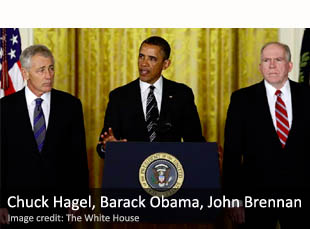
The deluge of reports that are flooding the news media about the national security nominations of United States President Barack Obama is both natural and understandable. The Departments of State and Defense, as well as the Central Intelligence Agency, are among the critical components of the American government, especially in matters of foreign policy. Yet much of the commentary on the nominations of John Kerry for State, Chuck Hagel for the Pentagon, and John Brennan for the CIA, is unduly over-dramatizing what is essentially a routine story. To begin with, it is clear that, in selecting Kerry, Hagel and Brennan for the nominations, the President’s priority was to surround himself with people he knows and trusts. Knowledgeable observers point out that all three nominees come from Obama’s most trusted circle of friends and —if appointed— will allow the President to stay well “within his comfort zone” as he begins his second term in office. In this sense, Obama selected the three candidates, not with some major policy shift in mind, but in order to ensure continuity and permanence in his foreign policy.
Take John Brennan, for instance: an Arabic-speaking career officer in the CIA, who has served the Agency in various positions for over 25 years. It is undeniable that, since 2008, Brennan has been instrumental in shaping the thinking behind the Obama administration’s targeted killings program using unmanned drones. According to some analysts, he has been the White House’s “most important adviser for shaping the campaign of drone strikes”. As intelNews explained recently, Washington’s unmanned drone program will continue and most likely expand, but this has little to do with Brennan. As an excellent analysis of Brennan’s nomination (by the Council on Foreign Relations’ Micah Zenko) points out, the CIA’s targeted killing program “has become institutionalized” with a momentum of its own, which ensures its sustainability, “making it far bigger than any one person —even John Brennan”.









 intelNews.org

How did the US know that Syria was about to use chemical weapons?
January 9, 2013 by Ian Allen 3 Comments
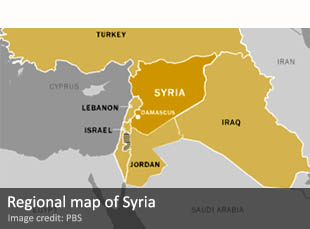
Early last December, United States President Barack Obama issued a surprise warning to the government of Syria, saying that if it made “the tragic mistake” of using chemical weapons against rebel forces, there would be “immediate consequences”. Most observers took this as a clear indication that the US was prepared to intervene militarily in the ongoing Syrian civil war. Today, a month after Obama’s December ultimatum, one question is still in need of an official answer: namely, how did the United States come to suspect that the Syrians were contemplating using chemical weapons? An article by The New York Times‘ Eric Schmitt and Dave Sanger suggests that Washington was alarmed in late November by a tip-off from Israeli intelligence. According to The Times, the Israelis shared with officials at the US Department of Defense a series of satellite images showing Syrian government troops transporting tank-loads of chemicals to at least two storage sites along the country’s border with Jordan. The paper, which says it confirmed this information by speaking to “half a dozen military, intelligence and diplomatic officials”, claims that Syrian troops were ordered to load sarin nerve gas onto dozens of 500-pound bombs. The plan was for the bombs to be secretly transported by land to military air bases and from there onto planes, pending final approval by Syrian President Bashar al-Assad. According to the Israelis, the bombs could be airborne less than two hours after Assad’s order. By the time the information from the Israelis reached President Obama, American military commanders realized they had been caught by surprise, as there was no time to act in the two hours that it would take the Syrians to deploy the bombs. Read more of this post
Filed under Expert news and commentary on intelligence, espionage, spies and spying Tagged with 2011 Syrian uprising, Analysis, chemical weapons, intelligence cooperation, Israel, Syria, United States