News you may have missed #574
August 22, 2011 2 Comments
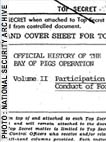
CIA documents
►►CIA told Kennedy Cuba invasion was ‘unachievable’. [Never mind. It turns out that the original article on Foreign Policy has been corrected to state that the meeting was not with Kennedy after all — see reader’s comment below]. More revelations from the newly declassified CIA Official History of the Bay of Pigs Invasion. According to the multi-volume history (pictured), a CIA team told President-Elect John F. Kennedy during a meeting in 1960 that toppling the Cuban government of Fidel Castro would not be feasible, considering the small invasion force that Kennedy insisted upon for the Bay of Pigs operation, in order to maintain plausible deniability.
►►NATO bombs home of Libyan intel chief. A compound in Tripoli destroyed overnight by NATO air strikes was the home of Abdullah Al-Senussi, former head of Libyan intelligence. This information allegedly comes from al-Senussi’s neighbor, oil engineer Omar Masood, who said he has lived across the street for 35 years. Meanwhile, several news outlets report that Abdel Salam Ahmed Jalloud, prime minister of Libya between 1972 and 1977, has defected to Italy.
►►Palestinian attacks took Israeli intel by surprise. The triple attacks, attributed by Israel to a Palestinian splinter group from the Gaza Strip, took Israel’s intelligence and security services by surprise, judging by the ensuing confusion and inaccuracy of initial reports. Between 15 and 20 Arab gunmen, some wearing Egyptian army fatigues, are believed to have taken part in the operation.














Western spies, security contractors, won Libyan war for rebels
August 23, 2011 by Joseph Fitsanakis 4 Comments
Libya
By JOSEPH FITSANAKIS | intelNews.org |
As I write these lines, celebratory gunfire is being heard all across Tripoli and the rebel National Transitional Council is appointing civilians to replace the crumbling administration of longtime Libyan leader Muammar al-Gaddafi. But a handful of news outlets discreetly remind us that the rebels’ claim to victory rests on vital covert assistance provided by several Western intelligence services. British daily The Independent notes that the victorious rebels were assisted on all levels by “an army of [British] diplomats, spooks, military advisers and former members of the special forces”, all of whom allowed “London to influence events in Libya beyond the activities of warplanes and naval vessels”. Early indications of Britain’s substantial covert involvement in the Libyan civil war emerged in March, when a secret operation involving a team of 20 Special Air Service (SAS) personnel was disrupted by a group of Libyan rebels, who thought the foreigners were employed by the Libyan government. Eight captured SAS members were soon released by the red-faced rebels, but not before the botched operation had made headlines all over the world. That experience prompted British intelligence planners to rethink their methodology. Eventually, notes The Independent, the British government decided to prompt the rebel National Transitional Council to use British funds to hire teams of former special forces operatives working for private security firms. This, according to the paper, accounts for the “small groups of […] Caucasian males, many with British accents [and] equipped with sunglasses, 4×4 vehicles and locally acquired weaponry, who [were] seen regularly by reporters in the vanguard of the rebels’ haphazard journey […] towards Tripoli”. Read more of this post
Filed under Expert news and commentary on intelligence, espionage, spies and spying Tagged with 2011 Libyan civil war, covert operations, intelligence outsourcing, Libya, Libyan National Transitional Council, NATO, News, Special Air Service (UK), UK, United States