Germany, UK, share intelligence with Free Syrian Army [updated]
August 20, 2012 Leave a comment
 By JOSEPH FITSANAKIS | intelNews.org |
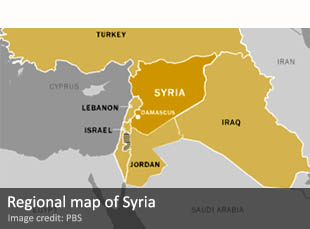
Two newspapers alleged over the weekend that German and British spy services routinely share critical intelligence on Syrian government troops with rebel forces in the country. In a leading article, German newspaper Bild am Sonntag claimed yesterday that Germany’s intelligence activities in Syria were far broader than officially acknowledged. The paper quoted an unnamed official from Germany’s Federal Intelligence Service (BND), who said that the country “can be proud of the significant contribution we are making to the fall of the Assad regime”. Also quoted in the article was an unidentified American intelligence official, who claimed that “no Western intelligence service has such good sources inside Syria as Germany’s BND”. According to Bild, the BND collects most of its intelligence on Syria through a number of ships, equipped with signals intelligence platforms, stationed in international waters off the Syrian coast. These ships can collect data on Syrian troop movements as far inland as 600 kilometers, or 400 miles. The collected data is then forwarded to BND officers stationed at the North Atlantic Treaty Organization base in Adana, Turkey, who are also tasked with intercepting radio messages and telephone exchanges between members of the Syrian government and/or military. The information is then passed on to members of the Free Syrian Army (FSA), the primary armed force engaged in a fierce civil war against the Syrian regime of Bashar al-Assad. Also on Sunday, the London-based Times newspaper quoted an unnamed FSA official as saying that the rebel forces are routinely given intelligence by British spy agencies. The official told the paper that “the British are giving the information to the Turks and the Americans and we are getting it from the Turks”. Read more of this post


















Analysis: Russia’s policy in Ukraine part of wider anti-NATO plan
May 8, 2014 by Ian Allen Leave a comment
Russia’s tactical maneuvering in Ukraine is part of a wider strategy of pushing back Western influence from former Soviet territories, according to East European and Western officials. That is the conclusion in a lead article in the latest issue of Time magazine, which quotes several eponymous sources, including John McLaughlin, former director of the Central Intelligence Agency, and Marina Kaljurand, Estonia’s ambassador to Washington. She tells the newsmagazine that Russia’s meddling in Ukraine forms part of a carefully organized and well-funded strategy that involves “overt and covert” operations throughout Eastern Europe, the Caucasus and Central Asia. Kaljurand says the operations include “a range of Cold War espionage tools”, such as planted agents, citizen groups funded by the Kremlin, as well as recruitment of intelligence assets. The aim, she argues, is to “restore in one form or another the power of the Russian Federation in the lands where Russian people live”. Western officials quoted in the Time article seem to agree that the strategy has a long-term, wider goal, which is “to undermine and roll back Western power” in former Soviet lands. Currently, Russian push-back operations are not only underway in Ukraine, but also in Latvia, where nearly half of the population consists of ethnic Russians, as well as in Estonia, where one in four citizens is Russian in origin. As in all former Soviet republics, many ethnic Russians in Estonia are members of the Coordination Council of Russian Compatriots, a group that is coordinated, guided, and often funded, by the Russian embassy in the country. In a recent report, the Estonian Internal Security Service said the Russian embassy in Tallinn is “guiding the Russian-speaking population […] by using influence operations inherited from the KGB”. IntelNews regulars will recall the case of Herman Simm, the high-level official at the Estonian Ministry of Defense, who once headed the country’s National Security Authority. He was arrested in 2008 and later convicted for —among other things— giving classified North Atlantic Treaty Organization (NATO) material to Russia. Two years later, Estonia had been subjected to a sustained cyberattack after its government removed a statue commemorating the Soviet military contribution to World War II from downtown Tallinn. Read more of this post
Filed under Expert news and commentary on intelligence, espionage, spies and spying Tagged with Analysis, Coordination Council of Russian Compatriots, Eastern Europe, Estonia, Marina Kaljurand, NATO, Russia